
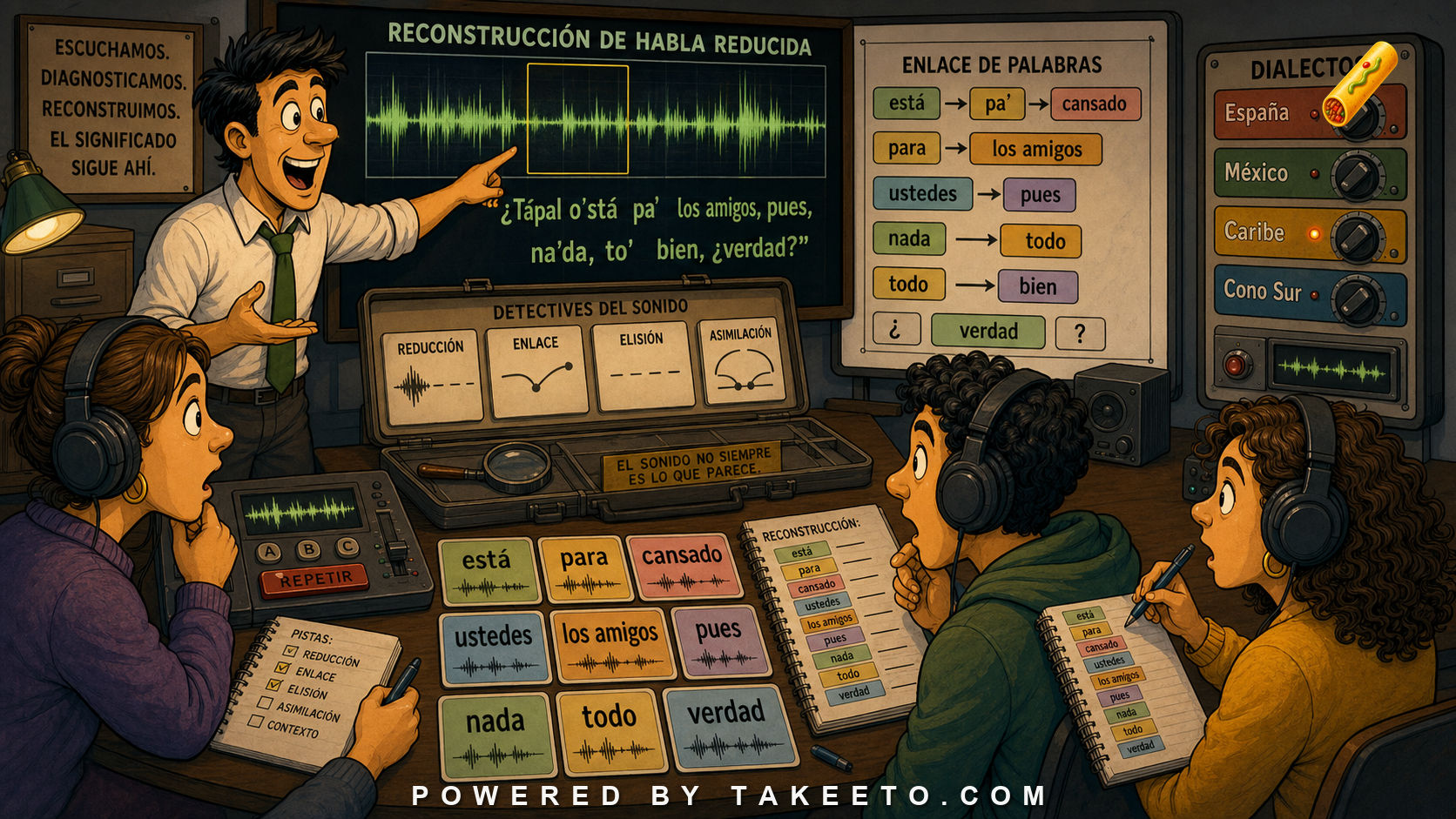
Native speech is not textbook Spanish made faster
Many learners think listening fails because native speakers are “too fast.” Speed matters, but it is not the whole problem. Natural Spanish is connected, reduced, linked, and regionally varied. A speaker may not pronounce every written consonant with classroom clarity. Words may blend across boundaries. Familiar forms may shrink.
The key principle is:
Advanced listening requires reconstruction: hearing the reduced form and recovering the underlying word or phrase.
The goal is not to complain that speakers “drop letters.” The goal is to learn which reductions are common, where they occur, and how they map back to standard written forms.
Spanish vowels are stable, but consonants move
Spanish generally keeps vowel quality clearer than English. The vowels in casa, camino, medicina do not reduce into the English-style weak vowel of about or support. That helps learners.
The difficulty often lies in consonants:
- final s may weaken or disappear in many dialects,
- intervocalic d may soften or disappear,
- final d may weaken strongly,
- words may link across boundaries,
- high-frequency words may compress,
- regional sounds may differ from textbook expectations.
A listener who expects every consonant to appear as spelled will miss ordinary speech.
Final s: present, aspirated, or absent
In many varieties, especially in Caribbean, coastal, Andalusian, and some other speech communities, syllable-final s may be pronounced as [s], weakened toward [h], or not heard clearly.
Written:
los amigos
Possible heard forms:
los amigos
loh amigos
lo amigo
This does not mean the plural disappeared grammatically. Plural meaning may remain recoverable from articles, vowels, context, or following agreement.
Learner action: when you hear something like lo amigo, ask whether the underlying form may be los amigos.
Intervocalic d: cansado, nada, todo
The Spanish d between vowels is often an approximant, a soft sound rather than a hard English-like stop. In many informal varieties, it can weaken further, especially in endings such as -ado and -ada.
Written:
cansado
Possible heard forms:
cansado
cansao
Written:
nada
Possible heard forms:
nada
naa, depending on dialect and speed
Written:
todo
Possible heard forms:
todo
to'o, in some colloquial speech
A learner should not imitate every local reduction immediately. First, recognize it.
High-frequency compression: para, está, usted, pues
Common words often shrink:
para → pa
está → ta, ’tá
usted → usté, ste, depending on context
pues → ps, pue, poh in some varieties
Example:
¿Para dónde va usted?
May sound like:
¿Pa dónde va usté?
Another:
Está bien, pues.
May sound like:
Ta bien, ps.
These are not random errors. High-frequency forms are especially vulnerable to reduction.
Linking across word boundaries
Spanish words often connect smoothly:
mis amigos
en el agua
todo está bien
A learner may hear one stream rather than separate dictionary words. The boundary between words is not always acoustically obvious.
Example:
todo está bien
May be heard as:
to-does-tá-bien
The spelling has spaces; the sound has continuity.
Dialect exposure is not optional
A learner trained only on slow, neutral classroom audio may panic when hearing Mexican casual speech, Caribbean speech, Rioplatense speech, Andalusian speech, or fast Peninsular media. Each variety has patterns. The answer is not to call one variety “sloppy.” The answer is to build dialectal listening maps.
Ask:
- Does this variety weaken final s?
- How is y/ll pronounced?
- Is final d strong, weak, or absent?
- Are ustedes and vosotros both relevant?
- Is there voseo?
- Are there common local particles or discourse markers?
Listening improves when the ear knows what kind of Spanish it is hearing.
Transcript alignment: what learners should mark
Use transcripts carefully. Do not only read them. Align them with audio.
Mark:
- reduced consonants,
- linked word boundaries,
- missing or weakened d,
- final s behavior,
- compressed high-frequency words,
- pauses,
- intonation groups,
- words you would not have recovered without text.
Example transcript:
Pues, para mí, los amigos de verdad están cuando uno está cansado.
Possible annotation:
Pues [pues/pue/ps], para [pa] mí, los amigos [loh amigos/lo amigos] de verdad [verdá] están [’tán] cuando uno está [’tá] cansado [cansao].
This is a listening map, not a recommendation to write that way.
Example bank walkthrough
está
Often reduced in fast speech.
Learner action: listen for ta or ’tá in context.
para
Frequently compressed to pa in casual speech.
Learner action: recover the full form from syntactic position.
cansado
Intervocalic d may weaken, especially in -ado.
Learner action: connect cansao back to cansado.
ustedes
May reduce in fast speech and varies regionally in frequency and function.
Learner action: identify whether it is subject pronoun, address form, or part of a contrast.
los amigos
Final s may weaken before vowel.
Learner action: do not miss plural meaning just because s is weak.
pues
Discourse marker with many reduced pronunciations.
Learner action: learn its conversational function, not only its dictionary meaning.
nada, todo, verdad
Common words with potential d weakening.
Learner action: practice hearing full, softened, and highly reduced versions.
Reconstruction workflow
- Listen without transcript. Write what you hear, even if partial.
- Mark uncertain stretches. Do not pretend you heard everything.
- Check transcript. Compare sound with written form.
- Annotate reductions. Especially s, d, para, está, pues.
- Replay short chunks. Five seconds is enough.
- Say the full form. Then say the reduced form carefully.
- Avoid premature imitation. Recognition comes before production.
- Rotate dialects deliberately. Do not let one audio source define all Spanish.
Common learner failure: confusing reduction with vocabulary
When learners hear pa, ta, or cansao, they sometimes add these as separate vocabulary items without understanding the underlying forms. That creates a fragmented listening system. The better note is not simply:
pa = for
The better note is:
para may reduce to pa in casual speech; recognize it, but write para in standard prose.
The same applies to está → tá, cansado → cansao, and verdad → verdá. Reduced forms belong to a speech register, region, and speed. They are not replacements in all contexts.
Mini-workshop: build a reconstruction table
Use a twenty-second clip with a transcript. Create a table with three columns:
| Written form | Heard form | Pattern |
|---|---|---|
| para | pa | high-frequency reduction |
| está | ’tá | initial vowel/consonant reduction |
| los amigos | loh amigos | final s aspiration |
| cansado | cansao | intervocalic d weakening |
Then replay the clip without looking. Try to hear the written forms through the reduced audio. This is the core listening skill: not memorizing every possible local pronunciation, but mapping sound back to structure quickly enough to keep following the conversation.
Common failure mode: calling every reduction “too fast”
Many learners respond to reduced speech by asking for slower audio. Slower audio helps at first, but it does not teach the main skill if the learner never returns to natural speed. The real target is mapping surface forms to underlying forms. If para becomes pa, the solution is not to demand full para forever. The solution is to recognize pa as a possible spoken form in the right register.
Another mistake is treating one dialect as the whole language. A learner who has only heard careful classroom Spanish may think final s weakening is unclear or incorrect. A better approach is descriptive: label the pattern, identify the region or register, and practice comprehension before deciding what to imitate.
Remediation pass: build a reduced-form inventory
Listening remediation should not begin with the vague advice “listen more.” Many learners already listen a great deal. They fail because they do not know what to listen for. The better goal is to build a personal inventory of reduced forms and recovery cues.
Start with a table that has four columns: written form, heard form, environment, and recovery clue. For example, para may appear as pa in casual speech; the recovery clue is often that it appears before an infinitive, a destination phrase, or a purpose expression. Está may sound like 'tá; the recovery clue is position before an adjective, gerund, or location expression. Cansado may sound like cansao; the recovery clue is the participial ending -ado and the surrounding adjective context.
This table keeps the learner from making a common error: treating every reduced sound as a new word. Pa is not a separate standard replacement for para in formal writing. Cansao is not a spelling upgrade. These are listening facts tied to speed, region, register, and speaker style.
A second repair is alignment by micro-chunk. Full podcast episodes are too long for reduction training. The useful unit is often three to seven seconds. Listen, write what you think you heard, compare with the transcript, annotate the mismatch, and replay until the reduced form becomes predictable rather than surprising. The point is not to memorize one clip. The point is to train the ear to expect Spanish connected speech.
Before/after repair: a transcript note that actually teaches
Weak note:
“They say pa instead of para and drop letters.”
This note is emotionally understandable but analytically weak. It groups all reduction together as carelessness and gives the learner no recovery method.
Stronger note:
In this speaker’s casual register, para reduces to pa before a destination or purpose phrase: pa la casa, pa que veas, pa hacerlo. Recognize it in listening. Use para in standard writing. Do not imitate automatically in formal speech.
Another weak note:
“I didn’t hear the plural in los amigos.”
Stronger note:
The final s in los is weakened before the vowel in amigos. Plural meaning may still be recoverable from the article position, the noun, context, and agreement elsewhere. Mark this as final-s weakening, not as missing grammar.
Mini-workshop: one minute, twenty reductions
Choose sixty seconds of natural Spanish with a transcript. The speaker should not be reading textbook audio. Play the minute once without text. Then play it again and write only the phrases you are unsure about. Now open the transcript and mark every instance of the following:
- s weakening or loss,
- d weakening or loss,
- compressed para, está, usted, pues,
- word-boundary linking,
- discourse markers that are pronounced lightly,
- places where the transcript contains a word you did not perceive at all.
Finally, create five reconstruction cards. Each card should show the heard form first and ask for the underlying standard form. Example: pa que → para que. Another: cansao → cansado. Another: loh amigo → los amigos. These are listening cards, not writing cards.
Dialect caution without panic
Reduction patterns are not evenly distributed across the Spanish-speaking world. A learner trained on Madrid media, Mexican classroom audio, and Caribbean conversation will hear different patterns. The aim is not to flatten them into one “correct” version. The aim is to learn what kind of variation you are hearing.
A good article should therefore talk about recognition before production. Learners can respect and understand reduced forms without adopting every feature in their own speech. This is especially important for advanced learners who want a stable professional register. Listening broadly and producing carefully are compatible goals.
Editorial quality checks for this article
A strong version of this article should include enough concrete reduced-form examples to make the system visible, but it should not turn dialects into stereotypes. It should avoid phrases like “lazy pronunciation” and “dropped letters” except as learner misconceptions being corrected. The better language is weakening, aspiration, loss, linking, compression, and reconstruction.
The article should also remind the reader that Spanish vowels remain comparatively stable in many contexts. The listening challenge is not identical to English reduction. The learner is not simply fighting speed; they are learning how Spanish organizes fast speech.
Extended remediation: build dialect-aware listening without losing your production target
Reduced speech practice should broaden comprehension while keeping production disciplined. A learner might choose educated central Mexican Spanish as a primary speaking model, but still train recognition of Caribbean final-s weakening, Andalusian aspiration, Chilean reduction, Rioplatense intonation, or casual Peninsular connected speech. The goal is not to become a collage of accents. The goal is to stop collapsing every unfamiliar surface form into “they speak too fast.”
Contrast set
- recognition target: I can recognize pa as reduced para in casual speech.
- production target: In my own formal speech, I will usually say para clearly unless the context supports reduction.
The contrast set should be read aloud or rewritten, not merely admired. Advanced learners often understand a correction when they see it, then fail to reproduce it when the task changes. The repair is to make the contrast portable: identify the decision, name the cue, and apply the same decision to a new sentence, clip, paragraph, or writing task.
Real-use transfer drill
- Pick one dialect feature for recognition only.
- Find two short clips with transcripts and two without transcripts.
- Mark each reduced form and reconstruct the careful form.
- Say the careful form yourself, then shadow the natural form once for perception.
- Write whether the feature belongs in your active production, passive recognition, or “recognize but avoid” category.
A strong listening log names the pattern and the decision: “Final s weakened in plural noun phrases; I will train recognition, but my production will remain clearer in formal settings.” That note is much better than “this speaker is unclear.”
Avoid treating dialect awareness as a checklist of stereotypes. Real speakers vary by region, class, register, age, context, and identity. The useful unit is an observed pattern in a speaker or community, not a cartoon label.
A good remediation pass ends with a usable artifact: a marked paragraph, a recording comparison, a collocation card, a frame note, a stance map, a change-claim table, or a revision pair. Without an artifact, the learner may feel enlightened but have nothing to review. With an artifact, the explanation becomes part of a study system.
Suggested interactive module: audio-to-transcript alignment
A strong tool for this article would show Spanish audio aligned to transcript, with reduced-form annotations.
Suggested functions:
- Reduced-form layer: Marks pa, ta, cansao, verdá.
- Underlying-form layer: Shows para, está, cansado, verdad.
- Dialect notes: Indicates common regional patterns.
- Boundary view: Highlights linking across word boundaries.
- Replay loop: Word, phrase, sentence, paragraph.
- Dictation mode: Learner guesses before revealing text.
- Production caution: Separates “recognize this” from “imitate this.”
Final rule
Fast Spanish is not just fast. It is connected, reduced, and regional.
Train yourself to hear reduced forms and reconstruct the underlying Spanish. The better your reconstruction, the less native speech feels like a blur.