
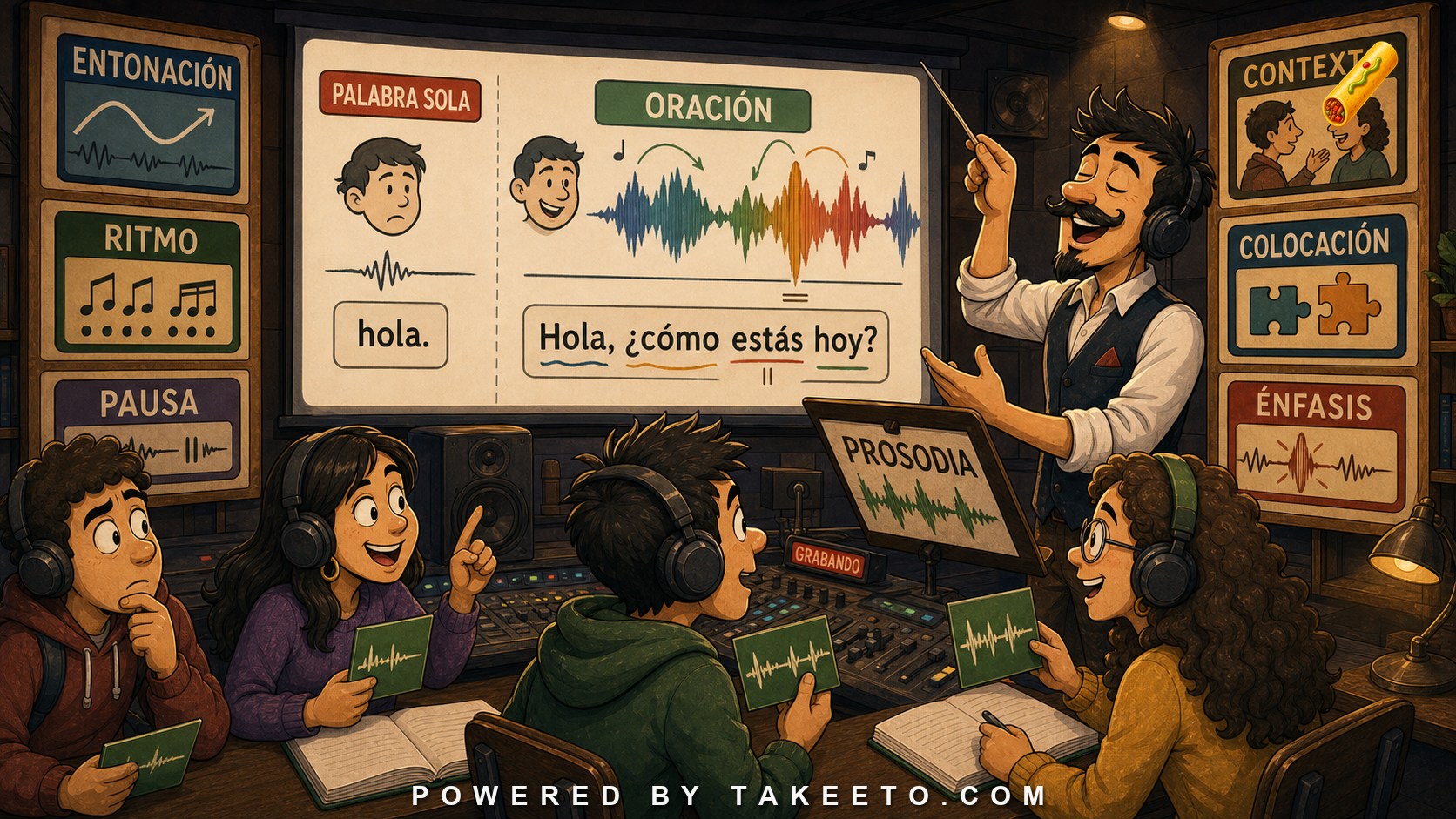
Words sound different inside sentences
A Spanish word in isolation is useful. A Spanish word in a sentence is different.
In isolation, para is clear and complete. In natural speech, it may be reduced in some contexts. In isolation, usted is tidy. In connected speech, it may link with neighboring words. In isolation, los amigos is two visible words. In audio, the final s of los may interact with the following vowel depending on variety and speech style.
Usage-sentence audio teaches the learner how an item lives in speech.
A card for sin avisar may have item audio:
sin avisar
But the usage sentence gives rhythm:
Salió de la oficina sin avisar.
Now the learner hears stress groups, phrase boundary, and how the expression fits into a clause.
Sentence audio teaches collocation
Many Spanish items are best learned with their neighbors.
| Item | Weak isolated learning | Strong sentence audio |
|---|---|---|
| tomar una decisión | decisión alone | Tomó una decisión difícil. |
| prestar atención | atención alone | Presta atención a la explicación. |
| cumplir los requisitos | requisitos alone | El solicitante debe cumplir los requisitos. |
| darse cuenta de que | cuenta alone | Se dio cuenta de que faltaba un documento. |
| me queda bien | quedar alone | Esa chaqueta me queda bien. |
Audio reinforces these chunks as units. The learner does not only hear words; they hear patterns.
Prosody reveals syntax
Spanish sentence audio helps learners hear grouping.
Consider:
Cuando llegó Ana, llamamos al director.
A natural pause after Ana supports the clause boundary. Without it, the sentence may be harder to parse.
Consider:
No, quiero estudiar.
versus
No quiero estudiar.
Punctuation and prosody change meaning. Sentence audio can make that contrast obvious.
Consider:
El libro que compré ayer es excelente.
A good reading keeps the relative clause integrated but intelligible. A robotic reading may flatten the structure.
Prosody is not decoration. It is part of sentence comprehension.
Pacing must match the teaching goal
Usage-sentence audio can be too slow, too fast, or too unnatural.
For early learners, a sentence should be clear enough to segment. For transfer to real listening, it should not be so slow that it destroys rhythm. A product may need two versions: study speed and natural speed.
Study speed should:
- preserve normal stress;
- keep vowels natural;
- use meaningful pauses;
- avoid syllable-by-syllable distortion;
- make target item audible.
Natural speed should:
- sound like careful real speech;
- allow normal linking or reduction for the variety;
- preserve intelligibility;
- avoid theatrical exaggeration.
The goal is not speed for speed’s sake. The goal is usable listening.
Voice rotation should not break context
Using multiple voices can make sentence audio less monotonous. It can also create inconsistency.
If a passage contains dialogue, different voices may be natural. If a deck rotates voices randomly across usage sentences, learners may hear useful variety. But if voice rotation creates region mismatch, stress inconsistency, or strange emotional tone, it harms learning.
A usage sentence such as:
¿Podría adjuntar el documento antes del viernes?
should not be delivered with cartoonish excitement. A sentence like:
¡Qué buena noticia!
should not sound like a legal notice.
Audio QA must judge tone, not only words.
Sentence audio supports grammar
Many Spanish grammar points become clearer when heard.
| Grammar point | Sentence audio value |
|---|---|
| Object pronouns | Learner hears clitic placement and rhythm: se lo mandé. |
| Commands | Learner hears force and politeness: Dímelo vs No me lo digas. |
| Questions | Learner hears intonation: ¿Vienes? vs Vienes. |
| Lists | Learner hears continuation: pan, queso, fruta y café. |
| Subjunctive clauses | Learner hears dependent clause flow: Quiero que vengas. |
| Connectors | Learner hears discourse transitions: Sin embargo... |
| Preposition + infinitive | Learner hears chunking: antes de salir. |
Grammar is not only visual. It has rhythm.
QA criteria for sentence-level audio
A usage-sentence audio audit should include:
- Does the audio match the written sentence exactly or acceptably?
- Is stress correct on all words?
- Is the target item audible and not swallowed?
- Is the pacing appropriate for the mode?
- Are phrase boundaries natural?
- Does intonation match sentence type?
- Is the regional pronunciation coherent or labeled?
- Does the emotional tone fit the sentence?
- Is the audio free of clipping, noise, and unnatural silence?
- Does the sentence remain useful when heard without text?
- Does it reinforce the intended grammar or collocation?
- Should a slow and natural version both exist?
Sentence audio needs more than word matching. It needs prosodic judgment.
Annotated audio examples
Sentence:
Le mandé el formulario a Marta.
Audio teaching value:
- Le mandé forms a clitic + verb rhythm.
- el formulario is a noun phrase stress group.
- a Marta clarifies recipient.
Sentence:
Se lo mandé ayer.
Audio teaching value:
- Se lo should not become two over-separated words.
- The stress falls on mandé and ayer.
- The sentence teaches double-pronoun flow.
Sentence:
Aunque estaba cansada, terminó el informe.
Audio teaching value:
- Clause boundary after cansada.
- Contrastive structure with aunque.
- Preterite event after background state.
Usage-sentence audio is a compact listening lesson.
Usage audio should be tied to sentence design
A usage sentence written only for text may not work as audio.
Consider:
La aprobación de la propuesta por parte del comité fue anunciada por la directora durante la reunión extraordinaria.
This may be a useful formal-style sentence in a reading article. As a beginner usage audio clip, it is too dense. The listener has to hold a nominalization, passive structure, agent phrase, institution noun, and time phrase before reaching the end.
For audio, a better teaching sentence may be:
El comité aprobó la propuesta durante la reunión.
Or, if the target is passive formal style:
La propuesta fue aprobada por el comité.
The audio goal determines sentence shape. A good sentence for reading may be too dense for pronunciation practice. A good sentence for pronunciation may be too simple for advanced discourse. The curriculum should know which job each sentence is doing.
Connected speech without caricature
Usage-sentence audio should expose learners to connected Spanish, but it should not become a caricature of reduction.
Some varieties weaken final s. Some weaken intervocalic d, especially in endings such as -ado. Some link vowels smoothly across word boundaries. Some speakers reduce common words in fast speech. These patterns are real, but a learning product must decide when to present them.
For early sentence audio, careful natural speech is usually better than theatrical reduction. The learner should hear phrase rhythm and normal connection without losing the written forms entirely. For advanced listening, a product can add reduced speech intentionally:
| Mode | Example purpose |
|---|---|
| Careful study sentence | Hear the grammar and target item clearly. |
| Natural sentence | Hear ordinary rhythm and linking. |
| Reduced-speech comparison | Learn why cansado may sound closer to cansao in some speech. |
| Dialect exposure clip | Hear a labeled regional model. |
The important word is labeled. Learners should not be left to believe all variation is sloppy or all careful speech is fake.
Sentence audio can diagnose bad examples
Reading a sentence aloud is a powerful audit.
If the audio sounds stiff, the sentence may be stiff. If the reader must pause unnaturally, the syntax may be overloaded. If the target item disappears in the middle of too many modifiers, the example may not be pedagogically focused. If an expression sounds formal but the scenario is casual, the register may be wrong.
A sentence such as:
El usuario procederá a efectuar la descarga del archivo.
may be grammatical, but audio reveals its bureaucratic heaviness. If the lesson is about plain instructions, a better sentence is:
El usuario descargará el archivo.
Or for direct learner instruction:
Descarga el archivo y abre la actividad.
Sentence audio does not merely check pronunciation. It tests whether the sentence can live in a human mouth.
A listening routine for usage sentences
A strong product can teach learners how to use sentence audio:
- Read the sentence silently and identify the target item.
- Play the sentence once without repeating.
- Mark where the voice pauses or groups words.
- Play again and repeat the full phrase, not only the target word.
- Compare the item audio with the sentence audio.
- Hide the text and listen once more.
- Use the sentence in a recall prompt later.
For se lo mandé ayer, this routine teaches pronoun flow. For aunque estaba cansada, it teaches clause boundary. For me faltan dos documentos, it teaches agreement and rhythm together.
What sentence audio should not do
Sentence audio should not become a dumping ground for every possible pronunciation objective. One sentence cannot simultaneously teach a new word, a regional reduction, a difficult grammar pattern, an emotional tone, and a minimal pair unless the learner is prepared for that complexity. If the target is prestar atención, the sentence should make that collocation clear. If the target is r/rr, the sentence should not bury the contrast in a long bureaucratic clause. If the target is question intonation, the sentence should actually be a question.
A useful QA question is: “What is this audio clip accountable for?” The answer may be pronunciation of the target item, phrase rhythm, sentence intonation, connected speech, or contextual listening. When the answer is “everything,” the clip usually teaches nothing cleanly. Serious audio design assigns a job to each recording and judges it by that job.
Sentence audio should expose grammar without overacting it
A sentence model should make grammar hearable, but it should not become theatrical. Learners need a clean signal: where the phrase begins, where the clause turns, which word carries stress, and how the target item behaves in context. They do not need exaggerated emotion unless the sentence itself calls for it.
This is especially important for Spanish clitics and connectors. In Se lo mandé ayer, the sequence se lo mandé should sound like a fluent unit, not like three flashcards. In Sin embargo, no todos aceptaron la propuesta, the connector should have a discourse pause after it, but not a melodramatic pause that makes ordinary writing sound like a speech contest. In ¿Cuándo llegó Ana?, the sentence should model a plausible question contour, not a generic rising tone imported from English.
Sentence audio can also teach what punctuation is doing. A comma after an introductory clause, a question boundary marked by ¿, and a contrast introduced by pero or sin embargo should be audible as structure. Good audio does not replace grammar notes, but it gives the ear a version of the same analysis.
For QA, reviewers should listen with the target item in mind. The question is not only “Is this audio natural?” but “Does this audio make the intended construction easier to hear?” If the answer is no, the clip may be pleasant but pedagogically weak.
V2 remediation refinement: sentence audio should audit prosody, not just words
The first draft explained why sentence audio teaches rhythm and syntax differently from isolated words. The remediation pass adds a QA standard: sentence audio should be audited for prosody, not merely text match. A clip can contain every word correctly and still be pedagogically weak if it has unnatural pauses, wrong intonation, broken clitic grouping, or flat TTS rhythm.
Spanish sentence audio should check:
| Feature | Why it matters | Example |
|---|---|---|
| stress groups | learners hear phrase units | se me olvidó / la contraseña |
| clitic attachment | pronouns are weak and rhythmic | dímelo, se lo dije |
| prepositional chunks | locutions stay together | a pesar de, con el fin de |
| question contour | intonation distinguishes question type | ¿Vienes?, ¿Cuándo vienes? |
| register | formal prose should not sound like chatty dialogue | No obstante, se establece... |
| natural speed | sentence should transfer to listening | slow mode must not become robotic |
Voice rotation also needs context. Rotating voices can help learners avoid overfitting to one speaker, but random rotation inside a single passage can break narrative coherence. A dialogue may use multiple voices deliberately. A formal explanatory passage may need one consistent voice. A regional deck should not switch between strongly different varieties without labeling the shift.
Sentence audio is where grammar becomes audible. Me gusta el libro and me gustan los libros teach agreement through sound. No creo que sea teaches the subjunctive form in a clause. Al llegar, se dio cuenta... teaches compression and phrase boundary. If the audio ignores syntax, the product wastes one of its best opportunities to make Spanish structure memorable.
Suggested interactive module: sentence-audio prosody checklist
A useful tool would let reviewers see a sentence with audio markers.
Features:
| Feature | Function |
|---|---|
| Text/audio alignment | Highlights words as audio plays. |
| Stress markers | Shows expected stress syllables. |
| Pause suggestions | Marks clause and phrase boundaries. |
| Target item visibility | Confirms the focus item is audible. |
| Speed comparison | Plays slow and natural versions. |
| Reviewer tags | natural, too robotic, wrong stress, wrong tone, mismatch. |
| Regeneration queue | Sends failed audio back with reason. |
The tool should help reviewers listen for teaching value, not only technical success.
Final rule
Usage-sentence audio teaches Spanish beyond isolated pronunciation.
It shows rhythm, syntax, collocation, intonation, clitic flow, register, and context. A good sentence audio clip sounds natural, supports the target item, and matches the learner’s stage. A bad one may pronounce the words but fail the sentence.
Spanish is learned through phrases as well as words. Sentence audio is where that becomes audible.