
Sequencing is not a decorative course outline
A Spanish curriculum is not a pile of useful things. It is an order. The order matters because each new item leans on previous knowledge, even when that dependency is hidden. A learner cannot read a dense passage about public health, immigration law, or economic policy if the course has not already built article use, gender, agreement, tense, pronouns, prepositions, clause linking, and domain vocabulary.
Bad sequencing produces a familiar learner experience: everything is “reviewed” but nothing connects. A deck teaches food words. Another teaches travel phrases. A third introduces the subjunctive without enough verb morphology. A reading passage includes se aprobó, dicho procedimiento, and con el fin de before the learner has been prepared to parse passive se, demonstrative reference, or purpose connectors. The result is not productive challenge. It is curriculum debt.
The practical rule for this article is simple:
A Spanish curriculum should not wander from topic to topic.
That rule is easy to state and hard to implement. It requires a curriculum designer, teacher, or serious independent learner to look past the visible artifact and ask what the artifact is doing in the learning system. A card, passage, note, audio button, PDF, notification, or metric is never just a feature. It is part of the learner's encounter with Spanish.
From prerequisites to domain literacy
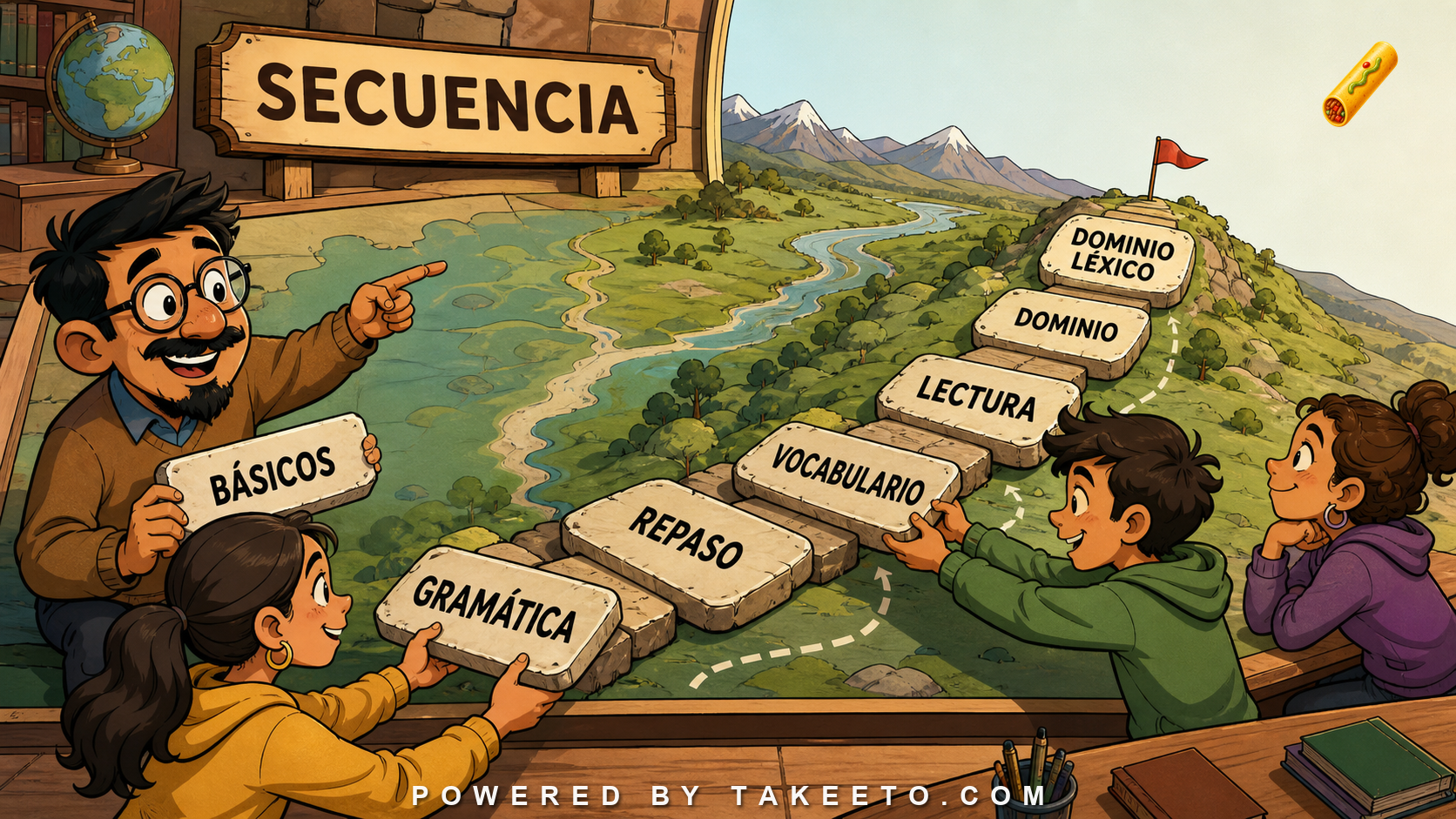
A strong Spanish sequence moves through layers. The first layer is sound and spelling: vowels, stress, accent marks, consonant variation, and syllable structure. The second is noun-phrase architecture: gender, articles, plurals, adjective agreement, and adjective position. The third is basic clause structure: ser/estar, hay/estar/existir, subject pronoun omission, present tense, object pronouns, and core prepositions. The fourth is tense, aspect, and mood: preterite, imperfect, future, conditional, perfect forms, commands, and the subjunctive. The fifth is discourse: connectors, relative clauses, negation, comparison, register, formal style, and paragraph-level reading. The sixth is domain literacy: Spanish for law, medicine, education, journalism, business, history, and academic argument.
This sequence should not be rigid in a mechanical way. Learners need vocabulary from the beginning, and reading should begin early. But early reading must be designed around what the learner can reasonably parse. Later reading can carry more density because the course has prepared the structures. Sequencing is not the enemy of immersion; it is what makes immersion intelligible.
The practical curriculum question is not “Can this item be taught?” but “What must already be in place for this item to be useful?” A low-count deck with three isolated words may not deserve a standalone unit. It may need to be folded into a broader section where the vocabulary appears in a coherent passage and reviews prior grammar. Conversely, a high-value grammar contrast may deserve multiple passages, audio, examples, and exams because it will support hundreds of future items.
The strongest design habit is to separate the learner-facing experience from the hidden support structure. The learner may see a clean passage, a small note, a speaker button, and a short exam. Behind that simplicity should be clear metadata: item identity, grammar role, register, audio status, review status, translation alignment, and assessment purpose. Good learning design often feels simple because the complexity has been organized, not because it has been ignored.
Annotated sequencing map
| Design element | What it checks or supports | Spanish-learning consequence |
|---|---|---|
| Phonology and orthography | Spanish vowels, stress, accent marks, b/v, c/z/s, r/rr | Learners need a stable spelling-to-sound system before trusting written input. |
| Noun phrases | gender, articles, plurals, adjectives, possessives, demonstratives | Agreement becomes visible across every later passage. |
| Core clauses | ser/estar, hay, tener, present tense, pronouns, prepositions | Basic sentence parsing becomes possible. |
| Tense and aspect | preterite, imperfect, future, conditional, perfects | Narrative and reporting become readable. |
| Subordination and mood | relative clauses, connectors, subjunctive | Essays, explanations, and argument become accessible. |
| Domain literacy | academic verbs, legal phrases, medical vocabulary, bureaucratic style | The learner moves from textbook Spanish into serious text. |
The table is not meant to turn learning into bureaucracy. It is meant to prevent vague praise. A curriculum artifact should be able to answer concrete questions: What does this teach? What does it assume? What can go wrong? What evidence would show that it is working? Where does the learner receive help if the item fails?
Spanish-specific stakes
Spanish makes these design decisions visible because the language is full of contrasts that cannot be solved by exposure alone. Learners need repeated contact with ser/estar, por/para, preterite/imperfect, object pronouns, se, agreement, article use, register, and regional variation. A product or curriculum that treats every item as an isolated translation will underprepare the learner for real text.
The issue is not that Spanish is uniquely impossible. The issue is that Spanish has structure. The learner must be given enough of that structure to make input intelligible and enough retrieval to make knowledge durable. A passage without review becomes a reading experience that fades. A card without context becomes a brittle memory. Audio without text may not teach spelling. Text without audio may teach silent mispronunciation. Explanations without examples become abstractions. Examples without explanations can create false rules.
The cure is integration. A Spanish item should move through several linked forms: it appears in context, receives a translation or gloss, is heard, is reviewed, is tested, and returns later in a different context. Each contact should add something. Repetition alone is not the same as cumulative design.
Edge cases and mature design questions
Sequencing must also handle learners who do not start at the beginning. Heritage speakers may have strong oral fluency but weak accent-mark control, formal register, or academic vocabulary. A college learner may know present tense and gender but have never learned clitic placement well. A translator may read advanced vocabulary but still be unstable on regional vosotros/ustedes systems. A good curriculum sequence therefore needs placement and repair paths, not just a single linear road.
The solution is not to abandon sequence. It is to build modular dependency. A learner can enter at a later domain unit if the system can detect missing prerequisites and route them to targeted refreshers. Sequencing becomes a graph rather than a hallway.
| Edge case | Why it matters | Better handling |
|---|---|---|
| Heritage learners | They may not need beginner conversation but may need literacy and register. | Offer diagnostic paths into accentuation, formal prose, and academic vocabulary. |
| False beginners | They recognize material but cannot produce it reliably. | Use reverse translation and writing checks before skipping sections. |
| Advanced readers | They may need domain vocabulary without basic drills. | Let them test out while preserving access to prerequisite explanations. |
Edge cases are useful because they reveal whether the model is real. A shallow rule works only in the clean example. A strong curriculum principle survives versioning, regional variation, learner differences, and product constraints. For Spanish, this matters because the learner will eventually meet forms outside the first example bank: another accent, another register, another tense, another passage genre, another medium.
A mature design does not need to solve every edge case in the first lesson. It does need to know where the edges are. When the course chooses not to explain something yet, that should be a deliberate sequencing decision, not ignorance disguised as simplicity.
Diagnostic workflow
- For every new deck, list the grammar it assumes but does not teach.
- Check whether each passage includes current focus items and manageable review items.
- Retire or merge low-count decks that cannot support a coherent passage.
- Mark prerequisite relationships among grammar topics instead of treating topics as independent lessons.
- Sequence domain vocabulary only after the learner has enough syntax to read it in context.
- Return to earlier structures through later passages so the sequence remains cumulative.
This workflow works best when it is used before publication rather than after learners complain. Retrofitting quality is expensive. It requires finding the passage, rewriting the sentence, updating the translation, changing the glossary, regenerating audio, revising the PDF, and rebuilding exams. Early diagnostic habits keep the curriculum from accumulating hidden debt.
Common failure patterns
- Starting domain reading too early: A legal passage full of nominalizations is not useful if the learner cannot parse de, se, and passive constructions.
- Delaying real text forever: Structure should feed reading; it should not become an endless pre-reading gate.
- Treating vocabulary decks as independent: Words learned without grammar, examples, audio, and passage context remain brittle.
- Ignoring review density: A passage that only teaches new items wastes the chance to stabilize old ones.
- Sequencing by theme alone: “Food,” “travel,” and “family” are themes, not enough for a serious grammar path.
These mistakes share one cause: treating the visible feature as the whole product. A learner does not experience a Spanish item only once. They meet it in a deck, a passage, an example, a translation, a voice, a note, an exam, and a review queue. If those encounters disagree, the learner pays the price through confusion. If they reinforce one another, the learner gains a stable model.
A concrete curriculum scenario
Suppose a curriculum wants a passage about renting an apartment. The vocabulary list includes alquiler, contrato, fianza, requisito, presentar, firmar, disponible. That topic also requires grammar: definite articles, hay/estar, se alquila, personal information, dates, obligations with tener que, and perhaps formal phrases like presentación de documentos. If those structures have not appeared, the passage becomes a glossary disguised as a reading task. If they have appeared, the same passage becomes integration: the learner sees old grammar doing new work in a realistic domain.
Notice the larger principle: the best design choice is usually the one that makes the next learning contact better. A good example sentence prepares better audio. Good audio prepares better listening review. A good glossary note prepares better reading. A good exam mistake prepares better spaced review. The curriculum should behave like a system rather than like a collection of assets.
What the reader should be able to do after this article
After working through this article, the reader should be able to inspect a Spanish-learning artifact and ask sharper questions. They should be able to identify the learning purpose, name the likely failure mode, and propose a repair that improves the next learner encounter. In practical terms, that means moving from vague judgments such as “this feels good” or “this is confusing” to specific diagnoses: the example is unnatural, the audio is mismatched, the translation hides the construction, the review prompt tests recognition rather than recall, or the note explains too much at the wrong moment.
The deeper habit is accountability. Every piece of a serious Spanish curriculum should be able to justify its presence. If it cannot, it should be revised, moved, linked, hidden, or removed.
Implementation checklist
For this topic, implementation should start with the article's own example bank: deck, section, review item, focus item, grammar dependency, domain vocabulary. Choose one representative item or artifact and trace it through the system. It should have a learner-facing purpose, a hidden data representation, a place in review, and a remediation path if something goes wrong. If the topic is not a single vocabulary item, trace a unit-level artifact instead: a passage, PDF, notification, metric, audio control, or exam.
- Name the learner action this design supports: reading, listening, retrieval, production, diagnosis, or long-term review.
- Name the hidden metadata needed to support that action: item ID, form, register, variety, audio status, version, prerequisite, or mistake link.
- Name the failure that would most damage trust, then build the audit check that catches it before publication.
A design is not mature because it has many parts. It is mature when those parts can be inspected, repaired, and explained.
V2 remediation refinement: sequencing needs dependencies, not merely levels
The first draft correctly argued for a path from basics to domain literacy, but sequencing should be more explicit about dependency types. A curriculum is not a single staircase. It is a graph with several kinds of edges: phonological prerequisites, orthographic prerequisites, morphological prerequisites, syntactic prerequisites, discourse prerequisites, and domain-literacy prerequisites.
For example, se me olvidó depends on indirect object pronouns, pronominal/event-framing patterns, and past-tense agreement with the postverbal subject. It does not need every advanced tense in the language before it appears, but it does need enough prior structure that the learner does not store it as an unanalyzed phrase. Likewise, lo que pasó should not be isolated as a vocabulary expression if the learner has not yet seen neuter lo and relative que. A passage about legal documents should not appear before the learner can handle passive se, nominalizations, and dense de chains.
A stronger sequencing audit asks four questions:
| Question | Why it matters |
|---|---|
| What must the learner already recognize? | prevents examples from becoming noise |
| What can the learner partially understand now? | allows productive preview without overload |
| What will be recycled later? | turns early exposure into a future retrieval hook |
| What should not be taught yet? | protects the learner from false simplification |
This also refines the “low-count deck” problem. A deck with few items is not automatically bad. It is bad when it creates administrative clutter without enough examples, passage support, review value, or contrastive purpose. A small deck on muy/mucho/tan/tanto may be justified because the contrast is conceptually dense. A tiny deck containing three unrelated business nouns should probably be folded into a broader register or domain deck.
The revised sequencing principle is: publish in units that create durable relations, not units that merely satisfy a database count. Domain literacy—academic prose, bureaucracy, legal notices, medical forms, business email, journalism—should emerge after learners have enough structure to parse the sentences that those domains actually use. Otherwise “advanced Spanish” becomes themed vocabulary pasted on beginner syntax.
Suggested interactive module: Curriculum dependency graph
Curriculum dependency graph. The tool would represent each item, deck, passage, grammar note, audio file, and exam as a node. Arrows would show prerequisites and review links. A designer could click se alquila habitación and see dependencies: passive se, noun agreement, housing vocabulary, and article use. Orphaned low-count units would appear as weakly connected nodes needing redesign.
A useful implementation would also preserve an audit trail. When a designer changes a sentence, the tool should reveal downstream effects: translation, highlights, audio, PDF, exams, and review data. When a learner misses an item, the tool should reveal upstream causes: weak example, poor contrast, missing audio, or a misleading note. The module should not merely display content. It should make relationships inspectable.
Final rule
A Spanish curriculum should not wander from topic to topic. It should build from sound to structure, from structure to discourse, and from discourse to domain literacy. Sequence is how serious learning becomes cumulative.
For serious Spanish learning, quality is not one decision. It is the alignment of content, explanation, sound, retrieval, assessment, and learner trust. When those parts agree, the learner can spend attention on Spanish instead of fighting the curriculum.