Mistakes are not random debris
A learner writes:
Yo gusto café.
A teacher can mark it wrong and move on. But a better question is: what system produced this sentence?
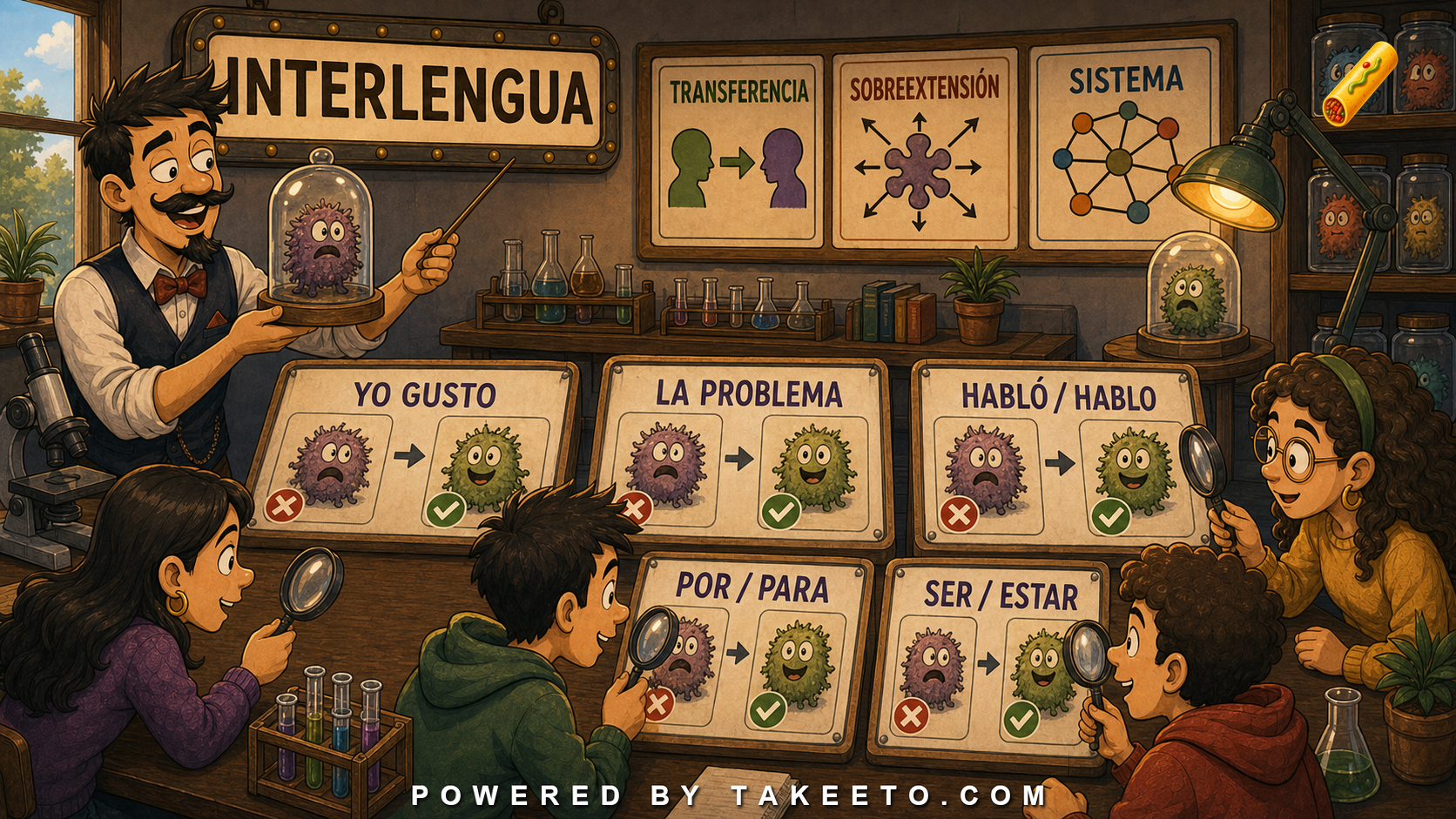
The learner may be mapping English I like coffee onto Spanish word order. They know a word related to liking. They know a subject should come first. They know Spanish verbs need conjugation. The result is wrong Spanish, but it reveals a coherent interlanguage pattern.
The key principle:
Errors are evidence. Analyze them before you correct them.
Error analysis helps learners and teachers identify whether a mistake comes from transfer, overgeneralization, incomplete rule learning, pronunciation interference, register mismatch, or fossilized habit.
Interlanguage is a developing system
An adult learner's Spanish is not simply English plus Spanish words. It is a developing system with its own patterns. This system may include:
- correct Spanish forms,
- transfer from the first language,
- overgeneralized Spanish rules,
- memorized phrases,
- avoided structures,
- unstable pronunciation,
- fossilized errors.
Calling it a system matters. It means a mistake can be diagnostic.
Example:
La problema es difícil.
The learner applies the common pattern that -a nouns are feminine. That is a reasonable overgeneralization, but problema is masculine:
El problema es difícil.
The correction is not just “wrong gender.” It is “your gender rule needs exceptions and word-level memory.”
Transfer: old knowledge shapes new Spanish
Transfer occurs when earlier knowledge affects Spanish.
English transfer:
Estoy 30 años.
I am 30 years old.
Spanish requires tener:
Tengo 30 años.
English transfer also produces:
preguntar por ayuda when the learner means pedir ayuda
aplicar para un trabajo depending on region/register and intended meaning
hacer una decisión instead of tomar una decisión
Not every similarity is bad. Transfer can help with cognates and shared structures. But when a pattern does not match, the learner needs contrast.
Overgeneralization: a real rule used too widely
Learners often learn a correct Spanish pattern and apply it everywhere.
Correct:
hablé, comí, viví
Overgeneralized:
tení instead of tuve
sabo instead of sé
ponido instead of puesto
This kind of error can be a sign of progress. The learner is building a rule. The next step is to add irregularity, frequency, and retrieval practice.
Error gravity: not all mistakes cost the same
Some errors barely affect comprehension:
un problema difícil vs el problema difícil in a sentence where meaning remains clear.
Some errors change meaning:
habló
he/she spoke
hablo
I speak
Some errors affect social perception:
Tú to a person expecting usted.
Informal request in a professional email.
Regional taboo vocabulary in the wrong country.
Some errors are high-stakes:
medical dosage, immigration status, legal deadlines, financial amounts.
Learners should prioritize errors by communicative impact, frequency, and fossilization risk.
Fossilization: when mistakes become habits
A fossilized error is not simply a mistake. It is a repeated pattern that becomes hard to dislodge because the learner communicates successfully enough without fixing it.
Examples:
always saying yo gusto
always omitting accent marks in past tense
always using para for por
always pronouncing Spanish vowels with English reduction
Fossilized habits need targeted contrast, not vague advice. The learner must notice the error, produce the correct form, receive feedback, and encounter the form again in meaningful input.
Self-audit routine
When you find an error, write five lines:
- My sentence: Yo gusto café.
- Correct sentence: Me gusta el café.
- Error type: English transfer + gustar argument structure.
- Pattern: me gusta + singular, me gustan + plural.
- New examples: Me gusta la música. Me gustan estos libros.
This turns correction into learning.
Error logs should preserve the wrong sentence
Learners often erase the wrong form as soon as they see the correction. That feels clean, but it loses diagnostic value. Keep both.
Write:
Wrong: Yo gusto el café.
Correct: Me gusta el café.
Cause: English transfer; wrong subject structure.
Repair: practice me gusta / me gustan with Spanish subjects.
The wrong sentence shows the interlanguage rule. The correction gives the target. The cause tells you what to watch for next time. The repair turns the error into practice.
An error log should be short enough to use. Three columns can be enough: wrong form, corrected form, reason. Later, add categories such as transfer, overgeneralization, spelling, pronunciation, register, or fossilized habit. The value is not in collecting shame. It is in finding patterns.
Example bank walkthrough
yo gusto
Wrong when intended as “I like.”
Learner action: analyze gustar argument structure.
es cansado
Possible in some meanings, but often learners mean está cansado for a tired person.
Learner action: identify whether you mean inherent description, tiring quality, or current state.
tengo 30 años
Spanish uses tener for age.
Learner action: avoid English I am transfer.
para/por
Common contrast error.
Learner action: build paired examples, not isolated translations.
habló/hablo
Accent mark changes tense/person.
Learner action: treat written accent as meaning-bearing.
la problema
Wrong in standard Spanish; problema is masculine.
Learner action: memorize high-frequency Greek-origin masculine -ma nouns: el problema, el tema, el sistema.
From correction to review queue
Error analysis should change what the learner reviews next. If the learner writes yo gusto, do not merely add gustar again as a vocabulary card. Add a contrast set:
me gusta el café
me gustan los libros
quiero café
prefiero té
me encanta esta canción
If the learner writes la problema, add a noun-gender mini-set:
el problema
el tema
el sistema
el idioma
el programa
The review queue should respond to the error source. A morphology error needs morphology. A collocation error needs collocations. A register error needs situations. That is how correction becomes learning rather than a momentary mark.
Remediation notes: one error is evidence, not a diagnosis
The strongest repair for error analysis is caution. A single error does not prove that a learner “doesn’t know” a structure. It may reflect speed, fatigue, transfer, overgeneralization, avoidance, task pressure, pronunciation, spelling, or a temporary retrieval failure. Error analysis treats mistakes as evidence, but evidence still requires interpretation.
A good error log should separate form, cause, and consequence. La problema is a gender assignment error with low communicative damage in many contexts but high visibility in writing. Pregunté ayuda may reveal English transfer from “ask for help” and blocks natural Spanish; the repair is pedí ayuda or pregunté por ayuda only in a different meaning. Yo gusto el café reveals argument-structure transfer; the repair is not just the answer me gusta el café, but the roles: thing liked as subject, experiencer as indirect object. Habló versus hablo may be accent-mark spelling, stress perception, or tense/person confusion depending on task.
The article should also distinguish local errors from system errors. If a learner misses por/para once in a timed exercise, that may not deserve a full intervention. If they repeatedly use para for cause, destination, exchange, and duration, the system needs contrastive retraining. Error gravity depends on frequency, communicative impact, social visibility, and whether the error blocks later learning.
Feedback must avoid moral language. Wrong is not enough. Better feedback says: You used a subject-verb frame from English. In Spanish, gustar marks the experiencer with me/te/le and the liked thing controls agreement. Try three new nouns. The correction becomes a rule and a retrieval task.
Production target: log repeated mistakes with four fields: my sentence, target sentence, likely cause, and next contrast drill. When the same cause appears three times, stop collecting errors and design a repair set. The goal is not a museum of failures. It is a map of the learner’s developing interlanguage.
Suggested interactive module: error-analysis worksheet
A strong tool for this article would turn mistakes into structured remediation.
Suggested functions:
- Error entry: learner enters original sentence.
- Correction field: corrected Spanish.
- Error type labels: transfer, overgeneralization, morphology, syntax, semantics, pragmatics, pronunciation, register.
- Gravity rating: low, medium, high, high-stakes.
- Contrast examples: generate minimal contrast sets.
- Review loop: schedule targeted retrieval.
- Fossilization tracker: repeated error patterns over time.
Final rule
A Spanish mistake is not just a red mark. It is evidence of a developing system.
Analyze errors by source, pattern, gravity, and remediation. Correction works best when it reveals why the wrong form made sense to the learner and what better pattern should replace it.