
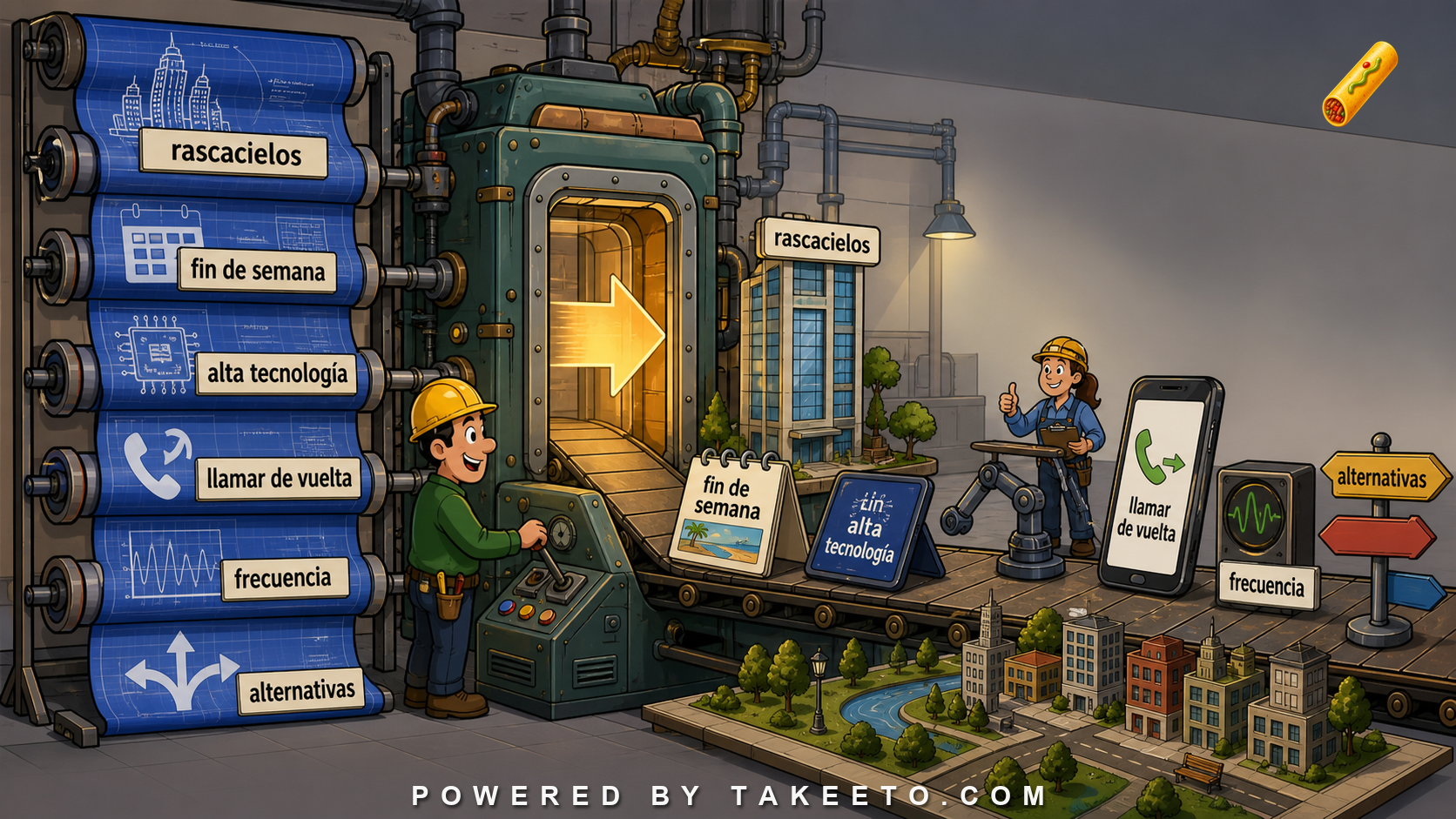
The learner problem is real
A calque can be invisible because every word in it is Spanish. The foreignness lies not in the vocabulary, but in the blueprint.
That reaction is understandable. Spanish is close enough to English and other European languages to reward pattern recognition, but different enough that pattern recognition can become overconfidence. The stronger habit is to treat each form as evidence. Ask what shape the word or sentence has, what job that shape is doing, and what context would make it natural.
The working rule for this article is simple:
Do not judge a calque only by whether its parts are Spanish. Ask whether the structure is established, contested, regional, technical, or translationese.
This rule matters because the topic is not only a small grammar point. It is a reading strategy, a writing strategy, and a way to keep learner Spanish from becoming a translation of English with Spanish-looking words.
The central pattern
A calque is a translation built from the structure of another language. Rascacielos mirrors “skyscraper”; fin de semana mirrors “weekend.” These are accepted Spanish words and phrases. Nobody needs to avoid them because they have foreign blueprints. Contact is one of the normal ways languages grow.
Other calques are more contested. Llamar de vuelta is understandable and used in some contexts, especially under English influence, but devolver la llamada is often the more idiomatic choice in many formal or neutral contexts. Aplicar para un trabajo is widespread in some American varieties and contact settings, but many style guides and teachers prefer solicitar un trabajo, postularse a un puesto, or presentarse a una convocatoria, depending on region and meaning. Realizar una decisión is usually awkward translationese for tomar una decisión.
The practical issue is not purity. It is control. Some calques are fully naturalized. Some are regional. Some belong to technical domains. Some are literal translations that make prose sound imported, stiff, or semantically wrong. Good Spanish writing does not avoid all foreign influence; it distinguishes accepted innovation from careless transfer.
The pattern is useful precisely because it is not mechanical. A mechanical rule lets you produce a few classroom examples and then fails in real prose. A durable pattern lets you inspect unfamiliar material, make a reasonable hypothesis, and then verify it with context.
Annotated contrast table
| Form or pattern | Example | What the learner should notice |
|---|---|---|
| Accepted lexical calque | rascacielos, fin de semana | established Spanish vocabulary |
| Technical or institutional calque | alta tecnología, base de datos | often accepted in specialized domains |
| Common but register-sensitive calque | llamar de vuelta | understandable; alternatives may sound more idiomatic |
| Contested regional usage | aplicar para | common in some areas; solicitar/postularse often safer in formal writing |
| Awkward translationese | realizar una decisión | use tomar una decisión |
| Semantic mismatch | estar supuesto a | usually an English-shaped structure, not standard Spanish |
Tables like this are not meant to replace reading. They train attention. Once the contrast is visible in short examples, the learner can notice it inside longer sentences, forms, articles, transcripts, and essays.
How to read it in context
A good reader does not translate from left to right as if each word were independent. A good reader first identifies the structure. In this topic, that means asking what is being built, modified, asserted, evaluated, connected, or backgrounded before choosing an English equivalent.
Consider the difference between a dictionary match and a contextual interpretation. A dictionary can give a gloss. It cannot by itself tell you whether a word sounds bureaucratic, whether a pronoun is attached because the verb is an infinitive, whether a relative clause describes a known person or a desired category, or whether a familiar-looking word is a false friend. Those decisions come from structure plus context.
The safest habit is to annotate one layer at a time. First mark the visible form. Then mark the grammatical relation. Then mark register or discourse function. Only after those steps should you settle on a translation or write your own sentence.
Diagnostic workflow
Use this checklist when you meet the pattern in real Spanish:
- Check whether the phrase appears in established Spanish dictionaries, institutions, or broad native usage.
- Ask whether it is regional rather than universally accepted.
- Look for a conventional Spanish collocation: tomar una decisión, devolver una llamada, solicitar un puesto.
- Consider genre: a contact-influenced colloquial phrase may be natural in speech but weak in formal prose.
- Distinguish innovation from literal translation that distorts meaning.
The point is not to slow down forever. The point is to slow down enough times that your eye starts doing the work automatically. Spanish becomes easier when you stop treating each example as a separate exception.
Common learner traps
| Trap | Better analysis |
|---|---|
| Condemning every calque | Fin de semana and rascacielos are normal Spanish. |
| Accepting every literal translation | Realizar una decisión sounds imported and should usually be tomar una decisión. |
| Ignoring regional legitimacy | Some contact-shaped expressions are part of real regional Spanish even when not ideal for panhispanic formal prose. |
| Confusing calque with loanword | Marketing is a loanword; alta tecnología is a calque-like Spanish phrase. |
The traps all have the same source: translating too early. If you first ask what the Spanish form is doing, many apparent exceptions become predictable.
Production practice
Translate “I applied for three jobs and called the manager back.” A literal contact-influenced version might be Apliqué para tres trabajos y llamé al gerente de vuelta. Depending on audience, a more neutral version could be Solicité tres puestos y le devolví la llamada al gerente or Me postulé a tres puestos y llamé de vuelta al gerente in a region where that phrasing feels natural. The goal is not one universal answer; it is awareness of region, register, and collocation.
For writing, build sentences around real contexts rather than isolated forms. A learner who writes only bare examples can produce a correct phrase and still miss the register, discourse function, or argument structure. A better practice sentence includes a speaker, a listener or reader, a purpose, and enough surrounding language to make the grammar meaningful.
One useful exercise is to write three versions of the same idea: a neutral spoken version, a careful written version, and a formal or technical version. The differences reveal which parts of the pattern are grammatical and which parts belong to style. This is especially important in articles 081-100, where morphology, word choice, discourse, word order, clitics, commands, and subjunctive mood all interact with register.
Deepening the pattern: from recognition to control
Recognition is the first stage. Control begins when the learner can explain why a neighboring form would change the interpretation. For Calques: Spanish Phrases Built on Foreign Blueprints, the essential habit is to keep three questions separate: what form is visible, what relation that form creates, and what discourse effect follows from it. When those questions collapse into one vague translation, the pattern becomes fragile. When they are separated, the learner can handle new examples without waiting for a memorized phrase.
Start with the example bank: rascacielos, fin de semana, llamar de vuelta, aplicar para, realizar una decisión, alta tecnología. Do not treat those items as decorative vocabulary. Treat them as test cases. For each one, ask what the form contributes that would disappear if the sentence were rewritten with a simpler, more English-like structure. Sometimes the answer is grammatical, as with agreement, clitic placement, or mood. Sometimes it is lexical, as with derivational families, false friends, loanwords, or register choices. Sometimes it is textual, as with connectors, discourse markers, word order, or formal nominalization. The same visible Spanish form can therefore carry information about grammar, vocabulary, stance, and genre at once.
| Control test | Example | What changes if the learner ignores it |
|---|---|---|
| Accepted lexical calque | rascacielos, fin de semana | established Spanish vocabulary |
| Technical or institutional calque | alta tecnología, base de datos | often accepted in specialized domains |
| Common but register-sensitive calque | llamar de vuelta | understandable; alternatives may sound more idiomatic |
| Contested regional usage | aplicar para | common in some areas; solicitar/postularse often safer in formal writing |
A useful self-check is the replacement test. Replace the form with the nearest English-looking option and ask what breaks. If nothing breaks grammatically, ask what changes stylistically. If the sentence remains possible but sounds more bureaucratic, more colloquial, more regional, more emphatic, or less precise, the difference still matters. Serious Spanish learning is not only avoiding ungrammatical sentences. It is learning why one grammatical sentence fits a context better than another. That final comparison is where mature command develops: the learner stops asking only whether a sentence is allowed and starts asking whether it is the sentence a competent speaker or writer would choose here.
This is also where translation discipline matters. English often hides distinctions that Spanish marks openly, and English sometimes marks distinctions that Spanish leaves to context. A literal translation may therefore produce the right dictionary meaning while losing the Spanish architecture. In this article's topic, the learner should practice moving in both directions: Spanish to analysis, then analysis to natural English; English intention to Spanish structure, then Spanish structure to a context where it sounds credible.
Applied editing drill
Use the topic as an editing lens. Take a paragraph that already communicates a basic message and revise it once for grammar, once for register, and once for discourse flow. In the grammar pass, look for visible evidence: endings, articles, pronouns, prepositions, mood, word order, and agreement. In the register pass, ask whether the vocabulary belongs to speech, academic writing, administrative prose, journalism, technical explanation, or intimate conversation. In the discourse pass, ask whether the sentence introduces information, contrasts it, reformulates it, softens it, commands action, evaluates it, or presents it as asserted or nonasserted.
For teachers and curriculum designers, the practical sequence is diagnosis before production. First ask learners to identify the form. Then ask them to explain the role. Only after that should they generate original examples. Production without diagnosis often creates lucky correct answers. Diagnosis followed by production creates transfer. For independent learners, the notebook method should be the same: record the example, label the structure, write the contrast, and add one original sentence with context.
For translators and heritage speakers, the main danger is different. They may understand the message quickly but underestimate the formal signal. A connector, suffix, clitic position, or subjunctive choice may feel obvious in context, yet that small signal is exactly what gives the sentence its written polish or regional flavor. Slow analysis is still useful even when the meaning is already clear.
V2 remediation refinement: calques need acceptance labels, not blanket condemnation
A calque is not automatically an error. The useful question is whether it is established, regional, technical, contested, or awkward translationese.
Some calques are fully ordinary Spanish. Rascacielos mirrors “skyscraper,” but it is not bad Spanish. Fin de semana is structurally modeled on a foreign pattern historically, but it is now completely normal. Alta fidelidad and alta tecnología are accepted expressions. A learner who treats every calque as contamination will misunderstand how languages grow.
Other calques are contested or regionally distributed. Aplicar para in the sense of applying for a job, scholarship, or program has spread in parts of the Americas under English influence and may be natural in some communities, but in many formal contexts solicitar, postularse a, presentarse a, or pedir will be safer. The article should not flatten this into “always wrong” or “always fine.” The editorial advice depends on audience.
Some forms remain poor translation choices in broad formal Spanish. Realizar una decisión is not the normal equivalent of “make a decision”; use tomar una decisión. Llamar de vuelta may be heard in some areas, but devolver la llamada is the stronger neutral option in careful writing. Soportar can mean support in a technical sense in some domains, but people generally apoyan a candidate or a cause.
A better classification table is:
| Expression | Status | Safer editorial note |
|---|---|---|
| rascacielos | established | Normal Spanish word. |
| fin de semana | established | No need to avoid. |
| alta tecnología | established | Natural in many contexts. |
| aplicar para | regional/contested | Use solicitar or postularse a in neutral formal prose. |
| llamar de vuelta | regional/translation-influenced | Devolver la llamada is broadly safe. |
| realizar una decisión | awkward | Use tomar una decisión. |
The upgraded article therefore teaches judgment, not purism. Translation influence is inevitable; the writer’s job is to know when it has become Spanish and when it still sounds like English syntax wearing Spanish words.
Suggested interactive module: Calque detector
Calque detector. The tool would compare a Spanish phrase with likely English or French blueprints, then label it accepted, regional, contested, or awkward. It would propose alternatives and explain the difference in register. For aplicar para, it would ask country, genre, and meaning before judging the phrase.
Suggested functions:
- Structure detection: identify the relevant form or construction automatically.
- Role labels: mark meaning, grammar, discourse function, and register separately.
- Contrast mode: show a nearby form that looks similar but behaves differently.
- Correction mode: let the learner repair common English-shaped errors.
- Context export: generate a short annotated example for study notes.
Final rule
Calques are not automatically wrong. They are contact footprints. Keep the ones Spanish has made its own; repair the ones that still sound like a translation draft.