
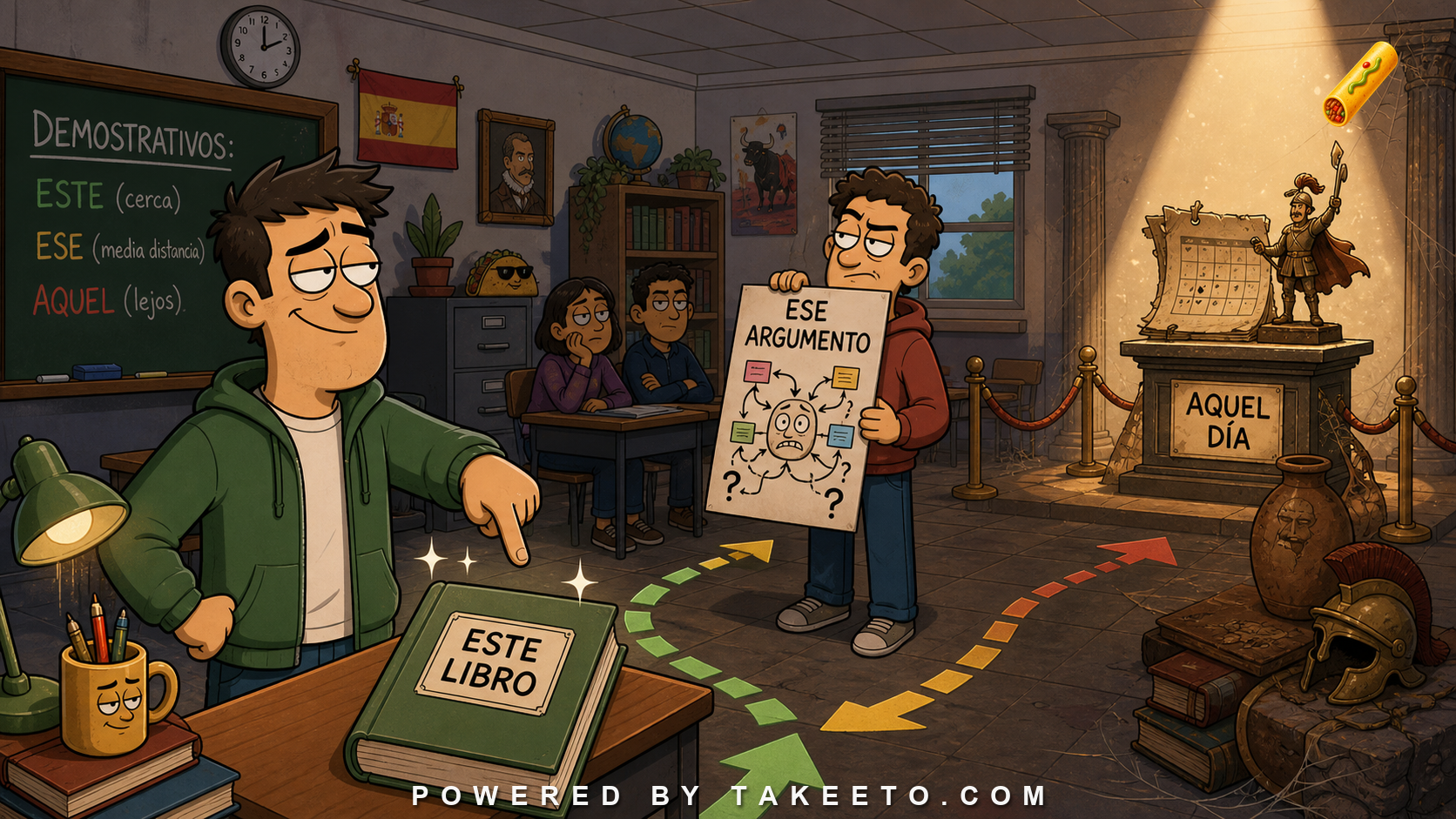
Demonstratives are not just pointing words
Spanish demonstratives are often introduced as equivalents of English this and that:
este libro
this book
ese libro
that book
aquel libro
that book over there
This is a useful start, but it is not enough. Spanish has a three-way demonstrative system that can mark physical distance, conversational distance, textual reference, time, memory, emotional closeness, and discourse structure.
The core forms are:
| Near speaker | Near hearer/context | Distant from both |
|---|---|---|
| este, esta, estos, estas | ese, esa, esos, esas | aquel, aquella, aquellos, aquellas |
| esto | eso | aquello |
English usually has a two-way system: this/these vs that/those. Spanish can divide “that” into ese and aquel.
A better learner rule is:
Demonstratives do not only locate objects. They locate referents in relation to speaker, hearer, memory, text, and stance.
Forms and agreement
Demonstratives agree in gender and number when they modify or replace nouns.
| Masculine singular | Feminine singular | Masculine plural | Feminine plural |
|---|---|---|---|
| este | esta | estos | estas |
| ese | esa | esos | esas |
| aquel | aquella | aquellos | aquellas |
Examples:
este libro
this book
esta casa
this house
esos problemas
those problems
aquellas montañas
those mountains over there
The gender and number belong to the noun referred to, not to the speaker or distance.
esta mano
this hand
este problema
this problem
Remember that problema is masculine, so este problema, not esta problema.
Neuter forms: esto, eso, aquello
Spanish also has neuter demonstratives:
esto
this thing / this matter / this situation
eso
that thing / that matter / that situation
aquello
that thing back there / that earlier matter / that distant situation
These forms do not modify nouns directly. You do not say:
esto libro
Correct:
este libro
Use esto/eso/aquello when the referent is an idea, situation, action, or unspecified thing:
Esto es importante.
This is important.
No entiendo eso.
I do not understand that.
Aquello cambió mi vida.
That thing back then changed my life.
The neuter forms are especially important in conversation and argument because speakers constantly refer to what has just been said.
Eso no es cierto.
That is not true.
Here eso may refer to a whole claim, not a physical object.
Physical distance
The simplest use is spatial pointing.
este libro
the book near me
ese libro
the book near you, or the one we are talking about
aquel libro
the book over there, away from both of us
In a classroom, a teacher might say:
Este ejercicio es para hoy.
This exercise, here in front of me/us, is for today.
Ese ejercicio que tienes en la mano es diferente.
That exercise you have in your hand is different.
Aquel cartel al fondo tiene un error.
That poster back there has an error.
In real speech, the physical division is flexible. Gestures, eye gaze, shared attention, and context matter.
Speaker and hearer space
Ese often points to the hearer’s space or to something already introduced in the conversation.
¿Me pasas ese lápiz?
Can you pass me that pencil?
The pencil may be near the listener. It may also simply be the pencil being discussed.
Este can introduce a new topic near the speaker’s mental focus:
Tengo este problema: no sé cómo explicarlo.
I have this problem: I do not know how to explain it.
Ese can pick up something the other person said:
—Creo que debemos esperar.
—Esa idea me parece razonable.
The idea is not physically near anyone. It belongs to the conversational field.
Temporal distance
Demonstratives can locate time.
esta mañana
this morning
esta semana
this week
ese día
that day
aquellos años
those years back then
Este often refers to the current time frame:
este mes
this month
este verano
this summer
Ese refers to a time already mentioned or contextually identified:
Llegamos el lunes. Ese día llovió mucho.
We arrived Monday. That day it rained a lot.
Aquel often evokes a more distant past or a remembered scene:
Aquel verano cambió todo.
That summer changed everything.
This is why aquel día can sound more literary, nostalgic, or historically distant than ese día.
Textual reference
In writing, demonstratives organize discourse.
Este problema requiere una solución inmediata.
This problem requires an immediate solution.
If the writer has just introduced a problem, este can keep it in focus.
El informe menciona tres causas. Estas causas se analizan a continuación.
The report mentions three causes. These causes are analyzed below.
Ese can refer back with a little more distance:
Algunos autores defienden esa interpretación.
Some authors defend that interpretation.
Aquel can contrast with este when two referents are in play:
Este enfoque se centra en la forma; aquel, en el significado.
This approach focuses on form; that one on meaning.
In academic Spanish, demonstratives must be used carefully. Overusing este/esta without a clear antecedent creates vague writing. The reader should know exactly what este problema, esta idea, or ese argumento refers to.
Emotional and evaluative distance
Demonstratives can carry stance.
No me gusta esa actitud.
I do not like that attitude.
Esa can create distance from the attitude. It may feel critical.
Esta casa me encanta.
I love this house.
Esta can create closeness, immediacy, or attachment.
Aquellos tiempos eran distintos.
Those times were different.
Aquellos can sound nostalgic, solemn, or distant.
This does not mean the demonstrative alone always expresses emotion. Context matters. But demonstratives are a common way to position the speaker socially and emotionally toward the referent.
Demonstratives as pronouns
Demonstratives can modify nouns:
este libro
They can also stand alone as pronouns:
Este es mío.
This one is mine.
Esa no funciona.
That one does not work.
Aquellos llegaron tarde.
Those people/ones arrived late.
The gender and number still point to an understood noun or group.
Tengo dos computadoras. Esta funciona; esa no.
I have two computers. This one works; that one does not.
The neuter forms esto/eso/aquello stand alone but do not replace gendered nouns:
Esto no funciona.
This thing/situation does not work.
If you mean “this computer,” use:
Esta no funciona.
because computadora is feminine.
Accent marks on demonstratives
Modern standard guidance generally writes demonstratives without accent marks in normal contexts:
este, ese, aquel
esta, esa, aquella
estos, esos, aquellos
estas, esas, aquellas
The older practice of accenting pronoun uses, such as éste or ése, is no longer the general rule. In cases of real ambiguity, current guidance allows optional accenting of pronominal demonstratives according to the writer’s judgment, but the safe modern default for learners is to write them without accents.
Este libro es mío.
Este es mío.
No accent is needed in ordinary writing.
Do not write ésto, éso, aquéllo. The neuter forms are not accented in standard modern spelling.
Dicho and tal
Formal Spanish also uses words such as dicho and tal for textual reference.
dicha cuestión
the aforementioned issue
dicho procedimiento
said procedure / the procedure mentioned
tal situación
such a situation
These are not ordinary demonstratives, but they belong to the same discourse family: they help manage reference in a text. Dicho is common in administrative, legal, and formal writing, but it sounds stiff in casual speech.
Compare:
Esa cuestión debe resolverse pronto.
neutral
Dicha cuestión debe resolverse pronto.
formal/documentary
Learners should recognize dicho in formal prose but not overuse it in everyday Spanish.
Common learner errors
Error 1: Using neuter forms before nouns
esto libro
Correct:
este libro
Error 2: Treating ese and aquel as identical
Both may translate as “that,” but aquel often marks greater distance, whether physical, temporal, textual, or emotional.
ese día = that day already mentioned
aquel día = that day back then / that more distant day
Error 3: Adding accent marks by old habit
Modern default:
Este es mi libro.
Avoid Éste es mi libro as routine learner spelling. Current guidance allows an optional accent only in genuine ambiguity judged by the writer; it is not the normal mark of a demonstrative pronoun.
Error 4: Losing agreement
esta problema
Correct:
este problema
Error 5: Vague textual reference
Esto demuestra que la teoría es falsa.
What is esto? A sentence? A data point? A whole paragraph? In academic writing, be precise:
Este resultado demuestra que la teoría es insuficiente.
Diagnostic workflow: locate the referent in space, text, and stance
To choose a demonstrative, identify the kind of distance involved. Physical distance is only one possibility.
Physical:
este vaso = the glass near me
ese vaso = the glass near you or already in shared attention
aquel vaso = the glass over there
Textual:
Este argumento se desarrollará en la siguiente sección.
Ese argumento no explica todos los datos.
Here este may point to the current or upcoming argument, while ese may refer back to one already mentioned or one held at a slight distance.
Temporal:
este año = the current year
ese año = that year already mentioned
aquellos años = those years back then
Emotional stance:
No acepto esa actitud.
The speaker creates distance from the attitude.
A good editing test is to replace a demonstrative with a fuller noun phrase. If esto in an essay means “the fact that the survey excluded rural participants,” write esta exclusión or este hecho instead. Demonstratives are efficient, but vague demonstratives weaken formal prose.
For active use, decide whether the referent is a gendered noun or an abstract situation:
este informe
esta decisión
estos resultados
estas causas
But:
esto demuestra...
eso no basta...
aquello fue distinto...
Do not put neuter esto/eso/aquello directly before nouns. If a noun follows, choose the agreeing form.
Finally, write modern demonstratives without routine accents. If you see older éste/ése/aquél, recognize it, but do not imitate it as the default.
Demonstratives as discourse navigation
In extended writing, demonstratives help readers navigate what has already been said and what is being introduced. This is not just pointing in physical space; it is pointing inside the text.
Consider:
La reforma redujo los costos administrativos. Este resultado explica su popularidad inicial.
Here este resultado points to the result just stated and presents it as the current focus. The writer is saying: keep this result in view; I am about to say something about it.
Now compare:
La reforma redujo los costos administrativos. Ese resultado ya se había observado en otros países.
Ese resultado treats the result as already available in the discourse and perhaps slightly more distant from the writer’s present line of development.
In formal contrast, este and aquel can separate two antecedents:
La gramática y la ortografía se complementan. Esta describe la estructura de las palabras y oraciones; aquella regula la escritura.
Here esta refers to the nearer antecedent, la ortografía, while aquella refers to the more distant antecedent, la gramática. This pattern is elegant but demanding. It requires the reader to count backward through the discourse.
For learner writing, use this power sparingly. If the antecedent is not obvious, repeat the noun instead of relying on a demonstrative:
La gramática y la ortografía se complementan. La ortografía regula la escritura; la gramática describe la estructura.
Clear prose beats clever reference. Demonstratives are best when they reduce repetition without making the reader guess.
Contrast lab: este vs ese in argument
In essays and presentations, este and ese can manage argumentative focus:
Este punto será central en el análisis.
This point will be central in the analysis.
Ese punto no responde a la pregunta inicial.
That point does not answer the initial question.
Este often brings a referent into the writer’s current focus. Ese can push a referent slightly away, especially when responding to someone else’s claim. The contrast is subtle but useful. Demonstratives do not only point; they position ideas.
V2 remediation refinement: demonstratives point in discourse as much as in space
The article already covers physical distance, but advanced reading depends on textual distance. In writing, este, ese, and aquel often manage the reader’s attention rather than point to objects in a room.
A common pattern is prospective este:
Este capítulo analiza tres problemas.
This chapter analyzes three problems.
The demonstrative points to the present text unit, often the one the reader is entering.
Retrospective ese can refer back to an idea already mentioned, sometimes with mild distance:
La propuesta reduce costos, pero ese argumento no resuelve el problema ambiental.
The proposal reduces costs, but that argument does not solve the environmental problem.
Aquel can reach farther back in time or text:
En aquel periodo, la economía dependía más de las exportaciones.
In that period, the economy depended more on exports.
In academic writing, this helps avoid vague esto. Compare:
Esto demuestra que la hipótesis es débil.
This shows that the hypothesis is weak.
Este resultado demuestra que la hipótesis es débil.
This result shows that the hypothesis is weak.
The second is better because it names the referent. Esto can be useful when referring to a whole situation, but it becomes lazy when the reader has to guess which previous claim is being invoked.
The accent-mark rule should be stored separately from the distance rule. Modern learner default: write este, ese, aquel and their feminine/plural forms without accent marks. The neuters esto, eso, aquello are never accented in standard spelling. Optional accenting of pronominal demonstratives belongs only to judged ambiguity, not routine article writing.
Suggested interactive module: demonstrative distance map
A useful tool would represent demonstratives across physical and discourse space.
Suggested functions:
- Distance selector: near speaker, near hearer/context, distant from both.
- Reference type: noun, understood noun, abstract situation, previous claim.
- Agreement checker: este/esta/estos/estas, etc.
- Neuter warning: prevents esto libro.
- Register tool: ese problema vs dicha cuestión.
Example input:
this problem
Output:
este problema. Although problema ends in -a, it is masculine.
Final rule
Spanish demonstratives map distance in space, time, discourse, and stance. Este keeps something near the speaker or current focus. Ese points to the hearer’s space, shared context, or a recently mentioned idea. Aquel marks greater distance. Esto, eso, aquello point to abstract or unspecified referents, not nouns directly.
Do not translate only “this” and “that.” Ask where the referent sits in the conversation.