
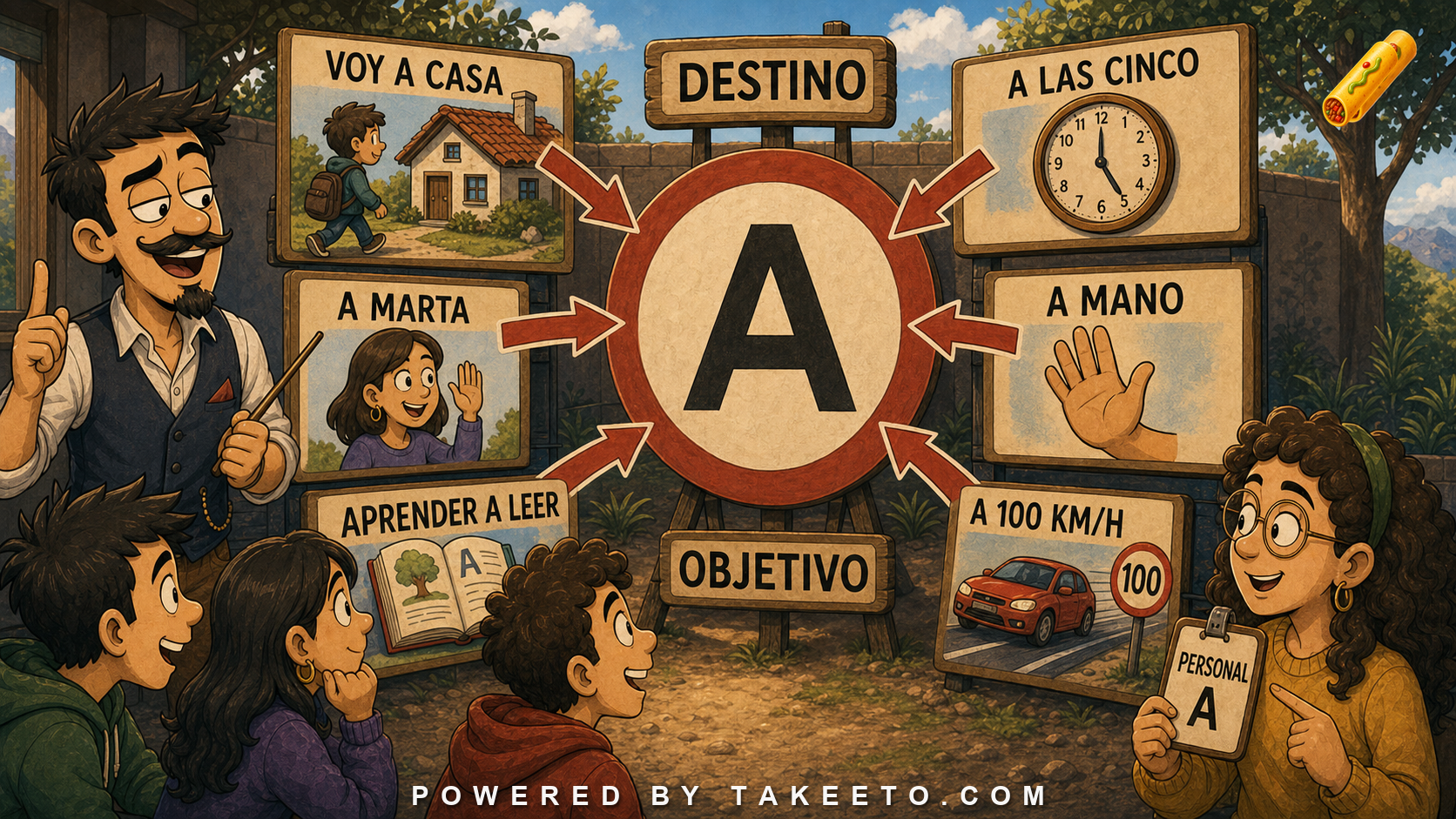
A points toward a target
The preposition a is small, frequent, and dangerous. Learners meet it first as “to,” then quickly find examples where “to” is wrong:
a las cinco
at five
a mano
by hand
cien kilómetros a la hora
one hundred kilometers per hour
veo a Ana
I see Ana
A single English translation will not work. The better core idea is target or endpoint. A often points toward a destination, recipient, time point, rate, manner pattern, personal object, or infinitive goal.
The rule is not perfect, but it is useful:
A often marks the endpoint, target, or directed relation of an action or description.
Physical direction and arrival
The most concrete use is motion toward a place.
Voy a casa.
I am going home.
Llegamos a Madrid.
We arrived in Madrid.
Entró a la habitación.
He/she entered the room.
Subimos al segundo piso.
We went up to the second floor.
Here a marks the endpoint of motion.
Do not confuse destination with location:
| Motion endpoint | Location |
|---|---|
| Voy a Madrid. | Vivo en Madrid. |
| Llegamos a la estación. | Estamos en la estación. |
| Entró a la oficina. | Trabaja en la oficina. |
English often uses “in” or “at” after arrive, but Spanish uses a for many arrival endpoints:
llegar a casa
llegar al aeropuerto
llegar a una conclusión
The endpoint can be physical or abstract.
Abstract endpoints
A extends naturally from physical movement to abstract direction:
Llegamos a un acuerdo.
We reached an agreement.
Volvimos al tema principal.
We returned to the main topic.
Esta idea lleva a otro problema.
This idea leads to another problem.
Se acostumbró al clima.
He/she got used to the climate.
The endpoint is not a place you can touch. It is a result, state, topic, or conceptual target.
This is one reason a appears with many verbs and adjectives. The preposition is part of the relation they build.
Recipients and addressees
A marks recipients and addressees, especially with indirect objects.
Le escribo a Marta.
I write to Marta.
Le di el libro a Juan.
I gave the book to Juan.
Les mandé un mensaje a mis padres.
I sent a message to my parents.
The a phrase names the person toward whom the transfer or communication is directed. The indirect object pronoun often appears too:
A Marta le escribo todos los días.
I write to Marta every day.
This is different from personal a, where a marks a direct object:
Vi a Marta.
I saw Marta.
Same preposition, different role. The verb determines whether the a phrase is a recipient or a marked direct object.
Time points
A marks specific time points:
a las cinco
at five
al mediodía
at noon
a medianoche
at midnight
a principios de junio
at the beginning of June
al final del día
at the end of the day
The time is treated as a point or endpoint on a temporal scale.
Compare:
| Spanish | Time relation |
|---|---|
| a las cinco | point time |
| en mayo | month/frame |
| por la mañana | broad period |
| desde 2020 | starting boundary |
| hasta mañana | ending boundary |
The preposition choice shows how the time is conceptualized.
Manner, method, and style
A appears in many manner expressions:
a mano
by hand
a pie
on foot
a oscuras
in the dark
a la derecha
on/to the right
a fuego lento
over low heat
a gritos
shouting / by shouting
These expressions do not all translate as “to.” They often describe a mode or manner shaped like a pattern or route.
Some are highly lexicalized and should be learned as phrases. Still, the endpoint/target idea can help: the action is carried out according to a manner, technique, or orientation.
Rates and distribution
A can mark rates:
a cien kilómetros por hora
at one hundred kilometers per hour
dos veces a la semana
twice a week
tres euros al kilo
three euros per kilo
In these expressions, a relates one quantity to a unit or scale. The article often appears:
una vez al día
once a day
dos tardes a la semana
two afternoons a week
Spanish also uses por in some distributive expressions:
tres veces por semana
Both exist, but the structures differ. Learners should notice the phrase as a unit rather than translate “per” mechanically.
A before infinitives
Many Spanish verbs and expressions take a + infinitive:
aprender a leer
to learn to read
empezar a trabajar
to begin working
ayudar a estudiar
to help study
volver a intentar
to try again
ir a comer
to go eat / be going to eat
The a often marks the infinitive as a target action, beginning, return, movement, or learned ability.
Do not assume every English “to + verb” becomes a + infinitive. Spanish also uses bare infinitives, de + infinitive, para + infinitive, and other patterns. Store the verb with its required structure:
- aprender a
- empezar a
- volver a
- dejar de
- tratar de
- acabar de
- servir para
Personal a
Article 051 treated personal a in detail, but it belongs in the map of a.
Veo a Ana.
I see Ana.
Respeto a mis profesores.
I respect my teachers.
No conozco a nadie.
I do not know anyone.
Here a does not mean “to.” It marks a specific human direct object. This use still fits the broad idea of marking a targeted participant, but it must be learned as object marking, not ordinary direction.
The pronoun replacement reveals the role:
Veo a Ana → La veo.
Escribo a Ana → Le escribo.
One is direct object; the other is indirect object.
Contraction: a + el = al
When a is followed by the masculine singular article el, the two normally contract:
a + el mercado → al mercado
Voy al banco.
I am going to the bank.
Le escribí al profesor.
I wrote to the professor.
Do not contract before él the pronoun:
Voy a él.
I am going to him / toward it.
And do not contract in writing when El is part of a capitalized proper name or title:
Viajé a El Salvador.
I traveled to El Salvador.
Common learner errors
Error 1: Using en after llegar
Llegamos en Madrid.
Better:
Llegamos a Madrid.
Error 2: Treating every a phrase as indirect object
Vi a Ana → La vi.
Ana is direct object despite a.
Error 3: Translating English “to” automatically as a
I want to leave = Quiero salir, not quiero a salir.
Error 4: Forgetting al
Voy a el mercado.
Better:
Voy al mercado.
Error 5: Missing fixed manner expressions
Phrases like a mano, a pie, a oscuras, and a tiempo should be learned whole.
Separating a as preposition from a as object marker
The same written word a appears in several environments. Learners improve quickly when they stop trying to assign it one translation and instead label its grammatical job.
A as endpoint
Voy a la universidad.
I am going to the university.
Here a is a true directional preposition. It marks the endpoint of motion.
A as recipient marker
Le mandé el archivo a Julia.
I sent the file to Julia.
Here a Julia is an indirect object phrase. The pronoun le confirms the role.
A as personal direct object marker
Vi a Julia.
I saw Julia.
Here a Julia is not a recipient. It is a direct object marked with personal a. The pronoun replacement is la vi, not le vi in broad non-leísta usage.
A as time point
Nos vemos a las seis.
We will meet at six.
Here a places the event at a point on a time scale.
A as manner or rate
Lo hizo a mano.
He/she did it by hand.
Iba a noventa kilómetros por hora.
He/she was going at ninety kilometers per hour.
Here a marks a manner or measurement relation.
A as infinitive connector
Empezó a llover.
It started to rain.
Here a belongs to a verb pattern. The English word “to” may appear, but that does not mean every English infinitive takes a.
The practical method is to annotate each a phrase by function: endpoint, recipient, personal object, time point, manner, rate, or infinitive complement. Translation comes after classification.
Verb patterns with a: learn them as units
Many a + infinitive structures are governed by the verb before them. The preposition is not chosen freely.
| Verb pattern | Example | Meaning |
|---|---|---|
| aprender a + infinitive | aprender a leer | learn to read |
| empezar a + infinitive | empezó a llover | it started to rain |
| comenzar a + infinitive | comenzó a hablar | began to speak |
| volver a + infinitive | volvió a llamar | called again |
| ayudar a + infinitive | ayuda a entender | helps to understand |
| enseñar a + infinitive | enseña a escribir | teaches how to write |
Do not generalize from English “to.” Spanish says:
Quiero salir.
I want to leave.
not:
Quiero a salir.
It also says:
Trato de entender.
I try to understand.
not usually:
Trato a entender.
The verb chooses the preposition or chooses no preposition. That means your vocabulary notes should include verb frames:
- aprender a hacer algo
- empezar a hacer algo
- volver a hacer algo
- tratar de hacer algo
- dejar de hacer algo
- querer hacer algo
This is one of the best places to stop thinking in individual-word translations. The unit to learn is the construction.
Micro-drill: endpoint or location?
Choose a or en by asking whether the phrase is an endpoint or a location.
Estoy en la universidad.
I am at the university.
Voy a la universidad.
I am going to the university.
El paquete está en la oficina.
The package is in the office.
Mandé el paquete a la oficina.
I sent the package to the office.
The same noun can follow either preposition. The verb and relation decide. This endpoint/location distinction is the backbone of many a choices, even when the endpoint is abstract: llegar a una conclusión, volver al tema, empezar a entender.
Diagnostic refinement: a is an endpoint marker, but not every endpoint is literal motion
The preposition a is easiest to unify around the idea of a target or endpoint. That endpoint may be physical:
Voy a casa.
Llegamos a Madrid.
It may be interpersonal:
Le escribí a Marta.
Entregaron el paquete al director.
It may be temporal:
Nos vemos a las cinco.
It may be a rate or measured target:
a cien kilómetros por hora
It may be a manner pattern:
a mano
a oscuras
a la antigua
And it may be a verb-selected infinitive complement:
aprender a leer
empezar a trabajar
volver a intentarlo
The remediation point is that a should not be translated as “to” and then applied everywhere English has “to.” English “to” before an infinitive often disappears in Spanish:
Quiero salir.
I want to leave.
No a appears because querer takes a bare infinitive.
Other verbs require a:
Aprendí a nadar.
Empezó a llover.
This is verb pattern knowledge, not a universal preposition rule.
Separate personal a from endpoint a:
Vi a Marta.
I saw Marta.
Here a does not mean “to Marta.” It marks a specific human direct object. The replacement proves the role:
La vi.
Compare:
Le escribí a Marta.
I wrote to Marta.
Now a Marta is an indirect object phrase, and the clitic is le.
The editing sequence is therefore:
- Is there motion or transfer toward an endpoint? a is likely.
- Is there a time point, rate, manner, or selected infinitive pattern? Check the expression or verb.
- Is there a specific human direct object? That is personal a, not “to.”
- Is the verb static location? Use en, not a: estoy en casa, not ordinary estoy a casa.
This keeps the unifying idea useful without making it simplistic.
Suggested interactive module: endpoint map
A useful tool for this article would display a uses on an endpoint map.
Suggested functions:
- Endpoint classifier: physical destination, recipient, time point, rate, manner, infinitive target, personal object.
- A vs en contrast: voy a Madrid / vivo en Madrid.
- Role checker: vi a Ana → la vi, escribí a Ana → le escribí.
- Contraction engine: a el → al, with proper-name exceptions.
- Verb-pattern notebook: records aprender a, empezar a, volver a, ayudar a.
Example input:
arrive at the airport
Output:
- Relation: motion endpoint.
- Spanish pattern: llegar a.
- Result: llegar al aeropuerto.
Final rule
A is best understood as a marker of endpoint, target, or directed relation. It marks destinations, recipients, time points, rates, manners, infinitive complements, and specific personal direct objects.
Do not reduce it to “to.” Ask what kind of target the phrase creates: place, person, time, action, rate, manner, or object. Then check the verb pattern and the grammatical role.