
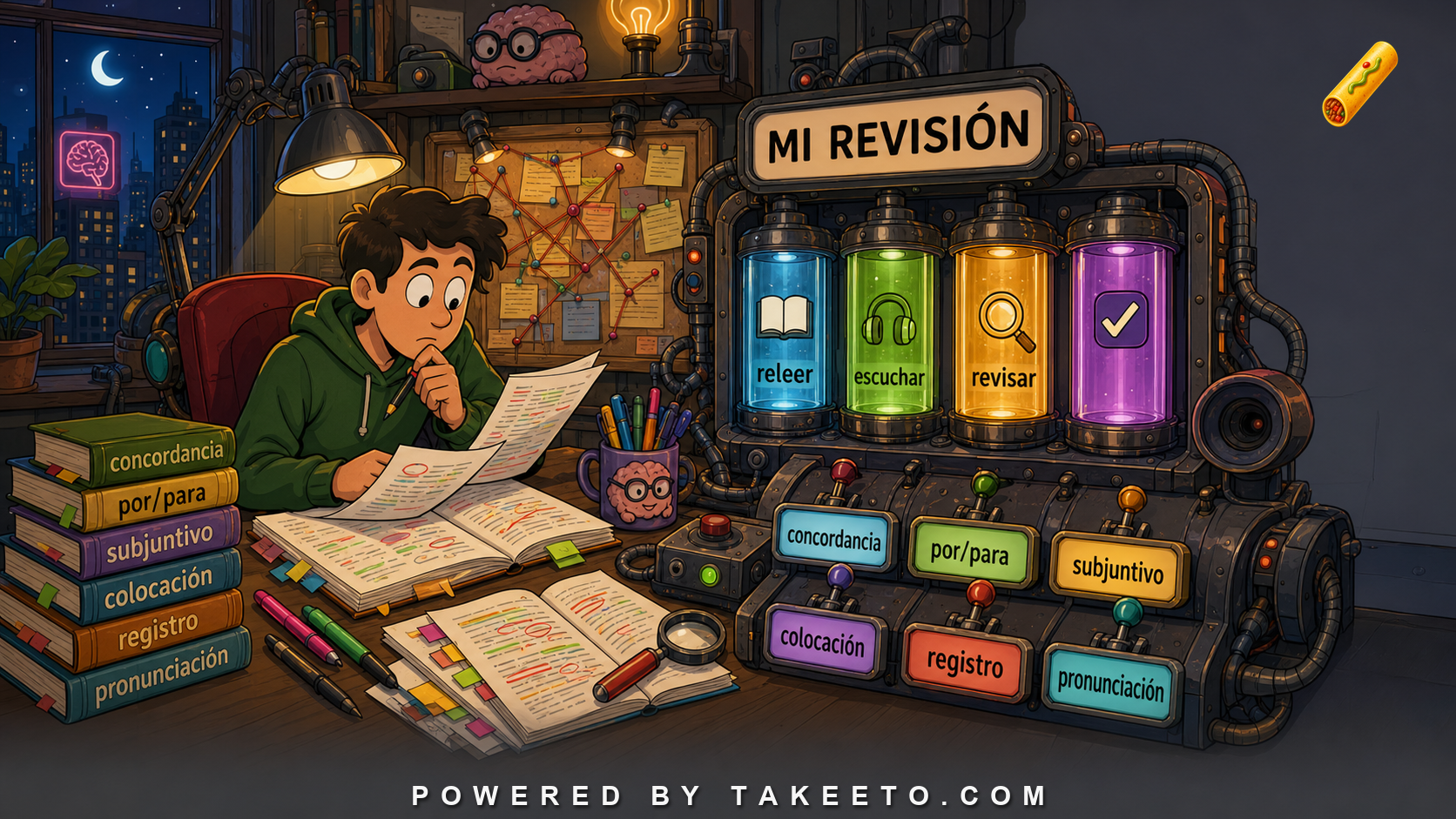
“Is this correct?” is too weak a question
Learners often ask one question about their Spanish:
Is this correct?
That question is understandable, but it is too blunt. A sentence can be grammatically possible and still unnatural. It can be natural in one country and odd in another. It can be acceptable in conversation and wrong for an academic email. It can be understandable but poorly organized. It can be technically correct but shaped by English.
A serious learner needs a better question:
What kind of problem does this Spanish have?
Self-audit is the habit of checking Spanish by category. Instead of feeling vaguely unsure, you inspect structure, meaning, naturalness, register, and sound. You do not need to catch every error. You need to build a repeatable way of finding the errors that matter most.
The key principle is:
A Spanish self-audit should separate correctness, naturalness, register, and communicative effect.
When you separate those layers, your corrections become sharper.
The four-pass audit
A strong self-audit has four passes:
- Mechanical pass: gender, number, verb endings, accent marks.
- Structural pass: tense, mood, pronouns, prepositions, word order, se.
- Naturalness pass: collocation, idiom, discourse markers, rhythm.
- Register pass: formality, politeness, regional consistency, audience.
Do not try to do all four at once. That creates fog. Read your Spanish several times, each time with one question.
A learner who tries to fix everything simultaneously often fixes nothing. A learner who audits one layer at a time becomes dangerous in the best way: precise.
Pass 1: mechanical control
Mechanical errors are visible and frequent. They include agreement, spelling, accent marks, and verb endings.
Examples:
la problema
el problema
los persona
las personas
yo hablo ayer
yo hablé ayer
esta informacion
esta información
Mechanical errors matter because they affect credibility. They may not always block communication, but they signal weak control. They are also relatively easy to audit if you slow down.
Mechanical checklist:
- Does every noun have the right article?
- Do adjectives agree in gender and number when they should?
- Do subject and verb agree?
- Are accent marks present where required?
- Are common irregular forms correct?
- Are plural forms complete?
- Are dates, numbers, and names written appropriately?
A good mechanical audit is boring. That is a compliment. Boring checks prevent avoidable errors.
Agreement: the fastest credibility repair
Agreement should be one of the first self-audit habits.
Example:
Las decisión importantes afectaron a muchas personas.
Repair:
Las decisiones importantes afectaron a muchas personas.
The problem was not vocabulary. The problem was noun phrase control:
- decisión becomes decisiones,
- article becomes las,
- adjective becomes importantes.
Agreement errors often cluster because the learner changes one word and forgets to update the phrase. During revision, circle noun phrases:
las decisiones importantes
un informe detallado
varios problemas graves
la situación económica
If noun phrases are stable, the whole sentence becomes more trustworthy.
Pass 2: structure
Structural errors involve the relationships inside the sentence.
Common targets:
- tense and aspect,
- indicative versus subjunctive,
- object pronouns,
- reflexive and pronominal verbs,
- ser and estar,
- por and para,
- prepositional government,
- subordinate clauses,
- se constructions,
- word order.
Example:
Quiero que tú vienes mañana.
Repair:
Quiero que vengas mañana.
The issue is not the meaning of querer. The issue is mood after a desire expression.
Example:
Depende en el contexto.
Repair:
Depende del contexto.
The issue is prepositional government: depender de.
Example:
Se me olvidé la contraseña.
Repair:
Se me olvidó la contraseña.
The issue is the structure of accidental forgetting: the forgotten thing controls the verb.
Self-audit means naming the pattern. If you cannot name it yet, describe it:
This is one of those “the thing happened to me” structures.
That is already better than guessing.
Por and para audit
Por and para are often taught as lists. In self-audit, they should be checked by function.
Ask:
- Is this a purpose or recipient? likely para.
- Is this a deadline? likely para.
- Is this a cause, exchange, route, duration, or means? often por.
- Is this a fixed expression? verify separately.
Examples:
Lo hice para ayudarte.
I did it in order to help you.
Gracias por la información.
Thank you for the information.
El informe es para mañana.
The report is for tomorrow / due tomorrow.
Caminamos por el centro.
We walked through downtown.
Audit action: underline every por and para in your writing and write one word above it: purpose, cause, route, deadline, exchange, recipient, duration, means.
If you cannot label it, check it.
Subjunctive audit
The subjunctive should not be audited as “doubt mood” only. That shortcut breaks quickly.
Instead, ask:
- Is there a trigger of desire, request, recommendation, emotion, doubt, denial, possibility, purpose, or nonexistence?
- Is there a subject change?
- Is the clause asserted as factual, or presented through evaluation or uncertainty?
Examples:
Es importante que revises los datos.
It is important that you review the data.
Busco un libro que explique el subjuntivo con claridad.
I am looking for a book that explains the subjunctive clearly.
No creo que sea necesario.
I do not think it is necessary.
Audit action: highlight every que clause. Not every que requires subjunctive, but many subjunctive environments are visible through subordinate clauses.
Se audit
The word se is not one thing. A self-audit must classify it.
Examples:
Se venden libros.
Books are sold / books for sale.
Se me cayó el vaso.
I dropped the glass, with accidental framing.
María se levantó temprano.
María got up early.
Se habla español.
Spanish is spoken.
Los documentos se enviaron ayer.
The documents were sent yesterday.
Audit questions:
- Is se reflexive?
- Is it part of a pronominal verb?
- Is it passive or impersonal?
- Is it accidental or affected-person se?
- Does the verb agree with the thing or the people involved?
A learner does not need to solve all se at once. But every time you classify one correctly, Spanish becomes less mysterious.
Pass 3: naturalness
Naturalness is where many intermediate learners plateau. Their Spanish is understandable, but it sounds translated.
The most important naturalness category is collocation: words that normally go together.
Weak or English-shaped:
hacer una decisión
Natural:
tomar una decisión
Weak:
aplicar para un trabajo
Often better:
solicitar un empleo
postularse a un puesto
presentar una solicitud
Weak:
tener sentido para mí in all contexts
Often better:
me parece lógico
tiene sentido
lo entiendo
Audit action: inspect verb-noun pairs. Ask whether Spanish uses the same verb English uses. Many naturalness errors live there.
Discourse markers and paragraph flow
Natural Spanish is not only sentence-level. Paragraphs need connectors and reference.
A learner paragraph may say:
El problema es importante. Muchas personas hablan del problema. El gobierno quiere resolver el problema. No es fácil.
Better:
El problema es importante y muchas personas lo han señalado en los últimos meses. Sin embargo, aunque el gobierno ha propuesto varias medidas, la solución no parece sencilla.
The improvement is not just vocabulary. It uses pronoun reference, contrast, subordination, and rhythm.
Audit questions:
- Am I repeating nouns because I lack reference tools?
- Do my connectors match the logic?
- Did I overuse pero when sin embargo, aunque, or en cambio would be clearer?
- Does each sentence connect to the previous one?
- Is the paragraph a list or an argument?
Pass 4: register and audience
Register asks whether the Spanish fits the situation.
Compare:
¿Me mandas el archivo?
Can you send me the file?
¿Podrías enviarme el archivo?
Could you send me the file?
Le agradecería que me enviara el archivo.
I would appreciate it if you sent me the file.
All three can be correct. They are not interchangeable.
Register checklist:
- Is this for a friend, teacher, client, official, reader, or public audience?
- Should I use tú, usted, vos, ustedes, or vosotros?
- Is the vocabulary too casual or too bureaucratic?
- Does the message need softeners?
- Is the Spanish regionally consistent?
- Am I using slang I do not fully control?
A learner who ignores register may sound rude, stiff, childish, over-formal, or fake-casual without intending to.
Regional consistency
Regional consistency is not about pretending that only one variety is correct. It is about avoiding accidental mixture when producing Spanish.
A learner might write:
Vosotros pueden tomar el carro y aparcarlo cerca de la computadora.
This mixes forms in a way that may sound unstable:
- vosotros expects podéis in Spain-style address,
- carro may be normal in some regions but not all,
- aparcar is common in Spain,
- computadora is common in many Latin American contexts.
A better regionally coherent version depends on target:
Spain-oriented:
Vosotros podéis coger el coche y aparcarlo cerca del ordenador.
Many Latin America-oriented contexts:
Ustedes pueden tomar el carro/auto y estacionarlo cerca de la computadora.
No variety is inherently better. The audit question is:
Am I mixing forms on purpose or by accident?
Pronunciation self-checks
Self-audit should include sound. Written Spanish can look stable while spoken Spanish remains unclear.
Pronunciation checklist:
- Are vowels clear and not reduced like English vowels?
- Is stress placed on the right syllable?
- Are written accent marks reflected in pronunciation?
- Are r and rr distinguished where needed?
- Is d pronounced naturally without over-English hardening?
- Is final s treated consistently with the variety being practiced?
- Are phrase groups natural, or am I reading word by word?
Record thirty seconds. Listen once for meaning, once for stress, once for rhythm. Do not attack every sound. Choose one target.
Example target:
This week I will mark stress in every new word with an accent mark and record the sentence twice.
Listening self-checks
Listening errors also deserve audit.
When you fail to understand audio, classify the failure:
- I did not know the word.
- I knew the written word but not the spoken form.
- I missed a reduced sound.
- I lost the clause structure.
- I recognized words but not the speaker's point.
- I was unfamiliar with the accent or variety.
- I could not process the speed.
These are different problems.
Repair differs too. Unknown word? Review vocabulary. Known written form but not audio? Use transcript alignment. Clause structure failure? Slow reading and sentence bracketing. Accent unfamiliarity? Add controlled exposure to that variety.
Error log template
A useful error log should be simple enough to use repeatedly.
| Date | Error | Type | Correction | Evidence | Next action |
|---|---|---|---|---|---|
| May 3 | la problema | gender/agreement | el problema | masculine noun despite -a | make 5 phrases |
| May 5 | depende en | preposition | depende de | verb governs de | add card with sentence |
| May 7 | missed se me olvidó | se/listening | accidental structure | transcript example | shadow 3 examples |
| May 9 | too casual email | register | use podría, le agradecería | teacher context | rewrite message |
The key is the final column. Every error should become an action.
Example bank walkthrough
Agreement
Agreement connects nouns, articles, adjectives, and verbs.
Learner action: circle noun phrases and check every agreement relationship.
Por/para
Por and para encode different functions and fixed patterns.
Learner action: label each use by function rather than memorizing an English translation.
Subjunctive
The subjunctive appears in subordinate environments involving desire, evaluation, uncertainty, nonexistence, purpose, and more.
Learner action: highlight que clauses and identify the trigger.
Se
Se has multiple functions.
Learner action: classify each se before translating.
Collocation
Collocation controls naturalness.
Learner action: audit verb-noun and adjective-noun pairings.
Register
Register controls social fit.
Learner action: name the audience before revising.
Pronunciation
Pronunciation determines whether written knowledge becomes usable speech.
Learner action: record short samples and focus on one sound or rhythm target.
Self-audit workflow
For one paragraph of your own Spanish:
- Read once for meaning.
- Circle all noun phrases.
- Check gender and number agreement.
- Underline finite verbs and check tense/person.
- Highlight que clauses and mood choices.
- Mark every se and classify it.
- Underline prepositions after verbs/adjectives/nouns.
- Check collocations against examples or corpus evidence.
- Identify audience and register.
- Read aloud and record.
- Choose three repairs, not twenty.
- Rewrite the paragraph.
Remediation pass: audit causes, not personalities
Self-audit becomes harmful when it turns into character judgment. “My Spanish is bad” is not an audit. “I keep losing agreement when the adjective is separated from the noun” is an audit. “I sound stupid” is not an audit. “I overuse English-shaped collocations such as hacer una decisión instead of tomar una decisión” is an audit.
The repair is to audit causes, not personalities. Every error should be tied to a system:
- form control — gender, number, conjugation, accent mark, spelling;
- syntactic control — word order, pronoun placement, clause structure, subordination;
- semantic control — wrong meaning, false friend, aspect choice, preposition meaning;
- pragmatic control — too direct, too casual, too formal, wrong relationship signal;
- register control — everyday vs formal vs technical vs bureaucratic;
- regional control — inconsistent variety or unrecognized regional expression;
- phonological control — stress, vowel quality, consonant weakening, intonation, rhythm;
- listening control — segmentation, reduction, speaker speed, dialect exposure, transcript dependence.
This taxonomy makes improvement less emotional and more precise. It also prevents the learner from correcting the wrong thing. A sentence may be grammatically correct but pragmatically harsh. A pronunciation may be intelligible but regionally inconsistent with the model the learner chose. A translation may preserve dictionary meaning but destroy register.
Error gravity: not all mistakes deserve the same repair
A serious self-audit should rank errors by gravity. Otherwise the learner spends the same energy on a typo and a meaning-changing tense error.
Use four levels.
Level 1: Surface errors are visible but rarely block meaning. Examples: occasional missing accent in informal notes, typo, minor punctuation issue. These should be corrected, but they do not need a week of remediation.
Level 2: Credibility errors do not usually block meaning, but they make the Spanish sound weak or careless. Examples: la problema, inconsistent agreement, repeated missing accent marks in formal writing, English-like capitalization, awkward literal collocations.
Level 3: Meaning errors change what the sentence says. Examples: wrong tense/aspect, por/para confusion in a consequential phrase, saber/conocer confusion, pedir/preguntar, wrong negation, wrong subject reference.
Level 4: High-stakes errors can cause practical harm in legal, medical, financial, academic, immigration, workplace, or safety contexts. Examples: misunderstanding plazo, recurso, contraindicación, dosis, deducible/franquicia, renovación automática, evacuar, no cruce. These require caution, verification, and often professional support.
This ranking does not excuse surface errors. It simply puts repair energy where it belongs.
Before/after repair: from correction to diagnosis
Weak correction:
Wrong: Estoy viviendo aquí por cinco años.
Correct: Vivo aquí desde hace cinco años.
This is useful, but it may not prevent recurrence.
Stronger audit note:
Error type: English progressive + duration transfer.
Spanish pattern: present tense + desde hace for an ongoing state that began in the past.
Correct sentence: Vivo aquí desde hace cinco años.
Contrast: Estoy viviendo aquí este mes can work for a temporary current arrangement.
Revisit: make five sentences with desde hace and five with current progressive.
Another weak correction:
Wrong: Realicé que estaba equivocado.
Correct: Me di cuenta de que estaba equivocado.
Stronger audit note:
Error type: false friend / translationese.
English “realize” is not normally realizar in this meaning.
Spanish pattern: darse cuenta de que + clause.
Register note: advertir que or percatarse de que may appear in more formal contexts.
Card repair: add phrase card for me di cuenta de que... not isolated cuenta.
The stronger note teaches the system behind the correction.
A practical audit of one paragraph
Take a paragraph you wrote in Spanish. Do not correct it immediately. First, label it.
- Underline every noun and mark gender/number agreement with articles and adjectives.
- Circle every finite verb and mark tense, person, and mood.
- Box every pronoun and identify its antecedent or role.
- Highlight prepositions after verbs, adjectives, and nouns.
- Mark connectors: cause, contrast, result, addition, reformulation, sequence.
- Label register: casual, neutral, formal, academic, bureaucratic, technical.
- Identify one sentence that sounds translated from English.
- Rewrite only the two highest-gravity issues first.
Example sentence:
La análisis muestra que los estudiantes no tienen suficiente apoyo para completar sus tareas, pero la institución debe de proveer más recursos.
Audit:
- la análisis → credibility/form error; el análisis.
- apoyo para completar → acceptable, but check whether apoyo para or apoyo en best fits intended meaning.
- debe de proveer → possible as probability in some descriptions, but obligation should normally be debe proveer; better formal verb may be proporcionar.
- Register: academic/institutional.
Repair:
El análisis muestra que los estudiantes no cuentan con suficiente apoyo para completar sus tareas; por ello, la institución debe proporcionar más recursos.
This repair improves gender, register, connector logic, and verb choice.
Pronunciation audit without panic
A pronunciation audit should not ask, “Do I sound native?” That question is too broad and often discouraging. Ask instead:
- Are vowels clear and stable?
- Is word stress in the right place?
- Are accent-marked words pronounced with correct stress?
- Is r/rr contrast controlled enough for high-frequency words?
- Are b/d/g too English-like between vowels?
- Is final s awareness aligned with the chosen variety?
- Are pauses placed at phrase boundaries rather than random grammar panic points?
- Is intonation making statements, questions, uncertainty, and politeness clear?
Record thirty seconds of reading and thirty seconds of spontaneous speech. Audit them differently. Reading tests script-to-sound control. Spontaneous speech tests retrieval, rhythm, and sentence planning. Do not demand the same precision from both.
A strong pronunciation note is specific:
In the reading, I stressed publico as publicó twice. Review accent-based stress contrasts: público / publico / publicó.
A weak pronunciation note is vague:
My accent is bad.
The first can be repaired. The second just hurts.
Listening audit: identify the bottleneck
Listening difficulty is not one skill. A learner may fail because of vocabulary, sound reduction, speed, dialect, syntax, topic knowledge, or weak working memory.
Use this listening audit after a short clip:
| Symptom | Likely bottleneck | Repair |
|---|---|---|
| I hear sounds but cannot find word boundaries | segmentation | transcript alignment, short-loop replay |
| I recognize words only after seeing transcript | sound-form mapping | listen before reading, then replay with text |
| I know the words but lose the sentence | syntax/working memory | mark finite verbs and phrase boundaries |
| One speaker is clear, another impossible | dialect exposure | build regional listening set |
| Formal speech is easier than casual speech | reduction and colloquial markers | annotate reductions like pa, 'tá, weakened d/s |
| Casual speech is easier than lectures | academic vocabulary/discourse | study connectors, abstract nouns, nominalizations |
A listening audit should produce one drill. Do not write “listen more.” Write “loop 15 seconds and mark reduced para, está, and final s.”
Register audit: correctness is not enough
A sentence can be correct and still wrong for the situation.
Example:
Quiero que me devuelvan el dinero.
This may be grammatically correct. In a formal customer-support message, it may be too blunt unless the context is already adversarial. A softer version might be:
Solicito el reembolso del importe abonado, ya que el servicio no se prestó en las condiciones indicadas.
In a casual conversation, that same formal version would sound stiff.
Self-audit should therefore ask:
- Who is speaking?
- To whom?
- In what medium?
- With what power relationship?
- With what emotional temperature?
- Is the goal to inform, request, complain, apologize, argue, document, or persuade?
Only then should the learner decide whether quiero, quisiera, solicito, le agradecería, me gustaría, or exijo fits.
Error-log template with remediation fields
A useful error log should have enough structure to drive future study.
| Field | Example |
|---|---|
| Date | May 27 |
| Source | passage, audio, writing, exam, conversation |
| Error | realicé que |
| Category | false friend / translationese |
| Correct form | me di cuenta de que |
| Contrast | realizar = carry out / accomplish; not “realize” in this sense |
| Register | neutral; formal alternatives: advertir, percatarse |
| Repair task | write five sentences with darse cuenta de que |
| Revisit date | June 1 |
| Re-test result | recognized? produced? used in writing? |
The revisit fields are essential. An error log without revisit dates is an archive. An error log with revisit dates is a remediation system.
Quality-control checklist for the self-audit article
A finished version of this article should avoid two bad extremes. It should not be soft advice that tells learners to “notice mistakes” without showing how. It should also not become a punitive checklist that makes every learner feel defective. The tone should be rigorous and sane.
The article should repeatedly show that an audit turns vague discomfort into specific action. It should include mechanical checks, sentence-structure checks, naturalness checks, register checks, pronunciation checks, listening checks, and error-log design. It should also remind readers that some high-stakes situations require professional review.
The final effect should be empowering: the learner does not have to guess whether their Spanish is “good.” They can inspect it.
A one-sentence audit worksheet
A full paragraph audit can be overwhelming. A one-sentence worksheet trains the same skill at a smaller scale. Take one sentence from your own writing and answer these questions in order.
- Main verb: What is the finite verb, and is person/number correct?
- Time/aspect: Does the tense match the timeline?
- Mood: Is the clause stating, wishing, doubting, requiring, evaluating, or reacting?
- Subject and agreement: What noun controls each adjective, article, and verb?
- Pronouns: What does each pronoun refer to, and is the role direct, indirect, reflexive, or impersonal?
- Prepositions: Did I choose the preposition as part of a Spanish pattern, or translate it from English?
- Collocation: Would a Spanish speaker normally combine these words?
- Register: Does this fit the audience?
- Region: Is the vocabulary consistent with my target or deliberately broad?
- Rewrite: Can I make the sentence clearer without losing meaning?
Example sentence:
Estoy interesado en aplicar para un trabajo que consiste de ayudar estudiantes.
Audit result:
- interesado en is good.
- aplicar para may be English-shaped; depending on region/context, use solicitar un empleo or postularme a un puesto.
- consiste de should usually be consiste en.
- ayudar estudiantes usually needs personal a: ayudar a estudiantes.
Revised:
Me interesa postularme a un puesto que consiste en ayudar a estudiantes.
One sentence can reveal grammar, collocation, prepositions, and register at once.
Suggested interactive module: Spanish self-audit form
A strong tool for this article would guide learners through layered revision.
Suggested functions:
- Text input: learner pastes or writes Spanish.
- Mechanical checklist: gender, number, accents, verb endings.
- Structure checklist: tense, mood, pronouns, prepositions, se.
- Collocation prompts: suspicious English-shaped pairings.
- Register selector: friend, teacher, customer, official, academic, public.
- Regional consistency tags: Spain, Mexico, Caribbean, Rioplatense, neutral, mixed.
- Audio recording slot: read the revised text aloud.
- Error log export: mistake, type, correction, next action.
- Before/after comparison: show concrete improvement.
Final rule
Do not audit Spanish by asking only, “Is it correct?”
Ask what kind of Spanish it is: mechanically accurate, structurally sound, natural, regionally coherent, and appropriate for the audience. Then fix one layer at a time.
Self-audit turns vague insecurity into usable information.