Automated checks catch structure, not judgment
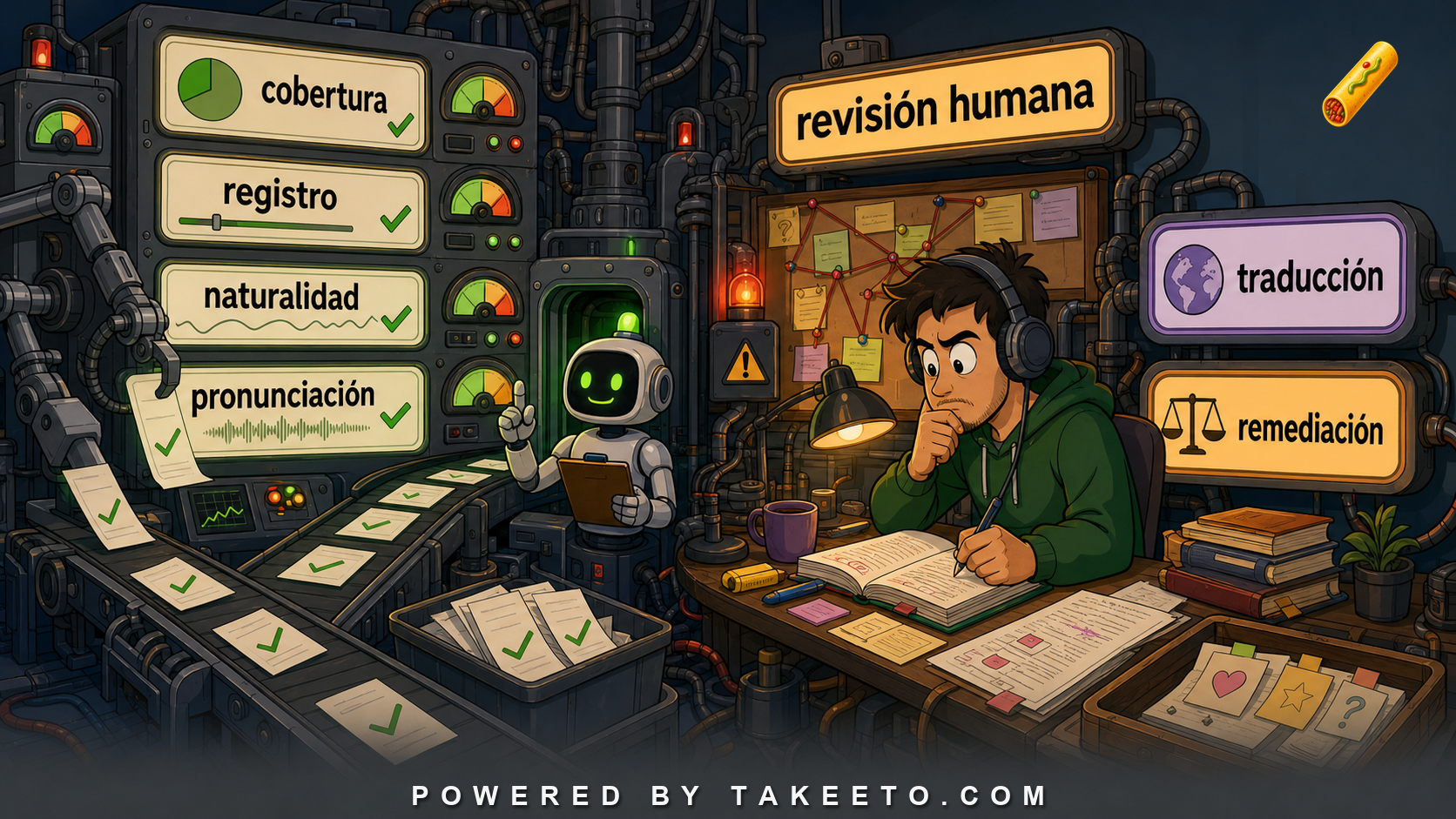
Automated checks are necessary in a large language curriculum. They can count items, detect missing audio, find broken links, flag empty translations, catch duplicate IDs, and verify that every focus item appears in a passage. But they cannot decide whether a Spanish sentence is natural, whether a register note is misleading, whether a translation teaches the wrong structure, or whether a learner will infer a bad rule from an example.
That is why manual audit is not old-fashioned. It is the part of quality assurance that understands language as language. Heuristics can tell you that por appears in a unit. A reviewer must decide whether the examples teach por responsibly.
The practical rule for this article is simple:
Heuristics catch what can be counted.
That rule is easy to state and hard to implement. It requires a curriculum designer, teacher, or serious independent learner to look past the visible artifact and ask what the artifact is doing in the learning system. A card, passage, note, audio button, PDF, notification, or metric is never just a feature. It is part of the learner's encounter with Spanish.
The QA stack needs both machines and humans
A good QA stack has layers. The bottom layer is mechanical validation: IDs, counts, required fields, file existence, formatting, highlight coverage, and version consistency. The next layer is linguistic validation: Spanish grammar, spelling, accent marks, agreement, tense, mood, pronoun placement, prepositions, idioms, and pronunciation. The next layer is pedagogical validation: whether the example teaches the target contrast, whether the difficulty is appropriate, whether feedback is useful, and whether distractors are fair. The top layer is learner-experience validation: whether the unit feels coherent, whether the media supports the task, and whether the product explains enough without overwhelming.
Heuristics fail because language is contextual. A sentence can be grammatical and still bad for a lesson. Le di a María el libro que me había prestado el profesor may be correct, but it is a poor first example for indirect object pronouns if the target is simply le di el libro. A translation can be accurate and still unhelpful for learners if it hides the structure under a too-natural English paraphrase. A passage can include all required vocabulary and still sound like a list stapled into paragraphs.
Manual audit should not be vague taste. It should produce logs: issue, location, category, severity, proposed fix, reviewer, date, and resolution. Serious review is disciplined human judgment, not intuition floating outside the system.
The strongest design habit is to separate the learner-facing experience from the hidden support structure. The learner may see a clean passage, a small note, a speaker button, and a short exam. Behind that simplicity should be clear metadata: item identity, grammar role, register, audio status, review status, translation alignment, and assessment purpose. Good learning design often feels simple because the complexity has been organized, not because it has been ignored.
Annotated audit map
| Design element | What it checks or supports | Spanish-learning consequence |
|---|---|---|
| Automated coverage | Every required item appears at least once. | Cannot tell whether the sentence is natural or pedagogically useful. |
| Format checks | Fields, IDs, links, and audio files exist. | Cannot judge Spanish quality. |
| Grammar audit | Agreement, tense, mood, pronouns, accent marks. | Requires expert or well-trained human review. |
| Register audit | Formal, informal, technical, regional, neutral. | Heuristics struggle with social appropriateness. |
| Pedagogy audit | Example density, contrast clarity, feedback fairness. | Needs knowledge of learner misconceptions. |
| Remediation audit | Fixes are logged, verified, and not reintroduced. | Requires process discipline, not just detection. |
The table is not meant to turn learning into bureaucracy. It is meant to prevent vague praise. A curriculum artifact should be able to answer concrete questions: What does this teach? What does it assume? What can go wrong? What evidence would show that it is working? Where does the learner receive help if the item fails?
Spanish-specific stakes
Spanish makes these design decisions visible because the language is full of contrasts that cannot be solved by exposure alone. Learners need repeated contact with ser/estar, por/para, preterite/imperfect, object pronouns, se, agreement, article use, register, and regional variation. A product or curriculum that treats every item as an isolated translation will underprepare the learner for real text.
The issue is not that Spanish is uniquely impossible. The issue is that Spanish has structure. The learner must be given enough of that structure to make input intelligible and enough retrieval to make knowledge durable. A passage without review becomes a reading experience that fades. A card without context becomes a brittle memory. Audio without text may not teach spelling. Text without audio may teach silent mispronunciation. Explanations without examples become abstractions. Examples without explanations can create false rules.
The cure is integration. A Spanish item should move through several linked forms: it appears in context, receives a translation or gloss, is heard, is reviewed, is tested, and returns later in a different context. Each contact should add something. Repetition alone is not the same as cumulative design.
Edge cases and mature design questions
Manual audit should be divided by expertise. A pronunciation reviewer may catch stress and voice problems that a grammar editor misses. A teacher may catch learner-confusion risks that a native speaker without pedagogy experience overlooks. A domain expert may catch legal or medical register problems. One reviewer can be excellent and still not be all reviewers.
A mature QA process assigns issue types to the right kind of judgment. It also accepts that “natural Spanish” is not a single universal object. A Mexican-neutral example, a Spain-neutral example, and a Rioplatense example may all be good Spanish, but they should not be mixed accidentally inside one beginner unit without explanation.
| Edge case | Why it matters | Better handling |
|---|---|---|
| Reviewer specialization | Different errors require different ears and knowledge. | Route pronunciation, grammar, pedagogy, and domain issues separately. |
| Dialect consistency | Naturalness depends partly on variety. | Choose a target variety or label variation deliberately. |
| Audit fatigue | Long manual passes can miss subtle errors. | Use short queues, severity filters, and second-pass verification. |
Edge cases are useful because they reveal whether the model is real. A shallow rule works only in the clean example. A strong curriculum principle survives versioning, regional variation, learner differences, and product constraints. For Spanish, this matters because the learner will eventually meet forms outside the first example bank: another accent, another register, another tense, another passage genre, another medium.
A mature design does not need to solve every edge case in the first lesson. It does need to know where the edges are. When the course chooses not to explain something yet, that should be a deliberate sequencing decision, not ignorance disguised as simplicity.
Diagnostic workflow
- Run automated checks first so reviewers spend time on judgment, not missing fields.
- Review Spanish examples aloud for naturalness and rhythm.
- Check whether each example actually teaches the target item rather than merely containing it.
- Compare translations against learning purpose: aligned enough, natural enough, not misleading.
- Record every issue in an audit log with category and severity.
- Re-audit remediated sections; fixes can create new problems.
This workflow works best when it is used before publication rather than after learners complain. Retrofitting quality is expensive. It requires finding the passage, rewriting the sentence, updating the translation, changing the glossary, regenerating audio, revising the PDF, and rebuilding exams. Early diagnostic habits keep the curriculum from accumulating hidden debt.
Common failure patterns
- Using heuristics as a substitute for expertise: A green dashboard can hide awkward Spanish.
- Relying on native-speaker intuition without pedagogy: A native speaker may fix style while weakening the lesson objective.
- Relying on teachers without content systems: Excellent feedback can be lost if it is not logged and applied consistently.
- Treating QA as a final step only: Quality should be checked during drafting, generation, review, and publication.
- Failing to classify severity: A typo, a wrong gender, a misleading grammar rule, and bad audio are not equal problems.
These mistakes share one cause: treating the visible feature as the whole product. A learner does not experience a Spanish item only once. They meet it in a deck, a passage, an example, a translation, a voice, a note, an exam, and a review queue. If those encounters disagree, the learner pays the price through confusion. If they reinforce one another, the learner gains a stable model.
A concrete curriculum scenario
Consider the example Tengo una decisión intended to teach “to make a decision.” An automated check sees a sentence, a translation, and the target word decisión. It passes. A human reviewer sees the problem: Spanish normally says tomar una decisión, not tener una decisión in that sense. The sentence is not only unnatural; it teaches a bad collocation. A good audit log would mark category: collocation/naturalness; severity: high if used as a model sentence; fix: Tomé una decisión difícil or Tenemos que tomar una decisión; follow-up: update audio and translation.
Notice the larger principle: the best design choice is usually the one that makes the next learning contact better. A good example sentence prepares better audio. Good audio prepares better listening review. A good glossary note prepares better reading. A good exam mistake prepares better spaced review. The curriculum should behave like a system rather than like a collection of assets.
What the reader should be able to do after this article
After working through this article, the reader should be able to inspect a Spanish-learning artifact and ask sharper questions. They should be able to identify the learning purpose, name the likely failure mode, and propose a repair that improves the next learner encounter. In practical terms, that means moving from vague judgments such as “this feels good” or “this is confusing” to specific diagnoses: the example is unnatural, the audio is mismatched, the translation hides the construction, the review prompt tests recognition rather than recall, or the note explains too much at the wrong moment.
The deeper habit is accountability. Every piece of a serious Spanish curriculum should be able to justify its presence. If it cannot, it should be revised, moved, linked, hidden, or removed.
Implementation checklist
For this topic, implementation should start with the article's own example bank: coverage, mismatch, register, naturalness, pronunciation, translation, remediation. Choose one representative item or artifact and trace it through the system. It should have a learner-facing purpose, a hidden data representation, a place in review, and a remediation path if something goes wrong. If the topic is not a single vocabulary item, trace a unit-level artifact instead: a passage, PDF, notification, metric, audio control, or exam.
- Name the learner action this design supports: reading, listening, retrieval, production, diagnosis, or long-term review.
- Name the hidden metadata needed to support that action: item ID, form, register, variety, audio status, version, prerequisite, or mistake link.
- Name the failure that would most damage trust, then build the audit check that catches it before publication.
A design is not mature because it has many parts. It is mature when those parts can be inspected, repaired, and explained.
V2 remediation refinement: make audit severity explicit
The first version defended manual audit, but a stronger QA system also needs severity levels. Without severity, teams argue about taste while urgent failures hide among minor polish issues. A typo in an English explanation, a Spanish agreement error, a wrong audio voice, a stale PDF, and an unnatural sentence are all “issues,” but they should not block release in the same way.
A practical severity scale could look like this:
| Severity | Example | Release action |
|---|---|---|
| Blocker | wrong Spanish form, wrong audio language, misleading grammar rule | cannot ship |
| High | unnatural example that teaches bad collocation; translation hides target construction | fix before public release if item is core |
| Medium | awkward but understandable sentence, inconsistent label, weak distractor | schedule remediation and mark for review |
| Low | typography, redundant note, mild style mismatch | fix opportunistically |
| Editorial discussion | regional preference, register choice, alternative translation | document rationale |
This scale prevents two common failures. The first is false precision: automated checks report 100% coverage, so the team assumes quality. The second is false paralysis: every human comment feels equally urgent, so nothing ships. A good audit stack distinguishes correctness, naturalness, pedagogy, accessibility, and maintainability.
Human review should be sampled intelligently. High-frequency items, early-course items, audio used in first exposure, subjunctive explanations, pronoun clusters, and passages exported to PDF deserve stricter review. Low-risk formatting changes can be batch-checked. The auditor’s log should preserve the reason for the decision, not just the decision itself: “blocked because aplicar para was presented as neutral for all contexts,” “approved because this article intentionally uses formal no obstante,” “sent to regional review because ahorita meaning depends on variety.”
Manual audit is not a romantic defense of human intuition. It is a way to inspect phenomena that rules do not fully capture: register, collocation, tone, dialect consistency, learner timing, and whether an explanation will repair the likely mistake rather than merely sound correct.
Suggested interactive module: QA pyramid for language content
QA pyramid for language content. The interface would show automated checks at the base, then reviewer queues for grammar, register, naturalness, pedagogy, translation, audio, and remediation verification. Each issue would have a lifecycle: detected, assigned, fixed, checked, closed. The tool would make visible that human review is not a bottleneck but a quality layer.
A useful implementation would also preserve an audit trail. When a designer changes a sentence, the tool should reveal downstream effects: translation, highlights, audio, PDF, exams, and review data. When a learner misses an item, the tool should reveal upstream causes: weak example, poor contrast, missing audio, or a misleading note. The module should not merely display content. It should make relationships inspectable.
Final rule
Heuristics catch what can be counted. Manual audit catches what can be understood. Serious Spanish content needs both: automation for coverage and humans for language, pedagogy, and judgment.
For serious Spanish learning, quality is not one decision. It is the alignment of content, explanation, sound, retrieval, assessment, and learner trust. When those parts agree, the learner can spend attention on Spanish instead of fighting the curriculum.