One letter hides two sounds
Spanish r is famous because of the trill.
Learners hear perro, rápido, or Rosa and focus on the dramatic rolling sound. They practice for weeks trying to vibrate the tongue. Some succeed quickly. Others feel defeated.
But Spanish r is not just “roll your r.” Spanish has two important r sounds:
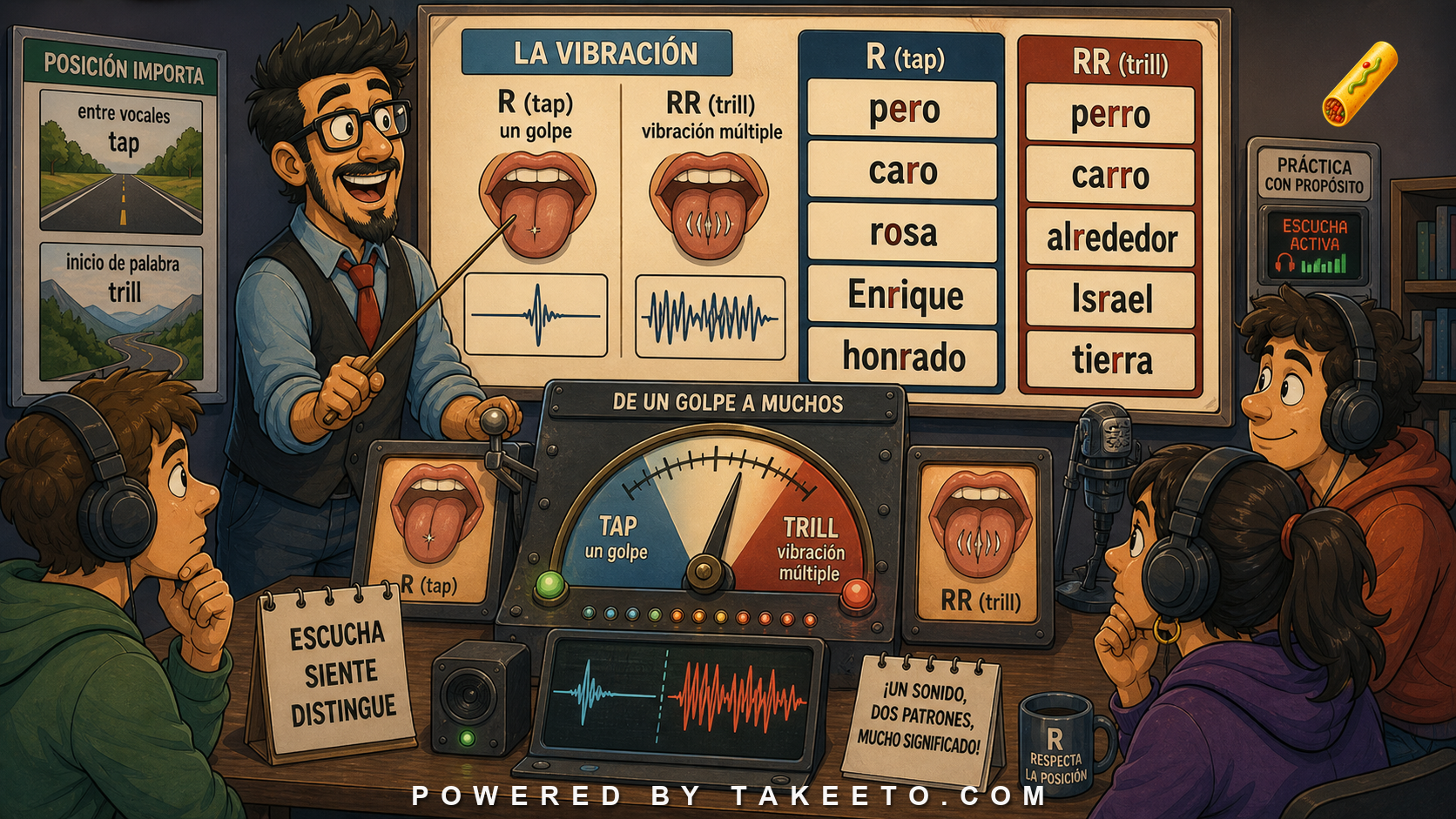
- A tap, as in pero.
- A trill, as in perro.
These sounds can distinguish words. That means the difference is not ornamental.
| Tap | Trill | Meaning contrast |
|---|---|---|
| pero | perro | but / dog |
| caro | carro | expensive / car, cart |
| coro | corro | choir / I run |
A better rule is:
Spanish has a single-tap r and a trilled rr; spelling tells you where each belongs.
The tap
The Spanish tap is a quick contact of the tongue tip against the alveolar ridge, the area just behind the upper teeth.
It is not the English r of most American or British varieties. For many English speakers, the closest familiar sound is the quick middle consonant in American English butter or ladder, depending on accent. That sound is not identical in all details, but it gives a useful physical starting point: a quick flap/tap, not a sustained English r.
Examples with tap:
- pero
- caro
- para
- mira
- ahora
- arena
In spelling, a single r between vowels usually represents the tap.
| Word | r sound |
|---|---|
| pero | tap |
| caro | tap |
| para | tap |
| mira | tap |
| toro | tap |
If you pronounce pero with a full trill, you may sound emphatic or produce a different word-like form. The tap matters.
The trill
The trill involves repeated vibration of the tongue tip against the alveolar ridge. Airflow and tongue position allow the tongue to flutter rapidly.
Examples with trill:
- perro
- carro
- tierra
- arriba
- Rosa
- alrededor
- Enrique
- honrado
In spelling, the trill appears as rr between vowels:
| Word | r sound |
|---|---|
| perro | trill |
| carro | trill |
| tierra | trill |
| arriba | trill |
| correr | trill in rr position |
But the trill is also written with a single r in certain positions.
Word-initial r is trilled
At the beginning of a word, written r represents the trill.
- rosa
- rápido
- río
- reloj
- rico
This is why Rosa does not begin with the tap of pero. It begins with the trill.
| Position | Spelling | Sound |
|---|---|---|
| between vowels | r | tap |
| between vowels | rr | trill |
| beginning of word | r | trill |
R after l, n, or s can be trilled
A single r can represent the trill after certain consonants when the r begins a new syllable or belongs to the onset after a preceding consonant.
Examples:
- alrededor
- Enrique
- Israel
- honrado
- subrayar in related spelling behavior
The key idea is that Spanish does not use rr after consonants in these positions. The spelling r is enough because the position itself calls for the trill.
| Word | Practical pronunciation |
|---|---|
| alrededor | al-re-de-dor, r trilled after l boundary |
| Enrique | En-ri-que, r trilled after n |
| Israel | Is-ra-el, r often trilled in standard careful pronunciation after s boundary |
| honrado | hon-ra-do, r trilled after n |
This is a major reason “single r = tap, double rr = trill” is incomplete. It is true only in the middle-between-vowels case.
The spelling boundary
The clearest contrast is between single r and rr between vowels:
| Tap | Trill |
|---|---|
| pero | perro |
| caro | carro |
| cero | cerro |
| para | parra |
| coro | corro |
Between vowels, the spelling must distinguish the sounds because both are possible.
At the beginning of a word, Spanish does not need rr because only the trill occurs there. That is why Spanish writes Rosa, not Rrosa.
After certain consonants, Spanish also uses single r for the trill.
Why duration is not the whole story
Learners sometimes think the difference is simply short r versus long r.
That is partly useful but incomplete. The tap and trill differ in articulation. A tap is one quick contact. A trill is repeated vibration. Making a tap longer does not automatically create a trill. It may just create an odd prolonged sound.
The right contrast is:
- tap: one contact
- trill: multiple contacts generated by airflow and tongue position
For comprehension, the contrast must be clear enough that pero and perro do not collapse.
Practice progression
Stage 1: master the tap first
Do not start with the trill if the tap is also wrong.
Practice:
- ara
- ere
- iri
- oro
- uru
- para
- pero
- caro
- mira
Aim for a quick, light contact. Avoid English r coloring.
Stage 2: use consonant clusters to approach the trill
Some learners find trills easier after consonants:
- tres
- grande
- pronto
- brazo
- crema
These are not all full trill contexts in the same phonemic sense, but they help place the tongue near the right area and prevent English r rounding.
Stage 3: trill in word-initial position
- Rosa
- rápido
- rico
- reloj
- río
Start with a gentle onset. Forcing tension often blocks the trill.
Stage 4: intervocalic rr
- perro
- carro
- tierra
- arriba
- correr
This is where the contrast with tap matters most.
Stage 5: minimal pairs
- pero / perro
- caro / carro
- coro / corro
- para / parra
Practice in sentences:
Pero el perro no corre.
El carro es caro.
El coro corre al teatro.
What if you cannot trill yet?
Do not panic. Many adult learners need time.
Prioritize three things:
- Do not use English r.
- Make the tap clear.
- Make trill contexts audibly stronger than tap contexts, even if the trill is imperfect.
A perfect trill is less urgent than avoiding total merger. If pero and perro sound identical, communication suffers. If your trill is not native-like but the contrast is clear, you are moving in the right direction.
Common learner mistakes
Mistake 1: Using English r everywhere
This affects both tap and trill contexts. Spanish r is made with the tongue tip near the alveolar ridge, not with the English approximant posture.
Mistake 2: Trilling every r
Pero should have a tap, not a full trill.
Mistake 3: Tapping word-initial r
Rosa begins with a trill in standard pronunciation, not the tap of pero.
Mistake 4: Writing rr at the beginning of words
Spanish writes r at the beginning even when the sound is trilled.
Mistake 5: Forcing the tongue
A trill needs airflow and relaxed positioning. Excess tension makes it harder.
Suggested interactive module: tap/trill animation
A useful tool for this article would combine mouth animation, waveform pulses, and spelling rules.
Suggested functions:
- Articulation animation: show tongue tap vs repeated trill.
- Spelling mode: classify r/rr by position.
- Minimal-pair audio: pero/perro, caro/carro.
- Recording feedback: detect English r coloring and lack of contrast.
- Practice ladder: tap drills, clusters, word-initial trills, intervocalic rr.
Example input:
alrededor
Possible output:
- Written r after l boundary
- Sound: trill, not tap
- Syllable guidance: al-re-de-dor
- Warning: do not write allrrededor or pronounce with English r
Final rule
Spanish r is not one problem. It is a system.
Between vowels, r is the tap and rr is the trill. At the beginning of a word, r is trilled. After certain consonants, a single r can also represent the trill.
Learn the tap, learn the trill, and above all learn the boundary between them. That boundary is the difference between pero and perro.