
The best review often begins with a mistake
A learner chooses preguntar ayuda when the target is pedir ayuda. The system can simply mark it wrong. Or it can learn something:
This learner is confusing request and question verbs.
That mistake should generate contrastive review:
pedir ayuda
preguntar la hora
pedir permiso
preguntar si hay permiso
The key principle:
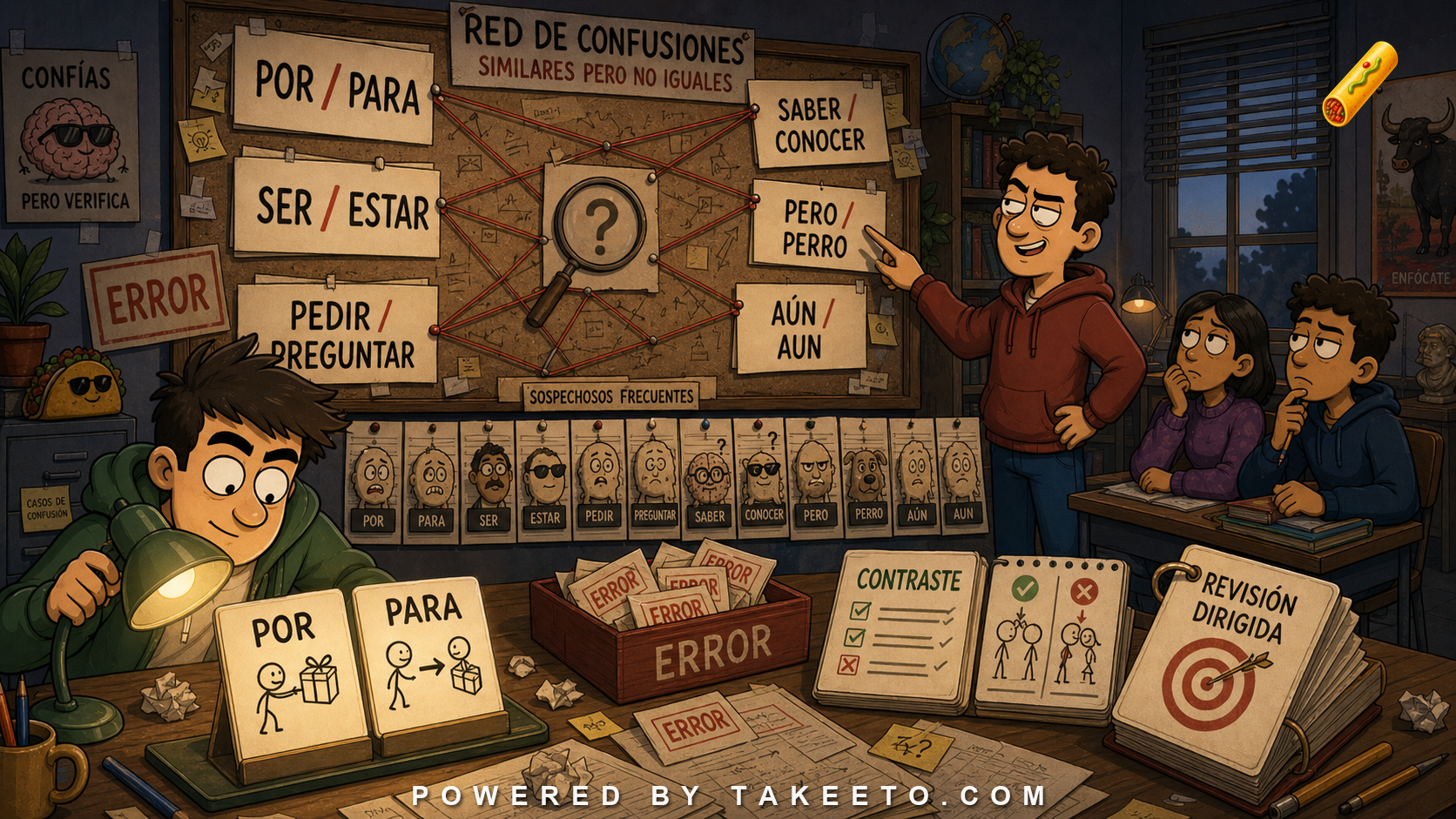
Mistakes identify neighborhoods of confusion. Review should target the neighborhood, not only the missed item.
Similar items cluster by type
Confusions can be grouped.
Grammar:
ser / estar
por / para
preterite / imperfect
indicative / subjunctive
Vocabulary:
pedir / preguntar
saber / conocer
llevar / traer
mirar / ver
Pronunciation:
pero / perro
caro / carro
papa / papá
Orthography:
aún / aun
sí / si
él / el
hablo / habló
Register:
pedir / solicitar
empezar / iniciar
ayuda / asistencia / auxilio
Each cluster requires a different review design.
Do not show similar items too early
There is a danger: contrastive review can overwhelm beginners if used before either item is stable.
If a learner has just met ser, immediately contrasting ten uses of estar may confuse them. But once both forms are familiar, contrast is essential.
A good system stages contrast:
- Learn item A in clear examples.
- Learn item B in clear examples.
- Recognize both separately.
- Contrast A/B in paired examples.
- Retrieve A/B in mixed practice.
- Use both in writing.
Timing matters.
Wrong answers are data
Multiple-choice distractors can reveal confusion.
Prompt:
I asked for help.
Correct:
Pedí ayuda.
Wrong chosen:
Pregunté ayuda.
The wrong answer is not random. It indicates English ask interference. The next review should include pedir/preguntar, not merely repeat pedir alone.
For pronunciation, a learner who confuses pero and perro needs an audio contrast, not a dictionary definition.
For orthography, a learner who writes hablo for habló needs stress/accent review.
Contrast cards should be compact
A contrast card should not become a textbook page. It should show the boundary quickly.
Example:
pedir = ask for something
preguntar = ask a question
Then paired examples:
Pedí ayuda.
Pregunté la hora.
Then a retrieval prompt:
I asked if there was help available.
Pregunté si había ayuda disponible.
I asked for help.
Pedí ayuda.
The learner practices the boundary.
Build confusion networks
Over time, a learner's mistakes form a network. One learner may confuse por/para constantly. Another may confuse accent marks. Another may confuse formal and informal requests.
A good review system can detect repeated edges:
pedir ↔ preguntar
ser ↔ estar
aún ↔ aun
pero ↔ perro
These edges should influence future exams and passages.
Contrastive review should not create false equivalence
Putting two items side by side can imply they are equally common, equally appropriate, or interchangeable except for one neat difference. That is not always true. Solicitar and pedir overlap, but solicitar is more formal and institutional. Aún and aun are not merely accent/no-accent twins; they occupy different semantic and prosodic territory. Coger may be ordinary in Spain and risky in parts of Latin America.
A contrast set should therefore include frequency, register, and region when relevant. The learner needs to know not only how items differ, but where each item belongs. Contrast without usage context can create overcorrection.
A good contrast card answers three questions: What is the meaning difference? Where is each form natural? What mistake was I likely to make?
Example bank walkthrough
por/para
Classic preposition contrast.
Learner action: review with paired contexts and production prompts.
ser/estar
Classification/state contrast with many subcases.
Learner action: avoid permanent/temporary slogans.
pedir/preguntar
Request vs question.
Learner action: treat English “ask” as danger signal.
saber/conocer
Knowledge/familiarity contrast.
Learner action: practice with facts, skills, people, places, and preterite forms.
pero/perro
Pronunciation contrast.
Learner action: use audio minimal pairs.
aún/aun
Orthographic and meaning contrast.
Learner action: learn aún as “still/yet” in many contexts; aun as “even” in concessive contexts, with nuance.
When contrast becomes clutter
Contrastive review is powerful, but too many contrasts at once can create new confusion. A learner who misses por should not immediately receive a giant page comparing por, para, durante, a causa de, debido a, mediante, and a través de.
Good remediation is narrow:
- Identify the actual mistaken neighbor.
- Build a two- or three-item contrast.
- Practice in clear contexts.
- Expand only after success.
Contrast should clarify the edge that failed. If the learner's error was pedir/preguntar, do not turn the review into every Spanish speech verb. Start with the boundary that caused the mistake.
Remediation notes: contrastive review should be timed carefully
The repair for similar and mistaken items is to avoid dumping confusables on learners too early. Contrast is powerful after the learner has at least a rough representation of each item. If a beginner has barely learned por, introducing every por/para contrast immediately can create fog rather than clarity. Contrastive review should arrive when confusion is likely and useful, not before the learner has anything to contrast.
Mistakes cluster by cause. Some clusters are semantic: saber/conocer, pedir/preguntar, llevar/traer. Some are grammatical: preterite/imperfect, ser/estar, subjunctive/indicative. Some are phonological: pero/perro, papa/papá, casa/caza in distinction varieties. Some are register-based: pedir/solicitar/requerir, hola/estimado, perdón/disculpe/lo siento. A good review system should not treat all similarity as one category.
The article should add mistake provenance. Did the learner choose the wrong item in a multiple-choice quiz? Type the wrong Spanish in reverse translation? Mishear audio? Use the wrong register in writing? Tap the glossary repeatedly? Each signal points to a different repair. Similarity is not enough; the system needs to know what kind of mistake occurred.
Contrast sets should remain small. Three to five items are often enough. A giant page of every possible confusable creates overload. For pedir/preguntar/solicitar, a strong set can show: pedir ayuda, preguntar la hora, solicitar información, then ask the learner to classify request, question, and formal request.
The remediation loop should end in production. Recognition contrast is useful, but the learner eventually needs to write or say the form without a warning label. After contrast drills, use mixed prompts inside real sentences and passages.
Production target: create contrast sets from actual learner errors, label the error cause, keep the set small, and schedule it after a delay. The best contrastive review feels like a precise repair, not a punishment for forgetting.
Suggested interactive module: confusion network graph
A strong tool for this article would turn errors into targeted contrast.
Suggested functions:
- Mistake capture: record wrong answer chosen or produced.
- Similarity edge: connect mistaken item to target item.
- Cluster type: grammar, vocabulary, pronunciation, orthography, register.
- Contrast card generator: brief distinction plus paired examples.
- Mixed retrieval: test both items together.
- Passage injection: include both items in future reading.
- Graph view: show learner's strongest confusion clusters.
- Resolved status: edge weakens after repeated success.
Final rule
A missed Spanish item rarely lives alone.
Use mistakes to find confusable neighbors, then design contrastive review. The goal is not to repeat the same card louder; it is to clarify the boundary that caused the error.