Bigger can mean worse, better, stronger, or just bigger
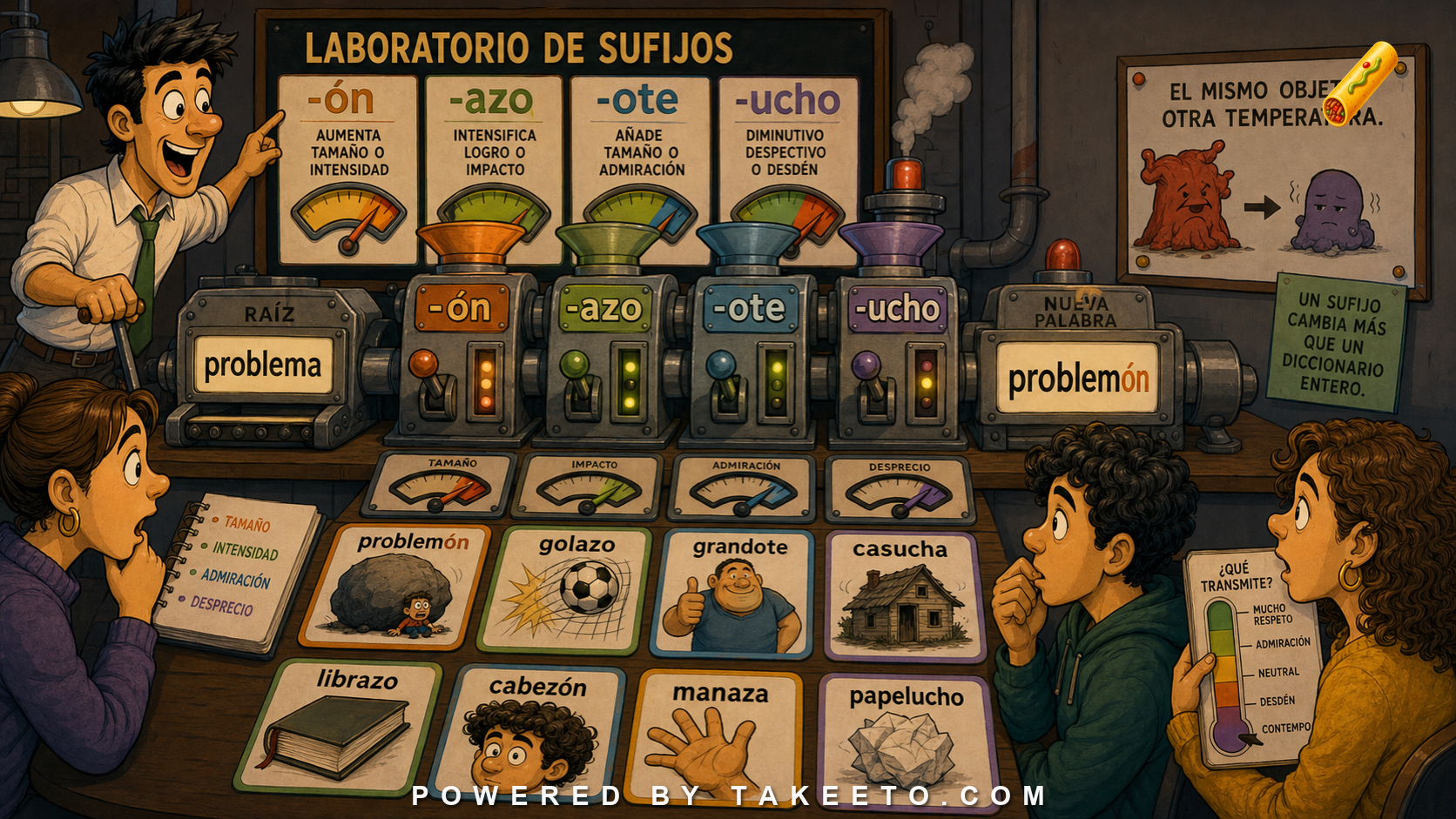
Spanish evaluative suffixes do not stop at diminutives. They also create augmentatives and pejoratives: forms that suggest largeness, intensity, force, admiration, roughness, contempt, or emotional stance.
problema → problemón
a big/serious problem
gol → golazo
a great goal
casa → casucha
a shabby house
papel → papelucho
a worthless or poor-quality paper/document
These forms are not merely size labels. A golazo is not just a large goal. It is an excellent, impressive goal. A casucha is not just a small or large house; it is a bad, poor, shabby one. A problemón is a major problem, not necessarily a physically large problem.
The practical rule:
Augmentative and pejorative suffixes mark stance toward the noun: size, intensity, admiration, contempt, or social evaluation.
-ón/-ona: size, intensity, trait, and lexicalization
The suffix -ón/-ona is one of the most common augmentative or evaluative suffixes.
problema → problemón
huge/serious problem
cabeza → cabezón
big-headed, stubborn, or a person with a big head depending on context
hombre → hombrón
big/strong man, sometimes admiring
noticia → notición
big news / major news
The meaning depends heavily on the base word and context. -ón can express:
- physical largeness;
- intensity;
- abundance;
- a prominent trait;
- admiration;
- mockery;
- lexicalized meaning.
Examples:
Es un problemón.
It is a huge problem.
Es muy cabezón.
He is very stubborn / big-headed.
Fue un notición.
It was huge news.
Many -ón words are lexicalized. Ratón is not normally felt as a spontaneous augmentative of rata in everyday speech. Camión is not “big cama.” Learners should not analyze every -ón word as currently augmentative.
-azo/-aza: blow, impact, excellence, event
-Azo/-aza is highly productive and expressive.
It can mean a blow or strike:
martillo → martillazo
hammer blow
puerta → portazo
door slam
mano → manotazo
slap/swipe with the hand
It can mean an excellent or impressive example:
gol → golazo
amazing goal
libro → librazo
great book
película → peliculón is also possible with another suffix; peliculaza can mean great movie in colloquial style.
It can mean sudden event or impact:
frenazo
sudden braking
telefonazo
phone call, often sudden/important depending on context
It can also be negative or violent depending on word:
balazo
gunshot
golpe → golpazo
big hit/blow
Because -azo is expressive, it is common in sports, journalism, conversation, and colloquial evaluation. It may be too informal for neutral academic prose unless the word is lexicalized or quoted.
-ote/-ota: big, rough, affectionate, sometimes clumsy
-Ote/-ota can express largeness, roughness, affection, or mild pejoration.
grande → grandote
big, biggish, hefty
animal → animalote
big animal, sometimes affectionate
casa → casota
big house, often colloquial
libro → librote
big book, perhaps heavy or unwieldy
The tone can be warm or mocking:
Es un perrote.
It is a big dog, possibly affectionate.
Qué librote.
What a huge book, possibly impressed or annoyed.
This suffix is strongly context-dependent. It may sound colloquial, rustic, playful, affectionate, or dismissive depending on speaker and region.
-ucho/-ucha: pejorative force
-Ucho/-ucha often has a negative or contemptuous flavor.
casa → casucha
shabby house
papel → papelucho
worthless paper/document
cuarto → cuartucho
miserable little room
pueblo → pueblucho
lousy little town, contemptuous
This is not a neutral suffix. It can insult. It can express disdain for quality, condition, importance, or social status.
Compare:
una casa pequeña
a small house, neutral
una casita
a little house, possibly affectionate
una casucha
a shabby/lousy house
The suffix does important pragmatic work.
-aco/-aca and other pejoratives
Other suffixes can carry negative, rough, or colloquial evaluations.
libraco
big/tedious book, often negative or jocular
pajarraco
big ugly bird, or shady person metaphorically depending on context
tiparraco
nasty guy / unpleasant man
Meanings are lexical and regional. Some words are playful; others are insulting. Learners should treat pejorative suffixes as high-risk in active use until they have strong local awareness.
Positive augmentatives
Not all augmentatives are negative. Spanish uses them for admiration:
golazo
fantastic goal
librazo
excellent book
planazo
great plan
cuerpazo
great body, often colloquial and potentially objectifying depending on context
artistazo
great artist
The same suffix -azo can praise or intensify. The base word and social context decide the effect.
Compare:
problemazo
big problem, usually negative
golazo
great goal, positive
cochazo
impressive car, often positive or admiring
This is why “augmentative” is too narrow as a semantic label. These are evaluative suffixes.
Lexicalized meanings
Many words that look like augmentatives or pejoratives have become ordinary lexical items.
sillón
armchair, not just a big chair in current ordinary meaning
portazo
door slam, a lexicalized event noun
manaza
large hand or clumsy hand/person depending on context
cabezón
stubborn or big-headed person/adjective, not just “big head” compositional meaning
Learners should ask whether a form is productive or lexicalized.
A productive form is created on the spot:
problemón
huge problem
A lexicalized form has a dictionary-like stable meaning:
sillón
armchair
Both are real. They just behave differently.
Gender and agreement
Evaluative suffixes often create nouns or adjectives with gender patterns that may differ from the base or depend on the referent.
el problema → el problemón
masculine because problema is masculine and the derived noun is masculine
la casa → la casucha
feminine
un hombre cabezón
masculine adjective
una mujer cabezona
feminine adjective
Some forms have fixed gender as lexical nouns. Always check the actual word.
Register and risk
These suffixes are expressive. That makes them useful in conversation, journalism, sports commentary, reviews, and informal writing. It also makes them risky in formal contexts.
A sports headline might say:
Golazo de Messi.
Amazing goal by Messi.
A formal match report might use:
un excelente gol
A friend might say:
Tengo un problemón.
A formal email might say:
Tenemos un problema grave.
A speaker might say jokingly:
Vivo en una casucha.
But saying that about someone else’s home could be insulting.
Translation difficulty
English often lacks a single suffix equivalent. Translation depends on context:
| Spanish | Possible English |
|---|---|
| problemón | huge problem, serious problem, major headache |
| golazo | amazing goal, world-class goal, brilliant strike |
| grandote | big, hefty, biggish, big old... |
| casucha | shack, dump, shabby house |
| papelucho | worthless paper, rag, lousy document |
| librazo | great book, fantastic read |
The suffix carries tone that English may need an adjective, noun choice, or idiom to express.
Common learner errors
Error 1: Treating augmentatives as only physical size
Golazo is not a large goal. It is an excellent or impressive goal.
Error 2: Using pejoratives casually with people
Words like tiparraco, feúcho, pueblucho, or casucha can insult. Passive recognition should come before active use.
Error 3: Overgeneralizing suffixes
Not every base accepts every suffix naturally. Check real usage.
Error 4: Missing lexicalized meanings
Sillón means armchair. Do not translate it as “big chair” every time.
Error 5: Using colloquial suffixes in formal prose
In formal contexts, prefer:
problema grave
excelente gol
vivienda deteriorada
documento de baja calidad
unless the expressive form is intentionally quoted or stylistically appropriate.
Diagnostic workflow: identify stance before translating
When reading an augmentative or pejorative, do not translate the suffix mechanically as “big.” Ask what stance the suffix adds.
problemón
not a physically large problem, but a serious or major problem
golazo
not a large goal, but an excellent or spectacular goal
casucha
not merely a small house, but a shabby or contemptible house
papelucho
a poor-quality or worthless paper/document
A four-question workflow helps:
- Is the form lexicalized? Sillón means armchair; do not overanalyze it as “big chair.”
- Is the tone positive? Golazo, librazo, planazo often praise.
- Is the tone negative? Casucha, papelucho, tiparraco often disparage.
- Is the tone playful or affectionate? Grandote, perrote may be warm in context.
For translation, choose an English phrase that preserves stance:
| Spanish | Weak translation | Better contextual translation |
|---|---|---|
| problemón | big problem | serious problem / huge headache |
| golazo | big goal | brilliant goal / amazing strike |
| casucha | little house | dump / shabby house |
| librazo | big book | fantastic book |
For active use, respect register. These suffixes are common in speech, reviews, headlines, and storytelling, but they may sound too colloquial or too judgmental in formal documents. A workplace report should probably say problema grave rather than problemón unless the tone is intentionally informal.
Finally, remember that pejoratives can insult people and places. Passive understanding can be broad; active use should be cautious. Evaluative morphology is socially loaded.
Live suffix or lexicalized word?
When you see -ón, -azo, -ote, -ucho, ask whether the suffix is still live in the speaker’s meaning or whether the word has become lexicalized.
A live suffix is easy to feel:
problema → problemón
a problem → a huge problem
gol → golazo
goal → amazing goal
casa → casucha
house → shabby/lousy house
The base word and the suffix meaning are both visible. You can feel the evaluation.
A lexicalized word is different:
ratón
mouse
sillón
armchair
buzón
mailbox
Modern speakers do not normally interpret these as “big rat,” “big chair,” or “big mailbox” in ordinary use. The suffix shape is historically or morphologically interesting, but the word is stored as a normal lexical item.
Some words sit in the middle. Cabezón can mean someone with a big head, but it can also mean stubborn. Manaza can refer to a large hand or clumsiness. Librazo can mean a great book or, in some contexts, a big/heavy book. The suffix remains interpretable, but the meaning is partly conventional.
Use this three-part reading test:
- Can I identify a base word clearly?
- Does the suffix add size, intensity, admiration, blow, or contempt in this context?
- Is the resulting meaning predictable, or has it become a dictionary word with its own meaning?
This test keeps learners from overtranslating. Portazo is not an impressive door; it is a door slam. Golazo is not a large goal; it is an excellent goal. Cinturón is not an augmentative you should analyze during normal reading; it is simply “belt.”
Gender shifts and suffix expectations
Evaluative suffixes can also affect gender expectations. A base noun may produce a derived form with a conventional gender that learners should verify rather than guess mechanically.
la noticia → el notición
the news item → huge news / major story
la mano → la manaza
big/clumsy hand
la casa → el caserón / la casucha
large old house / shabby house
The suffix does not merely attach sound; it creates a new lexical item with its own gender, tone, and distribution. For active use, learn common derived words with their article: el problemón, el golazo, la casucha, el papelucho. The article is part of knowing the word.
Applied contrast: positive and negative force can flip
The same suffix can praise or criticize depending on the base and context. -Azo in golazo praises; porrazo describes a hard fall or blow. -Ón in problemón warns; comilón may tease; cabezón may insult or affectionately describe stubbornness. This flexibility is why suffixes should be learned with examples, not one-word definitions.
Tone, speaker relationship, and genre decide whether the result sounds admiring, comic, affectionate, or harsh.
Contrast lab: neutral adjective, augmentative, pejorative
Compare three ways to describe a house:
una casa grande
a large house
una casota
a big house, colloquial and possibly admiring or playful
una casucha
a shabby/lousy house
The suffix changes stance more than objective size. Now compare books:
un libro largo
a long book
un librazo
a great book, colloquial praise
un libraco
a big or tedious book, often jocular or negative depending on context
The same base can move in different evaluative directions. A learner who translates all of these as “big” loses the speaker’s attitude.
For active writing, choose a neutral paraphrase when the expressive suffix would be too informal:
problemón → problema grave
golazo → gol excelente / gol espectacular
casucha → vivienda precaria / casa deteriorada
papelucho → documento de escaso valor
The expressive form may be better in dialogue, reviews, headlines, and social media. The paraphrase may be better in academic, administrative, or professional writing.
V2 remediation refinement: expressive suffixes can become ordinary vocabulary
Augmentatives and pejoratives begin as evaluative morphology, but many words become lexicalized. Once that happens, the suffix is visible without being fully compositional.
Compare a live evaluative form:
problemón
a huge/serious problem
with a lexicalized or semi-lexicalized form:
sillón
armchair, not simply “big chair” in ordinary use
buzón
mailbox, not a transparent “big buzo” or live augmentative for learners
-Azo is especially polyfunctional:
golazo
great goal
portazo
door slam
martillazo
blow with a hammer
The suffix may praise, intensify, or name an impact event. Translation must follow the lexicalized meaning, not the suffix alone.
Gender can also surprise learners. A suffix may change the word’s gender or create a noun with its own lexical behavior:
la mano → la manaza
big hand
la cabeza → el cabezón / la cabezona
big-headed/stubborn person; also adjective-like in use
Pejoratives require the most caution. Casucha, papelucho, medicucho, and similar words can insult not just the object but the person associated with it. In professional or academic prose, neutral paraphrases are often safer:
una vivienda deteriorada
un documento de escaso valor
un médico incompetente, if that is truly the claim and can be supported
The remediation habit is to classify each form twice:
- Is the suffix live, lexicalized, or somewhere between?
- Is the stance admiring, affectionate, comic, contemptuous, or simply descriptive?
Only after those two decisions should you translate. Spanish expressive morphology is compact, but it is not vague. It packs stance, register, and lexical history into a single word.
Suggested interactive module: suffix stance map
A useful tool would map suffixes by tone rather than by size alone.
Suggested functions:
- Suffix classifier: -ón, -azo, -ote, -ucho, -aco.
- Tone map: positive, neutral, affectionate, intense, negative, contemptuous.
- Register warning: colloquial, sports/journalistic, insulting, formal alternative.
- Lexicalization flag: sillón, portazo, cabezón.
- Translation helper: offers English phrases instead of one-word equivalents.
Example input:
casucha
Output:
Pejorative: shabby house, dump, poor-quality house. Use carefully; it can insult.
Final rule
Spanish augmentatives and pejoratives are evaluative morphology. -ón can mark size or intensity. -azo can mark impact, blow, or admiration. -ote often sounds big, rough, or affectionate. -ucho is usually pejorative.
Do not translate these suffixes as “big” every time. Ask what stance the speaker is taking: admiration, seriousness, affection, ridicule, contempt, or emphasis.