
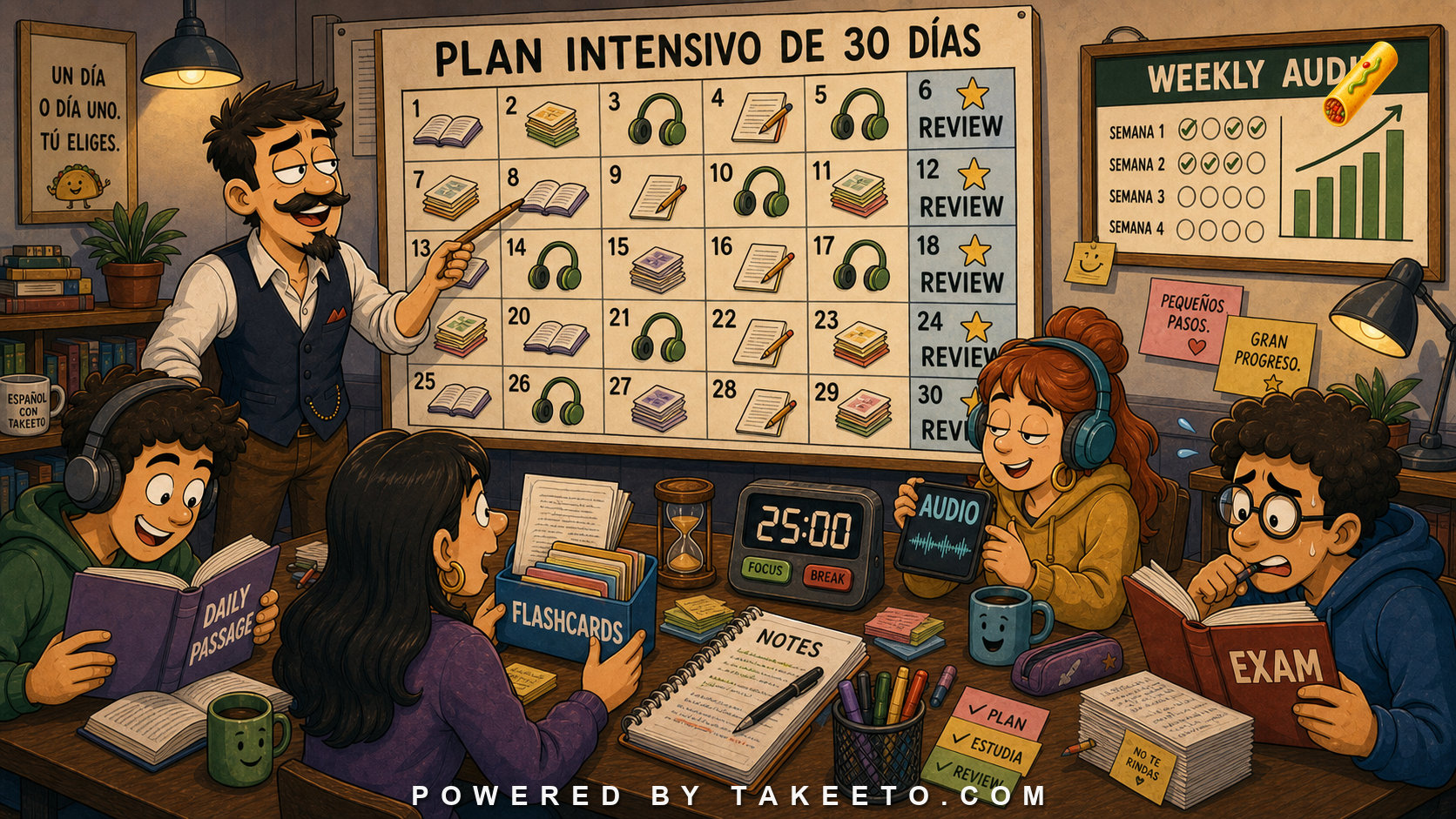
Thirty days is enough to build a system
Thirty days is not enough to “finish” Spanish. It is not enough to become broadly fluent if you are starting from scratch. It is not enough to solve every problem with tense, mood, listening, reading speed, pronunciation, and register.
But thirty days is enough to build a serious study system.
That distinction matters. Many learners fail because they start with an emotional goal rather than an operating rhythm. They say, “I want to speak Spanish,” “I want to understand native speakers,” or “I want to stop being intermediate.” Those goals are real, but they do not tell the learner what to do today. A useful plan must turn ambition into repeated contact with Spanish: reading, listening, retrieval, correction, re-reading, and review.
A Takeeto-style routine should not be built around one heroic session. It should be built around daily loops.
The key principle is:
A thirty-day Spanish plan should train contact, recovery, and review before it promises transformation.
You are not trying to prove that you can study hard once. You are trying to prove that you can return to Spanish every day, notice what breaks, and repair it.
The daily core
Every day should include four forms of contact:
- a Spanish passage,
- flashcard review,
- audio listening,
- a small exam or retrieval check.
These are not interchangeable. Each one teaches something different.
A passage gives context. It shows words inside grammar, grammar inside discourse, and discourse inside a communicative situation. Flashcards force retrieval. They reveal whether you can recall a word, phrase, conjugation, or meaning without the comfort of a paragraph. Audio adds sound, timing, stress, reduction, and rhythm. An exam or review check gives accountability: it separates “I recognized this when I saw it” from “I can produce or identify it under pressure.”
A weak routine does one of these and calls it study. A serious routine connects them.
Daily sequence:
- Read the passage first. Do not begin with isolated cards if the deck has a passage. Let context prime meaning.
- Listen to the passage slowly or clearly. Mark stress, pauses, and words that disappear in speech.
- Review the flashcards. Retrieve words and expressions after seeing them in context.
- Listen again at natural speed. Now the same Spanish should sound less opaque.
- Take a short exam. Translation, reverse translation, image recall, or form recognition all expose different weaknesses.
- Log one mistake. Do not write a diary. Write a repair target.
A daily routine can be short, but it should be complete. Twenty-five focused minutes using all four modes is better than ninety minutes of passive browsing.
A 45-minute daily version
For many adult learners, forty-five minutes is realistic. The routine below assumes serious but not full-time study.
| Time | Task | Purpose |
|---|---|---|
| 5 minutes | Re-read yesterday's notes | Keep errors alive long enough to repair them |
| 10 minutes | Read today's passage | See new and review items in context |
| 8 minutes | Listen to passage audio | Connect text to sound |
| 12 minutes | Flashcard review | Retrieve forms and meanings |
| 5 minutes | Mini-exam | Test recognition or production |
| 5 minutes | Error log | Record one to three useful failures |
The last five minutes are easy to skip. Do not skip them. The error log is where studying becomes instruction. Without it, each day resets emotionally. With it, patterns emerge.
A useful error log entry is small:
Mistake: I translated “I realized” as realicé.
Repair: Use me di cuenta de que... for “I realized that...”
Next check: Make three sentences with darse cuenta de que.
That is better than writing:
I need to improve vocabulary.
The second note is vague. The first note can change tomorrow's study.
A 90-minute daily version
Some learners want a heavier plan. A ninety-minute version can work if it remains sustainable.
A good extended session has two halves. The first half is contact and comprehension. The second half is retrieval and repair.
First half:
- Read a new passage.
- Listen slowly.
- Annotate unknown grammar.
- Read the English translation or support notes only after trying the Spanish.
- Listen again without looking.
Second half:
- Review cards from today's deck.
- Review due cards from older decks.
- Take a short mixed exam.
- Write five original Spanish sentences using focus items.
- Audit the sentences for one grammar target.
- Record yourself reading one paragraph aloud.
This is demanding. Do not start here if it makes you quit by day four. The best plan is the one you can actually repeat.
Week 1: establish the loop
The first week should not be a performance test. It should be a setup week.
Goals:
- learn the interface,
- understand the daily sequence,
- identify your baseline errors,
- set a realistic session length,
- create an error log,
- choose a primary pronunciation model or audio source if relevant.
Do not chase volume in week one. The main task is to make the loop automatic.
A week-one learner should ask:
Can I read, listen, review, test, and log an error every day without negotiating with myself?
The first week should also include a baseline writing sample. Write one short paragraph in Spanish about a familiar topic: your work, your day, your city, a book, a class, a problem you solved. Do not over-polish it. Save it. You will audit it later.
Example baseline paragraph:
Vivo en una ciudad grande y estudio español porque quiero leer mejor y hablar con más seguridad. A veces entiendo las palabras, pero me cuesta seguir las frases largas. Este mes quiero mejorar mi lectura, mi pronunciación y mi forma de revisar errores.
The paragraph does not need to be advanced. It creates evidence.
Week 2: add a grammar focus
The second week should add one weekly grammar target. Not ten. One.
Possible targets:
- gender and agreement,
- present tense endings,
- preterite versus imperfect,
- subjunctive triggers,
- object pronouns,
- ser and estar,
- por and para,
- se constructions,
- connectors,
- prepositional patterns.
Choose the target that appears in your errors, not the one that looks impressive.
A weekly grammar focus changes how you read. If the target is agreement, every noun phrase becomes evidence:
el problema grave
una decisión importante
los datos recientes
las consecuencias económicas
If the target is preterite/imperfect, every narrative sentence becomes a contrast:
Cuando era niño, vivía en Lima.
Ayer leí el informe y escribí un resumen.
The goal is not to memorize a rule in isolation. The goal is to see the rule repeatedly in passages, hear it in audio, retrieve it in cards, and notice it in your own output.
Week 3: increase passage re-reading
By week three, the temptation is to consume more and more new material. Newness feels productive. Re-reading feels slow. Serious learners should resist that temptation.
Re-reading is where speed and depth improve.
A passage you read on day one should return on day three, day seven, and day fourteen. The first reading is comprehension. The second reading is structure. The third reading is fluency. The fourth reading is proof that Spanish that once felt dense has become ordinary.
A week-three routine should add one re-reading slot per day:
- read one new passage,
- re-read one old passage,
- listen to one old passage without text,
- review due cards,
- take a mixed exam.
During re-reading, ask different questions:
- Where are the finite verbs?
- What does each pronoun refer to?
- Which connectors structure the argument?
- Which words are repeated as a theme chain?
- Which sentence would I have translated too literally?
A learner who only reads new texts gets exposure. A learner who re-reads strategically gets command.
Week 4: consolidate and audit
The fourth week should consolidate. This is not the time to double the workload. It is the time to see whether the system has changed your Spanish behavior.
Tasks for week four:
- re-read the first week's passages,
- retake older exams,
- review the error log,
- rewrite the baseline paragraph,
- record a reading sample,
- identify the next thirty-day focus.
The rewrite is especially important.
Original version might say:
Estudio español porque quiero hablar más bueno y entender personas nativas.
A later version might say:
Estudio español porque quiero hablar con más naturalidad y entender mejor a los hablantes nativos.
The improvement is not only “more correct.” It shows better collocation: hablar con naturalidad, entender a los hablantes, mejor placed naturally.
A thirty-day plan should produce visible repair.
The weekly audit
Once a week, stop adding new material and audit.
A weekly audit asks five questions:
- What did I repeatedly misunderstand?
- What did I recognize but fail to produce?
- Which cards felt easy only because the answer was familiar?
- Which audio remained unclear even after reading?
- Which grammar target deserves another week?
Do not use the audit to punish yourself. Use it to steer.
A strong audit produces a short list:
| Pattern | Evidence | Next action |
|---|---|---|
| Confusing por and para | 6 card errors, 2 writing errors | Build 10 contrast sentences |
| Missing final stress | Audio recording sounded flat | Practice words ending in consonants |
| Overusing muy | Writing sounded repetitive | Add bastante, sumamente, poco, stronger nouns |
| Translating “make a decision” literally | Wrote hacer una decisión | Practice tomar una decisión |
The goal is diagnosis, not guilt.
Note-taking that actually helps
Most language notes become graveyards. A learner writes something down, feels responsible, and never returns to it.
Good notes must be short, reusable, and testable.
Weak note:
Subjunctive is hard.
Better note:
After es importante que, use subjunctive: Es importante que revises los ejemplos. Make 5 examples tomorrow.
Weak note:
Spanish has different words for English “for.”
Better note:
para = destination/purpose/deadline in today's examples: para mañana, para estudiar, salir para Madrid. Review against por Friday.
A thirty-day plan needs a small note system. It does not need a beautiful note system. Ugly notes that create retrieval are better than polished notes that never come back.
Realistic outcomes after thirty days
A serious learner can expect several real outcomes after thirty days:
- faster passage reading,
- better tolerance for long sentences,
- more reliable recognition of recurring grammar,
- stronger recall of deck items,
- clearer sense of personal error patterns,
- better listening alignment for studied passages,
- improved confidence around review and exams,
- a usable plan for the next month.
A learner should not expect complete fluency, perfect conversation, native-like listening, or permanent mastery of all reviewed items. Overpromising damages motivation. The serious promise is better:
After thirty days, Spanish should feel less like a wall and more like a system you can work on.
That is worth more than a fantasy.
Example bank walkthrough
Daily passage
A daily passage provides context before retrieval.
Learner action: read the passage before flashcards whenever possible.
Flashcards
Flashcards test recall and recognition.
Learner action: mark cards that feel familiar but fail in production.
Audio
Audio connects written Spanish to stress, rhythm, pronunciation, and reduction.
Learner action: listen once with text and once without text.
Exam
An exam reveals whether study has produced retrievable knowledge.
Learner action: treat mistakes as routing information, not failure.
Review
Review is how knowledge survives beyond the session.
Learner action: never let new content crowd out due review.
Notes
Notes should capture repair targets.
Learner action: write notes as future tasks, not vague observations.
Weekly audit
The weekly audit turns scattered mistakes into a plan.
Learner action: identify patterns and choose one grammar or listening focus for the next week.
30-day plan structure
A simple thirty-day calendar:
- Days 1–3: establish routine, create error log, complete baseline writing.
- Days 4–7: stabilize daily passage-card-audio-exam loop.
- Day 7: first weekly audit.
- Days 8–14: add one grammar focus.
- Day 14: re-read week-one passages and audit errors.
- Days 15–21: increase old-passage re-reading and mixed review.
- Day 21: record reading sample and compare to first week.
- Days 22–27: consolidate weak categories.
- Day 28: rewrite baseline paragraph.
- Days 29–30: retake older exams, choose next 30-day focus.
Remediation pass: turn a calendar into a feedback machine
The most common failure in a thirty-day language plan is not laziness. It is weak feedback design. The learner makes a beautiful calendar, completes a few visible tasks, and then discovers that the tasks do not tell them what to repair. They read, but do not know what they misread. They review cards, but do not know which mistakes are structural. They listen, but cannot name the reduction, accent, or phrase boundary that blocked comprehension. They take a quiz, but treat the score as a mood signal rather than diagnostic information.
A Takeeto-style thirty-day plan should therefore be built as a feedback machine. Every day should produce three things:
- contact evidence — what Spanish the learner actually touched;
- failure evidence — what broke under reading, listening, recall, or production;
- repair evidence — what the learner changed because of that failure.
Without contact evidence, the learner is guessing about effort. Without failure evidence, the learner is guessing about weakness. Without repair evidence, the learner is repeating exposure without instruction.
A weak daily log says:
Studied lesson 14. Did flashcards. Listening was hard.
A stronger daily log says:
Passage: service-email Spanish.
Listening failure: missed se le enviará because I expected active le enviaremos.
Retrieval failure: confused solicitar with pedir in a formal context.
Repair: add contrast note pedir = everyday/request; solicitar = formal/request/application; reread passage tomorrow and highlight passive/impersonal forms.
The second note is not longer because the learner is more virtuous. It is better because it creates tomorrow’s study.
The three levels of a thirty-day plan
A thirty-day plan should work on three levels at once.
The first level is daily execution. This is the visible routine: read a passage, listen to audio, review cards, take an exam, log mistakes. The daily level creates continuity. It prevents the learner from drifting.
The second level is weekly consolidation. This is where the learner looks for patterns. One bad answer on por may be random. Seven errors involving cause, destination, exchange, and duration are a pattern. One missed reduced para may be a listening accident. Repeatedly missing pa, weakened final s, and fast está tells the learner that connected speech needs its own work.
The third level is monthly direction. At the end of thirty days, the learner should not ask only, “Did I finish?” They should ask, “What is now easier, what is still fragile, and what should the next thirty days target?” A real plan ends by producing the next plan.
These levels can be written as a simple loop:
Daily contact creates data.
Weekly review turns data into patterns.
Monthly reflection turns patterns into strategy.
If a thirty-day plan does not generate strategy, it is only a habit tracker.
Four learner profiles and how the plan changes
The same calendar should not be used blindly by every learner.
The false beginner knows greetings, present-tense forms, and common phrases, but has unstable grammar. This learner should keep passage length short and error logs concrete. The daily repair target should usually be one of these: agreement, verb form, pronoun reference, preposition, or listening segmentation.
Example repair:
Wrong: La problema es grande.
Repair: el problema is masculine despite ending in -a. Add to noun-gender exception set.
The intermediate plateau learner recognizes much but parses slowly. This learner should emphasize re-reading, sentence bracketing, connectors, and domain passages. Their daily work should include at least one structural annotation: main verb, subordinate clause, reference chain, or connector function.
Example repair:
Problem: I understood the words in sin embargo, dicha medida no se aplicará but missed the contrast and reference.
Repair: Mark sin embargo as contrast and tie dicha medida to the previous sentence.
The heritage learner may have strong listening or family-domain fluency but weaker formal writing, accent marks, academic vocabulary, and metalinguistic labels. This learner should not use the plan as a correction campaign against their home Spanish. The plan should build additional registers: formal email, academic paragraph, standard orthography, and explicit grammar vocabulary.
Example repair:
Home-register sentence: Me dijo que no había nada que hacer.
Formal rewrite: Se me informó que no existían opciones disponibles en ese momento.
The professional reader or translator needs precision under domain pressure. This learner should include legal, medical, technical, academic, or administrative passages early. Their error log should distinguish translation error, register error, term error, and source-structure error.
Example repair:
Term risk: responsable del tratamiento in a privacy policy is not simply “responsible for the treatment”; it is a defined data-protection role. Mark as domain term.
The plan remains the same shape, but the repair targets change.
Before/after repair: a thirty-day plan that can survive real life
Weak plan:
Day 1–30: study Spanish every day. Do a lesson, review vocabulary, listen to a podcast, practice speaking. Try to be consistent.
This plan is emotionally reasonable but operationally weak. It has no minimum version, no recovery rule, no audit, no error taxonomy, and no definition of success besides completion.
Stronger plan:
Daily minimum: one passage paragraph, one audio replay, ten due cards, one logged error.
Standard day: full passage, slow and natural audio, due cards, short exam, one repair note.
Deep day: standard day plus sentence bracketing, shadowing, or writing.
Missed day recovery: next day do the daily minimum plus reread the missed passage; do not double every card blindly.
Weekly audit: group mistakes by grammar, vocabulary, listening, register, and reading structure.
Thirty-day outcome: identify the three highest-value weaknesses for the next cycle.
The stronger plan gives the learner a way to continue after imperfection. That is not softness. It is serious design. A plan that collapses after one missed day is not rigorous; it is brittle.
Mini-workshop: build a one-page thirty-day dashboard
A strong dashboard should fit on one page. It does not need motivational stickers or decorative progress bars. It needs decision data.
Use these columns:
| Day | Passage/domain | Audio target | Retrieval target | Error type | Repair action | Revisit date |
|---|---|---|---|---|---|---|
| 4 | customer support | reduced para | formal request verbs | listening + register | contrast pedir/solicitar | day 7 |
| 5 | weather alert | impersonal se | risk vocabulary | syntax | rewrite se esperan lluvias actively | day 8 |
| 6 | academic paragraph | connectors | abstract nouns | discourse | label sin embargo / por lo tanto | day 10 |
The key column is revisit date. Many learners write excellent notes and never see them again. The revisit date turns a note into spaced repair.
A useful weekly review then asks:
- Which error type appeared most often?
- Which error caused misunderstanding, not just ugliness?
- Which item was recognized but not produced?
- Which listening problem repeated across clips?
- Which repair actually worked when revisited?
- Which grammar explanation needs a better example?
- Which deck, passage, or exam should be adjusted?
The minimum viable day
Every serious plan needs a minimum viable day. This is not an excuse to under-study. It is a protection against all-or-nothing thinking.
A good minimum viable day for this plan is:
- read five to ten Spanish sentences from a current or review passage;
- listen to the same passage once;
- review ten due items;
- write one error or uncertainty;
- schedule one revisit.
That can be done when tired. It preserves contact and keeps the review system alive. The learner should not pretend that a minimum day equals a deep day. But a minimum day is far better than a skipped day followed by guilt and overcompensation.
The rule is:
Never let a bad day become a broken system.
Quality-control checklist for the 30-day plan article
A finished version of this article should pass several editorial tests.
First, it should not promise fluency in thirty days. That would weaken trust. It should promise a working study system, clearer diagnostics, better review discipline, and visible progress in selected domains.
Second, it should make the Takeeto method concrete. The reader should see how passages, flashcards, audio, exams, notes, PDF/print review, and error logs interact. These should not be separate product features floating in a list. They should form a learning loop.
Third, it should make room for different learners without fragmenting the article. False beginners, plateau learners, heritage learners, and professional readers can use the same architecture with different repair targets.
Fourth, it should teach recovery. A study plan that only describes ideal days is incomplete. Serious adult learners need rules for travel, fatigue, missed days, review backlog, frustration, and plateaus.
Fifth, it should end with a useful monthly decision: what to keep, what to reduce, what to repair, and what to study next.
Three learner profiles for the same thirty days
A useful thirty-day plan should not assume one learner type. The same Takeeto-style loop can serve different learners if the emphasis changes.
The rebuilding intermediate already recognizes common grammar but has fragile production. This learner should keep the daily passage and cards, but the decisive task is output repair. Every day should end with three original sentences and one sentence-level audit. The risk is passive familiarity.
The busy adult beginner may not have the stamina for long passages yet. This learner should use shorter passages, slower audio, and fewer cards, but should still keep the full loop: context, audio, retrieval, tiny exam, error note. The risk is turning the plan into isolated vocabulary because longer reading feels intimidating.
The heritage or returning learner may understand casual speech better than formal writing. This learner should use the thirty days to build standard-register access: accent marks, formal connectors, academic verbs, and written paragraph structure. The risk is treating every correction as a judgment on family speech. The right frame is expansion, not replacement.
These profiles show why the plan should be principled rather than identical. The loop stays stable. The pressure point changes.
Suggested interactive module: 30-day study calendar
A strong tool for this article would turn Takeeto materials into a daily plan rather than leaving the learner to improvise.
Suggested functions:
- Session-length selector: 25, 45, 60, or 90 minutes.
- Daily loop builder: passage, audio, cards, exam, notes.
- Re-reading scheduler: automatically returns older passages.
- Weekly grammar focus: learner chooses one target.
- Error log: mistake, correction, evidence, next action.
- Audio checklist: slow, natural, with text, without text.
- Exam rotation: translation, reverse translation, image recall, mixed review.
- Weekly audit screen: recurring errors and next-week priorities.
- Baseline and rewrite storage: compare day-one and day-thirty output.
- Realistic outcome reminder: progress without fluency hype.
Final rule
A thirty-day Spanish plan should not be a motivational poster. It should be a loop.
Read a passage. Hear it. Retrieve it. Test it. Note the failure. Return to it later. Audit weekly. Repair one problem at a time.
Thirty days will not give you all of Spanish. It can give you something more important: a serious way to keep learning it.