
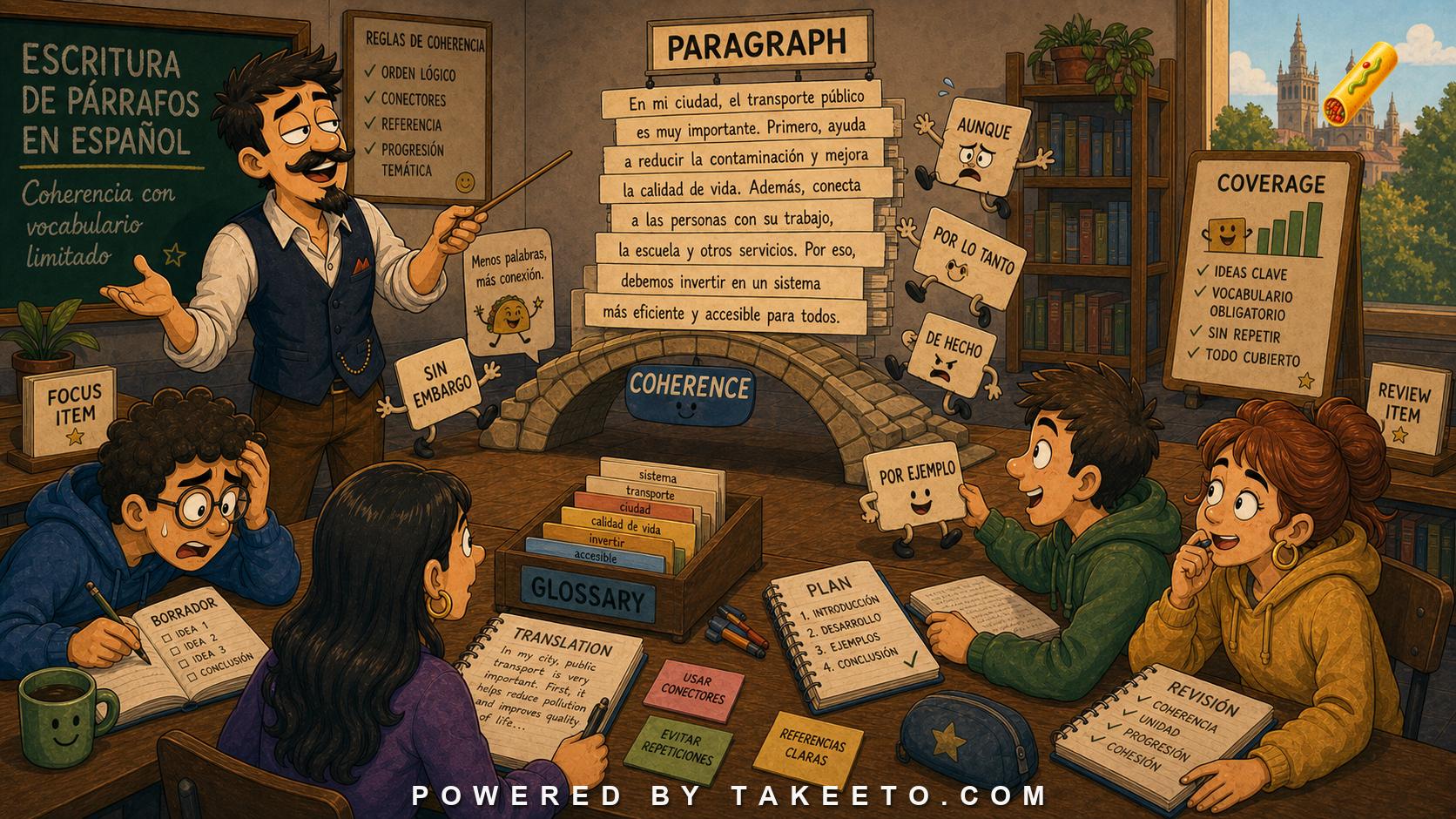
Coverage is not coherence
Pedagogical passage writing is harder than ordinary writing because the writer is not free. A passage may need to include fifteen focus items, twenty review items, certain grammar structures, and a level-appropriate style. The temptation is to force the required words into a paragraph and call it reading. Learners can feel the result immediately: the passage sounds like a vocabulary list wearing a story costume.
A strong Spanish learning passage must satisfy two demands at once. It must cover the curriculum items, and it must remain coherent as Spanish. The reader should feel that the passage exists for a communicative reason, not only to display target words.
The practical rule for this article is simple:
A learning passage is not a word list in paragraph form.
That rule is easy to state and hard to implement. It requires a curriculum designer, teacher, or serious independent learner to look past the visible artifact and ask what the artifact is doing in the learning system. A card, passage, note, audio button, PDF, notification, or metric is never just a feature. It is part of the learner's encounter with Spanish.
Passages need narrative pressure and curricular control
Coherence begins before drafting. The writer should identify the passage frame: a notice, email, dialogue, short narrative, report, instruction sheet, personal reflection, article excerpt, or institutional explanation. The frame determines register, pronouns, tense, connectors, and vocabulary. A passage about trámite, formulario, adjuntar, plazo, solicitud probably wants an administrative or service-interaction frame. A passage about vecino, llave, ruido, mudarse may want a neighborhood narrative.
The second step is item grouping. Required words should be clustered by semantic and grammatical compatibility. Solicitar, documento, plazo, requisito belong naturally together. Cafecito, subjuntivo, presupuesto, lluvia may not, unless the passage frame is carefully designed. Review items should support the passage rather than interrupt it. The writer should choose a story or argument that needs the items.
The third step is density control. New focus items need attention. Review items can appear more quietly. Too many highlighted words per line create cognitive overload. Too few make the passage inefficient. A good passage has waves: a sentence introduces new material, the next sentence stabilizes context, a later sentence recycles old grammar, and the paragraph ends with a meaningful development.
The strongest design habit is to separate the learner-facing experience from the hidden support structure. The learner may see a clean passage, a small note, a speaker button, and a short exam. Behind that simplicity should be clear metadata: item identity, grammar role, register, audio status, review status, translation alignment, and assessment purpose. Good learning design often feels simple because the complexity has been organized, not because it has been ignored.
Annotated passage-design map
| Design element | What it checks or supports | Spanish-learning consequence |
|---|---|---|
| Passage frame | Email, notice, narrative, report, dialogue, instruction. | Controls register and grammar choices. |
| Focus items | Current deck items the learner is meant to notice. | Should appear naturally and visibly. |
| Review items | Previously learned material. | Should reinforce without dominating. |
| Coherence chain | Who, where, why, what changes, what follows. | Prevents list-like writing. |
| Glossary alignment | Notes match the actual passage forms. | Supports learners without interrupting reading. |
| Translation alignment | English is literal enough for learning and natural enough to understand. | Keeps structure visible. |
The table is not meant to turn learning into bureaucracy. It is meant to prevent vague praise. A curriculum artifact should be able to answer concrete questions: What does this teach? What does it assume? What can go wrong? What evidence would show that it is working? Where does the learner receive help if the item fails?
Spanish-specific stakes
Spanish makes these design decisions visible because the language is full of contrasts that cannot be solved by exposure alone. Learners need repeated contact with ser/estar, por/para, preterite/imperfect, object pronouns, se, agreement, article use, register, and regional variation. A product or curriculum that treats every item as an isolated translation will underprepare the learner for real text.
The issue is not that Spanish is uniquely impossible. The issue is that Spanish has structure. The learner must be given enough of that structure to make input intelligible and enough retrieval to make knowledge durable. A passage without review becomes a reading experience that fades. A card without context becomes a brittle memory. Audio without text may not teach spelling. Text without audio may teach silent mispronunciation. Explanations without examples become abstractions. Examples without explanations can create false rules.
The cure is integration. A Spanish item should move through several linked forms: it appears in context, receives a translation or gloss, is heard, is reviewed, is tested, and returns later in a different context. Each contact should add something. Repetition alone is not the same as cumulative design.
Edge cases and mature design questions
Vocabulary-constrained passages become easier when the writer allows enough length. Very short passages often force unnatural collisions among items. A longer passage can introduce a setting, distribute focus words, repeat a few high-value items, and give review material room to breathe. Brevity is not always kindness. Sometimes it creates cognitive compression that makes the Spanish worse.
The mature question is not “How short can this be?” but “What is the shortest coherent text that lets these items appear naturally?” For some decks, that is one paragraph. For others, it is a three-part email, a short dialogue, or a mini article.
| Edge case | Why it matters | Better handling |
|---|---|---|
| Too short | Required items collide unnaturally. | Expand the passage or split the deck. |
| Too long | Learner loses focus and review becomes inefficient. | Use sections, headings, and controlled highlight density. |
| Wrong genre | Items are forced into a story that does not need them. | Choose a genre that naturally requires the vocabulary. |
Edge cases are useful because they reveal whether the model is real. A shallow rule works only in the clean example. A strong curriculum principle survives versioning, regional variation, learner differences, and product constraints. For Spanish, this matters because the learner will eventually meet forms outside the first example bank: another accent, another register, another tense, another passage genre, another medium.
A mature design does not need to solve every edge case in the first lesson. It does need to know where the edges are. When the course chooses not to explain something yet, that should be a deliberate sequencing decision, not ignorance disguised as simplicity.
Diagnostic workflow
- Name the genre of the passage before writing the first sentence.
- Group required items into natural clusters and reject impossible pairings early.
- Build a simple event chain or argument outline before inserting vocabulary.
- Check focus-item density per paragraph and per sentence.
- Read the passage without highlights; it should still make sense as a text.
- After revision, update translation, glossary, audio, PDF, and exams from the final version.
This workflow works best when it is used before publication rather than after learners complain. Retrofitting quality is expensive. It requires finding the passage, rewriting the sentence, updating the translation, changing the glossary, regenerating audio, revising the PDF, and rebuilding exams. Early diagnostic habits keep the curriculum from accumulating hidden debt.
Common failure patterns
- Writing around the list instead of from a scene: A coherent situation pulls vocabulary into place.
- Forcing every word into one paragraph: Longer passages are often better when they allow pacing and context.
- Using unnatural repetition for coverage: Repeated exposure matters, but repetition should be motivated.
- Ignoring grammar load: A vocabulary passage can become too hard if every sentence contains new syntax.
- Letting translation dictate Spanish: The Spanish passage should be written as Spanish, then translated for support.
These mistakes share one cause: treating the visible feature as the whole product. A learner does not experience a Spanish item only once. They meet it in a deck, a passage, an example, a translation, a voice, a note, an exam, and a review queue. If those encounters disagree, the learner pays the price through confusion. If they reinforce one another, the learner gains a stable model.
A concrete curriculum scenario
Suppose the required items are plazo, formulario, adjuntar, requisito, solicitar, correo electrónico. A bad passage says: Tengo un plazo. El formulario es importante. Adjunto un requisito. Solicito un correo electrónico. It covers words and teaches almost nothing. A stronger passage uses a frame: Para solicitar la beca, primero complete el formulario y adjunte una copia de su documento de identidad. El plazo termina el viernes, y la oficina enviará la respuesta por correo electrónico. Now the items belong to a procedure. The passage also teaches para + infinitive, command/register choices, article use, and administrative style.
Notice the larger principle: the best design choice is usually the one that makes the next learning contact better. A good example sentence prepares better audio. Good audio prepares better listening review. A good glossary note prepares better reading. A good exam mistake prepares better spaced review. The curriculum should behave like a system rather than like a collection of assets.
What the reader should be able to do after this article
After working through this article, the reader should be able to inspect a Spanish-learning artifact and ask sharper questions. They should be able to identify the learning purpose, name the likely failure mode, and propose a repair that improves the next learner encounter. In practical terms, that means moving from vague judgments such as “this feels good” or “this is confusing” to specific diagnoses: the example is unnatural, the audio is mismatched, the translation hides the construction, the review prompt tests recognition rather than recall, or the note explains too much at the wrong moment.
The deeper habit is accountability. Every piece of a serious Spanish curriculum should be able to justify its presence. If it cannot, it should be revised, moved, linked, hidden, or removed.
Implementation checklist
For this topic, implementation should start with the article's own example bank: focus item, review item, paragraph, translation, glossary, coherence, coverage. Choose one representative item or artifact and trace it through the system. It should have a learner-facing purpose, a hidden data representation, a place in review, and a remediation path if something goes wrong. If the topic is not a single vocabulary item, trace a unit-level artifact instead: a passage, PDF, notification, metric, audio control, or exam.
- Name the learner action this design supports: reading, listening, retrieval, production, diagnosis, or long-term review.
- Name the hidden metadata needed to support that action: item ID, form, register, variety, audio status, version, prerequisite, or mistake link.
- Name the failure that would most damage trust, then build the audit check that catches it before publication.
A design is not mature because it has many parts. It is mature when those parts can be inspected, repaired, and explained.
V2 remediation refinement: separate coverage pressure from story pressure
The first version focused on writing coherent passages under vocabulary constraints. The v2 repair names the central design tension more sharply: coverage pressure and story pressure must be managed separately. Coverage pressure asks, “Have all required items appeared?” Story pressure asks, “Does the passage have a reason to exist?” If coverage pressure wins alone, the passage becomes a decorated word list. If story pressure wins alone, the passage may read well while failing the deck.
A useful drafting workflow has two passes. In the coverage pass, the writer lists focus items, review items, required grammar, and forbidden overload. In the story pass, the writer defines a situation with a natural need for those items. A deck containing plazo, formulario, entregar, revisar, and se me olvidó should probably become a passage about an application deadline, not a random paragraph about a picnic. A deck containing quedar, faltar, and sobrar should become a scene about inventory, time, seating, money, or planning.
The audit should check for these failures:
| Failure | Symptom | Repair |
|---|---|---|
| Word-list passage | every sentence exists only to include an item | create a real problem, deadline, or decision |
| Translation pressure | Spanish sentence is unnatural because English outline came first | redraft in Spanish logic, then translate |
| Review overload | too many older items compete with new targets | lower review density or split the passage |
| Glossary mismatch | highlighted form is conjugated but note gives only an infinitive | add surface-form mapping |
| No discourse arc | paragraph has no beginning, development, or result | add sequence, contrast, cause, or consequence |
Longer passages are not automatically better, but they often give coherence room to breathe. A 120-word passage may be perfect for a compact deck. A 350-word passage may be necessary for domain vocabulary, formal connectors, and review recycling. The correct length is the shortest length that allows natural Spanish, visible targets, and a meaningful reading experience.
Suggested interactive module: Passage coverage and coherence checklist
Passage coverage and coherence checklist. The tool would show focus items, review items, sentence-by-sentence density, grammar load, glossary links, and translation status. It would flag isolated items, repeated awkward phrasing, missing context, and passages whose highlights cluster too tightly for comfortable reading.
A useful implementation would also preserve an audit trail. When a designer changes a sentence, the tool should reveal downstream effects: translation, highlights, audio, PDF, exams, and review data. When a learner misses an item, the tool should reveal upstream causes: weak example, poor contrast, missing audio, or a misleading note. The module should not merely display content. It should make relationships inspectable.
Final rule
A learning passage is not a word list in paragraph form. It is a coherent Spanish text built under constraints. Good design makes the constraints invisible to the learner and useful to memory.
For serious Spanish learning, quality is not one decision. It is the alignment of content, explanation, sound, retrieval, assessment, and learner trust. When those parts agree, the learner can spend attention on Spanish instead of fighting the curriculum.