
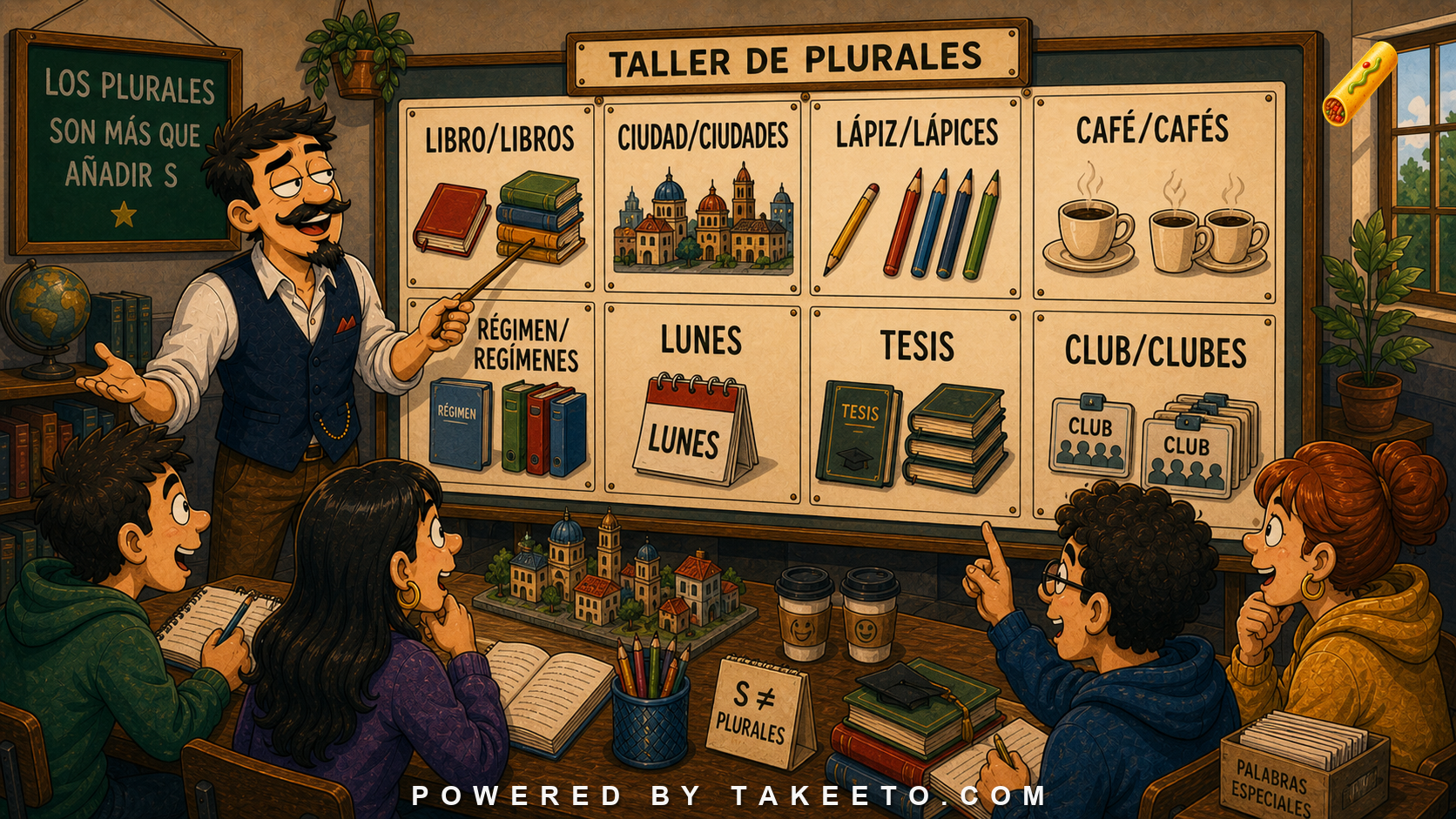
The easy rule is real, but incomplete
Spanish plurals look simple at first.
- libro → libros
- casa → casas
- mesa → mesas
- problema → problemas
Add -s and move on.
That rule is useful because many Spanish nouns end in unstressed vowels, and those nouns usually form the plural with -s. But Spanish plurals are not only “add s.” Final consonants, stressed vowels, written accents, invariant forms, loanwords, and compound nouns all complicate the picture.
The practical rule is:
Spanish plural formation depends on final sound, spelling, stress, and word type.
Nouns ending in unstressed vowels: add -s
This is the most common pattern.
| Singular | Plural |
|---|---|
| libro | libros |
| casa | casas |
| mesa | mesas |
| estudiante | estudiantes |
| problema | problemas |
| coche | coches |
| tribu | tribus |
The noun’s gender does not change:
- el libro → los libros
- la casa → las casas
- el problema → los problemas
- la estudiante → las estudiantes, when referring to feminine plural group
Adjectives and articles must agree:
el libro rojo → los libros rojos
la casa blanca → las casas blancas
Nouns ending in consonants: usually add -es
Many nouns ending in consonants form the plural with -es.
| Singular | Plural |
|---|---|
| ciudad | ciudades |
| papel | papeles |
| profesor | profesores |
| mujer | mujeres |
| árbol | árboles |
| reloj | relojes |
| canción | canciones |
This pattern often adds a syllable, which can affect stress and accent marks.
Compare:
ciudad → ciudades
papel → papeles
reloj → relojes
The stress remains where Spanish rules require, and accent marks may appear or disappear accordingly.
Final z becomes c before -es
Spanish spelling changes z to c before e in plurals.
| Singular | Plural |
|---|---|
| lápiz | lápices |
| luz | luces |
| vez | veces |
| voz | voces |
| juez | jueces |
| pez | peces |
This is not a pronunciation trick for all dialects; it is a spelling rule. Spanish does not normally write ze/zi for this sound in standard native spelling patterns, so z + es becomes ces.
Learners should memorize the pattern as spelling logic:
z → c before e
Stressed final vowels
Words ending in a stressed final vowel do not all behave identically. A useful first split is between á/é/ó and many words in í/ú.
For many everyday words ending in stressed á, é, ó, -s is the normal plural:
| Singular | Plural |
|---|---|
| café | cafés |
| sofá | sofás |
| dominó | dominós |
| mamá | mamás |
| papá | papás |
Words ending in stressed í or ú often allow -es, -s, or a preferred form that depends on the word, register, and region.
| Singular | Common plural notes |
|---|---|
| tabú | tabúes; tabús also occurs |
| hindú | hindúes; hindús also occurs |
| bambú | bambúes; bambús also occurs |
| israelí | israelíes; israelís also occurs |
| menú | menús is the normal everyday plural |
The details can be word-specific, especially with loanwords and demonyms. The learner’s safest move is to check high-frequency words and note variants when they matter.
Accent marks can appear, disappear, or move
Plural formation can change whether an accent mark is needed.
Accent appears in plural
| Singular | Plural | Why |
|---|---|---|
| examen | exámenes | plural is esdrújula |
| joven | jóvenes | plural is esdrújula |
| imagen | imágenes | plural is esdrújula |
| origen | orígenes | plural is esdrújula |
| margen | márgenes | plural is esdrújula |
The singulars are llanas ending in n, so they need no accent. The plurals become esdrújulas, and all esdrújulas take accents.
Accent disappears in plural
| Singular | Plural | Why |
|---|---|---|
| canción | canciones | plural follows default stress |
| nación | naciones | plural follows default stress |
| lección | lecciones | plural follows default stress |
| corazón | corazones | plural follows default stress |
The singulars are agudas ending in n, so they need accents. The plurals are llanas ending in s, so they do not.
This is one of the best examples of why accents are structural.
Invariant forms
Some nouns do not change in the plural, especially when they already end in unstressed -s or -x.
| Singular | Plural |
|---|---|
| el lunes | los lunes |
| la tesis | las tesis |
| la crisis | las crisis |
| el análisis | los análisis |
| el tórax | los tórax |
| el paraguas | los paraguas |
The article shows number:
El lunes es difícil.
Los lunes son difíciles.
La tesis es larga.
Las tesis son largas.
Do not add another -es automatically.
Loanwords and variation
Loanwords often create plural variation. Some forms are fully adapted to Spanish morphology; others preserve foreign-looking endings for a long time.
Examples:
| Singular | Possible plural notes |
|---|---|
| club | clubes and clubs are both used; clubes is especially learner-friendly because it follows the Spanish consonant + -es pattern |
| récord | récords is the normal plural and keeps the accent mark |
| fan | fans is widely established; fanes also exists by Spanish analogy |
| máster | másteres is common in academic usage; másters also occurs and keeps the accent mark |
| software | often treated as invariant or avoided through alternatives such as programas depending on context |
Institutional style guides may recommend adapted plurals. Actual usage may vary, especially in technology, business, sports, and youth language.
Learners should not assume one mechanical rule covers every loanword. Check the register.
Compound nouns
Spanish compounds can pluralize in different ways depending on their structure.
Some are invariant because they already have plural-looking internal structure:
- el paraguas → los paraguas
- el sacacorchos → los sacacorchos
- el abrelatas → los abrelatas
Some noun+noun compounds pluralize mainly in the first element or according to lexicalization:
- el hombre rana → los hombres rana
- el coche cama → los coches cama
Hyphenated or coordinated compounds can follow special style conventions:
- histórico-artístico → histórico-artísticos or agreement according to the noun modified
For the first 100 learner articles, the main point is awareness: compounds are not always pluralized by adding -s at the end.
Plural and agreement
Plural is not only a noun ending. It spreads through the noun phrase.
| Singular | Plural |
|---|---|
| el libro rojo | los libros rojos |
| la ciudad grande | las ciudades grandes |
| el lápiz azul | los lápices azules |
| la tesis difícil | las tesis difíciles |
| el problema serio | los problemas serios |
Adjectives ending in consonants may add -es:
- difícil → difíciles
- azul → azules
- joven → jóvenes
Plural errors often occur because the learner pluralizes the noun but forgets the adjective or article.
Common learner mistakes
Mistake 1: Adding -s to every noun
Ciudads is not correct. Use ciudades.
Mistake 2: Forgetting z → c
Lápizes is not correct. Use lápices.
Mistake 3: Missing accent changes
Examenes should be exámenes. Canciónes should be canciones.
Mistake 4: Pluralizing invariant nouns
Do not write lunesses or tesises. Use los lunes, las tesis.
Mistake 5: Forgetting agreement
Not los libro rojo. Use los libros rojos.
Suggested interactive module: plural builder
A useful tool for this article would generate plural forms with warnings.
Suggested functions:
- Final-letter detector: vowel, consonant, z, s, x.
- Stress and accent recalculation: examen → exámenes, canción → canciones.
- Invariant-form flag: lunes, tesis, análisis.
- Loanword variation note: club/clubes/clubs.
- Agreement expansion: article + noun + adjective.
Example input:
lápiz azul
Possible output:
- Singular: el lápiz azul
- Plural noun: lápices
- z → c before -es
- Adjective plural: azules
- Full plural: los lápices azules
Final rule
Spanish plurals are regular, but regular does not mean one rule.
Add -s after many vowels, -es after many consonants, change z to c, recalculate accent marks, recognize invariant forms, and make the whole noun phrase agree.
Plural is not just an ending. It is a grammatical signal that spreads.