
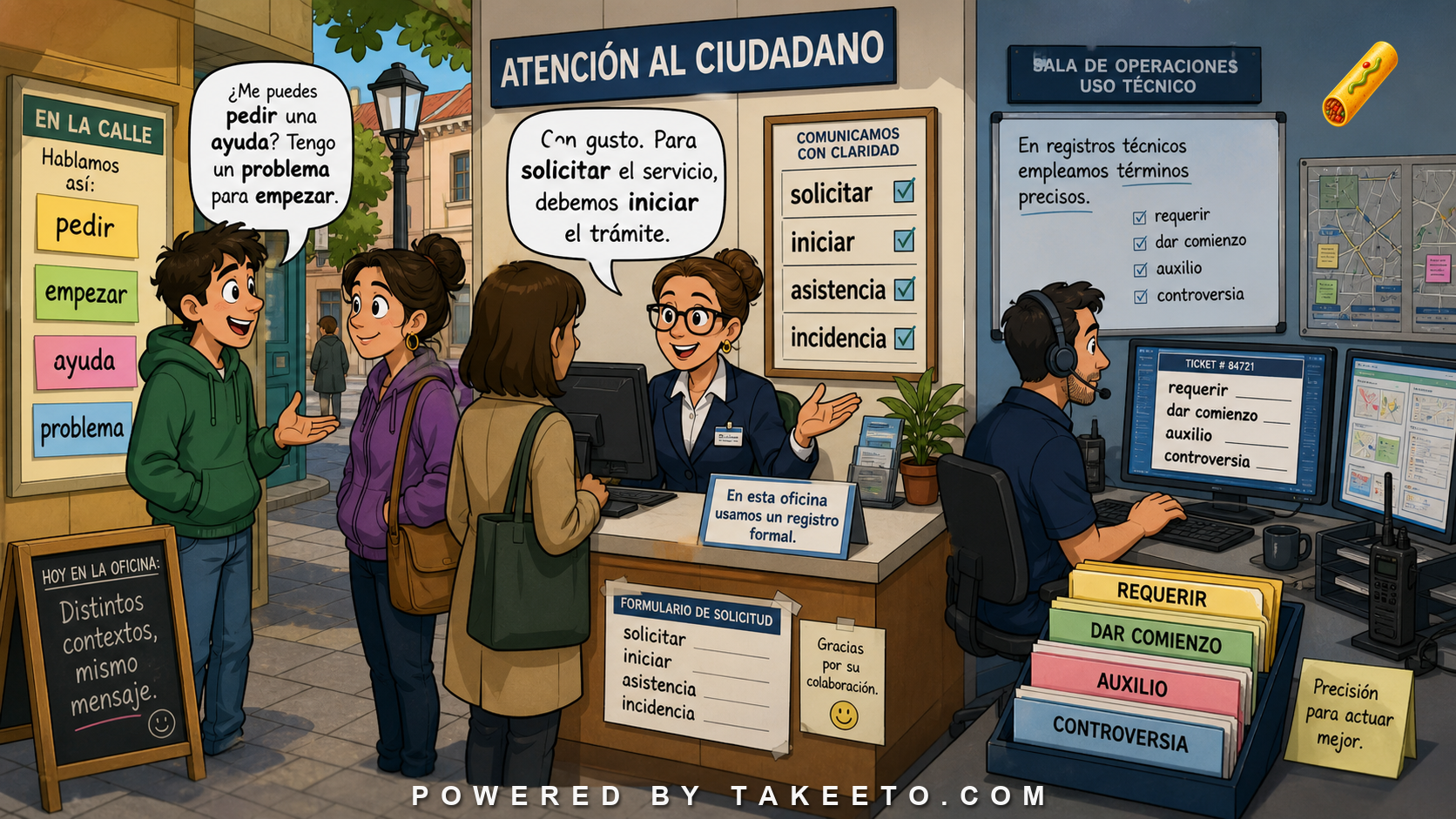
One English word is not one Spanish word
Learners often ask, “How do you say ask?” or “How do you say help?” The better question is: in what context, with what register, and for what purpose?
Spanish offers everyday, formal, and technical options. They are not interchangeable.
The key principle is:
Advanced vocabulary choice is register choice.
A word can be correct in meaning and wrong in social or institutional weight.
Everyday, formal, technical
A useful three-level model:
| Everyday | Formal | Technical/domain-specific |
|---|---|---|
| pedir | solicitar | requerir |
| empezar | iniciar | dar comienzo / incoar in legal contexts |
| ayuda | asistencia | auxilio / soporte / prestación |
| problema | incidencia | controversia / litigio / patología depending on domain |
The third column is not “more advanced” in a universal sense. It is more domain-bound.
Pedir, solicitar, requerir
Pedir is broad and everyday:
Voy a pedir información.
Solicitar is formal, administrative, or polite:
Puede solicitar una copia del documento.
Requerir can mean require or formally request/demand, depending on context:
El trámite requiere identificación oficial.
La autoridad requirió la presentación de pruebas.
Do not replace every pedir with solicitar to sound advanced. A friend does not usually solicitar a coffee in casual speech.
Empezar, iniciar, dar comienzo
Empezar is everyday:
La clase empieza a las ocho.
Iniciar is more formal or institutional:
El curso inicia en septiembre.
Dar comienzo is formal, ceremonial, or written:
Se dio comienzo a la sesión.
Technical/legal contexts may use specialized verbs, but learners should avoid overformalizing ordinary speech.
Ayuda, asistencia, auxilio
Ayuda is general:
Necesito ayuda.
Asistencia can mean assistance, attendance, or support depending on context:
asistencia técnica
asistencia a clase
asistencia sanitaria
Auxilio often carries urgency, rescue, or formal emergency/legal tone:
primeros auxilios
pedir auxilio
The words overlap, but their scenes differ.
Problema, incidencia, controversia
Problema is general:
Hay un problema con la cuenta.
Incidencia is common in technical support, operations, and administrative contexts:
Hemos registrado una incidencia en el sistema.
Controversia is a dispute or controversy, often legal, academic, or public:
La decisión generó una controversia jurídica.
A broken login is an incidencia. A constitutional dispute may be a controversia. A personal difficulty may simply be a problema.
Formal words are not automatically better
A common advanced-learner mistake is upward register drift:
Te solicito que me auxilies con una incidencia.
This may be grammatically possible, but in many everyday contexts it sounds absurdly institutional. Better:
Te pido que me ayudes con un problema.
Register control means being able to go down as well as up.
Technical terms depend on domain
The same everyday idea may have different technical names:
- law: controversia, recurso, requerimiento
- medicine: síntoma, patología, tratamiento
- technology: incidencia, soporte, configuración
- administration: solicitud, trámite, requisito
- academia: planteamiento, hipótesis, marco teórico
A technical word is precise only in its domain. Outside the domain, it may sound pretentious or unclear.
Register tagging in vocabulary notes
Instead of storing one translation, store register information:
pedir — everyday; broad request
solicitar — formal/administrative; request in writing or official context
requerir — require; formally demand; technical/legal/administrative
This makes vocabulary usable.
Example bank walkthrough
pedir/solicitar/requerir
Request family across register.
Learner action: choose by relationship and institutionality.
empezar/iniciar/dar comienzo
Beginning family.
Learner action: avoid ceremonial phrasing in casual speech.
ayuda/asistencia/auxilio
Support family.
Learner action: distinguish everyday help, service support, and urgent aid.
problema/incidencia/controversia
Problem/dispute family.
Learner action: match domain: support ticket, public debate, legal dispute, ordinary problem.
Register-choice workflow
- Identify audience. Friend, customer, professor, institution, court, patient.
- Identify channel. Speech, email, form, report, policy, support ticket.
- Identify domain. Everyday, technical, legal, medical, academic.
- Choose register level. Everyday, formal, technical.
- Check collocations. solicitar información, registrar una incidencia, interponer recurso.
- Avoid fake sophistication. Formal is not always clearer.
- Test with a sentence. Does it sound human in that context?
Common learner failure: permanent formal mode
After discovering formal vocabulary, many learners stop sounding like people. They write to friends as if filing a report:
Solicito tu asistencia para resolver una incidencia personal.
The sentence may be understandable, but the register is wrong for most friendships. Better:
Te pido ayuda con un problema.
Register control means being able to sound formal when the context demands it and ordinary when ordinary language is better.
Mini-workshop: shift the same message across registers
Message: you need someone to send a document.
Everyday:
¿Me mandas el documento?
Polite/formal:
¿Podría enviarme el documento?
Administrative:
Deberá presentar la documentación requerida dentro del plazo indicado.
Technical/legal, if context supports it:
Se requiere la remisión de la documentación correspondiente.
These are not interchangeable. Practice shifting register without changing the core function. That is advanced control.
Common failure mode: assuming formal equals better
Advanced learners sometimes replace ordinary words with formal ones everywhere: solicitar for pedir, iniciar for empezar, incidencia for problema. The result is not advanced Spanish. It is social miscalibration. A word that is perfect in an email to an institution can sound absurd at a dinner table.
The repair is to add a “wrong place” example to vocabulary notes. For auxilio, note emergency. For asistencia, note technical support or attendance. For controversia, note public dispute. A word is not mastered until you know where not to use it.
Before/after: same meaning, different social setting
Core meaning: “Please send the document.”
Casual message:
¿Me mandas el documento?
Polite workplace email:
¿Podría enviarme el documento?
Administrative request:
Solicito el envío del documento.
Legal or procedural requirement:
Se requiere la presentación del documento.
The information is similar, but the relationship has changed. The casual version assumes familiarity. The polite version uses a request. The administrative version frames the sentence as a formal act. The legal or procedural version may imply obligation. This is why register cannot be learned from translation pairs alone.
Remediation pass: register is a choice, not a ladder upward
Learners often imagine vocabulary as a vertical scale: simple words at the bottom, advanced words at the top. That model breaks down in Spanish register. Pedir, solicitar, and requerir are not three versions of the same word arranged from bad to good. They belong to different contexts, relationships, and institutional frames.
The remediation model is a register triad: everyday, formal/institutional, and technical/domain-specific. The learner should tag vocabulary by where it works. Ayuda is broad and ordinary. Asistencia may be institutional, technical, or service-related. Auxilio can carry urgency or rescue. Problema is general. Incidencia may belong to customer support or technical reporting. Controversia suggests public dispute or debate, not every personal problem.
This approach prevents the embarrassing advanced-learner habit of using formal words everywhere. Overformal Spanish can be as unnatural as underdeveloped Spanish.
Before/after repair: replacing without overcorrecting
Weak learner revision:
¿Me puede asistir con este problema?
I want to sound more formal than ayudar.
Better options:
¿Me puede ayudar con este problema?
Necesito asistencia técnica para resolver esta incidencia.
El servicio de asistencia al cliente no respondió.
The issue is not that asistir or asistencia is wrong. The issue is that the phrase must match the setting.
Weak learner revision:
Voy a iniciar a estudiar español.
Stronger:
Voy a empezar a estudiar español.
El curso se inicia el lunes.
La empresa dio comienzo al proceso de selección.
Register and construction both matter.
Mini-workshop: build wrong-place examples
For every formal word, create one correct-place example and one wrong-place warning.
Example:
Solicitar
Correct: Solicitar una beca, solicitar información, solicitar una cita.
Wrong-place warning: Saying te solicito que me pases la sal at dinner sounds absurdly formal or joking.
Incidencia
Correct: Hemos registrado una incidencia en el sistema.
Wrong-place warning: Tengo una incidencia con mi hermano is not the normal way to say you have a problem with your brother.
These warnings are powerful because they teach social boundaries.
Register dimensions beyond formality
A finished article should explain that register is not only formal versus informal. It includes domain, medium, relationship, geography, and purpose. A term can be formal but common in one country and odd in another. A technical word can be perfect in a manual and ridiculous in a love letter. A customer-support phrase can sound polite in an email and robotic in a conversation.
Vocabulary notes should therefore include tags such as:
- everyday,
- institutional,
- legal,
- medical,
- academic,
- technical support,
- journalistic,
- conversational,
- regional,
- written-only,
- spoken-friendly.
The tags do not need to be exhaustive. They simply remind the learner that words live in situations.
Production guidance: choose the plain word unless the context demands more
Many advanced learners would improve immediately by trusting ordinary Spanish more. Pedir, empezar, ayuda, problema, and decir are not childish. They are core words. Replace them only when the context gives a reason: institutional politeness, legal precision, technical classification, academic stance, or genre convention.
A good exercise is to write the same message three ways: a text to a friend, an email to an office, and a formal complaint. The vocabulary should change because the situation changes, not because one version is “more advanced.”
Editorial quality checks for this article
The article should include triads, but it should also include context. A table alone can mislead if it suggests direct substitutability. Every register pair or triad should show sample sentences. The article should push readers to ask: who is speaking, to whom, through what medium, for what purpose, and with what institutional stakes? That is register competence.
Extended remediation: build vocabulary notes that include social consequences
Register control requires imagining the social scene. Who is speaking? To whom? In what medium? With what power relationship? A word can be grammatically correct and socially wrong. Deseo solicitar asistencia may work in an institutional email; it would sound strange in a casual request to a friend. Auxilio may be urgent; ayuda may be ordinary; asistencia may be service, attendance, or support depending on context.
Contrast set
- translation note: assistance = asistencia.
- register note: Asistencia técnica = technical support; asistencia a clase = attendance; necesito ayuda is the ordinary request; auxilio signals emergency or rescue.
The contrast set should be read aloud or rewritten, not merely admired. Advanced learners often understand a correction when they see it, then fail to reproduce it when the task changes. The repair is to make the contrast portable: identify the decision, name the cue, and apply the same decision to a new sentence, clip, paragraph, or writing task.
Real-use transfer drill
- Choose a word with at least three register options.
- Write one sentence for a friend, one for an institution, and one for a technical document.
- Mark which sentence would sound strange in another context.
- Add regional alternatives if relevant.
- Review the set by choosing the context first, then the word.
The deliverable is a context-tagged vocabulary note. It should include at least one “do not use here” warning, because knowing where a word fails is part of knowing the word.
Avoid using formal vocabulary as a shield for insecurity. Strong Spanish often uses ordinary words precisely. Prestige vocabulary without context makes prose worse.
A good remediation pass ends with a usable artifact: a marked paragraph, a recording comparison, a collocation card, a frame note, a stance map, a change-claim table, or a revision pair. Without an artifact, the learner may feel enlightened but have nothing to review. With an artifact, the explanation becomes part of a study system.
Depth reinforcement: technical words are not neutral upgrades
Technical vocabulary often narrows meaning rather than merely raising register. Auxilio is not just formal ayuda; it can signal urgent assistance. Incidencia is not just fancy problema; it often frames an event as a logged issue, service interruption, or reportable irregularity. Controversia is not just a difficult situation; it suggests public disagreement or dispute.
For that reason, register notes should include semantic narrowing. A learner should not replace common words with technical words unless the technical frame is intended. This is especially important in customer support, law, medicine, and administration, where a word can imply process, responsibility, or severity. Advanced vocabulary gives control only when the learner knows the institutional meaning attached to it.
Applied drill: same message, three registers
Write the same request in three contexts.
Friend:
¿Me ayudas a revisar esto?
University office:
Quisiera solicitar ayuda para revisar este documento.
Technical support ticket:
Solicito asistencia para revisar una incidencia relacionada con la carga del documento.
The grammar is not the main issue. The situation is. The friend version is direct and ordinary. The office version is polite and institutional. The support-ticket version uses domain language: asistencia, incidencia, carga del documento.
Now try the same exercise with problema/incidencia/controversia, pedir/solicitar/requerir, and empezar/iniciar/dar comienzo. A learner who can move across these registers has more than vocabulary. They have social control.
Suggested interactive module: register triad table
A strong tool for this article would help learners choose vocabulary by context.
Suggested functions:
- Semantic field selector: request, begin, help, problem, proof, payment.
- Register columns: everyday, formal, technical.
- Domain tags: law, medicine, tech, administration, academia.
- Example sentences: each word in natural context.
- Mismatch warnings: flags overformal casual sentences.
- Rewrite practice: shift a sentence up or down in register.
Final rule
Advanced Spanish is not the fanciest word.
It is the right word for the relationship, domain, and channel. Learn vocabulary in register sets and your Spanish will become both more precise and more natural.