
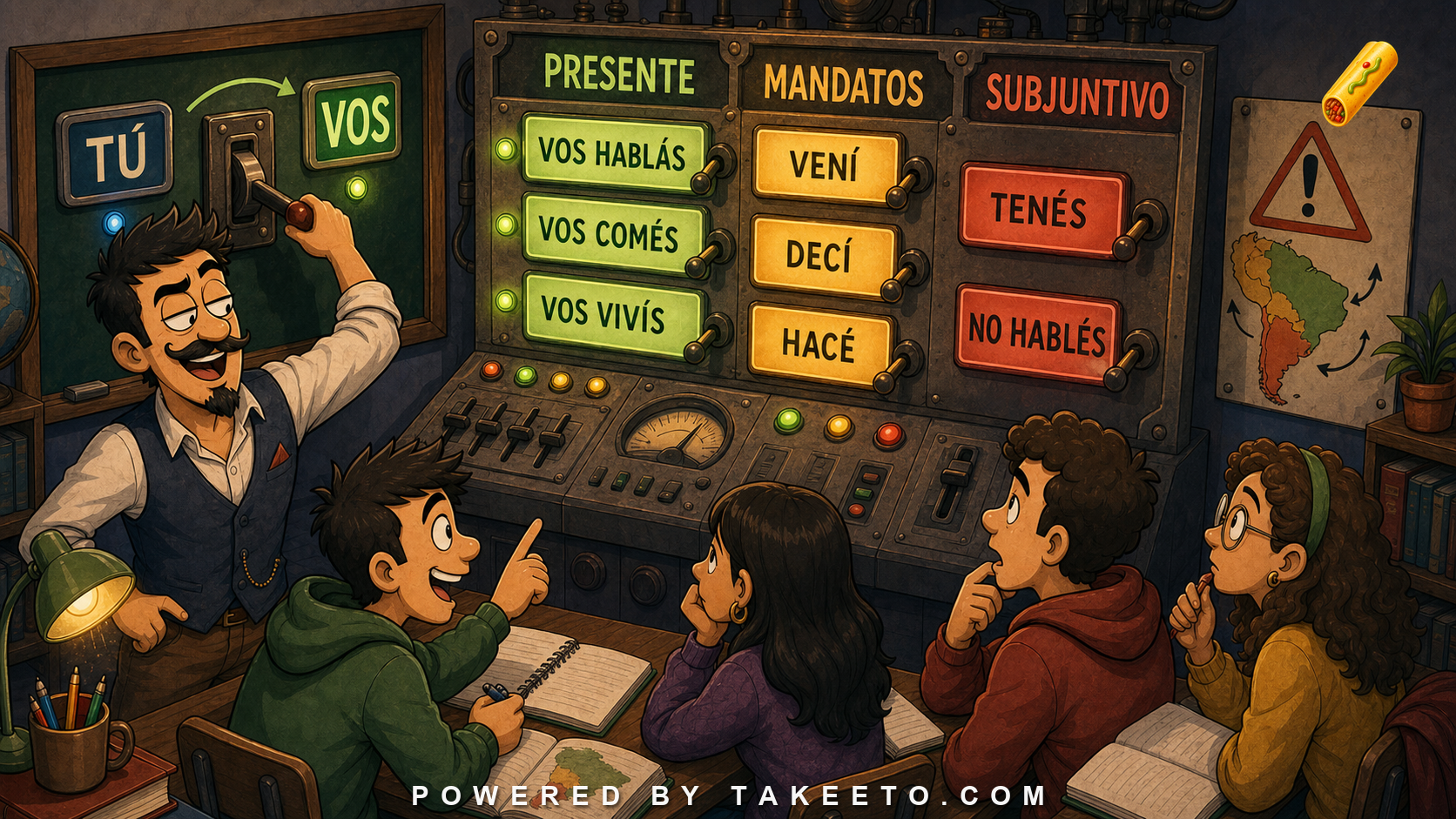
Voseo is a verb system, not just a pronoun
Some learners think voseo means replacing tú with vos and leaving everything else alone. That is only part of the story. In many regions, vos comes with its own verb morphology.
Compare:
Tú hablas.
You speak.
Vos hablás.
You speak.
The pronoun changes, the stress changes, and the ending changes. To understand voseo, you need the forms.
The key principle is:
Voseo is both an address system and a conjugation system, and its forms vary by region.
A learner should start with major productive patterns, then add regional variation.
Present indicative: the core pattern
A common American voseo pattern uses final-stressed forms:
hablar → vos hablás
comer → vos comés
vivir → vos vivís
The stress is crucial. These are not pronounced like hablas, comes, vives. The accent falls at the end.
hablás
comés
vivís
Many forms are easy once you recognize the pattern:
trabajar → trabajás
aprender → aprendés
escribir → escribís
This system is extremely regular in high-frequency speech.
Common irregulars
Some high-frequency verbs have forms learners should memorize as chunks.
ser → vos sos
you are
tener → vos tenés
you have
venir → vos venís
you come
poder → vos podés
you can
querer → vos querés
you want/love
decir → vos decís
you say
hacer → vos hacés
you do/make
These are not difficult after exposure, but they can surprise learners trained only on tú eres, tú tienes, tú vienes.
Present-tense comparison table
A learner should be able to move across the three common singular address systems:
tú hablas
vos hablás
usted habla
tú comes
vos comés
usted come
tú vives
vos vivís
usted vive
tú tienes
vos tenés
usted tiene
This comparison prevents confusion. Vos is not third person. It is singular second-person address with regional second-person morphology.
Affirmative commands
Voseo affirmative commands are highly important in conversation.
hablá
speak
comé
eat
viví
live
vení
come
decí
say/tell
hacé
do/make
poné
put
salí
leave/go out
Learners often hear forms like decime, vení, mirá, escuchá.
Decime la verdad.
Tell me the truth.
Mirá esto.
Look at this.
Vení acá.
Come here.
These are not mistakes for dime, mira, ven in voseo regions. They are local command forms.
Negative commands
Negative commands vary more.
You may encounter forms like:
No hablés.
Don’t speak.
and also:
No hables.
Don’t speak.
The distribution depends on region, register, and the particular voseo system. Some dialects use voseo forms strongly in the negative command and subjunctive; others use forms closer to tuteo.
Learner action: recognize both no hablés and no hables, and follow local patterns if producing voseo.
Subjunctive variation
The subjunctive is where voseo becomes especially regional.
Possible patterns include:
quiero que vengás
I want you to come
quiero que vengas
I want you to come
Both may exist in different regions or registers. Some regions maintain voseo stress in subjunctive forms. Others use tuteo-like subjunctives after vos.
A learner should not assume one voseo system covers all countries.
Practical rule:
Learn present indicative and affirmative commands first. Add negative commands and subjunctive from your target region.
Pronoun and preposition forms
With prepositions, vos appears as itself:
para vos
for you
con vos
with you
This contrasts with tú/ti/contigo:
para ti
for you
contigo
with you
Learners should store con vos as a normal phrase in voseo regions.
Mixing systems
Real speakers may mix vos, tú, and usted in ways shaped by region and relationship. Learners, however, should avoid accidental mixing caused by incomplete knowledge.
Problematic learner mix:
Vos tienes razón.
This may occur in some pronominal-only voseo systems, but if your target is a region where vos tenés is expected, vos tienes may sound off.
Safe learning habit: choose a target system, then practice it consistently.
Example bank walkthrough
vos hablás
Regular voseo present for hablar.
Learner action: final stress.
vos comés
Regular voseo present for comer.
Learner action: compare to tú comes.
vos vivís
Regular voseo present for vivir.
Learner action: notice final stress and distinguish vos vivís from vosotros vivís by context and pronoun system.
vení
Voseo command from venir.
Learner action: recognize in Argentina, Uruguay, Central America, and other voseo zones.
decí
Voseo command from decir.
Learner action: connect decime to “tell me.”
hacé
Voseo command from hacer.
Learner action: do not replace it automatically with haz in voseo contexts.
no hablés / no hables
Negative command variants.
Learner action: learn target-region preference.
tenés
High-frequency voseo form of tener.
Learner action: memorize early.
Remediation notes: voseo morphology, accent marks, and mixed systems
The article correctly teaches the core forms. This pass strengthens the difference between a learning table and real regional systems. Voseo morphology is systematic, but there is no single universal voseo.
A learner should distinguish:
Rioplatense-like pattern: vos hablás, vos comés, vos vivís, vení, decí, hacé.
Central American patterns: often similar in the present, but with different social meanings and regional subjunctive/negative-command behavior.
Colombian or Chilean patterns: local mixtures, reductions, or forms that may not match the learner's first voseo table.
Pronominal-only or mixed use: vos may appear with forms that look closer to tú in some communities or contexts.
Accent marks are not decorative here. They show stress:
hablas = first syllable stress in tú hablas.
hablás = final stress in vos hablás.
comes vs comés.
tienes vs tenés.
In speech, the stress is the feature. In writing, the accent mark helps signal it.
Commands also need more practice than learners expect. The forms vení, decí, hacé, poné, salí, mirá, escuchá occur constantly. With clitics, the learner must parse the whole chunk:
decime = tell me.
miralo = look at it/him.
haceme un favor = do me a favor.
sentate = sit down.
Negative commands and subjunctives are the variation zone:
No hablés / no hables.
Quiero que vengás / quiero que vengas.
Espero que tengás tiempo / espero que tengas tiempo.
Learners should not try to produce all variants. Pick the target region and learn its preferences. For broad recognition, store both possibilities.
A useful repair table:
Present: first priority.
Affirmative commands: second priority.
Prepositional forms: para vos, con vos.
Negative commands: target-region priority.
Subjunctive: advanced regional control.
The common learner error remains accidental mixing:
Vos eres, vos tienes, tú tenés, usted tenés.
Some mixed patterns may exist regionally, but if the learner is mixing because they do not know the system, it sounds unstable. Learn one active system, then recognize others descriptively.
Final remediation rule:
Voseo is not hard because it is irregular. It is hard because it is regional. Learn the pattern, then learn the community.
Suggested interactive module: voseo conjugator with regional variants
A useful tool for this article would make variation explicit.
Suggested functions:
- Verb input: hablar, comer, vivir, tener, ser, venir, decir, hacer.
- Region selector: Rioplatense, Central American, Colombian, mixed/recognition.
- Present forms: vos hablás, comés, vivís, tenés, sos.
- Command forms: vení, decí, hacé, mirá.
- Negative command variants: no hablés/no hables.
- Subjunctive variants: vengás/vengas.
- Comparison view: tú, vos, usted.
- Audio stress trainer: final stress recognition.
Final rule
Voseo is not just vos. It is morphology.
Start with vos hablás, vos comés, vos vivís, vos tenés, and commands like vení, decí, hacé. Then learn regional differences in negative commands and subjunctive forms. Voseo is systematic, but it is not identical everywhere.