
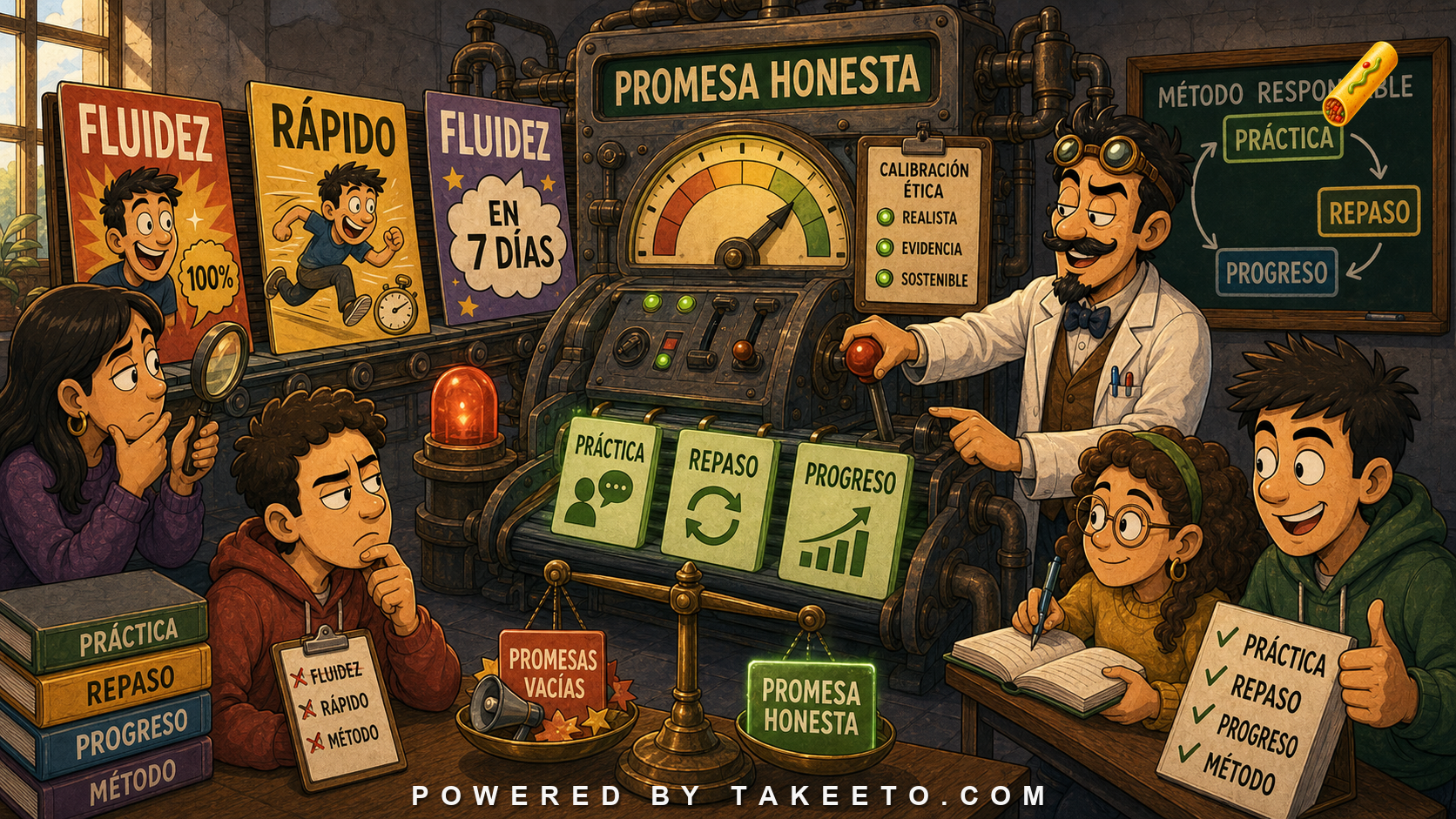
Language-learning marketing often sells the emotion of fluency
Spanish-learning products frequently promise speed, ease, confidence, native-like speech, perfect memory, or effortless progress. The problem is not that learners want results. They should. The problem is that many claims blur the difference between exposure, practice, comprehension, production, accuracy, fluency, and real-world competence.
A claim such as:
Habla español con fluidez en 30 días.
sounds powerful. But it hides almost everything: starting level, daily time, definition of fluency, domains of use, assessment method, and learner responsibility.
The key principle is:
Ethical Spanish-learning claims describe the path and evidence, not just the dream.
Fluidez is not one thing
Fluidez often translates as fluency, but fluency can mean different things:
- speaking smoothly,
- understanding normal speech,
- reading quickly,
- writing accurately,
- handling daily situations,
- using advanced registers,
- sounding natural,
- communicating despite errors.
A learner may be fluent in restaurant interactions but not academic reading. Another may read novels but speak slowly. Another may converse socially but struggle with formal documents.
Claims using fluidez should specify domain.
Weak:
Logra fluidez rápidamente.
Better:
Mejora tu fluidez al responder preguntas cotidianas con práctica oral guiada.
Now the claim has a domain and method.
Dominio and mastery
Dominio means command or mastery. It is a heavy word.
Domina el subjuntivo.
This may be acceptable if the course truly teaches recognition, formation, interpretation, production, and review across contexts. But dominar español is a far larger claim.
Better claims:
Comprende los usos principales del subjuntivo.
Practica el contraste entre indicativo y subjuntivo en frases reales.
Aprende a reconocer patrones frecuentes antes de producirlos.
Ethical copy should not use dominio when the product offers only an introduction.
Fast is not always false, but it is usually incomplete
Rápido and en poco tiempo are common. Speed can be real for narrow tasks. A learner can quickly memorize survival phrases, learn one verb pattern, or improve recognition of a common structure. But broad competence takes volume and time.
Weak:
Aprende español rápido y sin esfuerzo.
Better:
Avanza con sesiones breves y constantes diseñadas para facilitar el repaso.
This does not deny efficiency. It avoids fantasy.
Memorizar, repasar, practicar
These verbs reveal the product’s learning model.
Memorizar is memorize. It can be useful, but isolated memorization is not enough.
Repasar is review. It suggests spaced reinforcement and return.
Practicar is practice. It is broad and should be specified.
Compare:
Memoriza 5.000 palabras.
Repasa vocabulario en frases con audio y contexto.
The second claim is better because it connects memory to use.
Método and evidence
Método is one of the most abused words in language marketing.
método revolucionario
método probado
método natural
método científico
A method is not credible just because it is named. Ethical copy should explain what the method does:
repaso espaciado
recuperación activa
lectura graduada
explicación gramatical
práctica de producción
retroalimentación
input comprensible
A product does not need to sound academic, but it should not hide behind vague method language.
Resultados and progress
Resultados are results. Progreso is progress. Good claims define how progress appears.
Weak:
Resultados garantizados.
Better:
Sigue tu progreso por tema: vocabulario, comprensión, gramática y repaso.
Better still:
Al terminar esta unidad, deberías poder reconocer tres usos frecuentes de por y para en contexto.
The most honest claim is specific, testable, and bounded.
What apps can responsibly promise
Apps can responsibly promise tools, structure, feedback, practice opportunities, reminders, explanations, review systems, and well-designed content.
They cannot honestly promise that every learner will become fluent without effort. They cannot promise native-like pronunciation for everyone. They cannot promise real conversation competence from passive tapping alone.
A good product says:
We give you structured practice.
A bad product implies:
We will replace the work.
Better Spanish claims
Instead of:
Habla como nativo.
Use:
Practica pronunciación y ritmo con modelos de audio claros.
Instead of:
Aprende sin estudiar.
Use:
Estudia en sesiones cortas con ejercicios diseñados para mantener la constancia.
Instead of:
Domina toda la gramática.
Use:
Construye una base sólida en los patrones gramaticales más frecuentes.
Instead of:
Resultados inmediatos.
Use:
Observa tu progreso con repasos, pruebas breves y seguimiento por tema.
Example bank walkthrough
Fluidez needs a domain: speaking, reading, listening, interaction, professional use.
Dominio is strong; use it only for bounded skills.
Memorizar is useful but insufficient without context.
Repasar suggests responsible learning design.
Practicar should specify what the learner actually does.
Método requires explanation, not mystique.
Resultados should be measurable and bounded.
Progreso should be visible through tasks, not just motivational language.
Learning-claim ethics workflow
- Identify the promise.
- Define the skill domain.
- Ask what starting level is assumed.
- Ask what learner effort is required.
- Check whether the claim is measurable.
- Replace vague speed with concrete practice design.
- Replace fluency claims with domain-specific outcomes.
- Avoid guarantees unless there is a real, narrow guarantee.
- Tie claims to features users can verify.
- Write the claim so a serious teacher would not wince.
Mini-workshop: rewrite one unethical promise
Take a claim such as Fluidez garantizada en 30 días and rewrite it three ways: a safer marketing version, a teacher-approved version, and a measurable learner outcome. For example: Practica respuestas cotidianas con sesiones guiadas, Desarrolla fluidez gradual mediante práctica frecuente, and Al terminar la unidad, podrás responder cinco preguntas comunes sobre tu rutina. The final version is the most honest because the learner can test it.
Claim-repair workshop
Take any language-learning claim and repair it through three passes. First, remove impossible guarantees. Second, name the mechanism. Third, name the learner action.
Original:
Habla español como nativo sin estudiar gramática.
Pass one:
Mejora tu español con práctica guiada.
Pass two:
Mejora tu español con lecturas, explicaciones gramaticales y repaso espaciado.
Pass three:
Lee un texto breve, estudia una explicación y repasa tus errores para construir una práctica constante.
The final version is less flashy, but it is more trustworthy and more actionable. It gives the product a clear ethical posture: we can guide practice, provide structure, and surface errors; we cannot guarantee effortless native-like identity.
This workshop is also useful for evaluating competitors. The question is not “Does this copy sound exciting?” The question is “What exactly is being promised, and who controls that outcome?”
Remediation drill: classify claims by ethical risk
Make three categories: safe, careful, and risky.
Safe claims describe product features:
Incluye lecturas graduadas, ejercicios de gramática y revisión de errores.
Careful claims describe plausible learner benefits with conditions:
Con práctica constante, puedes mejorar tu reconocimiento de estructuras frecuentes.
Risky claims guarantee broad outcomes:
Habla como nativo en un mes.
Now rewrite risky claims into careful claims. Do not remove persuasion; remove false certainty.
Risky:
Domina la gramática española sin esfuerzo.
Careful:
Practica estructuras clave con explicaciones claras y ejercicios diseñados para reforzar el uso.
Risky:
Nunca olvidarás una palabra.
Careful:
El repaso espaciado te ayuda a volver a encontrar palabras y frases antes de que se debiliten.
This exercise trains ethical precision. A product can be ambitious without pretending to control every learner’s time, memory, motivation, prior knowledge, and environment.
For advanced Spanish writing, define fluidez before using it. If you mean faster reading, say mayor fluidez lectora. If you mean conversation, say más soltura al hablar. If you mean professional competence, say capacidad para desenvolverse en contextos laborales. Ethical claims become more persuasive when they are specific.
The goal is not timid marketing. It is durable trust.
Suggested interactive module: marketing-claim ethics rubric
A strong tool would evaluate Spanish learning-product claims.
Suggested functions:
- Claim strength scale: modest, specific, strong, overclaim, unethical.
- Skill-domain field: reading, speaking, grammar, vocabulary, pronunciation, exam.
- Evidence requirement: what would prove this claim?
- Effort disclosure: minutes, frequency, level, review.
- Rewrite assistant: converts hype into honest Spanish copy.
- Red-flag detector: native-like, guaranteed, effortless, complete fluency.
- Teacher review mode: checks whether claim respects learning reality.
Applied ethics drill: test the promise
Claim:
Domina el español en 30 días.
Ask three questions. What does domina mean? Which level, skills, and contexts? What happens if the learner practices only ten minutes a day? What evidence supports the timeline?
Ethical rewrite:
En 30 días puedes construir una rutina de lectura, gramática y repaso con sesiones guiadas.
The rewrite still promises value, but it promises a process under the product’s control. Ethical marketing does not have to be dull. It has to stop pretending that a product can guarantee every learner’s final identity.
Remediation focus: replacing seductive fluency claims with ethical learning promises
Language-learning marketing becomes unethical when it converts hope into certainty. Fluidez, dominio, rápido, sin esfuerzo, garantizado, inmersión, and memorización automática are not automatically false, but they are often used without defining the learner, the level, the time, the measurement, or the required effort. Serious Spanish copy must respect the learner’s ambition without exploiting impatience.
The remediation principle is to promise process, not fantasy. A product can promise structured exposure, spaced review, clearer explanations, pronunciation practice, diagnostic feedback, and better study routines. It cannot honestly promise that every adult learner will become fluent quickly without effort. The stronger marketing language is less flashy but more durable.
Common failure modes to repair
- Leaving fluidez undefined: Fluency may mean conversation speed, listening comfort, grammatical control, reading ease, or professional performance.
- Treating time as universal: “In 30 days” ignores starting level, study time, prior languages, motivation, and feedback quality.
- Using sin esfuerzo as a virtue: Language learning requires effort. The ethical promise is directed effort, not no effort.
- Hiding learner responsibility: Apps can structure practice. Learners still need time, attention, retrieval, listening, reading, and correction.
Before/after: make a learning claim defensible
Weak version:
Alcanza la fluidez en español en solo tres meses con nuestro método probado.
Stronger version:
Construye una rutina de lectura, escucha, repaso y práctica guiada para avanzar con más claridad; el progreso dependerá de tu nivel inicial, constancia y tiempo de estudio.
The upgraded claim is less aggressive but more honest. It names the learning path and includes conditions.
Upgrade workshop: claim ethics rubric
- Underline the promised result: fluency, mastery, memory, pronunciation, confidence, exam score.
- Ask how the result is measured. If it cannot be measured, weaken the claim.
- Identify the required learner behavior: minutes per day, review schedule, writing, speaking, feedback.
- Replace guarantee language with support language where appropriate.
- Add a concrete feature that justifies the claim.
Quality-control checklist
- Does método describe an actual sequence, or is it a marketing label?
- Does inmersión mean full environment, content exposure, audio-rich practice, or branding?
- Does dominio overpromise compared with the product scope?
- Are testimonials framed as individual experiences, not universal outcomes?
- Does the copy make the learner feel capable without lying about difficulty?
Applied remediation drill: audit one fluency promise for evidence and conditions
Use this source-style excerpt:
Nuestro método te lleva de cero a la fluidez con solo diez minutos al día, sin memorizar reglas y sin estudiar listas interminables.
A fast but weak reading might say:
The claim sounds learner-friendly because it lowers anxiety and promises an easy routine.
That reading is incomplete. A stronger reading says:
The claim overpromises. It does not define fluency, starting level, measurement, time frame, learner effort, feedback, input volume, or what replaces explicit study of rules and vocabulary.
The repair comes from five checks:
- De cero a la fluidez is an extreme outcome claim.
- Solo diez minutos al día may be useful for habit formation but is unlikely to cover all skills quickly.
- Sin memorizar reglas can be reasonable if it means learning in context, but misleading if it implies grammar is unnecessary.
- Sin estudiar listas is better when replaced by contextual vocabulary practice.
- The promise lacks conditions and evidence.
Rewrite ethically: Con diez minutos al día puedes crear una rutina constante de lectura, escucha y repaso en contexto. Para avanzar hacia conversaciones más fluidas, necesitarás aumentar exposición, práctica y retroalimentación con el tiempo. This version still encourages the learner, but it stops selling magic.
Final rule
Spanish learning claims should respect the learner enough to tell the truth.
Use fluidez, dominio, memorizar, repasar, practicar, método, resultados, and progreso carefully. Promise structure, practice, clarity, and measurable growth. Do not sell magic where the learner needs a path.