
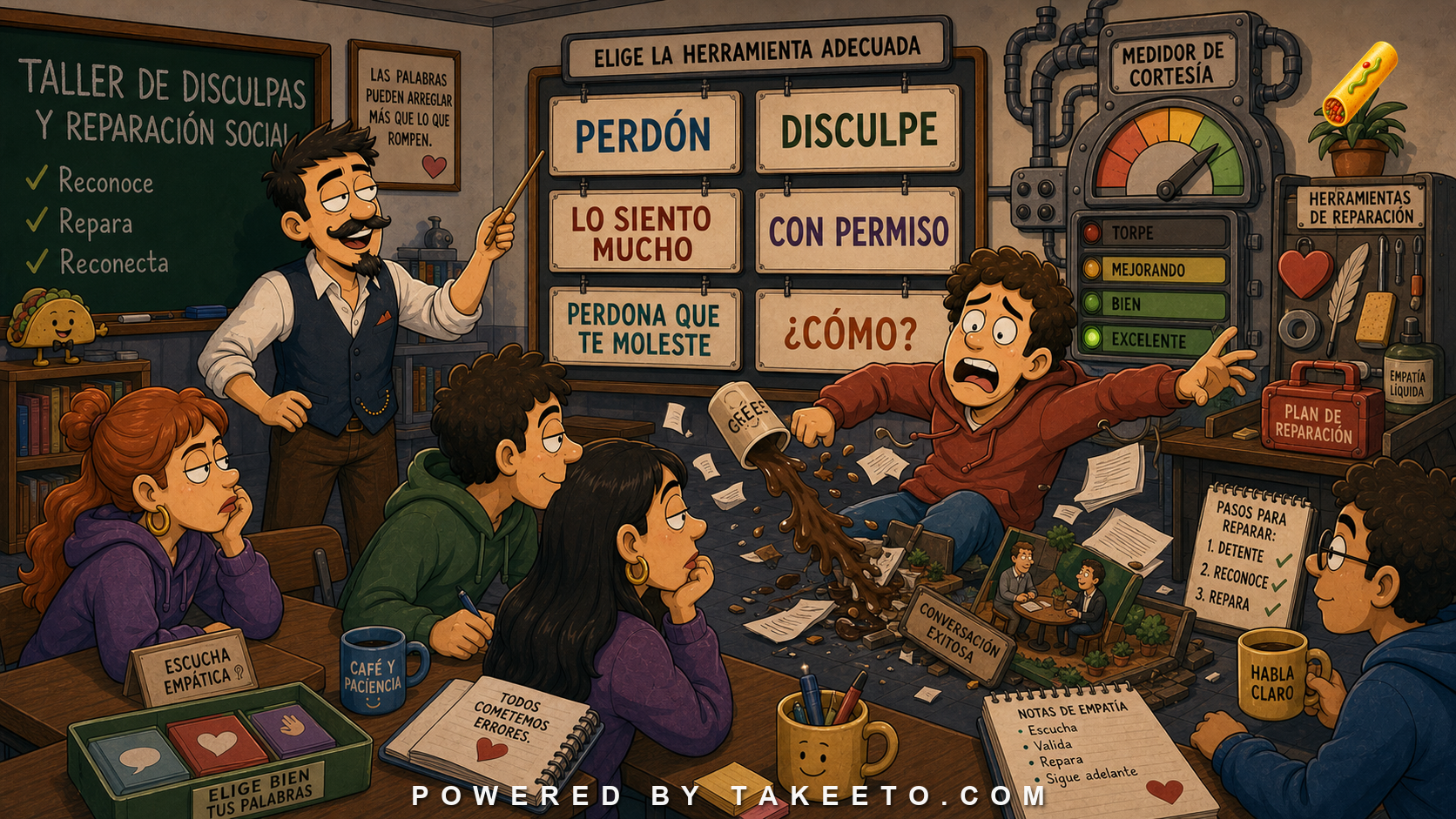
Not every “sorry” is the same Spanish word
English uses “sorry” for many functions: apology, sympathy, interruption, asking for repetition, bumping into someone, refusing, and softening bad news. Spanish divides these functions across several formulas.
The key principle is:
Choose the phrase based on what you are doing: apologizing, interrupting, getting attention, asking for repetition, showing sympathy, or moving through space.
A learner who says lo siento every time English would say “sorry” will sometimes sound too intense, too emotional, or simply unnatural.
Perdón
Perdón is versatile. It can mean “sorry,” “excuse me,” “pardon,” or “what?” depending on tone and context.
You bump into someone:
Perdón.
Sorry.
You need to interrupt:
Perdón, ¿me puede ayudar?
Excuse me, can you help me?
You did not hear:
¿Perdón?
Pardon? / Sorry?
Because it is short and flexible, perdón is one of the safest repair words for learners.
Disculpe and disculpa
Disculpe uses usted form; disculpa uses tú form.
Disculpe, ¿dónde está la salida?
Excuse me, where is the exit?
Disculpa, ¿tienes un minuto?
Sorry/excuse me, do you have a minute?
These are especially useful for getting attention or beginning a request. Disculpe is a strong default with strangers, service staff, officials, or formal contexts.
Learners should match address form:
disculpe → usted
disculpa → tú
In voseo regions, learners may hear disculpá as a command form.
Lo siento
Lo siento is more appropriate for genuine regret, sympathy, or emotional apology.
Lo siento mucho.
I’m very sorry.
Siento haber llegado tarde.
I’m sorry I arrived late.
Siento lo de tu abuelo.
I’m sorry about your grandfather.
Use lo siento when there is harm, sadness, serious inconvenience, or sympathy. Do not use it as your default for squeezing past someone in a hallway. That may sound too heavy.
Con permiso
Con permiso is used when moving through space, entering, leaving, reaching past someone, or politely interrupting physical presence.
Con permiso.
Excuse me.
It is often closer to “excuse me” than to “sorry.” It asks permission to pass, enter, or act.
In some contexts, people also say permiso alone.
Perdona que te moleste
When interrupting someone or making a request, Spanish often acknowledges the imposition.
Informal:
Perdona que te moleste, ¿tienes un momento?
Sorry to bother you, do you have a moment?
Formal:
Disculpe que le moleste, ¿podría hacerle una pregunta?
Sorry to bother you, could I ask you a question?
This is useful, but do not overuse it for every tiny interaction. In a quick store encounter, Disculpe may be enough.
Asking for repetition
When you did not understand, several formulas are common.
¿Perdón?
Pardon?
¿Cómo?
Sorry? / What was that?
¿Me lo puede repetir?
Can you repeat that?
¿Puede hablar más despacio, por favor?
Can you speak more slowly, please?
¿Cómo? can be a normal repair question, but tone matters. Said sharply, it can sound like “What?” with irritation.
Apologizing with responsibility
For real apologies, include the action.
Perdón por llegar tarde.
Sorry for arriving late.
Siento no haber respondido antes.
I’m sorry I did not respond earlier.
Le pido disculpas por el error.
I apologize for the error.
Formal written apology:
Le ofrecemos disculpas por las molestias ocasionadas.
We apologize for the inconvenience caused.
The formula depends on how serious the issue is and whether the speaker is an individual, company, or institution.
Repair sequences
A repair sequence has steps:
- signal trouble,
- request repetition or clarification,
- confirm understanding,
- continue.
Example:
—La cita es el jueves a las diez.
—Perdón, ¿a qué hora?
—A las diez.
—Perfecto, gracias.
Learners need repair language because misunderstanding is normal. Good repair phrases keep the conversation alive.
Example bank walkthrough
perdón
Flexible apology, interruption, or repetition marker.
Learner action: safe all-purpose repair word.
disculpe
Formal/usted attention-getter or apology.
Learner action: use with strangers and service contexts.
lo siento mucho
Sympathy or serious apology.
Learner action: do not use it for every minor bump.
con permiso
Permission to pass, enter, move, or interrupt physically.
Learner action: use in crowded or formal spaces.
perdona que te moleste
Informal softened interruption.
Learner action: match perdona/te with tú.
¿cómo?
Request for repetition.
Learner action: use with gentle tone or add perdón.
Remediation notes: repair language keeps conversation alive
This article is about more than apologies. It is about keeping interaction from breaking. Learners often freeze after misunderstanding, bumping into someone, interrupting, or making a mistake. A strong repair toolkit gives them social resilience.
The first upgrade is to separate four common English "sorry" functions:
Minor apology: Perdón.
Attention-getting: Disculpe / disculpa.
Sympathy or serious regret: Lo siento mucho.
Physical passage or entry: Con permiso.
The second upgrade is repetition strategy. ¿Cómo? is useful, but it can sound abrupt if the tone is sharp. Learners can soften it:
Perdón, ¿cómo dijo?
¿Me lo puede repetir, por favor?
Perdona, no entendí la última parte.
¿Podría hablar un poco más despacio?
Repair is not shameful. It is part of fluent conversation.
The third upgrade is responsibility. A real apology usually names the problem:
Perdón por llegar tarde.
Siento no haber respondido antes.
Le pido disculpas por el error.
Disculpe las molestias.
A vague perdón may be enough for a bump in a hallway; it is not enough for a missed appointment, a wrong document, or a professional mistake.
The fourth upgrade is response formulas. Learners also need to understand what others say back:
No pasa nada. = It’s okay / no problem.
No se preocupe. = Don’t worry.
Está bien. = It’s okay.
No hay problema. = No problem.
Gracias por avisar. = Thanks for letting me know.
These responses help the learner know whether the repair succeeded.
The fifth upgrade is address consistency:
Disculpe que le moleste... = usted.
Disculpa que te moleste... = tú.
Disculpá que te moleste... = voseo region, informal.
Perdone / perdona / perdoná follow the same social alignment.
A common learner mistake is mixing:
Disculpe que te moleste.
Native speakers may tolerate it, but in careful speech it sounds unstable.
Practical repair sequence:
Perdón, no entendí. ¿Me lo puede repetir más despacio?
Ah, perfecto. Entonces la cita es el jueves a las diez, ¿verdad?
That sequence does three things: signals trouble, requests help, and confirms the answer. This is real communicative competence.
Suggested interactive module: apology-function matrix
A useful tool for this article would classify the interaction before choosing the phrase.
Suggested functions:
- Function selector: apology, interruption, repetition, sympathy, passing through, formal complaint.
- Address toggle: tú, vos, usted.
- Seriousness scale: minor bump, inconvenience, mistake, grief, institutional error.
- Formula options: perdón, disculpe, lo siento, con permiso, le pido disculpas.
- Repair practice: ask for repetition and confirm understanding.
- Tone warning: when ¿cómo? may sound abrupt.
- Email mode: formal apology templates.
Final rule
Do not translate every English “sorry” as lo siento.
Use perdón for flexible repair, disculpe/disculpa for attention and apology, lo siento for real regret or sympathy, con permiso for movement, and clear repetition requests when you do not understand. Spanish repair is a toolkit, not one word.