
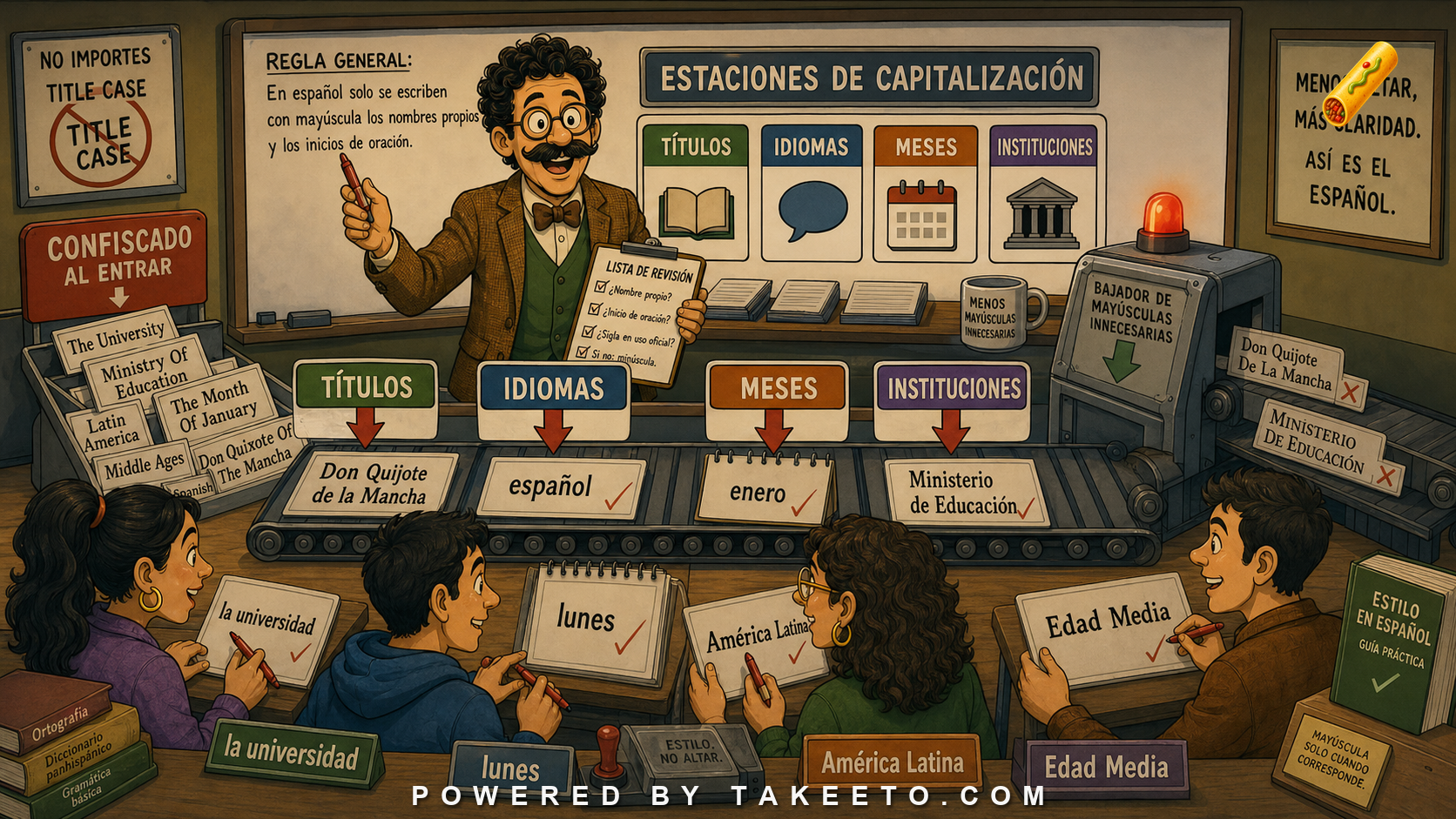
English title-case instincts will mislead you
Spanish uses capital letters differently from English.
This sounds minor until you start writing essays, resumes, titles, headings, institutional names, dates, and professional documents. English speakers often overcapitalize Spanish because English habits are visually powerful:
- Spanish
- Monday
- January
- The Ministry of Education
- A History of Latin America
In Spanish, many of these categories are lowercase unless a specific proper-name rule requires capitalization.
The first corrective rule is:
Spanish capitalization is more restrained than English capitalization.
That does not mean Spanish avoids capital letters. Proper names, official institutional names, historical periods, and titles have their own rules. But Spanish does not use capital letters as broadly as English in categories such as languages, nationalities, weekdays, months, seasons, or title words.
Languages and nationalities are lowercase
In Spanish, names of languages are common nouns and are normally written lowercase:
- español
- inglés
- francés
- árabe
- japonés
- chino
Examples:
Estudio español.
I study Spanish.
Habla inglés y francés.
He/She speaks English and French.
Nationalities and demonyms are also lowercase when used as adjectives or nouns:
- mexicano
- chilena
- argentino
- española
- peruano
- colombiano
Examples:
Es una escritora mexicana.
She is a Mexican writer.
Muchos argentinos viven en Buenos Aires.
Many Argentines live in Buenos Aires.
This is a major English interference point. Do not write Español for the language unless it appears at the beginning of a sentence, in a title position requiring initial capitalization, or as part of a proper name.
Days, months, and seasons are lowercase
Spanish writes days of the week, months, and seasons with lowercase initial letters in ordinary use:
- lunes
- martes
- miércoles
- enero
- febrero
- marzo
- primavera
- verano
- otoño
- invierno
Examples:
Nos vemos el lunes.
I’ll see you on Monday.
Nació en enero.
He/She was born in January.
Viajamos durante el verano.
We travel during the summer.
They are capitalized only when another rule requires it: beginning of a sentence, part of a proper name, title formatting, or an official name.
Compare:
El lunes tengo clase.
Monday, I have class.
Vivo en la avenida Dieciséis de Septiembre.
I live on Sixteenth of September Avenue.
In the second example, the date phrase is part of a proper street name, so capitalization follows proper-name behavior.
Titles of works: Spanish uses sentence-style capitalization
English title case capitalizes many major words:
One Hundred Years of Solitude
Spanish generally capitalizes only the first word and proper names within titles:
Cien años de soledad
Examples:
| English-style expectation | Spanish norm |
|---|---|
| Don Quijote De La Mancha | Don Quijote de la Mancha |
| La Casa De Los Espíritus | La casa de los espíritus |
| Historia De América Latina | Historia de América Latina |
| El Amor En Los Tiempos Del Cólera | El amor en los tiempos del cólera |
Proper names inside titles still keep capitals:
- Don Quijote de la Mancha
- Historia de América Latina
- La ciudad y los perros
For article headlines, book titles, essay titles, and section headings, do not import English title case unless a publisher’s branding or design guide explicitly asks for it.
Institutions and official names
Spanish capitalizes official names of institutions, organizations, departments, laws, programs, and entities when referring to the proper name.
Examples:
- Ministerio de Educación
- Real Academia Española
- Universidad Nacional Autónoma de México
- Biblioteca Nacional
- Tribunal Supremo
- Organización de las Naciones Unidas
But generic references are lowercase:
- el ministerio
- la academia
- la universidad
- la biblioteca
- el tribunal
- la organización
Compare:
El Ministerio de Educación publicó el informe.
The Ministry of Education published the report.
El ministerio publicó el informe.
The ministry published the report.
Estudio en la Universidad de Chile.
I study at the University of Chile.
Estudio en la universidad.
I study at the university.
The distinction is not importance. It is proper-name status.
Historical periods and events
Spanish capitalization with historical periods and events requires care.
Common historical periods often take capitals when treated as established proper names:
- la Edad Media
- el Renacimiento
- la Ilustración
- la Revolución francesa, with variation depending on treatment and style guides
- la Segunda Guerra Mundial
But generic descriptive phrases remain lowercase:
- una guerra civil
- una revolución cultural, unless part of an official/historical proper name
- el periodo colonial, depending on whether used as generic description
For learners, the safe method is to check whether the phrase is a conventional historical name or a generic description.
Sacred, honorific, and formal titles
Words such as don, doña, señor, señora, doctor, presidente, papa, rey vary by context.
General patterns:
- Lowercase in ordinary generic or descriptive use: el presidente habló, la doctora llamó.
- Capitalization may appear in abbreviated forms: Sr., Dra..
- Capitalization may be used in protocol, official documents, or religious contexts depending on style.
- Proper names keep capitals: don Quijote, doña Ana, el rey Felipe VI with style variation for titles.
Learners should not assume every title is capitalized because English often does it.
Compare:
La presidenta llegó tarde.
The president arrived late.
La presidenta García llegó tarde.
President García arrived late.
Spanish style may still use lowercase for the title word itself unless it is part of an official name or formal heading.
Geographic names
Proper geographic names are capitalized:
- España
- México
- América Latina
- Buenos Aires
- los Andes
- el Caribe
- el Pacífico
Generic geographic nouns are lowercase unless part of the proper name:
- el río Amazonas: río may be lowercase as generic classifier, Amazonas proper
- la cordillera de los Andes
- el océano Pacífico, with style conventions
- el mar Mediterráneo
Directional words are lowercase when they indicate direction or region generically:
- el norte
- el sur
- hacia el oeste
But they may be capitalized inside proper names:
- América del Sur
- Corea del Norte
Academic subjects and school courses
Spanish often lowercases fields of study when generic:
- estudio historia
- me interesa la biología
- enseña matemáticas
But official course names, department names, or program titles may be capitalized:
- Departamento de Historia
- Licenciatura en Matemáticas
- Historia de América Latina II, as a formal course title
Again, proper-name status controls capitalization.
Branding and journalism may diverge
Real-world Spanish includes branding, headlines, institutional identity, and graphic design.
A company may style its name in all caps. A newspaper may use headline conventions. A university may capitalize a program name for institutional branding. A social media post may ignore formal norms.
Do not confuse branding with neutral orthography.
If you are writing an essay, application, formal email, translation, or teaching material, use standard Spanish capitalization unless a specific style guide says otherwise.
Editing checklist for English speakers
Before submitting Spanish writing, check these categories:
| Category | Spanish default |
|---|---|
| Languages | lowercase: español, inglés |
| Nationalities | lowercase: mexicano, chilena |
| Days | lowercase: lunes, martes |
| Months | lowercase: enero, febrero |
| Seasons | lowercase: primavera, verano |
| Titles of works | capitalize first word and proper names |
| Institutions | capitalize official proper name, lowercase generic reference |
| Academic fields | lowercase unless official program/course name |
| Historical periods | capitalize established proper names; check style |
| Directions | lowercase unless part of proper name |
Common learner mistakes
Mistake 1: Writing languages with capitals
Incorrect in ordinary use: Estudio Español. Better: Estudio español.
Mistake 2: Importing English title case
Avoid: La Historia De América Latina. Better: La historia de América Latina.
Mistake 3: Capitalizing all institutional references
La Universidad is only capitalized if part of a proper name or heading convention. Generic la universidad is lowercase.
Mistake 4: Capitalizing months and days
Write lunes and enero, not Lunes and Enero, except where another rule applies.
Mistake 5: Assuming importance requires capitals
Capitalization is not a respect meter. It follows proper-name and style conventions.
Suggested interactive module: Spanish title-case converter
A useful tool for this article would accept English-shaped capitalization and convert it to standard Spanish style.
Suggested functions:
- Title converter: La Casa De Los Espíritus → La casa de los espíritus.
- Category labels: language, weekday, month, institution, proper name.
- Generic/proper distinction: la universidad vs Universidad de Buenos Aires.
- Style warning: branding/headline exceptions.
- Document checklist: essays, resumes, academic titles, formal letters.
Example input:
Estudio Español los Lunes en la Universidad Nacional.
Possible output:
Estudio español los lunes en la Universidad Nacional.
Explanation:
- español: language, lowercase
- lunes: weekday, lowercase
- Universidad Nacional: institution name, capitalized
Final rule
Spanish capitalization is not English capitalization with Spanish words.
Languages, nationalities, weekdays, months, seasons, and most title words are lowercase in ordinary use. Proper names and official institutional names are capitalized. Generic references are usually not.
When in doubt, ask whether the word is a true proper name or merely an important common noun. Spanish does not capitalize importance; it capitalizes naming.