
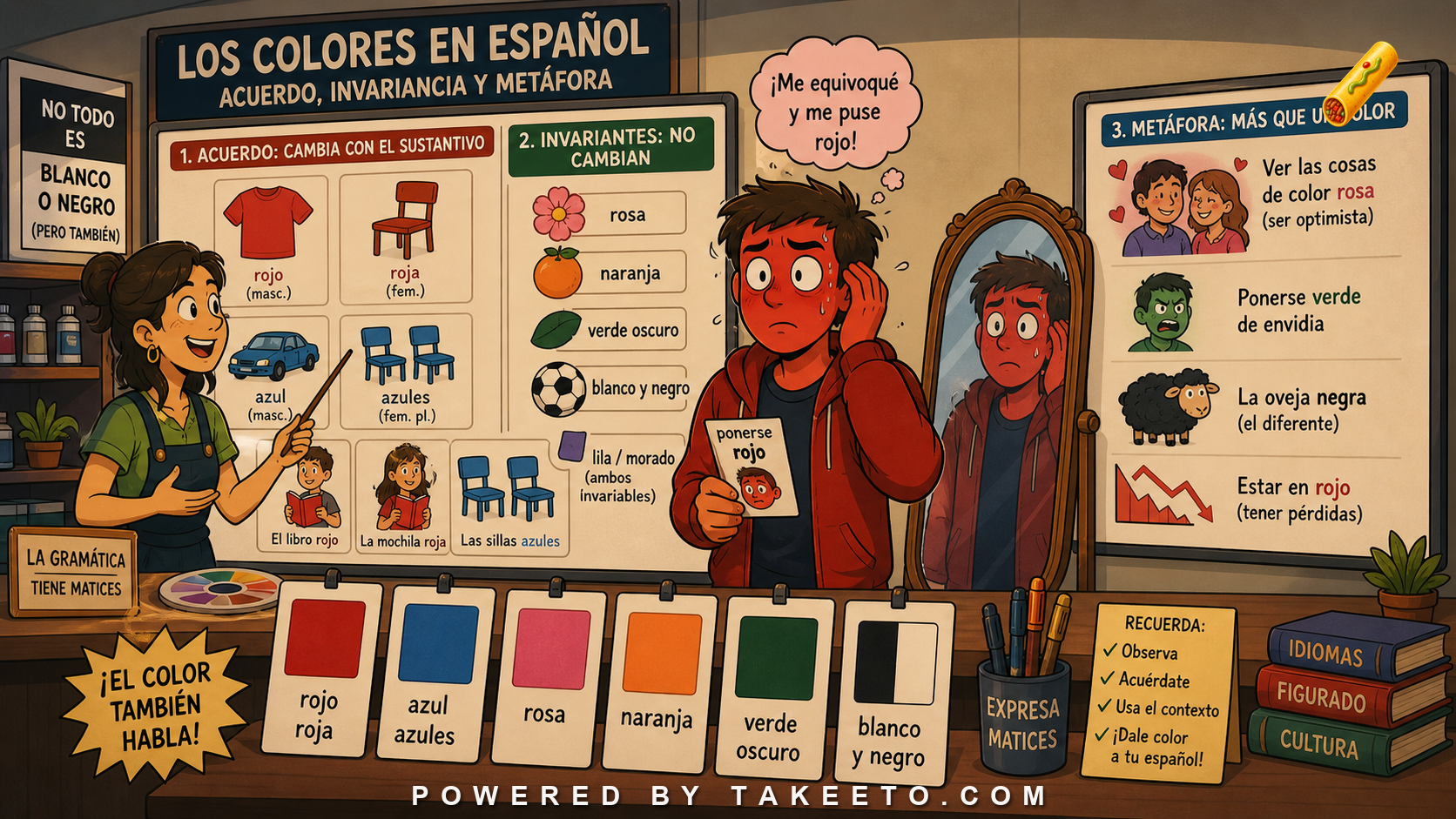
Colors look simple until they start behaving like nouns
A beginner learns:
una camisa roja
unos zapatos negros
una casa blanca
So far, colors look like ordinary adjectives. They agree with the noun in gender and number. Then the learner meets:
camisas naranja
ojos verde oscuro
pantalones azul marino
una foto en blanco y negro
se puso rojo
Now the system seems less simple. Why does roja agree, but naranja may not? Why verde oscuro and not always verdes oscuros? Why is blanco y negro fixed in some expressions? Why does ponerse rojo describe embarrassment or anger?
The key principle is:
Spanish color words move between adjective behavior, noun behavior, compound description, and metaphor.
A learner who understands those roles will stop memorizing color exceptions randomly.
Basic color adjectives agree
When a color word functions as an ordinary adjective, it agrees with the noun.
el coche rojo
la falda roja
los coches rojos
las faldas rojas
el vestido blanco
la camisa blanca
los vestidos blancos
las camisas blancas
Some color adjectives do not mark gender but do mark number:
el vestido azul
la camisa azul
los vestidos azules
las camisas azules
el pantalón gris
la falda gris
los pantalones grises
las faldas grises
This is ordinary adjective agreement. The adjective agrees where its form allows it.
Color nouns are masculine
Color names can also be nouns:
el rojo
el verde
el azul
los blancos
los grises
In this role, they are masculine nouns. You can talk about colors as things:
El azul de esa pared es demasiado intenso.
Los verdes del cuadro son muy oscuros.
This noun use matters because many complex color expressions treat the color term as a noun inside a larger phrase.
Noun-derived colors can remain invariable
Some colors come from nouns that originally name fruits, flowers, minerals, substances, or objects:
naranja
rosa
violeta
lila
malva
turquesa
añil
These may be used as invariable noun modifiers:
faldas naranja
camisas rosa
ojos malva
They may also appear as more adjective-like forms in actual usage:
faldas naranjas
camisas rosas
aguas turquesas
The invariable pattern is especially important in formal color description, product language, and style guides. The variable pattern is also real in many cases. Learners should recognize both and choose conservatively when writing formally.
A safe production rule:
For noun-derived colors like naranja and rosa, the invariable form is often safe in compound/product descriptions: camisas naranja, vestidos rosa.
But do not be shocked when native usage varies.
Compound colors often stay masculine singular
When a color is modified by another color word, adjective, or noun, the phrase often behaves like a color noun in apposition and remains masculine singular:
una camisa verde oscuro
unos ojos azul claro
unas hojas verde oscuro
una pared blanco roto
unas baldosas gris perla
This pattern means “of a dark green color,” “of a light blue color,” “of pearl gray color.” The color phrase is not behaving like a simple adjective agreeing directly with the noun.
You may also see concordant variants in real usage, especially with adjective-like second elements:
una vela azul clara
campos verdes oscuros
But for learners, the non-agreeing compound color pattern is important and often preferred in formal description:
camisas azul marino
coches gris plata
paredes verde oliva
Hyphens are not the default
Spanish generally does not use a hyphen in ordinary compound color expressions:
amarillo limón
verde esmeralda
rojo sangre
azul marino
Do not import English hyphen habits automatically. Product descriptions, fashion writing, and design language often keep color terms as separate words.
Black and white, color, and visual categories
Some expressions are fixed or semi-fixed:
en blanco y negro
a todo color
televisión en color
fotografía en blanco y negro
Here blanco y negro describes a visual mode rather than agreeing with a noun. You do not say fotografía blanca y negra unless you mean the photo itself is physically white and black as an object or image content in a different sense.
Compare:
una película en blanco y negro
a black-and-white film
una bandera blanca y negra
a flag that is white and black
The first is a medium/style category. The second describes visible colors on an object.
Colors become metaphors
Colors carry emotional, political, cultural, and physical meanings.
ponerse rojo
to blush, turn red, become embarrassed or angry
estar verde
to be inexperienced, unripe, or not ready depending on context
dinero negro
undeclared/illegal money
mercado negro
black market
prensa amarilla
sensationalist press
novela rosa
romance novel
chiste verde
dirty joke in many contexts
Some metaphors are widely shared. Others vary by country, politics, and domain. Color words can refer to political parties, sports teams, traffic signals, race categories, environmental movements, and branding.
Learner action: never translate color metaphors mechanically.
Product descriptions and visual language
In clothing, cars, design, cosmetics, and online shopping, color grammar becomes practical.
Examples:
talla M, color azul marino
vestido rosa palo
zapatillas blanco roto
funda gris oscuro
bolso verde botella
Product language often uses color as a label. Agreement may be reduced because the phrase is treated as a color category.
Learner action: when reading product descriptions, ask whether the color phrase is an adjective or a label.
Example bank walkthrough
rojo / roja
A basic variable adjective.
Learner action: agree it normally: coche rojo, camisa roja.
azul / azules
Common-gender adjective with plural change.
Learner action: la camisa azul, las camisas azules.
rosa
Noun-derived color that may remain invariable or agree in some usage.
Learner action: recognize both camisas rosa and camisas rosas, with formal caution.
naranja
Fruit-derived color with variable/invariable possibilities.
Learner action: use faldas naranja safely in product-style description.
verde oscuro
Compound color often masculine singular as a phrase.
Learner action: hojas verde oscuro is a normal formal pattern.
blanco y negro
Fixed visual-mode expression in en blanco y negro.
Learner action: distinguish medium from object color.
ponerse rojo
Metaphorical/body-state use.
Learner action: learn colors in verb phrases, not just as adjectives.
Remediation notes: color agreement has two systems at once
The repair for color terms is to show why both faldas naranja and faldas naranjas can appear without making learners think anything goes. Spanish has ordinary adjective agreement, but it also has color nouns used in apposition. When a color word behaves like a regular adjective, it agrees: falda roja, pantalones negros, camisas blancas. When a noun-derived color is used as an appositional noun, it may remain invariable: faldas naranja, camisas rosa, ojos malva. Some of these forms can also be adjectivized and agree: faldas naranjas, camisas rosas, ojos malvas.
Compound colors need a separate rule. In expressions like verde oscuro, azul claro, gris perla, rojo cereza, and blanco roto, the color phrase often stays masculine singular because it behaves like a color-name unit: camisas verde oscuro, paredes blanco roto, tonos gris perla. Concordant variants such as camisas verdes oscuras also occur, especially when speakers feel both words as adjectives, but the invariable color-unit pattern is often the safest in formal product-style description.
Do not use hyphens by English habit. Spanish normally writes verde esmeralda, amarillo mostaza, azul marino, rojo cereza without a hyphen. There are technical and compound-word exceptions, but the learner default should be no hyphen for ordinary color modifiers.
Metaphor is separate from physical color. Novela rosa, prensa amarilla, mercado negro, ponerse rojo, estar en números rojos, chiste verde, and political color labels are lexicalized or cultural expressions. They must be learned as phrases, not recalculated from paint samples.
Production target: for basic colors, agree normally. For noun-derived colors and modified color names, recognize both patterns but prefer conservative invariable color-unit forms in product descriptions until you know the register: vestidos rosa palo, camisas azul claro, faldas naranja.
Suggested interactive module: color adjective agreement chart
A strong tool for this article would show color behavior by type.
Suggested functions:
- Simple adjective mode: rojo/roja/rojos/rojas, azul/azules.
- Noun-derived mode: rosa, naranja, violeta, turquesa with variable/invariable examples.
- Compound mode: verde oscuro, azul marino, gris perla, rojo sangre.
- Product description mode: clothing, cars, cosmetics, design.
- Metaphor bank: ponerse rojo, estar verde, mercado negro, prensa amarilla.
- Correction exercise: identify whether agreement is required, optional, or not expected.
- Register note: formal description versus colloquial variation.
Final rule
Color words in Spanish are not one simple adjective class.
Basic colors agree. Color nouns are masculine. Noun-derived colors may remain invariable. Compound color phrases often stay masculine singular. Metaphors must be learned as expressions. Color grammar is a small system inside the larger system of agreement.