
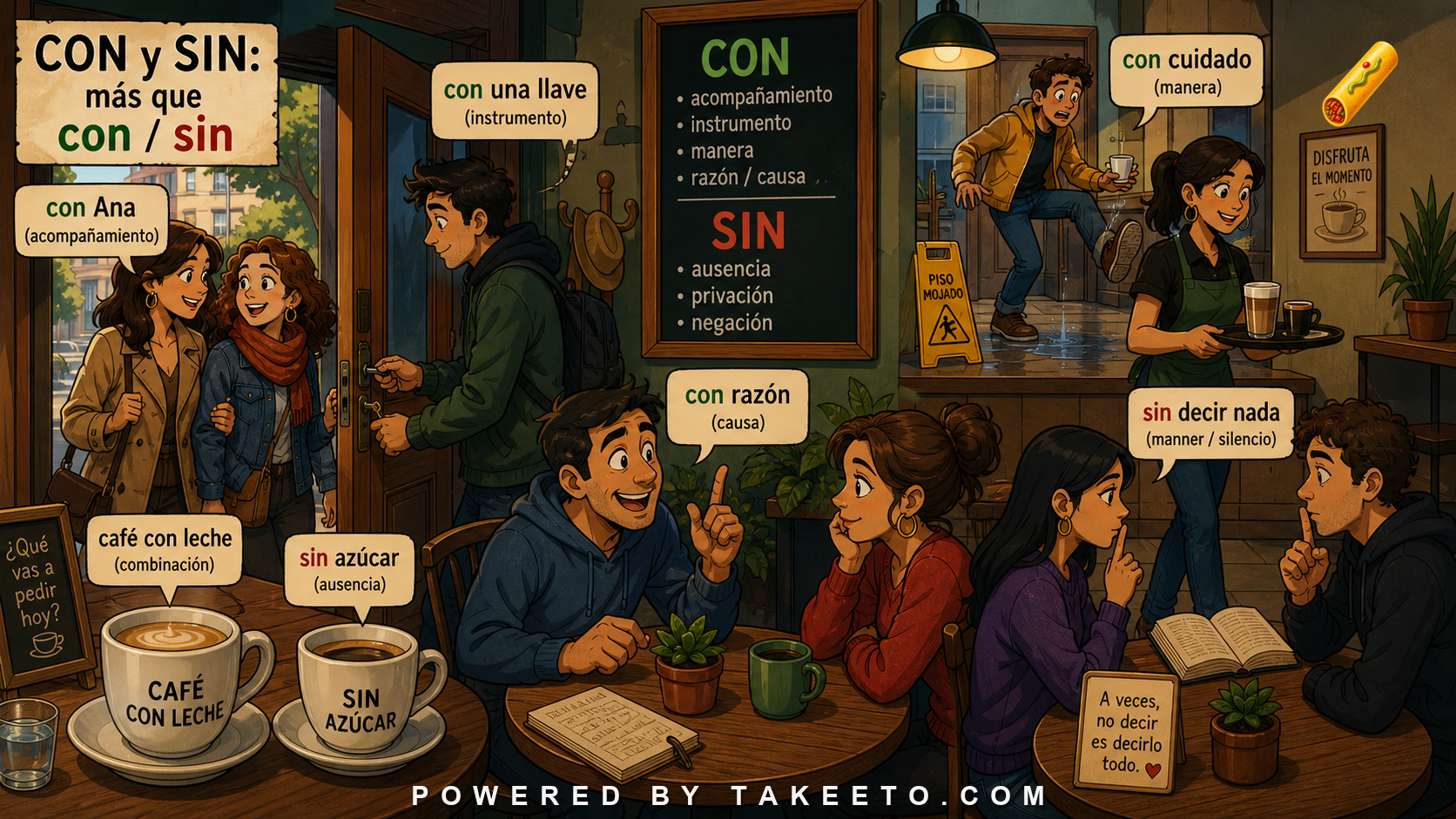
With and without are only the beginning
Spanish con and sin are often introduced as “with” and “without.” That is mostly true, but it is not enough.
con Ana
with Ana
sin azúcar
without sugar
So far, easy. But then learners meet:
con cuidado
carefully
con razón
rightly / with good reason
con una llave
with a key / using a key
sin decir nada
without saying anything
café con leche
coffee with milk
These are not isolated idioms. Con links an event to accompaniment, instrument, manner, ingredient, condition, or stance. Sin marks absence, lack, non-performance, exclusion, or negative circumstance.
The useful rule is:
Con adds an accompanying element; sin removes or denies one.
The element may be a person, tool, manner, ingredient, condition, or action.
Con as accompaniment
The most concrete use is accompaniment.
Voy con Ana.
I am going with Ana.
Vive con sus padres.
He/she lives with his/her parents.
Hablé con el director.
I spoke with the director.
Here con marks a co-participant.
Spanish has special forms for some pronouns:
| Phrase | Meaning |
|---|---|
| conmigo | with me |
| contigo | with you |
| consigo | with himself/herself/itself/themselves, or with you formal in reflexive contexts |
Examples:
Ven conmigo.
Come with me.
Quiero hablar contigo.
I want to talk with you.
Do not say con mí or con ti in standard Spanish.
Con as instrument or means
Con can mark the tool or means used to do something.
Abrí la puerta con una llave.
I opened the door with a key.
Escribió la carta con lápiz.
He/she wrote the letter in pencil.
Cortó el pan con un cuchillo.
He/she cut the bread with a knife.
The tool accompanies the action as an instrument.
This extends to means more generally:
Con práctica, mejorarás.
With practice, you will improve.
Con paciencia se aprende.
With patience, one learns.
The “tool” may be abstract.
Con as manner
Many con phrases describe how an action is done.
Hazlo con cuidado.
Do it carefully.
Escuchó con atención.
He/she listened attentively.
Respondió con calma.
He/she answered calmly.
Lo dijo con ironía.
He/she said it ironically.
English often uses an adverb ending in -ly. Spanish often uses con + noun.
| Spanish | Natural English |
|---|---|
| con cuidado | carefully |
| con calma | calmly |
| con atención | attentively |
| con respeto | respectfully |
| con dificultad | with difficulty |
This pattern is especially useful in formal and instructional Spanish.
Con as ingredient or feature
Con marks ingredients and included features:
café con leche
coffee with milk
pan con tomate
bread with tomato
una habitación con baño privado
a room with a private bathroom
un coche con aire acondicionado
a car with air conditioning
Here con adds an included component.
The opposite is often sin:
café sin azúcar
coffee without sugar
una habitación sin ventana
a room without a window
un formulario sin firma
an unsigned form / a form without a signature
Sin as absence or lack
Sin marks absence:
Estoy sin dinero.
I am without money.
Salió sin abrigo.
He/she went out without a coat.
No hay café sin azúcar.
There is no coffee without sugar.
Sin can also form adjective-like descriptions:
una respuesta sin sentido
a senseless answer
una persona sin experiencia
a person without experience
documentos sin firma
unsigned documents
The phrase after sin describes what is missing.
Sin + infinitive
Sin commonly takes an infinitive to mean “without doing.”
Salió sin decir nada.
He/she left without saying anything.
Firmó sin leer el contrato.
He/she signed without reading the contract.
No puedes aprender sin practicar.
You cannot learn without practicing.
English often uses a gerund after “without.” Spanish uses the infinitive after a preposition.
This is a major pattern that article 060 treats more broadly:
preposition + infinitive
With sin, the infinitive names the action that does not happen.
Con + infinitive and condition-like meanings
Con can also appear before infinitives in some structures:
Con estudiar un poco cada día, mejorarás.
By studying / If you study a little every day, you will improve.
Con solo mirarlo, entendí el problema.
Just by looking at it, I understood the problem.
This use often gives a condition, means, or sufficient action. It is less basic than sin + infinitive, but important in dense Spanish.
Con razón and sin razón
Some con/sin phrases express stance or justification.
Tienes razón.
You are right.
Lo dijo con razón.
He/she said it with good reason.
Se quejó sin razón.
He/she complained without reason.
Con razón no vino.
No wonder he/she did not come.
Con razón can mean “rightly,” “with reason,” or “no wonder,” depending on placement and context.
This is a good reminder that prepositional phrases can become discourse expressions.
Common learner errors
Error 1: Saying con mí or con ti
Better:
conmigo
contigo
Error 2: Translating English adverbs too literally
carefully = con cuidado is often more natural than inventing a -mente adverb.
Error 3: Forgetting infinitive after sin
sin decir nada
without saying anything
Not sin diciendo nada.
Error 4: Treating con only as accompaniment
con una llave = using a key
con cuidado = carefully
con leche = containing milk
Error 5: Missing adjective-like sin phrases
un documento sin firma = an unsigned document
Do not translate every sin phrase clumsily as “without a signature document.”
Con/sin phrases as compact modifiers
Spanish uses con and sin phrases to modify nouns and clauses compactly. These phrases often correspond to English adjectives, adverbs, or relative clauses.
Noun modifiers
una habitación con baño privado
a room with a private bathroom
una casa sin jardín
a house without a garden
documentos sin firma
unsigned documents
café con leche
coffee with milk
The con/sin phrase gives a feature. English may use “with,” “without,” a compound, or an adjective. Spanish keeps the prepositional phrase.
Clause modifiers
Lo hizo con cuidado.
He/she did it carefully.
Salió sin mirar atrás.
He/she left without looking back.
Here the phrase modifies the event. Con adds manner or means; sin removes an expected accompanying action.
Conditions and concessions
Con can introduce a condition:
Con más tiempo, lo haría mejor.
With more time, I would do it better.
Sin can introduce a limiting absence:
Sin datos, no podemos decidir.
Without data, we cannot decide.
These phrases can replace fuller clauses:
Si tuviéramos más tiempo...
If we had more time...
Si no tenemos datos...
If we do not have data...
Con as attitude or stance
con razón
with reason / no wonder
con respeto
respectfully
con franqueza
frankly
These phrases are not just physical accompaniment. They tell the reader the speaker’s stance or the manner of discourse.
Sin and negative polarity
Because sin already marks absence, it often appears with words like nada, nadie, or ningún:
sin decir nada
without saying anything
sin ningún problema
without any problem
This is normal Spanish negative concord behavior, not a logical error.
The practical reading strategy is to ask: does the con/sin phrase describe an included feature, missing feature, tool, manner, condition, stance, or omitted action?
When con and sin change the tone of a noun
A con/sin phrase can make a noun more specific, more evaluative, or more administrative.
una persona con experiencia
a person with experience
una persona sin experiencia
a person without experience
These are neutral descriptions in hiring or education contexts. But similar structures can carry judgment:
un comentario sin sentido
a senseless comment
una respuesta con fundamento
a well-founded answer
The prepositional phrase becomes almost adjective-like.
In official writing, con/sin phrases can define eligibility:
estudiantes con matrícula vigente
students with current enrollment
solicitudes sin documentación completa
applications without complete documentation
Here the phrase is not merely descriptive; it determines category membership.
In menus and product descriptions, con/sin marks ingredients or features:
pan con semillas
bread with seeds
yogur sin lactosa
lactose-free yogurt
habitación con vista al mar
room with sea view
Spanish often keeps these as prepositional phrases where English creates adjectives such as “lactose-free,” “seeded,” or “ocean-view.”
A good reading habit is to ask whether the con/sin phrase is adding a physical component, required feature, missing document, evaluative quality, or category condition. The translation will change accordingly.
Micro-drill: included, missing, or manner?
Classify the con/sin phrase before translating.
té con limón
included ingredient: tea with lemon
té sin azúcar
missing ingredient: tea without sugar
habló con seguridad
manner/stance: he/she spoke confidently
salió sin cerrar la puerta
omitted action: he/she left without closing the door
estudiantes con beca
included status/category: students with a scholarship
solicitudes sin firma
missing required feature: applications without a signature
This classification is especially helpful because English may use adjectives instead of prepositional phrases:
sin azúcar → sugar-free
sin firma → unsigned
con experiencia → experienced
con cuidado → carefully
Spanish often keeps the relation visible with con or sin. Do not flatten all of these into literal “with/without” translations if English has a more natural equivalent.
Sin plus infinitive vs sin que
Use sin + infinitive when the subject is clear:
Salió sin avisar.
He/she left without warning.
Use sin que + clause when another subject must be named:
Salió sin que sus padres lo supieran.
He left without his parents knowing.
This contrast will become more important in the subjunctive articles, but it already explains why sin avisar and sin que nadie avise are not interchangeable structures.
Final contrast: con as addition, sin as subtraction
A quick production test is to imagine a checklist. If the phrase adds a person, tool, ingredient, feature, reason, or manner, con is likely: con Ana, con llave, con leche, con cuidado. If it removes one, sin is likely: sin Ana, sin llave, sin azúcar, sin avisar.
Diagnostic refinement: con and sin can modify nouns, verbs, or whole situations
The pair con/sin begins with inclusion and absence, but serious reading requires role labels.
Con can mark accompaniment:
Fui con Ana.
It can mark instrument:
Abrí la puerta con una llave.
It can mark manner:
Habló con cuidado.
Respondió con calma.
It can mark ingredient or feature:
café con leche
una casa con jardín
Sin can mark absence:
café sin azúcar
una habitación sin ventanas
And it can mark non-performance with an infinitive:
Salió sin decir nada.
He/she left without saying anything.
The subject of a sin + infinitive phrase is usually recovered from the main clause:
Ana salió sin avisar.
Ana left without Ana notifying anyone.
If the subject changes, Spanish commonly uses sin que + subjunctive:
Ana salió sin que nadie la viera.
Ana left without anyone seeing her.
This distinction prevents many English-shaped errors.
Con + infinitive can express a condition-like or sufficiency relation:
Con estudiar una hora más, basta.
Studying one more hour is enough.
Con decir la verdad no pierdes nada.
By telling the truth, you lose nothing.
These are not ordinary “with + gerund” translations. They compress a condition or means.
A useful label set for con/sin phrases is:
| Phrase | Role |
|---|---|
| con Ana | accompaniment |
| con una llave | instrument |
| con paciencia | manner/stance |
| con leche | ingredient/feature |
| sin azúcar | absence |
| sin avisar | absent action |
| sin que avisara | absent event with different subject |
Once the role is named, translation becomes easier. Without the role, learners overuse literal “with” and “without” and miss how compact Spanish modification can be.
Suggested interactive module: con/sin phrase-role labeler
A useful tool for this article would classify con and sin phrases by role.
Suggested functions:
- Role labels: accompaniment, instrument, manner, ingredient, feature, absence, non-performance, stance.
- Pronoun form checker: conmigo, contigo, consigo.
- Adverb converter: suggests con cuidado, con calma, con atención.
- Infinitive checker: flags sin diciendo and suggests sin decir.
- Menu/form mode: interprets con leche, sin azúcar, sin gluten, con baño privado.
Example input:
without reading the document
Output:
- Preposition: sin.
- Spanish uses infinitive after preposition.
- Result: sin leer el documento.
Final rule
Con adds an accompanying element; sin removes one. That element may be a person, tool, manner, ingredient, feature, reason, condition, or action.
Do not stop at “with” and “without.” Read what role the phrase plays: con Ana is accompaniment, con una llave is instrument, con cuidado is manner, café con leche is ingredient, sin decir nada is non-performance, and sin azúcar is absence.