
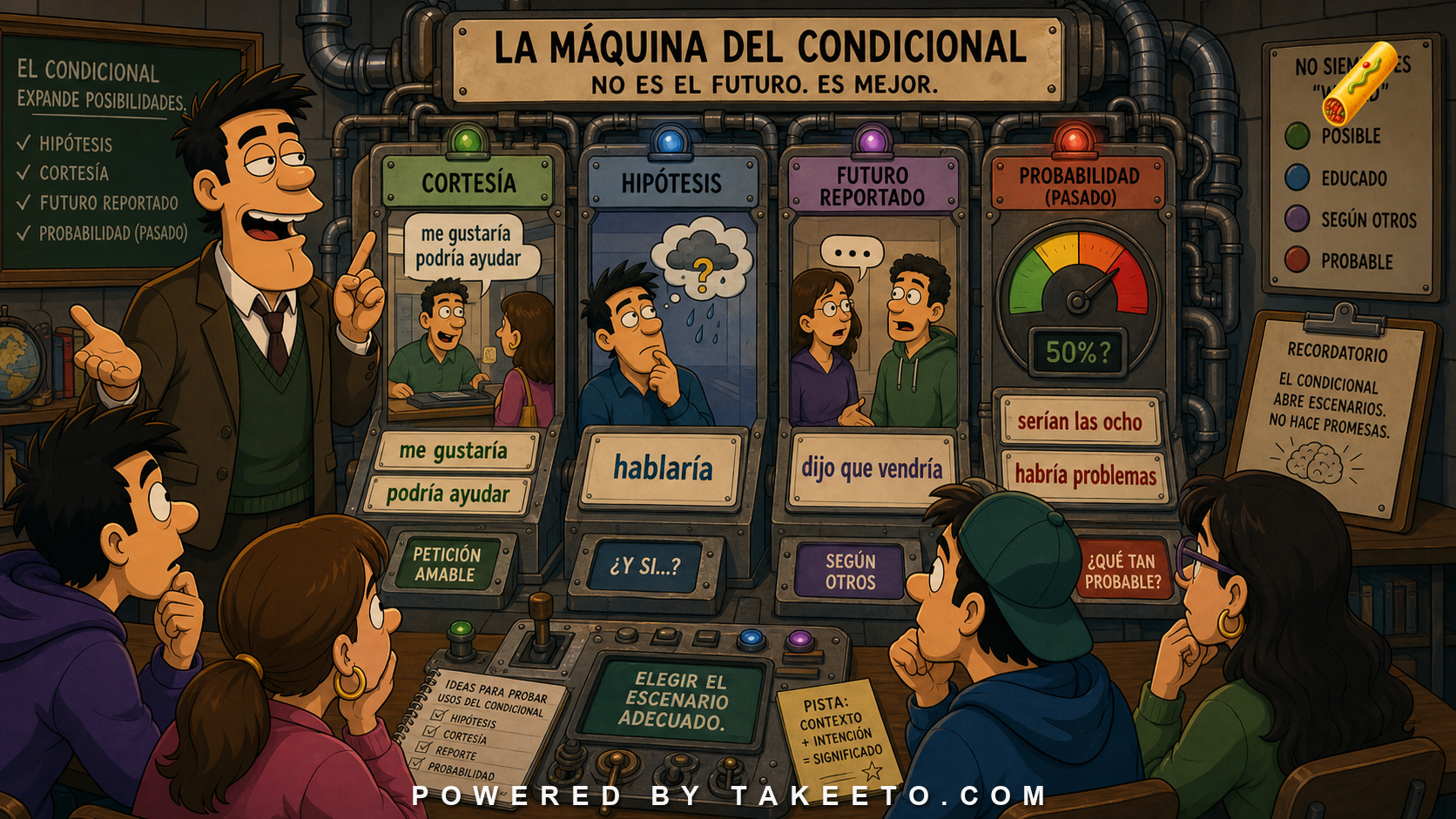
“Would” is a translation, not an explanation
The Spanish conditional is often introduced as the “would” form:
hablaría — I would speak
comeríamos — we would eat
vivirían — they would live
That is a useful doorway, but it is not enough. The conditional does more than translate English would. It participates in hypothesis, politeness, reported future, conjecture about the past, and journalistic distance.
A better learner rule is this:
The conditional presents a situation as dependent, projected, softened, reported, or inferred rather than simply asserted.
That dependency may be explicit:
Si tuviera tiempo, viajaría más.
If I had time, I would travel more.
It may be social:
Me gustaría hacer una pregunta.
I would like to ask a question.
It may be temporal:
Dijo que vendría.
He said he would come.
It may be inferential:
Serían las ocho cuando llegó.
It was probably around eight when he arrived.
All of these uses share a sense that the speaker is not presenting the situation as a plain, direct indicative fact.
The form parallels the future
The conditional is built from the infinitive plus endings:
| Infinitive | yo | nosotros/as | ellos/as |
|---|---|---|---|
| hablar | hablaría | hablaríamos | hablarían |
| comer | comería | comeríamos | comerían |
| vivir | viviría | viviríamos | vivirían |
The endings are the same across -ar, -er, and -ir verbs:
-ía, -ías, -ía, -íamos, -íais, -ían
The irregular stems are mostly the same as the future stems:
| Infinitive | Future | Conditional |
|---|---|---|
| tener | tendré | tendría |
| hacer | haré | haría |
| decir | diré | diría |
| poner | pondré | pondría |
| salir | saldré | saldría |
| venir | vendré | vendría |
| poder | podré | podría |
| querer | querré | querría |
| haber | habré | habría |
This parallel matters because the conditional is historically and structurally tied to future-like projection. It often presents an event from a viewpoint other than direct actuality.
Hypothetical consequence
The best-known use appears in hypothetical sentences:
Si tuviera más tiempo, estudiaría todos los días.
If I had more time, I would study every day.
Si viviera en Madrid, iría al museo con frecuencia.
If I lived in Madrid, I would go to the museum often.
Compraría el libro si no fuera tan caro.
I would buy the book if it were not so expensive.
The common pattern is:
si + imperfect subjunctive, conditional
| If-clause | Result clause |
|---|---|
| Si tuviera dinero | compraría el coche |
| Si pudiera | viajaría más |
| Si Ana estuviera aquí | sabría qué hacer |
A common learner error is using the conditional in both clauses:
Si tendría dinero, compraría el coche.
For standard learner Spanish, use:
Si tuviera dinero, compraría el coche.
There are regional and colloquial patterns that complicate the picture, but they are not the learner’s starting point. The durable standard pattern is si tuviera… compraría.
Politeness and social distance
The conditional softens requests, offers, and preferences.
Quiero hacer una pregunta.
I want to ask a question.
Querría hacer una pregunta.
I would like to ask a question.
¿Puede ayudarme?
Can you help me?
¿Podría ayudarme?
Could you help me?
Me gusta hablar con usted.
I like speaking with you.
Me gustaría hablar con usted.
I would like to speak with you.
The conditional does not automatically make a sentence polite. Tone, context, relationship, and wording matter. But it often creates distance between desire and demand. Instead of placing the speaker’s wish directly on the listener, it frames the request as conditional, softened, or less immediate.
This is especially important in service encounters, professional emails, academic questions, and situations where directness might sound abrupt.
Useful formulas include:
| Direct | Softer |
|---|---|
| Quiero saber… | Querría saber… / Me gustaría saber… |
| Necesito hablar con usted. | Necesitaría hablar con usted. |
| ¿Puede enviarme el documento? | ¿Podría enviarme el documento? |
| Dígame si está disponible. | ¿Me diría si está disponible? |
Do not overuse these forms until everything sounds evasive. But learn them as tools of social grammar.
Future in the past
The conditional also reports a future event from a past viewpoint.
Ana dice que vendrá.
Ana says she will come.
Ana dijo que vendría.
Ana said she would come.
In the second sentence, the coming is future relative to the moment of saying, but the saying itself is in the past. The conditional handles that shifted viewpoint.
More examples:
Pensé que sería más difícil.
I thought it would be harder.
Prometió que llamaría al día siguiente.
He promised that he would call the next day.
Nos dijeron que habría cambios.
They told us there would be changes.
This use is not hypothetical in the same way as si tuviera. It is a tense-of-reporting use: future from a past reference point.
A useful diagnostic is to ask: future relative to what?
| Sentence | Future relative to |
|---|---|
| Vendrá mañana. | now |
| Dijo que vendría mañana. | the past saying |
| Iba a venir. | a past plan or imminent setup |
Spanish gives you several ways to project forward from a past moment. The conditional is one of the most important.
Probability and conjecture about the past
The conditional can express probability or conjecture about a past situation.
Serían las ocho cuando llegó.
It was probably about eight when he arrived.
Habría unas veinte personas en la sala.
There were probably about twenty people in the room.
Estaría cansado después del viaje.
He was probably tired after the trip.
This mirrors the conjectural use of the future for present probability:
| Time of conjecture | Form | Example |
|---|---|---|
| present | future | Tendrá treinta años. — He is probably thirty. |
| past | conditional | Tendría treinta años entonces. — He was probably thirty then. |
This use surprises learners because English translations may not use would at all. The sentence serían las ocho often translates as “it must have been around eight” or “it was probably around eight.”
Journalistic conditional and source distancing
In journalism and formal reporting, the conditional can distance the writer from an unverified claim:
El ministro habría presentado su renuncia, según fuentes cercanas al gobierno.
The minister has reportedly submitted his resignation, according to sources close to the government.
Habría problemas en la negociación.
There are reportedly problems in the negotiation.
This use does not mean the event is hypothetical in the ordinary “if” sense. It signals that the information is attributed, unconfirmed, or reported with caution.
Learners should understand this use when reading news, but should use it carefully. In ordinary writing, overusing habría for rumors can make prose sound journalistic, evasive, or unnecessarily distant.
Common learner errors
The first error is thinking every English would maps to the conditional.
When I was young, I would visit my grandparents every summer.
This habitual past often uses the imperfect:
Cuando era joven, visitaba a mis abuelos todos los veranos.
The conditional visitaría would suggest a hypothetical or future-in-past reading, not ordinary habitual past.
The second error is using conditional in the si clause:
Si tendría tiempo, iría.
Si tuviera tiempo, iría.
The third error is missing the conjectural reading:
Serían las diez.
This may not mean “they would be ten.” It often means “it was probably ten o’clock.” Context decides.
The fourth error is treating polite conditionals as always equivalent to direct forms. Quiero hablar and querría hablar may refer to the same desire, but they do different social work.
Conditional with modal verbs
The conditional is especially common with modal or semi-modal verbs:
Podría ayudarle.
I could help you.
Deberíamos revisar el plan.
We should review the plan.
Tendrías que hablar con Ana.
You would have to talk with Ana.
Habría que estudiar el caso.
The case would need to be studied / One would have to study the case.
These forms let speakers suggest, advise, or evaluate without sounding as direct as the present:
Debemos salir.
We must leave.
Deberíamos salir.
We should leave.
The conditional does not automatically make a sentence polite, but it often reduces pressure by making the statement less immediate.
Conditional and desire
The forms me gustaría, quisiera, and querría can all soften desire, but they differ in distribution and tone:
Me gustaría hablar con usted.
I would like to speak with you.
Quisiera hacer una pregunta.
I would like to ask a question, often formal or courteous.
Querría reservar una mesa.
I would like to reserve a table, possible but more marked in many regions.
This shows that politeness is not a one-form solution. Spanish has several softened desire strategies, and regional preference matters. Me gustaría is broadly useful and safe for learners.
Reported future vs unfulfilled future
In dijo que vendría, the conditional only says that the coming was future from the past saying. It does not tell us whether the person came.
Dijo que vendría, y vino.
He/she said he/she would come, and did.
Dijo que vendría, pero no vino.
He/she said he/she would come, but did not.
The truth of the later event is supplied by context. This is why calling the conditional “unreal” is misleading. Some conditional uses are hypothetical, but future-in-the-past can describe real, unrealized, or unknown outcomes.
Conditional is not the same as subjunctive
Both the conditional and the subjunctive can appear in hypothetical language, but they do different jobs:
Si tuviera tiempo, viajaría.
If I had time, I would travel.
Tuviera is imperfect subjunctive in the condition. Viajaría is conditional in the consequence. Learners often blur these because English uses “would” in one part and past-looking forms in the other. Spanish keeps the architecture clear.
The conditional is a finite indicative form with modal uses. The subjunctive is a mood used in dependent contexts. They can cooperate, but they are not interchangeable.
Conditional in advice can be gentle or firm
A sentence like:
Yo hablaría con Ana.
may mean “I would talk to Ana if I were you.” It is advice framed through a hypothetical self. It can be gentle, but it can also be firm depending on tone. Similarly:
Deberías revisar el contrato.
is softer than debes revisar, but it still communicates obligation-like advice. Learners should remember that grammar softens; it does not erase social force.
Diagnostic refinement: conditional belongs in the result, not the ordinary si-clause
For standard learner Spanish, the most important conditional pattern is:
Si tuviera tiempo, viajaría más.
If I had time, I would travel more.
The si clause uses imperfect subjunctive; the result clause uses conditional. A very common learner error is to put the conditional in both clauses:
Si tendría tiempo, viajaría más.
That is not the baseline standard pattern for hypothetical conditions. Use:
| Meaning | Baseline Spanish |
|---|---|
| real/open future condition | Si tengo tiempo, iré. |
| hypothetical present/future condition | Si tuviera tiempo, iría. |
| counterfactual past condition | Si hubiera tenido tiempo, habría ido. |
The conditional also softens requests, but it does not automatically make them polite. Querría hablar con usted may sound formal or distant. Me gustaría hablar con usted often sounds smoother. ¿Podría ayudarme? is a conventional polite request, but tone and context still matter.
For reported future, the conditional is not hypothetical by itself:
Dijo que vendría.
He/she said that he/she would come.
This means the coming was future relative to the past saying. It does not tell us whether the person eventually came.
For probability, the conditional points to a past reference frame:
Serían las ocho.
It was probably around eight.
Compare with the future of conjecture:
Serán las ocho.
It is probably around eight.
This future/conditional pair is one of the cleanest ways to see that Spanish tense morphology often carries modality as well as time.
Suggested interactive module: conditional use map
A useful tool would ask the learner to classify conditional examples by function.
Example set:
| Sentence | Function |
|---|---|
| Si pudiera, viajaría más. | hypothetical result |
| Me gustaría hacer una pregunta. | politeness / softened desire |
| Dijo que vendría. | future in the past |
| Serían las ocho. | conjecture about the past |
| El acuerdo se habría firmado ayer. | journalistic/source distancing |
The tool should include a timeline layer for reported future, a social-distance layer for politeness, and an evidence layer for conjecture.
It should also contrast false matches:
| English sentence | Better Spanish |
|---|---|
| When I was little, I would play outside. | De pequeño jugaba afuera. |
| If I would have time… | Si tuviera tiempo… |
| He would be about forty then. | Tendría unos cuarenta años entonces. |
Final rule
The Spanish conditional is not just the “would tense.” It is a form of dependency, projection, softening, reporting, and inference.
Use it for hypothetical consequences, polite requests and preferences, future seen from a past viewpoint, conjecture about past situations, and cautious reported claims. When you see hablaría, podría, vendría, serían, or habría, ask what kind of distance the sentence is creating: logical, social, temporal, evidential, or journalistic.