
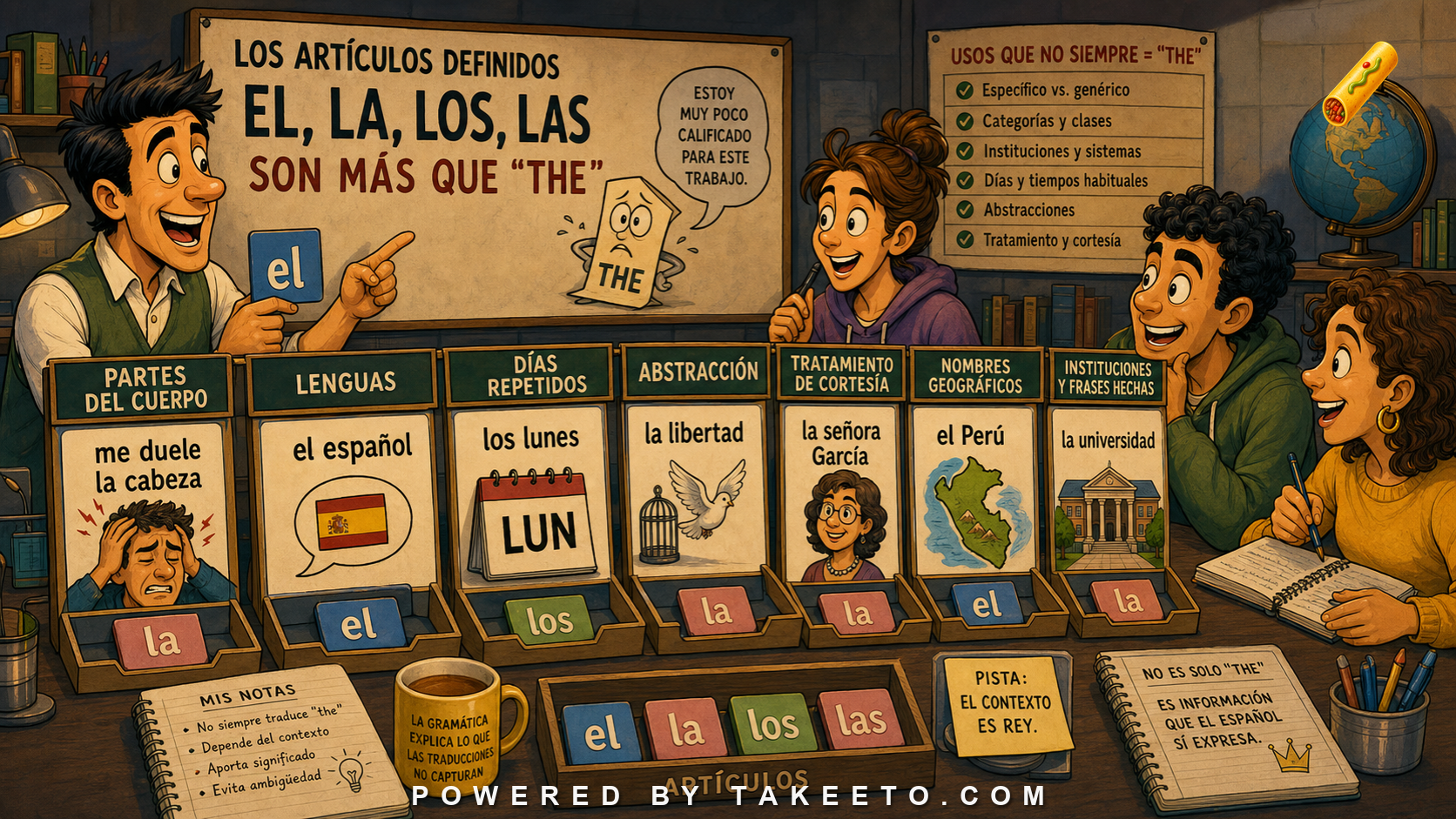
“The” is only the beginning
Spanish definite articles are usually introduced as translations of English the:
- el libro = the book
- la casa = the house
- los estudiantes = the students
- las ideas = the ideas
This is a necessary starting point. It is not enough.
Spanish uses definite articles in many places where English uses no article. It also omits them in some places where English might use one. If learners translate article by article from English, their Spanish will sound thin, foreign, or sometimes ungrammatical.
The core rule is:
Spanish definite articles mark definiteness, but they also mark generic reference, body-part possession, abstract nouns, routines, titles, and many conventional noun phrases.
The forms
Spanish definite articles agree in gender and number:
| Gender/number | Article | Example |
|---|---|---|
| masculine singular | el | el libro |
| feminine singular | la | la casa |
| masculine plural | los | los libros |
| feminine plural | las | las casas |
A special form appears with feminine singular nouns beginning with stressed a/ha:
- el agua fría
- el alma pura
- el águila blanca
But those nouns remain feminine.
Basic definiteness
Like English the, Spanish definite articles identify something known, specific, or recoverable from context.
Cerré la puerta.
I closed the door.
El profesor llegó tarde.
The professor arrived late.
Dejé las llaves en la mesa.
I left the keys on the table.
In these examples, the article tells the listener that the speaker expects them to identify the door, professor, keys, or table.
Generic nouns often take the article
Spanish often uses the definite article for general statements about a class.
El español es una lengua global.
Spanish is a global language.
Los gatos son independientes.
Cats are independent.
La tecnología cambia la educación.
Technology changes education.
La libertad exige responsabilidad.
Freedom requires responsibility.
English often uses bare plural or abstract nouns in these cases: “Cats,” “technology,” “freedom.” Spanish often uses el/la/los/las.
Compare:
| English | Spanish |
|---|---|
| Spanish is useful. | El español es útil. |
| Freedom matters. | La libertad importa. |
| Mondays are difficult. | Los lunes son difíciles. |
| Children learn quickly. | Los niños aprenden rápido. |
This is one of the highest-impact article differences for English speakers.
Body parts and clothing: Spanish often uses articles where English uses possessives
English says:
My head hurts.
Spanish usually says:
Me duele la cabeza.
Literally: “The head hurts me.” The indirect object me marks the affected person, while the article appears with the body part.
More examples:
Me lavé las manos.
I washed my hands.
Se rompió el brazo.
He/She broke his/her arm.
Ponte los zapatos.
Put on your shoes.
Me quité la chaqueta.
I took off my jacket.
Spanish can use possessives with body parts or clothing when contrast or clarification is needed, but the default is often article + affected participant.
This is not a small idiom. It reflects a broader grammar pattern.
Days and routines
Spanish uses definite articles with days in ways English does not.
| Spanish | Meaning |
|---|---|
| el lunes | on Monday / this Monday, depending on context |
| los lunes | on Mondays |
| el martes que viene | next Tuesday |
| los fines de semana | on weekends |
Examples:
Trabajo el lunes.
I work on Monday.
Trabajo los lunes.
I work on Mondays.
Cerramos los domingos.
We are closed on Sundays.
The plural article often marks habitual recurrence.
Languages
Spanish often uses the definite article with language names when they function as nouns:
El español tiene cinco vocales.
Spanish has five vowels.
El inglés usa muchas vocales reducidas.
English uses many reduced vowels.
But the article is often omitted after certain verbs, especially hablar, and in some course/subject contexts:
Hablo español.
I speak Spanish.
Estudio español.
I study Spanish.
Both patterns matter. Do not mechanically add el before every language name, and do not omit it in generic statements where Spanish expects it.
Titles and people
Spanish commonly uses articles with titles when talking about a person:
- la señora García
- el doctor Morales
- la profesora Ruiz
- el presidente
- la ministra
Examples:
La señora García llamó.
Mrs. García called.
El doctor Morales no está.
Dr. Morales is not here.
Usage varies with direct address. You generally do not use the article when addressing someone directly:
Buenos días, doctora Morales.
Good morning, Dr. Morales.
But when referring to the person, the article is common.
Institutions, places, and conventional nouns
Spanish often uses articles with institutions and places when referring to them as known social entities:
- la universidad
- el hospital
- la escuela
- el banco
- la iglesia
- el gobierno
Examples:
Voy a la universidad.
I’m going to the university / college.
Está en el hospital.
He/She is in the hospital.
Trabajo en el gobierno.
I work in government / for the government.
The article may be part of the natural Spanish phrase even when English uses no article.
Geographic names
Some country and region names take articles in common usage or formal style:
- el Perú
- el Ecuador
- la Argentina in some varieties and contexts
- los Estados Unidos
- el Reino Unido
- la India
- el Caribe
Others usually appear without article:
- México
- Chile
- España
- Colombia
- Cuba
Usage can vary regionally and stylistically. Learners should observe actual usage rather than impose a single rule.
Abstract nouns
Spanish often uses articles with abstract nouns:
- la libertad
- la justicia
- la paciencia
- el amor
- el miedo
- la educación
Examples:
La paciencia es necesaria.
Patience is necessary.
El amor no basta.
Love is not enough.
La educación cambia vidas.
Education changes lives.
English often uses no article for abstractions in general statements. Spanish often does.
Translation restraint
The learner’s job is not to translate the. The learner’s job is to decide how the Spanish noun phrase functions.
Ask:
- Is the noun specific and known?
- Is it a generic class?
- Is it an abstract noun used generally?
- Is it a body part with an affected person?
- Is it a weekday or routine?
- Is it a title, institution, language, or geographic name with conventional article use?
This decision is more reliable than English-to-Spanish word substitution.
Common learner mistakes
Mistake 1: Omitting articles in generic statements
Incorrect: Español es útil. Better: El español es útil.
Mistake 2: Using possessives for every body part
Awkward in many contexts: Mi cabeza duele. Better: Me duele la cabeza.
Mistake 3: Missing articles with habitual days
Incorrect: Trabajo lunes. Better: Trabajo los lunes for habitual Mondays.
Mistake 4: Overusing articles after hablar
Usually: Hablo español, not Hablo el español, unless a specific contrast or modified noun phrase justifies it.
Mistake 5: Assuming country articles are predictable from English
Learn them as conventional names.
Suggested interactive module: article-decision flowchart
A useful tool for this article would ask users why a noun phrase needs or omits an article.
Suggested functions:
- Function classifier: specific, generic, abstract, routine, body part, title, institution.
- English contrast: show why English omits the article.
- Agreement check: el/la/los/las based on gender and number.
- Conventional list: countries, titles, institutions, days.
- Correction mode: fix learner sentences.
Example input:
Spanish is useful.
Possible output:
El español es útil.
Explanation:
- Language used as generic noun
- Spanish uses definite article
- el agrees with español
Final rule
El, la, los, las are not just translations of English the.
They are Spanish noun-phrase architecture. They mark definiteness, but also generic meaning, abstract reference, body-part constructions, habitual days, titles, institutions, and conventional geographic names.
Do not ask only “Would English say the?” Ask what Spanish is doing with the noun.