
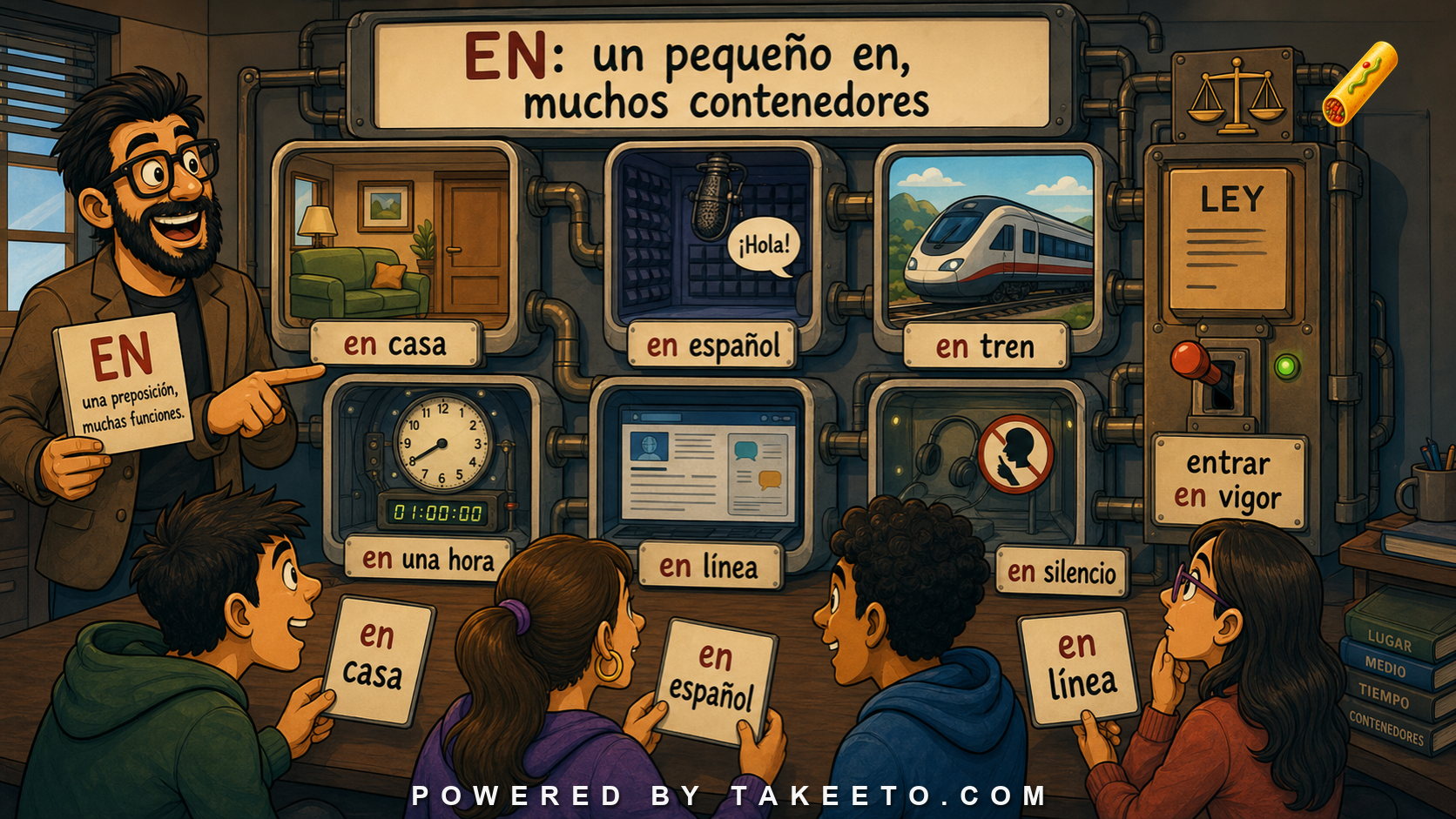
En places an event inside a frame
Spanish en is often translated as “in,” “on,” or “at,” depending on English context:
en casa
at home
en la mesa
on the table
en Madrid
in Madrid
en enero
in January
But the core Spanish idea is broader than any single English preposition. En often places something inside a physical, temporal, linguistic, technological, social, or conceptual frame.
A useful rule is:
En marks location within a space, medium, state, time frame, or conceptual container.
Physical location
The most concrete use is location.
Estoy en casa.
I am at home.
El libro está en la mesa.
The book is on the table.
Vive en Bogotá.
He/she lives in Bogotá.
Nos vemos en la oficina.
We will see each other at the office.
English uses in, on, or at depending on the noun. Spanish often uses en for all three. The question is not whether English says “in” or “on.” The question is whether Spanish places the thing in a location frame.
En vs a: location vs endpoint
The contrast with a is essential.
| Endpoint with a | Location with en |
|---|---|
| Voy a Madrid. | Estoy en Madrid. |
| Llego a la estación. | Estoy en la estación. |
| Entró a/en la sala depending on variety and frame. | Está en la sala. |
| Vuelve al tema. | Estamos en ese tema. |
For many verbs of motion, a marks the endpoint. En marks where something is located.
Vivo en México.
I live in Mexico.
Viajo a México.
I travel to Mexico.
English interference often causes errors because English says “arrive in Madrid” but Spanish says llegar a Madrid.
Medium: language, communication, and format
En marks the medium in which something is expressed or carried.
Lo escribí en español.
I wrote it in Spanish.
La entrevista fue en inglés.
The interview was in English.
Lo vi en la televisión.
I saw it on television.
Está publicado en línea.
It is published online.
El documento está en PDF.
The document is in PDF format.
The medium can be a language, platform, file format, channel, or mode of expression.
Transport
Spanish commonly uses en with modes of transport:
Voy en tren.
I am going by train.
Llegaron en coche.
They arrived by car.
Viajamos en avión.
We traveled by plane.
Se mueve en bicicleta.
He/she gets around by bicycle.
But some expressions are lexicalized differently:
ir a pie
to go on foot
montar a caballo
to ride horseback
Prepositions are partly systematic and partly conventional. Learn the common transport phrases as phrases.
Time frames
En places an event within a time frame:
en enero
in January
en 2026
in 2026
en verano
in summer
en la Edad Media
in the Middle Ages
It can also mark time required for completion:
Lo terminé en una hora.
I finished it in one hour.
And future time from now, depending on context:
Vuelvo en una hora.
I will return in an hour.
Do not confuse this with desde hace for duration continuing into the present:
Vivo aquí desde hace dos años.
I have lived here for two years.
Lo hice en dos años.
I did it in two years.
English “for” can mislead. Spanish distinguishes duration, completion span, and starting boundary.
States and conditions
En often marks states or conditions:
en silencio
in silence
en secreto
in secret
en peligro
in danger
en orden
in order
en duda
in doubt
en vigor
in force
These are conceptual containers: the subject or action is placed inside a condition or status.
Some formal expressions are especially common in documents:
entrar en vigor
to come into force
poner en marcha
to launch / set in motion
tener en cuenta
to take into account
estar en condiciones de
to be in a position to
Learners should record these as phrase-level units.
Topic and domain
En can mark a domain of knowledge, activity, or expertise:
Es experto en lingüística.
He is an expert in linguistics.
Trabaja en medicina.
She works in medicine.
Tiene experiencia en traducción.
He/she has experience in translation.
But for “about” as topic of discussion, Spanish often uses sobre, acerca de, or de, depending on the verb and style:
un libro sobre historia
a book about history
hablar de política
to talk about politics
una conferencia acerca de la memoria
a lecture about memory
Do not automatically use en for every English “in” or “about.” Ask whether the phrase is a domain/container or a topic relation.
Common learner errors
Error 1: Using en for motion endpoints
Voy en Madrid.
Better:
Voy a Madrid.
Use en for location:
Estoy en Madrid.
Error 2: Translating “on” too literally
on the table = en la mesa, not necessarily a special “on” preposition.
Error 3: Confusing duration with completion time
Lo hice en dos horas. = I did it in two hours.
Estudié durante dos horas / por dos horas. = I studied for two hours.
Error 4: Overusing en for topics
un libro en historia for “a book about history” is usually not the basic pattern.
Better:
un libro de historia
un libro sobre historia
depending on meaning.
Error 5: Missing lexical phrases
Expressions like entrar en vigor, tener en cuenta, and poner en marcha should be learned as units.
En in documents, interfaces, and real-world reading
Many learners first meet en in location phrases, but advanced reading depends on recognizing its abstract uses. Official, academic, and digital Spanish use en constantly to place information inside systems, media, and procedural states.
En as document location
en el artículo 5
in Article 5
en la página 12
on page 12
en el formulario
on/in the form
English alternates between “in” and “on.” Spanish often uses en because the text, page, or form is treated as the place where information appears.
En as digital medium
en línea
online
en la plataforma
on the platform
en PDF
in PDF format
en el sitio web
on the website
The medium is a container for the action or file.
En as procedural state
en revisión
under review
en trámite
in process
en vigor
in force
en espera
on hold / waiting
These phrases are essential in administrative Spanish. They describe the status of a request, law, document, or process.
La solicitud está en revisión.
The application is under review.
La norma entrará en vigor en junio.
The rule will come into force in June.
En as field or domain
experiencia en traducción
experience in translation
especialista en salud pública
specialist in public health
investigación en lingüística
research in linguistics
The domain functions like a conceptual container. This is different from a topic phrase with sobre:
un artículo sobre salud pública
an article about public health
The distinction is subtle but useful: en often locates expertise or activity inside a field; sobre presents a topic of discussion.
When reading real Spanish, label en as place, medium, status, time frame, transport, or domain. That habit turns a vague preposition into a map of the sentence.
En versus dentro de, sobre, and entre
Because en covers many English “in/on/at” meanings, learners sometimes overextend it. Three nearby expressions help sharpen the boundary.
En vs dentro de
En gives general location. Dentro de emphasizes inside-ness.
El libro está en la mochila.
The book is in the backpack.
El libro está dentro de la mochila.
The book is inside the backpack.
The second sentence makes the container relation explicit. Use it when inside vs outside matters.
En vs sobre
En la mesa is the ordinary way to say “on the table.” Sobre la mesa can also mean “on the table,” but it often sounds more explicit, formal, or contrastive; it can also mean “about/concerning” in topic uses.
El vaso está en la mesa.
The glass is on the table.
un debate sobre educación
a debate about education
Do not use sobre for every English “on.” Spanish en is often the default location preposition.
En vs entre
Entre means between or among.
Está en la caja.
It is in the box.
Está entre los libros.
It is among/between the books.
If the location is a surrounding group or interval, entre may be more precise.
These contrasts show that en is broad but not shapeless. It marks general containment or location; other prepositions refine the spatial or conceptual relation when needed.
Micro-drill: one place, three relations
Use one place noun and change the relation.
Estoy en la escuela.
I am at school. Location.
Voy a la escuela.
I am going to school. Endpoint.
Salgo de la escuela.
I leave school / come from school. Source.
Now use one medium noun:
Lo escribí en español.
I wrote it in Spanish. Medium.
Traduzco al español.
I translate into Spanish. Endpoint/result language.
Vengo del español como lengua materna is unusual phrasing, but de would mark origin/source in the right context.
This drill shows that en is not chosen by the English word “in.” It is chosen because Spanish places the event inside a frame: place, language, medium, status, or domain.
En in learner production
When producing Spanish, pause before choosing en for every English “at.” Some phrases use a:
a las cinco
at five
Some use no preposition or a different one:
el lunes
on Monday
Some use en:
en enero
in January
The category matters more than the English preposition: time point, day, month, place, medium, status.
Final contrast: en as frame, not destination
Before choosing en, ask whether the phrase answers “where/within what frame?” If yes, en is likely: en casa, en español, en línea, en silencio. If the phrase answers “toward what endpoint?” look for a instead. This single contrast repairs many high-frequency mistakes.
Diagnostic refinement: en frames, a targets, sobre profiles a surface or topic
The preposition en is often taught as “in/on/at,” which is accurate only as a translation range. Its deeper job is to place something inside a spatial, temporal, medial, or conceptual frame.
Physical frame:
Estoy en casa.
El documento está en la mesa.
Medium or format:
Lo escribí en español.
Lo encontré en línea.
El aviso aparece en la pantalla.
Time frame or time-to-event:
Terminó el trabajo en una hora.
Vuelvo en una hora.
These two English translations differ: “in one hour” can mean duration required or time until return. Spanish en una hora can support both; context decides.
Transport creates a special learner trap. Spanish often uses en with vehicles understood as transport frames:
en tren
en autobús
en coche
But not all movement uses en:
a pie
a caballo
These should be learned as conventional transport expressions rather than forced into a single English preposition.
Contrast en, a, and sobre:
| Relation | Spanish | Meaning |
|---|---|---|
| location/frame | Estoy en Madrid. | I am in Madrid. |
| destination/endpoint | Voy a Madrid. | I am going to Madrid. |
| topic | un libro sobre Madrid | a book about Madrid |
| domain/language | hablar en español | speak in Spanish |
Sobre is available for physical “on top of” and for topics, but en remains common for domains and media: en política, en biología, en el informe.
The best learner question is not “Is it in, on, or at?” It is “What frame does the phrase create?” If the phrase names the space, medium, state, document, platform, language, or time span inside which something happens, en is a strong candidate.
Suggested interactive module: conceptual container visualizer
A useful tool for this article would show the “container” created by en.
Suggested functions:
- Container labels: physical place, language, medium, transport, time frame, state, domain.
- A/en contrast: destination vs location drills.
- Time interpretation: en una hora as completion span or future time depending on verb.
- Topic warning: suggests sobre, acerca de, or de when en is not natural.
- Document phrase bank: en vigor, en línea, en relación con, en caso de.
Example input:
I live in Lima but I am going to Lima tomorrow.
Output:
Vivo en Lima, pero voy a Lima mañana.
Final rule
En places something inside a physical, temporal, linguistic, technological, social, or conceptual frame. It covers many English “in,” “on,” and “at” meanings because Spanish conceptualizes them as location within a frame.
Use a for endpoints and en for location or medium: voy a Madrid, vivo en Madrid, lo escribí en español, viajamos en tren, entró en vigor. The container idea will not solve every phrase, but it gives the system a center.