Gender is not a personality trait of objects
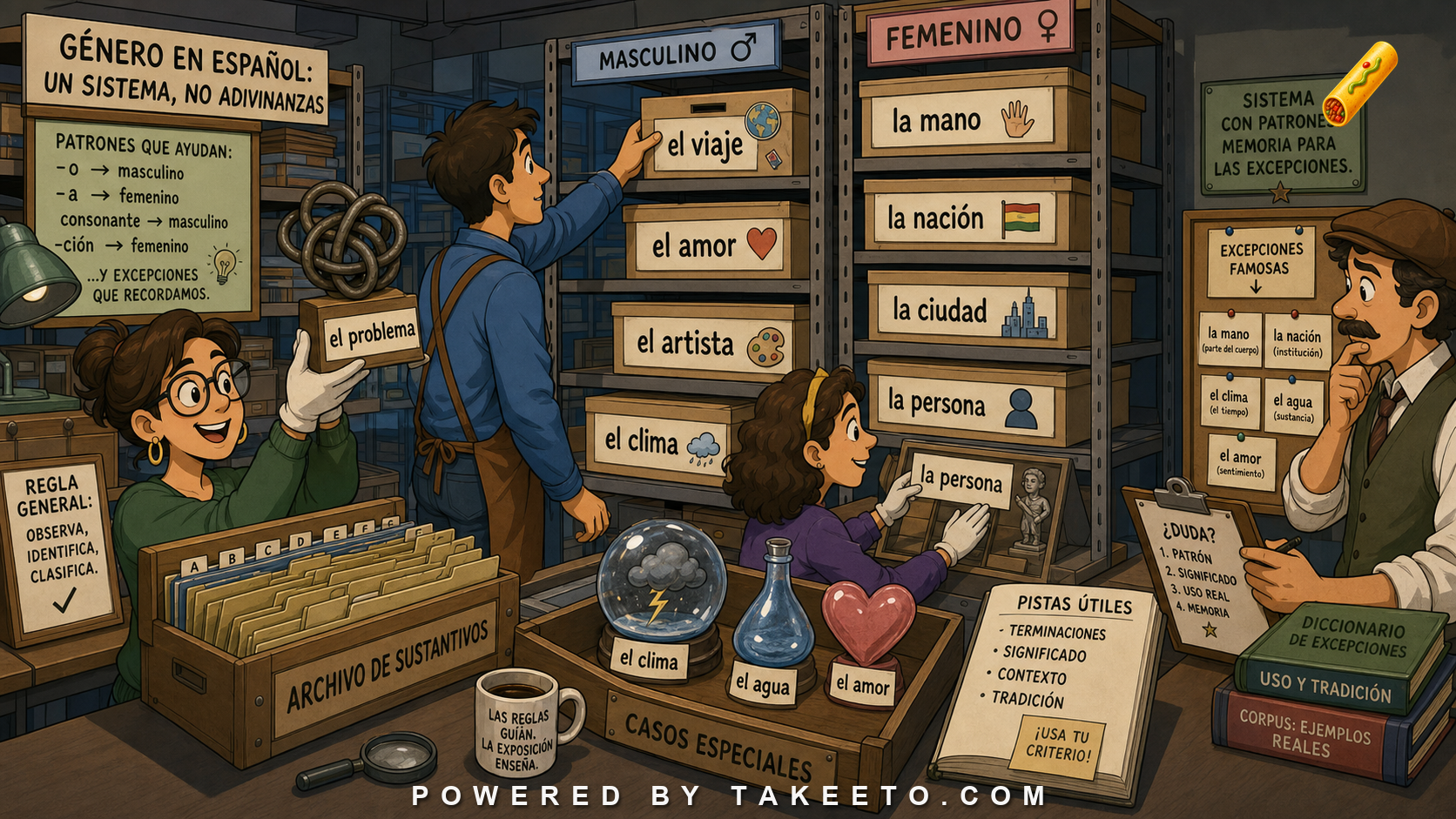
Spanish nouns have grammatical gender. Most are masculine or feminine.
For English speakers, this can feel arbitrary. Why is mesa feminine? Why is problema masculine? Why is mano feminine despite ending in -o? Why is persona feminine even when referring to a man? Why is it el agua but agua fría?
The wrong reaction is to treat gender as pure memorization chaos. The opposite wrong reaction is to assume one simple rule, such as “-o masculine, -a feminine,” and then get angry at every exception.
Spanish gender is a system. It includes strong patterns, semantic logic, historical residues, derivational suffixes, exceptions, and agreement behavior.
A better rule is:
Spanish gender is partly predictable, but every noun must still be stored with its article and agreement pattern.
Grammatical gender is noun classification
Grammatical gender is not the same as biological sex.
Some nouns refer to male or female beings:
- el hombre
- la mujer
- el padre
- la madre
- el gato / la gata
- el profesor / la profesora
But many nouns refer to objects, ideas, places, actions, and abstractions:
- la mesa
- el libro
- la libertad
- el problema
- la ciudad
- el viaje
A table is not biologically feminine. A book is not biologically masculine. These nouns belong to grammatical classes that control articles, adjectives, pronouns, and other agreement.
Gender is visible because other words respond to it:
| Noun | Article | Adjective |
|---|---|---|
| libro | el libro | el libro rojo |
| mesa | la mesa | la mesa roja |
| problema | el problema | el problema difícil |
| ciudad | la ciudad | la ciudad grande |
The strongest beginner pattern: -o and -a
Many nouns ending in -o are masculine:
- el libro
- el perro
- el banco
- el momento
- el trabajo
Many nouns ending in -a are feminine:
- la casa
- la mesa
- la palabra
- la escuela
- la silla
This pattern is useful and should be learned. It covers a large number of nouns.
But it is not a law.
Common exceptions:
| Noun | Gender | Note |
|---|---|---|
| la mano | feminine | ends in -o |
| el día | masculine | ends in -a |
| el mapa | masculine | often from Greek-pattern historical class |
| el planeta | masculine | Greek-origin pattern |
| el problema | masculine | Greek-origin -ma pattern |
| el clima | masculine | Greek-origin -ma pattern |
| la radio | feminine in many uses | shortened form from radiodifusión; also regional variation in some meanings |
The pattern helps, but it cannot replace lexical learning.
Reliable feminine suffixes
Several endings strongly predict feminine gender.
| Ending | Examples |
|---|---|
| -ción | la nación, la canción, la información |
| -sión | la decisión, la televisión, la presión |
| -dad | la ciudad, la libertad, la universidad |
| -tad | la amistad, la libertad |
| -tud | la juventud, la actitud |
| -umbre | la costumbre, la incertidumbre |
| -ie | la serie, la especie, often feminine though not all learner cases are equally transparent |
Examples:
La información es importante.
The information is important.
La ciudad es grande.
The city is big.
La libertad política es frágil.
Political freedom is fragile.
These suffixes are powerful because they also build abstract nouns. Learn them as gender signals.
Common masculine endings
Several endings often predict masculine gender.
| Ending | Examples |
|---|---|
| -aje | el viaje, el mensaje, el paisaje |
| -or | el amor, el color, el dolor, el profesor when male or generic depending on context |
| -án, -én, -ín, -ón in many nouns | el refrán, el almacén, el jardín, el corazón |
| Greek-origin -ma | el problema, el tema, el sistema, el clima, el idioma, el programa |
The -ma pattern is especially important because it defeats the beginner -a rule.
El problema es serio.
The problem is serious.
El sistema es complejo.
The system is complex.
El idioma español tiene muchas variedades.
The Spanish language has many varieties.
Not every -ma noun is masculine, and not every masculine-looking ending is exception-free. La flor and la labor, for example, show why suffixes should be treated as strong tendencies rather than automatic answers. Still, many high-frequency Greek-origin -ma nouns are masculine. Learn them as a set.
Semantic gender: people and animals
For nouns referring to people and animals, gender often interacts with sex, social role, or lexical category.
Variable endings
| Masculine | Feminine |
|---|---|
| el amigo | la amiga |
| el profesor | la profesora |
| el niño | la niña |
| el gato | la gata |
| el escritor | la escritora |
Common-gender nouns
Some nouns have one form for both masculine and feminine referents; the article changes:
| Masculine referent | Feminine referent |
|---|---|
| el artista | la artista |
| el estudiante | la estudiante |
| el periodista | la periodista |
| el cantante | la cantante |
| el testigo / la testigo in many uses |
The noun form does not change, but agreement around it may.
El artista mexicano llegó.
La artista mexicana llegó.
Epicene nouns
Some nouns have fixed grammatical gender regardless of the sex of the referent.
| Noun | Gender | Note |
|---|---|---|
| la persona | feminine | can refer to a man or woman |
| la víctima | feminine | can refer to a male or female victim |
| el personaje | masculine | can refer to a female character |
| la criatura | feminine | can refer to a male child/creature |
This is crucial:
Juan es una persona muy generosa.
Juan is a very generous person.
The adjective generosa agrees with persona, not with Juan.
Ambiguous and regional nouns
Some nouns vary by region, meaning, or style:
- el mar / la mar
- el azúcar / la azúcar, with agreement complications
- el sartén / la sartén depending on region
- el radio / la radio depending on meaning and region
- el internet / la internet in some variation, though usage varies widely
Learners should not be shocked by variation. Gender is stable for most nouns, but not all.
When a noun varies, learn the version used in your target variety and be able to recognize alternatives.
El agua is not masculine
The phrase el agua causes disproportionate confusion.
Agua is feminine. It takes el in the singular because it begins with stressed a. This avoids an awkward sequence with la agua in standard usage.
But agreement reveals the feminine gender:
- el agua fría
- las aguas frías
- esta agua
- mucha agua
The article el in el agua is a special form used before feminine nouns beginning with stressed a/ha. It does not make the noun masculine.
This topic deserves its own article, but the key point belongs here: article form is not always the same thing as noun gender.
Store nouns with articles
Do not memorize problema = problem.
Memorize:
el problema
Do not memorize ciudad = city.
Memorize:
la ciudad
This sounds simple, but it changes learning. The article becomes part of the noun’s identity.
Better vocabulary cards:
| Weak card | Strong card |
|---|---|
| problema = problem | el problema serio |
| ciudad = city | la ciudad grande |
| mano = hand | la mano derecha |
| viaje = trip | el viaje largo |
| nación = nation | la nación moderna |
| artista = artist | el/la artista joven |
Include an adjective when possible because agreement reinforces gender.
Common learner mistakes
Mistake 1: Equating gender with biological sex
Objects and abstractions have grammatical gender. Do not look for biological meaning in la mesa.
Mistake 2: Trusting -o/-a too much
La mano and el problema are high-frequency exceptions.
Mistake 3: Ignoring suffix patterns
Endings like -ción, -dad, -aje, -ma are useful. Use them.
Mistake 4: Letting natural referent override epicene noun gender
La víctima masculina is grammatically feminine because víctima is feminine.
Mistake 5: Learning nouns without articles
This creates agreement errors later.
Suggested interactive module: gender-pattern confidence chart
A useful tool for this article would predict noun gender and show confidence levels.
Suggested functions:
- Ending detector: -o, -a, -ción, -dad, -ma, -aje, -or.
- Exception flags: la mano, el día, el problema.
- Semantic category: person, animal, object, abstraction.
- Agreement preview: article + adjective forms.
- Regional variation alert: nouns with known gender variation.
Example input:
problema
Possible output:
- Ending: -ma
- Pattern: many Greek-origin -ma nouns are masculine
- Correct phrase: el problema serio
- Warning: do not use la problema
Final rule
Spanish gender is not random, but it is not reducible to one trick.
Use strong patterns, learn suffixes, respect exceptions, and store every noun with its article and agreement behavior. Gender is not a label you add later. It is part of how Spanish noun phrases are built.