
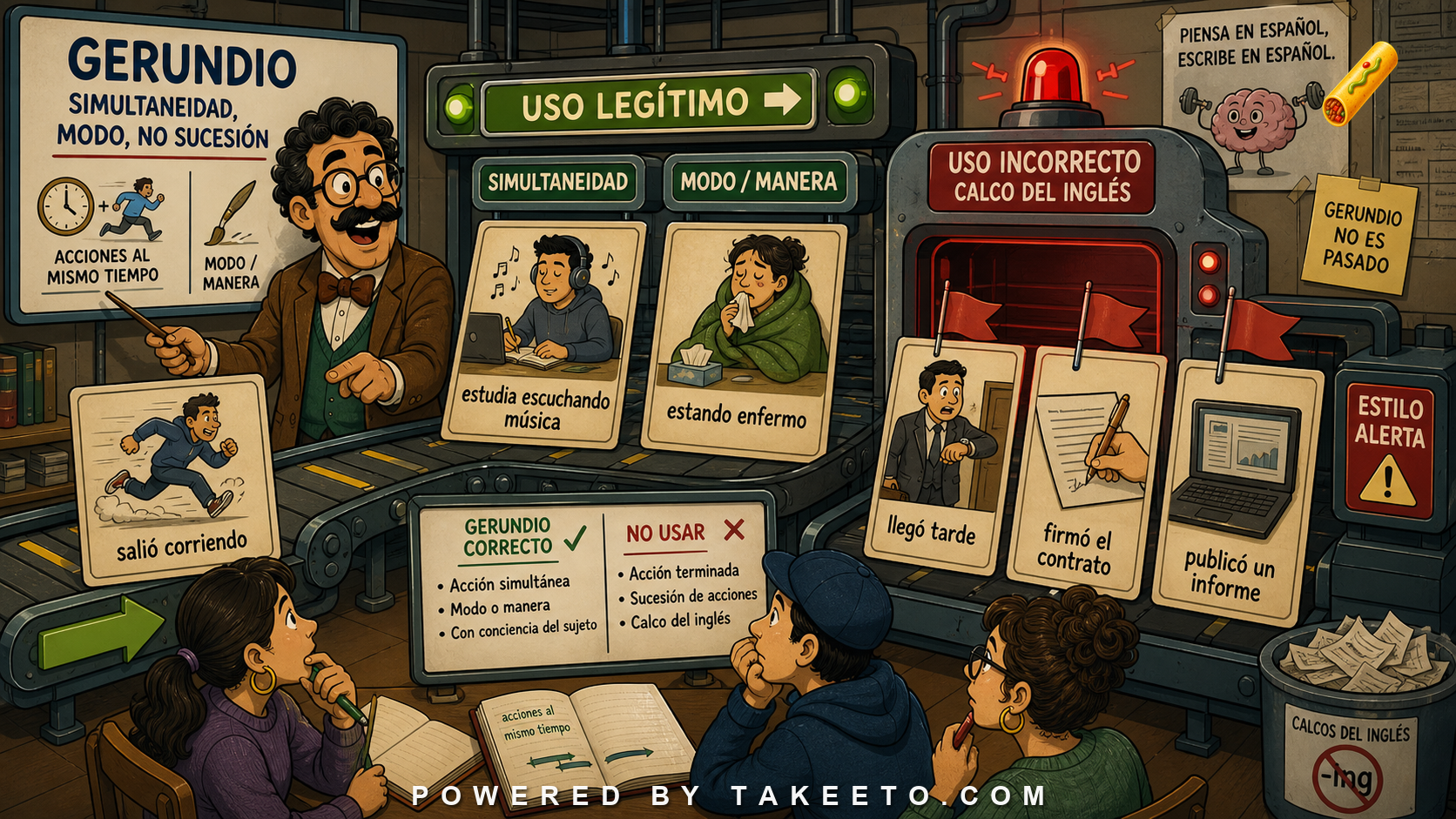
The gerundio is not the English gerund
The Spanish gerundio looks familiar to English speakers because it often translates as an -ing form:
corriendo — running
hablando — speaking
leyendo — reading
But the resemblance is dangerous. English -ing forms do many jobs: progressive verbs, nouns, adjectives, participial clauses, labels, and reduced relatives.
Spanish gerundio is narrower. It is a nonfinite verb form used mainly for progressive aspect and adverbial meanings such as manner, simultaneity, cause, condition, or accompanying circumstance.
It is not the normal way to make a verb into a noun. For that, Spanish usually uses the infinitive:
Leer es importante.
Reading is important.
not:
Leyendo es importante.
A durable rule:
The Spanish gerundio usually modifies an event; it does not usually name an activity as a noun.
Forming the gerundio
Regular forms:
| Infinitive | Gerundio |
|---|---|
| hablar | hablando |
| estudiar | estudiando |
| comer | comiendo |
| aprender | aprendiendo |
| vivir | viviendo |
| escribir | escribiendo |
Common irregular or adjusted forms:
| Infinitive | Gerundio |
|---|---|
| leer | leyendo |
| creer | creyendo |
| oír | oyendo |
| ir | yendo |
| dormir | durmiendo |
| pedir | pidiendo |
| servir | sirviendo |
| decir | diciendo |
| venir | viniendo |
| poder | pudiendo |
The gerundio has no person, number, tense, or gender marking. It does not agree:
Ana salió corriendo.
Los niños salieron corriendo.
Las niñas salieron corriendo.
The form corriendo stays the same.
Progressive constructions
The most familiar use is with estar:
Estoy leyendo.
I am reading.
Estaban hablando.
They were talking.
Seguimos aprendiendo.
We keep learning.
Other auxiliary-like verbs combine with gerundios:
Va mejorando.
It is gradually improving.
Vienen trabajando desde enero.
They have been working since January.
Anda buscando problemas.
He/she is going around looking for trouble.
These are periphrastic constructions. The conjugated auxiliary carries tense, person, and number; the gerundio carries the lexical event.
Manner: how an action happens
A very common gerundio use is manner:
Salió corriendo.
He/she left running. / He/she ran out.
Entró gritando.
He/she came in shouting.
Estudia escuchando música.
He/she studies while listening to music.
Aprendemos practicando.
We learn by practicing.
The gerundio explains how the main action is carried out.
In salió corriendo, the main event is salió. Corriendo tells the manner of leaving. It is not a second later event. The leaving happens by running.
Compare:
Salió y corrió al autobús.
He/she left and ran to the bus.
This describes two coordinated events. Salió corriendo fuses the manner into the leaving event.
Simultaneity and accompanying circumstance
The gerundio can describe an action happening at the same time as the main verb:
Caminaba hablando por teléfono.
He/she was walking while talking on the phone.
Estudia escuchando música.
He/she studies while listening to music.
Cocinaba cantando.
He/she was cooking while singing.
The key idea is temporal overlap. The gerundio event accompanies the main event.
This is one reason Spanish style guides and teachers warn against using the gerundio for a later result or separate next event. If the gerundio event happens afterward, a finite verb or another structure is often better.
Cause, condition, and concession
The gerundio can sometimes express cause or condition:
Estando enfermo, decidió quedarse en casa.
Being sick, he decided to stay home.
Teniendo en cuenta los datos, la conclusión parece razonable.
Taking the data into account, the conclusion seems reasonable.
Aun sabiendo la verdad, no dijo nada.
Even knowing the truth, he/she said nothing.
These uses are common in formal and written Spanish, but they require control. The relationship between the gerundio and the main clause must be clear.
The subject is often understood as the same as the main subject, but not always. Ambiguity can create awkwardness:
Vi a Ana saliendo del edificio.
This can mean “I saw Ana while she was leaving the building” or, depending on context, “I saw Ana as I was leaving.” Good writing avoids unclear attachments.
The gerundio of posteriority: why it is criticized
A classic style warning concerns using the gerundio for a later, separate event:
Firmó el contrato, publicando un informe al día siguiente.
If the report was published the next day, the gerundio does not express simultaneity or manner. It expresses a subsequent event. In careful formal Spanish, this is usually considered faulty or at least awkward.
Better:
Firmó el contrato y publicó un informe al día siguiente.
He/she signed the contract and published a report the next day.
or:
Después de firmar el contrato, publicó un informe al día siguiente.
After signing the contract, he/she published a report the next day.
The problem is not that the gerundio can never describe consequences. Real usage is more nuanced, especially with immediate results, legal-administrative style, and fossilized patterns. But for learners, the safe rule is:
Do not use the gerundio to mean “and then.”
If the events are sequential, use y, después, luego, tras + infinitivo, or a subordinate clause.
English participial clauses are a trap
English permits sentences like:
He signed the contract, publishing a report the next day.
She moved to Madrid, starting a new job in June.
The company opened a branch, creating fifty jobs.
Some of these English sentences are stylistically questionable too, but English tolerates many reduced participial structures. Spanish is stricter in careful prose.
Better Spanish versions often use finite verbs:
Firmó el contrato y publicó un informe al día siguiente.
Se mudó a Madrid y empezó un nuevo trabajo en junio.
La empresa abrió una sucursal y creó cincuenta puestos de trabajo.
If the gerundio expresses manner or simultaneity, it works:
Firmó el contrato sonriendo.
He/she signed the contract smiling.
Se mudó a Madrid buscando nuevas oportunidades.
He/she moved to Madrid looking for new opportunities.
Here the gerundio explains attitude, purpose-like circumstance, or accompanying action, not a later event.
Gerundio vs infinitive
The infinitive names an action or functions after prepositions and many verbs:
Leer ayuda.
Reading helps.
Antes de salir, revisa la puerta.
Before leaving, check the door.
Quiero aprender.
I want to learn.
The gerundio modifies an event:
Aprende leyendo.
He/she learns by reading.
Salió sin mirar.
He/she left without looking.
Notice that sin mirar uses an infinitive after the preposition sin, not a gerundio. English says “without looking,” but Spanish says sin mirar.
This is a major learner trap:
| English | Spanish |
|---|---|
| before leaving | antes de salir |
| after eating | después de comer |
| without saying anything | sin decir nada |
| by practicing | practicando / con práctica / mediante la práctica, depending on context |
| reading is useful | leer es útil |
The English -ing ending does not tell you which Spanish form to use.
Gerundio with subject control
In many gerundio clauses, the understood subject is the subject of the main verb:
María estudia escuchando música.
María studies while María listens to music.
Salimos corriendo.
We left running.
If the understood subject is different, Spanish may need a clearer construction:
Mientras María estudiaba, su hermano escuchaba música.
While María studied, her brother listened to music.
A sentence like:
María estudia escuchando música su hermano.
is not a good way to say that her brother is listening. Use mientras or a finite clause.
Common learner errors
Error 1: Using gerundio as a noun
Estudiando español es difícil.
Use:
Estudiar español es difícil.
Error 2: Translating preposition + English -ing directly
Antes de saliendo...
Sin diciendo nada...
Use:
Antes de salir...
Sin decir nada...
Error 3: Using gerundio for “and then”
Llegó tarde, firmando el contrato después.
Use:
Llegó tarde y firmó el contrato después.
Error 4: Creating dangling or unclear gerundios
Viendo el problema, la solución fue obvia.
Who saw the problem? If a person saw it, say:
Al ver el problema, entendimos la solución.
When we saw the problem, we understood the solution.
Gerundio vs adjective-like -nte forms
Spanish has words that look historically related to participles but behave as adjectives or nouns:
interesante
interesting
urgente
urgent
estudiante
student
cantante
singer
These are not ordinary gerundios. You cannot form adjectives freely by taking a verb and adding -ando or -iendo the way English often uses -ing adjectives.
English says:
an interesting book
a confusing explanation
a surprising result
Spanish often uses adjectives, relative clauses, or different lexical choices:
un libro interesante
una explicación confusa / una explicación que confunde
un resultado sorprendente
The gerundio can modify a noun only in restricted contexts, often when it functions almost like a reduced clause with an event in progress:
una mujer hablando por teléfono
a woman talking on the phone
Even here, many formal styles prefer a relative clause:
una mujer que hablaba por teléfono
The key learner point: hablando is not a general-purpose adjective meaning “talking” in all English-like positions. The gerundio remains verbal and event-oriented.
Gerundio and punctuation
Gerundio phrases can appear before or after the main clause:
Caminando por el centro, encontré una librería.
Walking downtown, I found a bookstore.
Encontré una librería caminando por el centro.
I found a bookstore while walking downtown.
The first version normally takes a comma because the gerundio phrase frames the whole clause. The second may be more tightly attached. In both cases, the reader must be able to identify who was walking. If the attachment is unclear, use mientras, cuando, or a finite clause.
When in doubt, expand the clause
A safe editing technique is to replace a questionable gerundio with a full clause and see whether the relation is clear:
mientras estudiaba
porque estaba enfermo
después de firmar el contrato
If the expanded clause means “after,” the gerundio is probably the wrong tool in careful prose.
Study checkpoint
A good gerundio sentence should answer a question like how?, while doing what?, or under what circumstance? If it answers what happened next?, choose another construction.
Diagnostic refinement: use the attachment test
The gerundio is easiest to control when you ask what it attaches to. A good gerundio normally attaches to the main event as manner, simultaneity, cause, condition, or accompanying circumstance.
| Gerundio phrase | Good question | Example |
|---|---|---|
| manner | How did the action happen? | Salió corriendo. |
| simultaneity | What was happening at the same time? | Cocinaba escuchando música. |
| cause / condition | Under what circumstance? | Estando enfermo, no fue. |
| progressive aspect | What event was in progress? | Estaba leyendo. |
If the gerundio answers “what happened next?”, you should become suspicious:
Presentó la solicitud, recibiendo la respuesta dos meses después.
The natural repair is usually a finite verb:
Presentó la solicitud y recibió la respuesta dos meses después.
The warning is not absolute in every historical, literary, legal, or immediate-result context. Spanish sources recognize that some consecutive gerundios occur, especially when the second event is immediate or tightly connected. But for learner writing and careful modern prose, the safe diagnostic is strong: do not use the gerundio to mean “and then” when the second event is separate, later, or narratively independent.
The attachment test also catches dangling gerundios:
Caminando por la calle, el teléfono sonó.
Who was walking? The phone? The sentence is awkward because the gerundio has no clear human controller. Better:
Mientras caminaba por la calle, sonó el teléfono.
Cuando iba caminando por la calle, sonó el teléfono.
When the attachment is unclear, expand the clause. Clear Spanish is better than compressed Spanish that leaves the reader guessing.
Suggested interactive module: gerund legality checker
A useful tool would ask three questions about a gerundio:
- Does it express an action in progress with an auxiliary?
- Does it express manner, simultaneity, cause, condition, or accompanying circumstance?
- Does it wrongly express a later event?
Input:
Salió corriendo.
Output:
- Main event: salió.
- Gerundio: corriendo.
- Function: manner.
- Status: good.
Input:
Firmó el contrato, publicando un informe al día siguiente.
Output:
- Main event: signed contract.
- Gerundio event: published report the next day.
- Function: later event.
- Warning: use y publicó or después de firmar.
Input:
Estudia escuchando música.
Output:
- Function: simultaneity/accompaniment.
- Status: good.
Final rule
The Spanish gerundio is not the English gerund. It does not usually name an activity as a noun, and it should not be used as a lazy translation of every English -ing form.
Use it for progressive constructions, manner, simultaneity, accompanying circumstance, and certain cause or condition readings: estoy leyendo, salió corriendo, estudia escuchando música, estando enfermo.
Avoid it for later, sequential events in careful Spanish. If you mean “and then,” use a finite verb. The gerundio should normally attach to the main event, not sneak in a second event after it.