
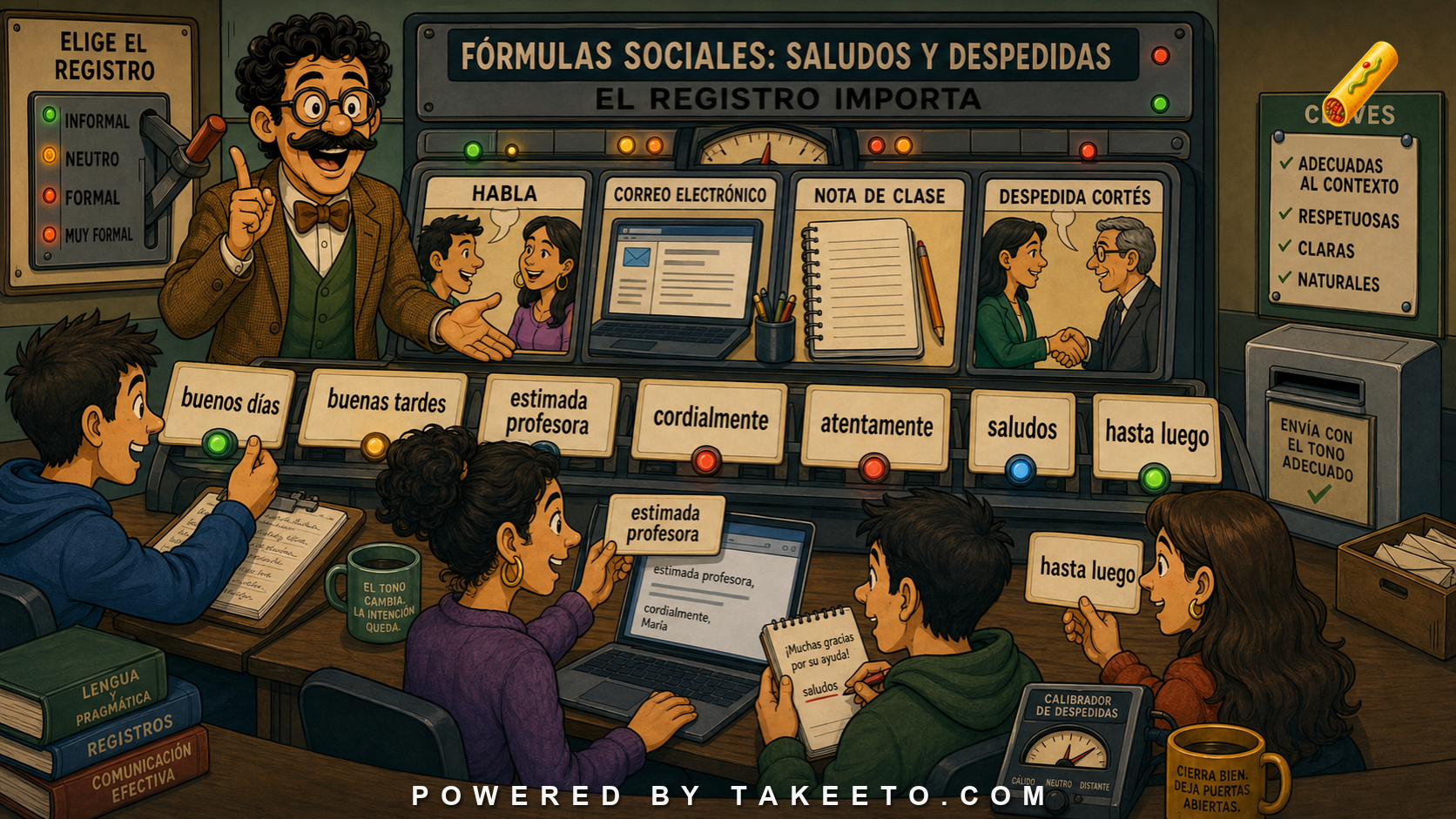
Openings and closings carry social information
A greeting is not just a hello. A closing is not just goodbye. In Spanish, openings and closings signal relationship, time of day, formality, region, medium, and institutional role. A learner can have perfect grammar and still sound strange by opening an email too casually or closing a service interaction too abruptly.
The key principle is:
Greetings and closings are register markers. Learn them by situation, not as isolated vocabulary.
A text to a friend, a message to a professor, a customer-service email, a doctor’s office call, and a government form do not use the same formulae.
Spoken greetings
Core spoken greetings include:
Buenos días.
Good morning.
Buenas tardes.
Good afternoon / good evening.
Buenas noches.
Good evening / good night.
Hola.
Hi / hello.
¿Qué tal?
How’s it going?
¿Cómo está? / ¿Cómo estás?
How are you?
Buenos días and buenas tardes are especially useful in service, professional, and public interactions. In many contexts, entering a shop, office, elevator, waiting room, or reception area without greeting can sound abrupt.
Time-of-day variation
The boundary between buenos días and buenas tardes varies by region and habit. In many places, buenas tardes begins after midday or after lunch. Buenas noches can be used as an evening greeting and as a farewell before sleep or late departure.
Learners do not need perfect boundaries. A polite greeting with good tone usually succeeds.
When unsure, buenas is an informal shortened form used in some regions:
Buenas.
Hi / good day.
It may be too casual for some formal settings, but it is common.
Service encounters
In shops, offices, clinics, and reception areas, combine greeting with request:
Buenos días, tengo una cita a las diez.
Good morning, I have an appointment at ten.
Buenas tardes, quisiera hacer una consulta.
Good afternoon, I would like to ask a question.
Hola, ¿me puede ayudar?
Hello, can you help me?
A greeting softens the request and marks respect.
Casual spoken closings
Common closings include:
Hasta luego.
See you later / goodbye.
Nos vemos.
See you.
Chao / chau.
Bye, regionally common.
Hasta mañana.
See you tomorrow.
Que estés bien.
Take care.
Adiós is correct, but in some contexts it can sound final or formal. Hasta luego is often a safe everyday closing even if you do not literally expect to see the person later.
Written openings
Email and letters require register control.
Informal:
Hola, Ana:
Professional neutral:
Estimada profesora García:
Estimado Sr. López:
Buenos días:
Institutional:
A quien corresponda:
Estimados señores:
In Spanish, a colon after the greeting is common in formal correspondence:
Estimada profesora:
Then the body begins on the next line. A comma is increasingly seen under English influence, but learners should know the colon convention for formal writing.
Written closings
Common closings vary by formality.
Informal:
Un abrazo,
Best / hugs, depending relationship
Besos,
Kisses, intimate/friendly in some contexts
Neutral/professional:
Saludos,
Regards,
Un saludo,
Regards,
Saludos cordiales,
Kind regards,
Formal:
Atentamente,
Sincerely,
Cordialmente,
Cordially,
Quedo atento/a a sus comentarios.
I remain attentive to your comments / I look forward to your response.
Atentamente is useful but can feel stiff in routine modern emails. Saludos cordiales is broadly safe in professional contexts.
Gender and role in written address
When addressing a person by role, use appropriate gender and title when known:
Estimada profesora:
Dear Professor,
Estimado doctor:
Dear Doctor,
Estimada directora:
Dear Director,
If you do not know the person, use a neutral institutional opening:
Buenos días:
or
A quien corresponda:
Do not invent titles or overdo honorifics. Spanish formal writing values clarity and appropriate respect.
Regional variation
Closings differ across countries. Chao is common in many Latin American contexts; chau is common in the Río de la Plata; hasta luego is broadly understood; vale is strongly associated with Spain as an agreement marker and sometimes closing sequence.
Email closings also vary by institution and country. When in doubt, choose a neutral professional formula rather than local slang.
Example bank walkthrough
buenos días
Polite morning greeting.
Learner action: use it in service and professional encounters.
buenas tardes
Afternoon/evening greeting.
Learner action: learn local timing but do not obsess.
estimada profesora
Formal written opening.
Learner action: use colon in formal correspondence.
cordialmente
Formal/professional closing.
Learner action: useful but somewhat formal.
atentamente
Traditional formal closing.
Learner action: good for official letters, less necessary in casual emails.
saludos
Neutral email closing.
Learner action: broadly useful.
hasta luego
Everyday spoken goodbye.
Learner action: safe even when “later” is not literal.
Remediation notes: openings and closings must match the medium
The original article covers speech and email. The remediation is to make medium alignment explicit. A formula that works in a hallway may not work in an email, and a formula that works in a formal letter may sound absurd in a text message.
Spoken public interaction often needs a greeting before the request:
Buenos días, tengo una cita.
Buenas tardes, quería hacer una consulta.
Hola, ¿me puede ayudar?
Learners from more transactional speech cultures sometimes begin directly with the request. In many Spanish-speaking settings, a greeting is not decoration; it is the social opening that makes the request acceptable.
Digital messages are more variable. A short message to a friend can begin:
Hola, Ana
Oye, Ana
Buenas
A professional email should usually choose a more stable opening:
Estimada profesora García:
Buenos días:
Estimado equipo de admisiones:
The colon after a formal greeting is not just a stylistic flourish; it is the careful Spanish convention in correspondence. A comma after the greeting is common under English influence, but learners aiming for polished formal Spanish should control the colon pattern.
Closings also need calibration. Atentamente is good for formal letters and institutional messages, but can feel stiff for an ordinary colleague. Saludos may be too thin for a delicate request but fine for routine email. Un abrazo can be warm among friends or colleagues with closeness, but wrong for a government office.
A register ladder:
Text/friend: Nos vemos, un abrazo, besos if relationship permits.
Routine professional: Saludos, un saludo, saludos cordiales.
Formal/institutional: Atentamente, cordialmente, quedo a la espera de su respuesta.
Spoken service: gracias, hasta luego, muy amable, buen día regionally.
The greeting and closing should agree with the body. Do not open with Estimada doctora: and then write like a casual text. Do not open Hola, profe and close Atentamente unless the relationship and local style justify that mix.
Time-of-day greetings also deserve a learner-safe strategy. Buenos días and buenas tardes are broadly useful; buenas noches works as evening greeting and farewell; buenas is common but more informal and regional. A learner does not need perfect local boundaries, but should avoid sounding abrupt.
Final repair rule:
Open the social channel before asking, and close at the same level of formality you opened.
Suggested interactive module: formula selector by relationship and setting
A useful tool for this article would choose openings and closings by context.
Suggested functions:
- Medium selector: speech, email, formal letter, text message, phone call.
- Relationship selector: friend, professor, customer, institution, colleague, stranger.
- Region notes: chao/chau, vale, buenas, nos vemos.
- Opening generator: hola, buenos días, estimada, a quien corresponda.
- Closing generator: saludos, cordialmente, atentamente, hasta luego.
- Punctuation check: colon after formal greeting.
- Register warning: too casual, too stiff, safe neutral.
Final rule
Greetings and closings are not filler.
They mark relationship, medium, formality, and region. Use buenos días/buenas tardes generously in spoken public life. Use estimado/a and appropriate closings in formal writing. Choose formulas by setting, not by dictionary translation.