
The infinitive is more than a dictionary form
Spanish infinitives end in -ar, -er, or -ir:
hablar
comer
vivir
Textbooks introduce them as dictionary forms, and that is true. But the infinitive is not merely the form you look up before conjugating. It is one of the most important nonfinite verb forms in Spanish. It can behave like a verb, like a noun, like an instruction, like a compressed clause, or like the complement of another verb.
Consider:
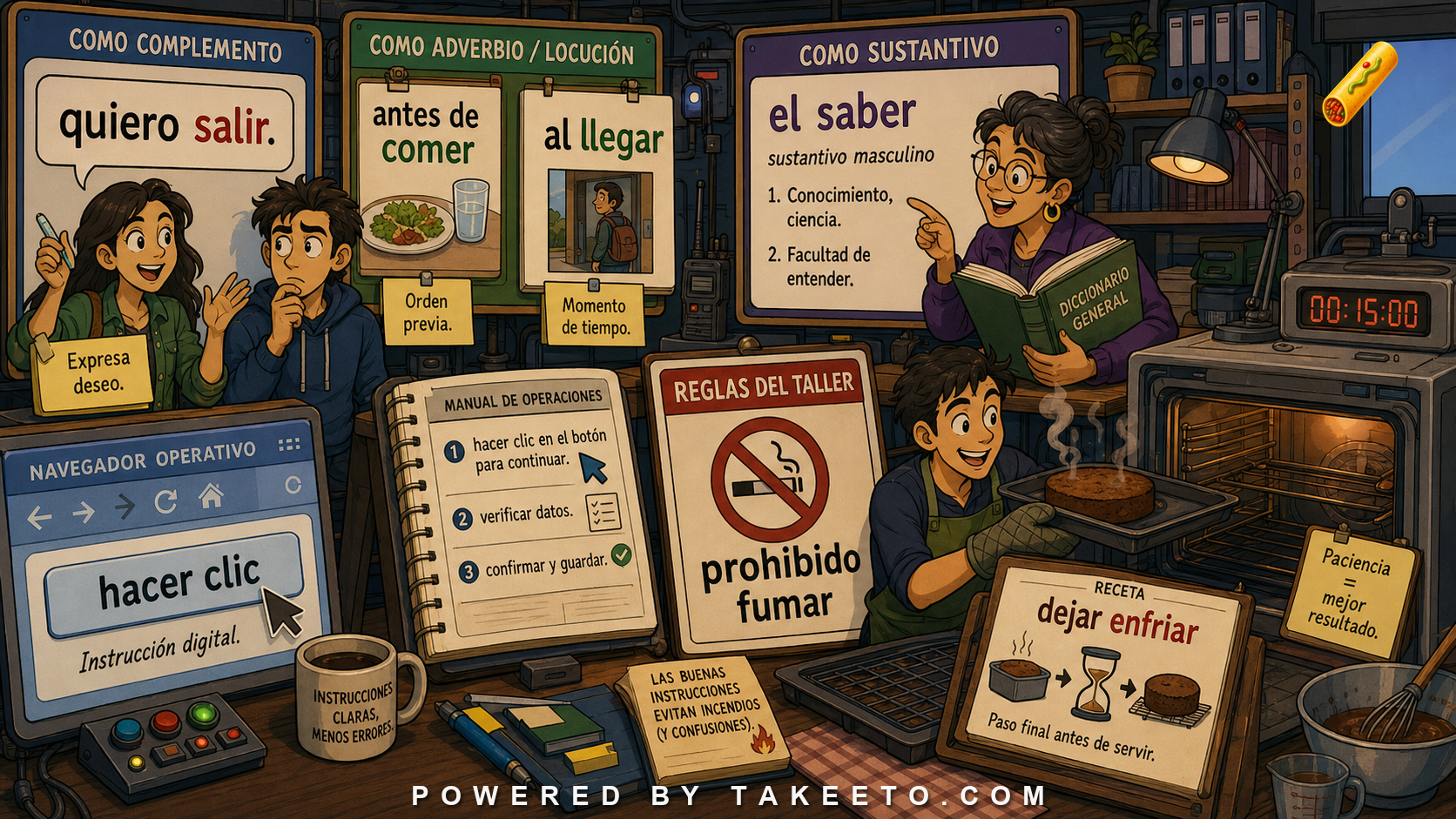
Quiero salir.
I want to leave.
Antes de comer, lávate las manos.
Before eating, wash your hands.
Al llegar, llámame.
When you arrive, call me.
El saber no ocupa lugar.
Knowledge takes up no space.
Prohibido fumar.
Smoking prohibited.
Hacer clic.
Click.
One form, many roles.
A durable rule is:
The infinitive names an action without assigning it to a finite subject, tense, or mood. Spanish then lets syntax decide whether that action functions as complement, noun, instruction, or compressed clause.
Infinitives as citation forms
Dictionaries list verbs under the infinitive:
hablar — to speak
comer — to eat
vivir — to live
tener — to have
salir — to leave
When you see an inflected form, you often need to recover the infinitive:
| Seen form | Infinitive |
|---|---|
| hablo | hablar |
| comimos | comer |
| vivían | vivir |
| tengo | tener |
| saldré | salir |
| fui | ir / ser, depending on context |
This is practical dictionary literacy. You cannot look up every conjugated form as if it were an independent word. You need to identify the infinitive entry.
Infinitives after conjugated verbs
Many verbs take an infinitive complement when the subject is the same:
Quiero salir.
I want to leave.
Necesito estudiar.
I need to study.
Podemos empezar.
We can start.
Prefiere esperar.
He/she prefers to wait.
Debes leer esto.
You should read this.
In these sentences, the conjugated verb carries person, tense, and mood. The infinitive supplies the action.
Compare:
Quiero salir.
I want to leave. Same subject: I want, I leave.
Quiero que salgas.
I want you to leave. Different subject: I want, you leave.
The infinitive is common when the subject of both verbs is the same. A que + subjunctive clause often appears when the subject changes, especially after verbs of desire, influence, or recommendation.
Infinitives after prepositions
Spanish uses infinitives after prepositions where English often uses -ing forms:
antes de comer
before eating
después de estudiar
after studying
sin decir nada
without saying anything
para entender
in order to understand
por no saber
because of not knowing / for not knowing
al llegar
upon arriving / when arriving
This is one of the most important English-interference zones. Do not translate the English -ing with a Spanish gerundio after prepositions.
Wrong:
antes de comiendo
sin diciendo nada
Right:
antes de comer
sin decir nada
The preposition selects the infinitive.
Al + infinitive: a compressed time clause
The construction al + infinitive often means “upon doing” or “when one does/did”:
Al llegar, llámame.
When you arrive, call me.
Al abrir la puerta, vio una carta.
When he/she opened the door, he/she saw a letter.
Al leer el informe, entendimos el problema.
When we read the report, we understood the problem.
This construction compresses a time clause. It does not explicitly mark the subject. Usually the subject is understood from context.
Compare:
Cuando llegues, llámame.
When you arrive, call me.
Al llegar, llámame.
On arriving / when you arrive, call me.
The cuando clause can mark person and mood. The al + infinitive construction is shorter and more compressed.
Infinitives as nouns
Spanish infinitives can function as nouns:
Leer es útil.
Reading is useful.
Viajar abre la mente.
Traveling opens the mind.
Fumar daña la salud.
Smoking damages health.
Aprender requiere paciencia.
Learning requires patience.
The infinitive can even take an article:
el saber
knowledge / knowing
el poder
power
el deber
duty
el vivir de cada día
everyday living, literary or elevated
Some infinitives become lexicalized nouns:
el poder — power
el deber — duty
el placer — pleasure, historically related but now lexical noun
el amanecer — dawn
But even ordinary infinitives can serve as subjects:
Estudiar cansa.
Studying is tiring.
Mentir es peligroso.
Lying is dangerous.
English uses “studying” and “lying” here. Spanish uses estudiar and mentir.
Infinitives in instructions and signs
Infinitives are common in instructions, recipes, software, labels, and public notices:
Hacer clic aquí.
Click here.
Dejar enfriar durante diez minutos.
Let cool for ten minutes.
Agitar antes de usar.
Shake before use.
No tocar.
Do not touch.
Prohibido fumar.
Smoking prohibited.
Mantener fuera del alcance de los niños.
Keep out of reach of children.
This style is impersonal and procedural. It does not address the reader with a specific command form like haz, haga, or hagan. It presents the action as an instruction to be performed.
Compare:
| Form | Example | Effect |
|---|---|---|
| tú command | Haz clic aquí. | direct familiar command |
| usted command | Haga clic aquí. | direct formal command |
| infinitive instruction | Hacer clic aquí. | impersonal/procedural instruction |
In interface Spanish, hacer clic is common. Some regions and style guides may prefer alternatives such as pinchar, pulsar, or seleccionar depending on context, but hacer clic is widely recognizable.
Prohibido + infinitive
Public prohibitions often use prohibido + infinitive:
Prohibido fumar.
No smoking.
Prohibido estacionar.
No parking.
Prohibido entrar.
No entry.
The structure is elliptical: “It is prohibited to smoke/park/enter.” The infinitive names the prohibited action.
You may also see:
Se prohíbe fumar.
Smoking is prohibited.
No se permite fumar.
Smoking is not allowed.
These are more explicit finite constructions. The sign style with prohibido fumar is compact and common.
Infinitives with causative and perception verbs
Certain verbs can take infinitive complements in causative or perception constructions:
Me hizo reír.
He/she made me laugh.
La vi salir.
I saw her leave.
Oí cantar a los niños.
I heard the children sing.
Dejé enfriar la sopa.
I let the soup cool.
The subject of the infinitive may be expressed as an object of the main verb:
La vi salir.
I saw her leave.
La is the person seen; salir is the action she performed.
These structures require careful treatment later when object pronouns and personal a enter the picture. For now, notice that the infinitive can remain verbal: it can have its own participants and complements even though it is not finite.
Infinitive and subject interpretation
Because infinitives do not mark person, their subject is inferred.
Quiero salir.
I want me-to-leave; same subject.
Antes de salir, apaga la luz.
Before leaving, turn off the light. The addressee is probably the one leaving.
Para entender el texto, hay que leerlo dos veces.
To understand the text, one must read it twice.
Sometimes ambiguity is possible:
Hablé con Ana antes de salir.
Who left, I or Ana? Often context answers, but the sentence can be ambiguous. If clarity matters, use a finite clause:
Hablé con Ana antes de que ella saliera.
I spoke with Ana before she left.
Hablé con Ana antes de salir yo.
I spoke with Ana before I left.
The infinitive is compact, but compactness can hide subject relations.
Common learner errors
Error 1: Using gerundio where Spanish wants infinitive
Leyendo es importante.
Use:
Leer es importante.
Error 2: Translating “before eating” as gerundio
Antes de comiendo...
Use:
Antes de comer...
Error 3: Using infinitive when subjects differ after desire
Quiero tú salir.
Use:
Quiero que salgas.
Error 4: Overusing direct commands where signs use infinitives
No tocar is normal sign style.
No toque is also possible as a formal command, but it feels more directly addressed.
Know the difference.
The infinitive can carry objects and modifiers
Even when an infinitive functions like a noun, it can still behave verbally inside its own phrase:
Leer novelas largas requiere paciencia.
Reading long novels requires patience.
Aprender una lengua de adulto exige constancia.
Learning a language as an adult requires consistency.
Traducir documentos técnicos no es fácil.
Translating technical documents is not easy.
The whole infinitive phrase acts as the subject, but inside that phrase the infinitive can take objects, adverbs, and prepositional phrases. This is why the infinitive is not simply a noun. It is a verbal form that can occupy noun-like positions.
With an article, the infinitive often becomes more abstract, literary, or lexicalized:
el saber
knowledge, knowing
el vivir cotidiano
daily living
el decir una cosa y hacer otra
saying one thing and doing another
This article use is productive but stylistically marked. In everyday Spanish, leer es útil is more neutral than el leer es útil, though both can occur depending on emphasis and style. Learners should recognize article + infinitive without forcing it into every sentence.
Infinitive in command-like public language
Public Spanish often chooses among infinitives, imperatives, and se constructions according to tone:
| Form | Example | Tone |
|---|---|---|
| infinitive | No tocar. | sign-like, impersonal |
| usted command | No toque. | direct formal address |
| se construction | No se permite tocar. | institutional rule |
A museum label, software prompt, medication instruction, and recipe may choose different forms. The infinitive is compact and procedural; it tells the reader what action is relevant without building a full relationship between speaker and addressee.
Infinitive after adjectives and nouns
Spanish also uses infinitives after many adjectives and nouns:
fácil de entender
easy to understand
difícil de explicar
difficult to explain
ganas de salir
desire to go out
tiempo para estudiar
time to study
These patterns are partly lexical. Learn the preposition with the phrase, not only the infinitive.
Study checkpoint
When English gives you an -ing form, pause before translating. Ask whether Spanish needs an infinitive as a noun, an infinitive after a preposition, a gerundio of manner, or a full clause. That pause prevents many advanced-looking errors.
One more practical contrast
Compare al salir and saliendo. Al salir, apaga la luz means “when you leave, turn off the light.” Salió corriendo means “he/she left running.” The first uses the infinitive to create a time relation; the second uses the gerundio to describe manner. The English -ing form hides this distinction. Spanish does not.
Diagnostic refinement: infinitives compress clauses, but the subject must be recoverable
Spanish infinitives are powerful because they let the language compress information. But compression works only when the reader can recover the subject and relationship.
Compare:
| Compressed form | Expanded meaning |
|---|---|
| Antes de salir, cerré la puerta. | Before I left, I closed the door. |
| Antes de salir Ana, cerré la puerta. | Before Ana left, I closed the door. |
| Al llegar, llamé a mi madre. | When I arrived, I called my mother. |
| Para entenderlo, hay que leer el contexto. | In order to understand it, one must read the context. |
| Sin decir nada, se fue. | Without saying anything, he/she left. |
The infinitive does not carry person or tense by itself. Context assigns those. Often the understood subject is the main-clause subject. Sometimes a noun after the infinitive supplies a different subject: al llegar Ana, después de terminar la reunión, antes de salir los estudiantes.
This matters because English often uses an -ing form where Spanish uses preposition + infinitive:
| English | Spanish |
|---|---|
| before leaving | antes de salir |
| after eating | después de comer |
| without looking | sin mirar |
| by studying more | estudiando más / mediante el estudio, depending on meaning |
| for understanding the problem | para entender el problema |
Do not translate the English form mechanically. Identify the relation: time, purpose, cause, absence, manner, means, or condition. Then choose the Spanish structure.
Nominalized infinitives also need restraint. Spanish can say el saber, el vivir, el querer, but this is often abstract, literary, philosophical, or formulaic. For ordinary activity nouns, Spanish may prefer a regular noun when one exists:
la lectura, not always el leer
la escritura, not always el escribir
el aprendizaje, not always el aprender
The infinitive is a clause-compression tool, a citation form, and sometimes a noun-like form. It is not a universal substitute for every English gerund.
Suggested interactive module: infinitive function tagger
A useful tool would label each infinitive by function.
Input:
Quiero salir.
Output:
- Infinitive: salir.
- Function: complement of querer.
- Subject: same as querer.
Input:
Antes de comer, lávate las manos.
Output:
- Infinitive: comer.
- Function: after preposition de in time expression.
- English equivalent: eating.
Input:
Leer es útil.
Output:
- Infinitive: leer.
- Function: nominal subject.
- English equivalent: reading.
Input:
Hacer clic aquí.
Output:
- Infinitive phrase: hacer clic.
- Function: impersonal instruction.
Final rule
The Spanish infinitive is the unassigned action form. It can be a dictionary entry, a verb complement, the object of a preposition, a noun-like subject, a public instruction, or a compressed clause.
Do not translate English -ing mechanically. Spanish often uses the infinitive where English uses an -ing noun or prepositional phrase: leer es útil, antes de comer, sin decir nada.
The infinitive is simple in form, but not simple in function. Learn to ask what job it is doing in the sentence.