
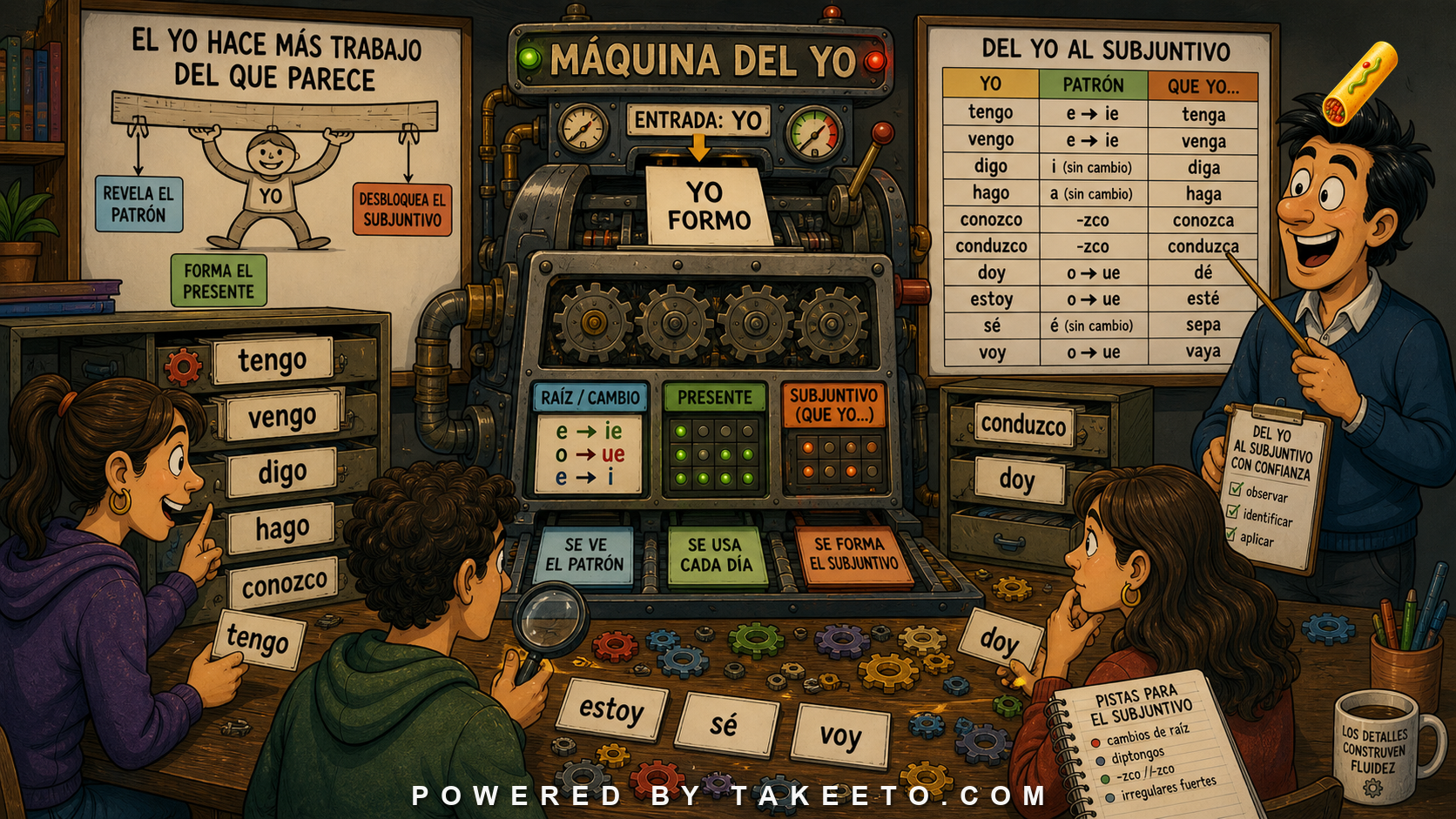
The yo form is a diagnostic form
Spanish present-tense irregularity often concentrates in the yo form:
tener → tengo
venir → vengo
decir → digo
hacer → hago
conocer → conozco
conducir → conduzco
dar → doy
estar → estoy
saber → sé
ir → voy
These forms are not just isolated annoyances. They often reveal the stem used in the present subjunctive:
tengo → tenga
vengo → venga
digo → diga
hago → haga
conozco → conozca
conduzco → conduzca
This is why the yo form carries so much information. If you know only the infinitive, you may not know the present subjunctive. If you know the irregular yo form, you often do.
A durable rule:
For many verbs, the present subjunctive is built from the present indicative yo form after removing -o and adding subjunctive endings.
This rule has exceptions, but it is one of the most useful bridges in Spanish morphology.
The -go family
Many high-frequency verbs have yo forms ending in -go:
| Infinitive | Yo form | Present subjunctive stem |
|---|---|---|
| tener | tengo | teng- |
| venir | vengo | veng- |
| poner | pongo | pong- |
| salir | salgo | salg- |
| hacer | hago | hag- |
| decir | digo | dig- |
| traer | traigo | traig- |
| oír | oigo | oig- |
| caer | caigo | caig- |
| valer | valgo | valg- |
Examples:
Tengo tiempo.
I have time.
Vengo de Chile.
I come from Chile.
Pongo el libro aquí.
I put the book here.
Salgo mañana.
I leave tomorrow.
Digo la verdad.
I tell the truth.
These verbs do not all behave identically in every tense, but the -go form gives a major clue:
tener → que yo tenga
venir → que yo venga
poner → que yo ponga
salir → que yo salga
hacer → que yo haga
decir → que yo diga
The -zco family
Many verbs ending in -cer or -cir have yo forms in -zco:
| Infinitive | Yo form | Present subjunctive |
|---|---|---|
| conocer | conozco | conozca |
| agradecer | agradezco | agradezca |
| ofrecer | ofrezco | ofrezca |
| parecer | parezco | parezca |
| conducir | conduzco | conduzca |
| producir | produzco | produzca |
| traducir | traduzco | traduzca |
Examples:
Conozco a tu hermana.
I know your sister.
Agradezco tu ayuda.
I appreciate your help.
Traduzco documentos técnicos.
I translate technical documents.
The -zco is not optional and not a pronunciation flourish. It is the standard first-person singular present form for these verbs.
But learners must avoid overgeneralization. Not every verb ending in a similar spelling uses -zco:
convencer → convenzo
ejercer → ejerzo
The dictionary and reliable conjugation patterns matter.
The -jo spelling family
Verbs ending in -ger and -gir often change g to j before o to preserve the /x/ sound:
| Infinitive | Yo form |
|---|---|
| escoger | escojo |
| proteger | protejo |
| dirigir | dirijo |
| exigir | exijo |
| corregir | corrijo |
This is partly orthographic. The letter g before e/i can represent the /x/ sound, but before o it would not. So Spanish uses j:
dirigir → dirijo
proteger → protejo
Some of these verbs may also have stem changes:
corregir → corrijo, corriges, corrige
Here the learner must separate spelling adjustment from stem change.
-oy forms and tiny high-frequency irregulars
Some of the most common Spanish verbs have short irregular yo forms:
| Infinitive | Yo form |
|---|---|
| dar | doy |
| estar | estoy |
| ser | soy |
| ir | voy |
Examples:
Doy clases.
I teach classes.
Estoy cansado.
I am tired.
Soy de México.
I am from Mexico.
Voy al trabajo.
I am going to work.
These forms are so frequent that they must be learned early. Their subjunctives are also irregular:
dar → dé
estar → esté
ser → sea
ir → vaya
The yo form helps you recognize irregularity, but it does not always predict the subjunctive by the simple remove-o method.
Sé, he, veo, quepo: small forms with large importance
Other important irregular yo forms include:
| Infinitive | Yo form | Notes |
|---|---|---|
| saber | sé | present subjunctive: sepa |
| haber | he | auxiliary: he visto |
| ver | veo | regular-looking except added e; subjunctive vea |
| caber | quepo | to fit; subjunctive quepa |
Examples:
Sé la respuesta.
I know the answer.
He visto esa película.
I have seen that movie.
Veo el problema.
I see the problem.
No quepo en este asiento.
I do not fit in this seat.
These are high-value forms because they appear in common grammar structures: perfect tenses with he, knowledge with sé, perception with veo, and subjunctive forms such as sepa and vea.
Orthographic changes are not the same as irregular stems
Some yo forms look different because Spanish spelling protects pronunciation:
buscar → busco
pagar → pago
llegar → llego
These are regular present forms. But in the subjunctive, spelling changes appear before e:
buscar → busque
pagar → pague
llegar → llegue
This is not the same as the deeper irregularity in tengo → tenga or conozco → conozca. It is an orthographic adjustment.
Similarly:
vencer → venzo
proteger → protejo
The spelling reflects sound patterns. A good learner does not lump all non-identical spellings into one category called “irregular.” Some changes are phonological spelling maintenance; others are lexical irregular stems.
Why the yo form predicts the present subjunctive
For many verbs, the present subjunctive is built from the yo form of the present indicative:
- Take the yo form.
- Remove final -o.
- Add opposite-vowel subjunctive endings.
Examples:
| Infinitive | Yo present | Stem | Subjunctive example |
|---|---|---|---|
| tener | tengo | teng- | tenga |
| venir | vengo | veng- | venga |
| decir | digo | dig- | diga |
| hacer | hago | hag- | haga |
| conocer | conozco | conozc- | conozca |
| conducir | conduzco | conduzc- | conduzca |
| salir | salgo | salg- | salga |
This is why teachers emphasize yo forms before subjunctive formation. If you know conozco, conozca becomes predictable. If you only know conocer, it does not.
But the rule must be used intelligently. Some verbs have special subjunctive stems:
| Infinitive | Yo form | Subjunctive |
|---|---|---|
| ser | soy | sea |
| ir | voy | vaya |
| saber | sé | sepa |
| estar | estoy | esté |
| dar | doy | dé |
| haber | he | haya |
These must be learned directly.
Stem change plus yo irregularity
Some verbs combine stem changes with irregular yo forms:
decir → digo, dices, dice, decimos, decís, dicen
venir → vengo, vienes, viene, venimos, venís, vienen
tener → tengo, tienes, tiene, tenemos, tenéis, tienen
This is why a single label such as “irregular” is too blunt. Tener has:
- yo irregularity: tengo;
- stem change in several present forms: tienes, tiene, tienen;
- regular-looking nosotros/vosotros in the present: tenemos, tenéis;
- irregular preterite: tuve;
- future stem: tendré.
A verb can be irregular in several layers. Learn the high-frequency families rather than panicking at each form.
Common learner errors
Error 1: Regularizing the yo form
Yo teno.
Yo conozo.
Yo sabo.
Use:
Tengo.
Conozco.
Sé.
Error 2: Forgetting that yo predicts subjunctive
If you know:
hago
then:
haga
is not a new arbitrary form. It uses the same irregular stem.
Error 3: Confusing spelling adjustments with deeper irregularity
busco is normal present indicative.
busque is a subjunctive spelling adjustment before e.
Do not memorize buscar as wildly irregular.
Error 4: Overgeneralizing -zco
conocer → conozco, but vencer → venzo.
Patterns help, but dictionary confirmation matters.
The yo form is a bridge, not a complete theory
The “yo-form rule” for the subjunctive is powerful, but learners should understand its limits. It works well for many verbs because the irregular consonant or stem appears in the yo form and then continues through the present subjunctive:
salgo → salga
pongo → ponga
traigo → traiga
traduzco → traduzca
But it does not explain every special form:
soy → sea
voy → vaya
sé → sepa
estoy → esté
Those forms must be learned as high-frequency irregulars. This is not a failure of the rule. It simply means the rule is a bridge for many verbs, not a full grammar of all irregularity.
Families reduce memory load
Group verbs by family rather than alphabetically:
| Family | Verbs | Subjunctive clue |
|---|---|---|
| -go | tener, venir, poner, salir | tenga, venga, ponga, salga |
| -zco | conocer, parecer, ofrecer, traducir | conozca, parezca, ofrezca, traduzca |
| j spelling | dirigir, proteger, escoger | dirija, proteja, escoja |
| special short forms | ser, ir, dar, estar, saber | sea, vaya, dé, esté, sepa |
This method also helps listening. When you hear tenga, you should connect it to tengo and tener, not treat it as an unrelated word. When you hear conduzca, you should see the conduzco family.
A good verb notebook should therefore include at least three columns: infinitive, present yo, and present subjunctive yo/él form. That one habit prepares the learner for later mood work.
Yo irregulars and first-person statements
These forms are frequent because first-person statements are frequent:
tengo una pregunta
no sé
digo que no
voy a salir
estoy listo
hago ejercicio
A learner who hesitates over tengo, sé, voy, or hago will sound uncertain in ordinary conversation. These are not advanced forms; they are everyday self-expression.
Practice them in useful chunks rather than isolated charts:
No sé si puedo.
Tengo que irme.
Voy a pensarlo.
Hago lo que puedo.
Conozco ese lugar.
Chunks connect morphology to speech. They also prepare the ear for subjunctive relatives such as no creo que pueda, quiero que tengas, and espero que conozcas.
Orthography, analogy, and restraint
Spanish spelling sometimes makes a yo form look more irregular than it is. Recojo from recoger preserves the /x/ sound; venzo from vencer preserves the /s/ or /θ/ value before o. These are predictable spelling pressures. By contrast, sé, voy, and soy are deeper irregulars that must be learned directly.
This distinction matters for confidence. If every unfamiliar form is labeled “exception,” Spanish feels chaotic. If you separate spelling maintenance, stem alternation, and true suppletion, the system becomes learnable.
Study checkpoint
Before learning the present subjunctive, build a list of twenty verbs with their yo forms: tengo, vengo, digo, hago, salgo, pongo, conozco, conduzco, doy, estoy, sé, voy. This is not extra work; it is the foundation.
Why yo forms matter for dictionaries and tools
Many dictionaries list the infinitive, but real sentences give you forms like hago, sé, conozco, and traigo. A learner must connect those forms back to hacer, saber, conocer, and traer. Digital tools can help, but the mental link still matters. Without it, common sentences look more irregular than they are.
A final recognition drill
Read these forms and name the infinitive before translating: tengo, vengo, digo, hago, salgo, pongo, traigo, oigo, conozco, traduzco, soy, voy, sé. This reverse drill is essential because reading and listening rarely hand you the infinitive first.
Diagnostic refinement: the yo-form bridge has exceptions
The yo form is a powerful bridge into the present subjunctive, but it is not an automatic machine. The usual classroom rule is useful:
Take the present indicative yo form, drop -o, then add the opposite-vowel subjunctive endings.
That works well for many verbs:
| Infinitive | Yo form | Present subjunctive base | Example |
|---|---|---|---|
| tener | tengo | teng- | tenga |
| venir | vengo | veng- | venga |
| decir | digo | dig- | diga |
| hacer | hago | hag- | haga |
| conocer | conozco | conozc- | conozca |
| conducir | conduzco | conduzc- | conduzca |
But some of the smallest, most frequent verbs do not follow the bridge transparently:
| Infinitive | Yo form | Subjunctive |
|---|---|---|
| ser | soy | sea |
| ir | voy | vaya |
| estar | estoy | esté |
| dar | doy | dé |
| saber | sé | sepa |
| haber | he / hay | haya |
The lesson is not “the rule fails.” The lesson is that high-frequency verbs preserve older or highly compressed forms. You should still use the yo form as a diagnostic, but you must memorize the small set of major suppletive or irregular subjunctive stems.
Also distinguish real irregularity from spelling repair:
| Infinitive | Yo / subjunctive | Type |
|---|---|---|
| pagar | pago / pague | spelling repair |
| buscar | busco / busque | spelling repair |
| empezar | empiezo / empiece | stem change + spelling repair |
| conocer | conozco / conozca | morphological irregularity with -zco |
This prevents overreaction. Busque is not a new irregular verb; it protects the /k/ sound. Conozca is part of the -zco family. Sea and vaya must simply be learned as high-frequency irregulars.
Suggested interactive module: yo-form family tree
A useful tool would let the learner enter an infinitive and see the present yo form, related family, and subjunctive stem.
Example:
tener
Output:
- family: -go;
- yo: tengo;
- subjunctive: tenga, tengas, tenga, tengamos, tengáis, tengan;
- related verbs: venir, poner, salir.
Example:
conocer
Output:
- family: -zco;
- yo: conozco;
- subjunctive: conozca, conozcas, conozca, conozcamos, conozcáis, conozcan;
- warning: not all similar verbs use -zco.
Example:
ir
Output:
- yo: voy;
- special subjunctive: vaya;
- warning: high-frequency suppletive irregular verb.
Final rule
The present-tense yo form is one of the most informative forms in Spanish. It often reveals irregular stems that reappear in the present subjunctive: tengo → tenga, digo → diga, hago → haga, conozco → conozca.
Learn verbs with their yo form, not just their infinitive. That single habit will make the present tense, subjunctive formation, and irregular verb families much easier to manage.