
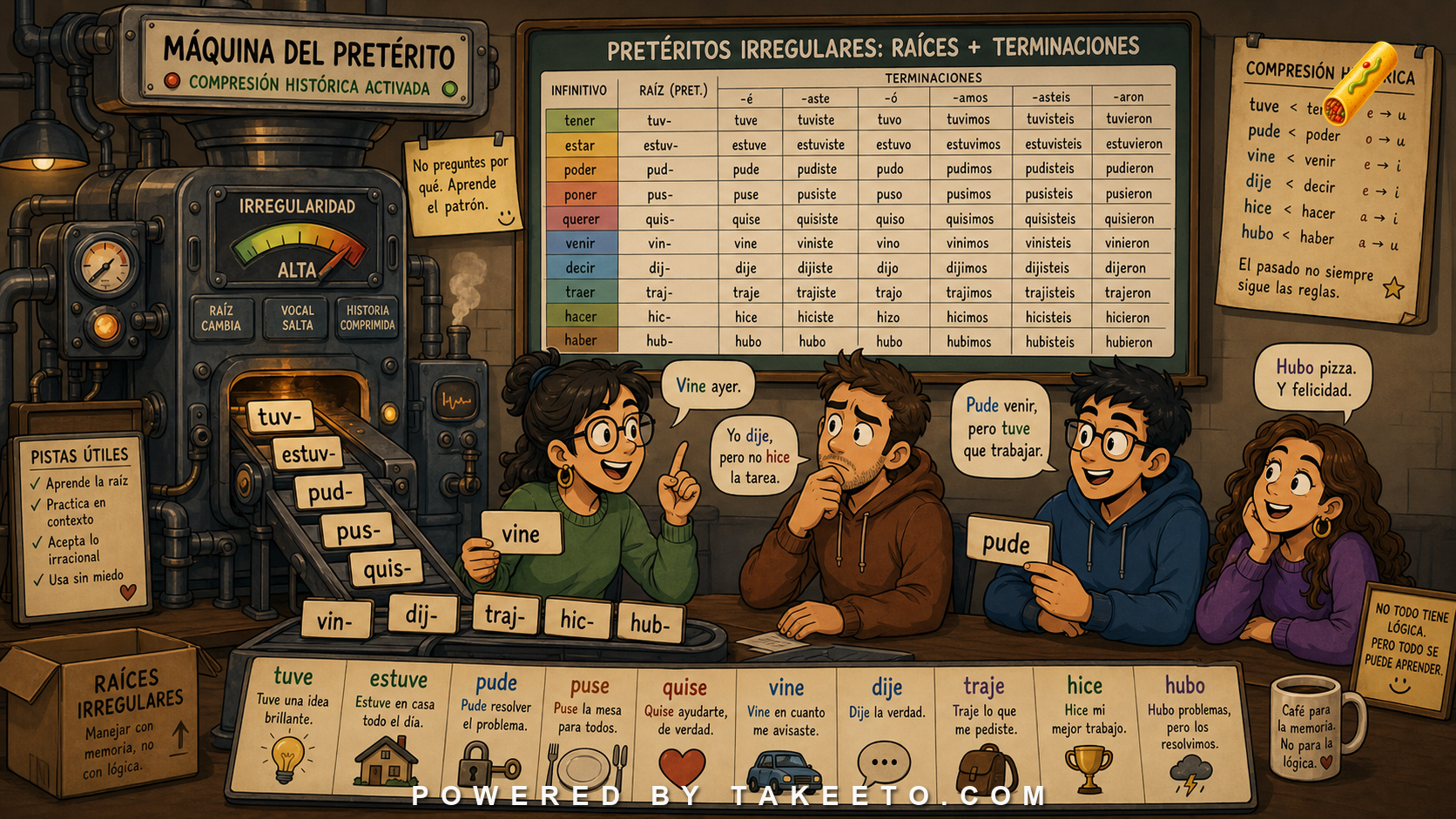
Irregular preterites are central, not peripheral
The Spanish preterite has many regular forms:
hablé, comí, viví
hablaste, comiste, viviste
habló, comió, vivió
But some of the most common verbs in narrative Spanish have irregular preterite stems:
tuve
estuve
pude
puse
quise
vine
dije
traje
hice
hubo
These are not rare exceptions. They are the verbs used to tell stories: had, was, could, put, wanted, came, said, brought, did/made, there was.
The good news is that many irregular preterites share a special set of endings. The irregularity is not chaos; it is compressed into stems and families.
The shared irregular preterite endings
Many irregular preterites use these endings:
| Person | Ending | Example: tener |
|---|---|---|
| yo | -e | tuve |
| tú | -iste | tuviste |
| él/ella/usted | -o | tuvo |
| nosotros/as | -imos | tuvimos |
| vosotros/as | -isteis | tuvisteis |
| ellos/ellas/ustedes | -ieron | tuvieron |
Notice two things:
- The yo and third-person singular forms do not have written accent marks: tuve, tuvo, not tuvé, tuvó.
- These endings attach to an irregular stem: tuv-.
This same pattern works for many stems:
estuve, estuviste, estuvo, estuvimos, estuvisteis, estuvieron
pude, pudiste, pudo, pudimos, pudisteis, pudieron
puse, pusiste, puso, pusimos, pusisteis, pusieron
Major stem families
Learn irregular preterites by stem family.
| Infinitive | Stem | Forms |
|---|---|---|
| tener | tuv- | tuve, tuviste, tuvo... |
| estar | estuv- | estuve, estuviste, estuvo... |
| poder | pud- | pude, pudiste, pudo... |
| poner | pus- | puse, pusiste, puso... |
| querer | quis- | quise, quisiste, quiso... |
| venir | vin- | vine, viniste, vino... |
| saber | sup- | supe, supiste, supo... |
| caber | cup- | cupe, cupiste, cupo... |
| haber | hub- | hubo for existential use; hubieron only in nonexistential plural/periphrastic contexts |
Examples:
Tuve un problema.
I had a problem.
Estuve en casa todo el día.
I was at home all day.
Pude terminar a tiempo.
I managed to finish on time.
Puso el libro en la mesa.
He/she put the book on the table.
Quise ayudarte.
I wanted/tried to help you.
Vino tarde.
He/she came late.
Supe la verdad.
I found out the truth.
Hacer: hic- and hizo
Hacer has the irregular stem hic-, but the third-person singular is hizo:
| Person | hacer |
|---|---|
| yo | hice |
| tú | hiciste |
| él/ella/usted | hizo |
| nosotros/as | hicimos |
| vosotros/as | hicisteis |
| ellos/ellas/ustedes | hicieron |
The c becomes z before o in hizo. This preserves the expected sound relationship in Spanish spelling.
Examples:
Hice la tarea.
I did the homework.
¿Qué hiciste ayer?
What did you do yesterday?
Hizo frío toda la semana.
It was cold all week.
Hicieron una pregunta difícil.
They asked a difficult question.
Decir, traer, and -ducir verbs: j stems
Verbs with j stems use a modified third-person plural ending: -eron, not -ieron.
| Infinitive | Stem | Forms |
|---|---|---|
| decir | dij- | dije, dijiste, dijo, dijimos, dijisteis, dijeron |
| traer | traj- | traje, trajiste, trajo, trajimos, trajisteis, trajeron |
| conducir | conduj- | conduje, condujiste, condujo, condujimos, condujisteis, condujeron |
| producir | produj- | produje, produjiste, produjo, produjimos, produjisteis, produjeron |
| traducir | traduj- | traduje, tradujiste, tradujo, tradujimos, tradujisteis, tradujeron |
Examples:
Dije la verdad.
I told the truth.
Trajo comida.
He/she brought food.
Tradujeron el documento.
They translated the document.
Do not write dijieron or trajieron. The standard forms are dijeron and trajeron.
Ser and ir share the same preterite forms
Two extremely common verbs share one preterite paradigm:
| Person | ser / ir |
|---|---|
| yo | fui |
| tú | fuiste |
| él/ella/usted | fue |
| nosotros/as | fuimos |
| vosotros/as | fuisteis |
| ellos/ellas/ustedes | fueron |
Context tells you whether the verb is ser or ir:
Fui al mercado.
I went to the market. ir
Fui el responsable.
I was the person responsible. ser
La reunión fue en la sala 3.
The meeting was in room 3. ser for event location.
Fuimos a Chile.
We went to Chile. ir
This shared form is not a learner mistake. It is part of the historical compression of high-frequency verbs.
Dar and ver: short forms without accent marks
Dar and ver have short preterite forms that resemble regular -er/-ir endings but lack written accents in the first and third singular:
| Person | dar | ver |
|---|---|---|
| yo | di | vi |
| tú | diste | viste |
| él/ella/usted | dio | vio |
| nosotros/as | dimos | vimos |
| vosotros/as | disteis | visteis |
| ellos/ellas/ustedes | dieron | vieron |
Do not write dió or vió under current standard orthography. They are monosyllabic forms and normally do not take written accent marks.
Examples:
Di una respuesta.
I gave an answer.
Vio una película.
He/she saw a movie.
Haber: hubo and existential use
The preterite of existential haber is hubo:
Hubo un problema.
There was a problem.
Hubo muchas quejas.
There were many complaints.
Because existential haber is impersonal in careful standard Spanish, hubo remains singular even with plural noun phrases:
Hubo problemas.
There were problems.
The form hubieron exists as a third-person plural preterite form of haber in compound or periphrastic contexts:
Ellos hubieron de esperar.
They had to wait, formal/literary.
But for ordinary existential “there were problems,” the careful standard form is:
Hubo problemas.
Irregular preterite stress
Regular preterites often carry stress on the ending:
hablé
habló
comí
comió
Many irregular preterites carry stress on the stem and do not use written accents in the same places:
tuve
tuvo
pude
pudo
dije
dijo
This is why tuvo has no accent but habló does. The stress pattern is different.
Common learner errors
Error 1: Adding regular endings to irregular stems incorrectly
tení for “I had” in the preterite.
Use:
tuve.
Error 2: Writing j-stem plurals with -ieron
dijieron
trajieron
Use:
dijeron
trajeron
Error 3: Adding accents to dio and vio
dió
vió
Use:
dio
vio
Error 4: Making existential hubo plural in formal writing
Hubieron problemas.
Use in careful standard Spanish:
Hubo problemas.
Error 5: Confusing ser and ir without context
Fue can mean “he/she/it was” or “he/she/it went.” Read the sentence.
Irregular stems often preserve old high-frequency forms
Many irregular preterites are historically old and highly frequent. From a learner’s point of view, the history matters less than the result: the most common verbs resisted full regularization, so their preterites are compact and distinctive.
This distinctiveness helps fluent readers and listeners. Forms like tuve, hice, dije, and pude are short, recognizable narrative anchors. They occur so often that Spanish speakers do not experience them as exotic exceptions.
The learner’s mistake is to place them at the end of the chapter as “irregulars.” They belong near the center of the preterite system.
Aspect effects with irregular preterites
Several irregular preterites are also verbs whose meaning shifts with aspect:
| Imperfect | Preterite | Common effect |
|---|---|---|
| tenía | tuve | bounded possession/problem/episode |
| podía | pude | managed to, succeeded in doing |
| sabía | supe | found out, came to know |
| quería | quise | wanted/tried/decided; negative often refused |
| venía | vine | came as a bounded movement event |
These meaning effects are not caused by irregular spelling. They come from the preterite viewpoint applied to state-like or modal verbs. The irregular forms just happen to belong to high-frequency verbs where the aspectual contrast is very noticeable.
A high-yield practice set
A useful drill is to build one sentence for each stem:
Tuve que esperar.
Estuve enfermo.
Pude terminar.
Puse la mesa.
Quise llamar.
Vine temprano.
Supe la verdad.
Hice la tarea.
Dije que no.
Traje comida.
Hubo un problema.
These sentences cover a large amount of everyday narration. Once they are automatic, longer preterite narratives become much easier.
Distinguish irregular preterites from imperfect forms
Some learners confuse irregular preterites with imperfects because English may translate both with “was,” “had,” or “could.” Keep the Spanish forms separate:
| Infinitive | Imperfect | Preterite |
|---|---|---|
| estar | estaba | estuve |
| tener | tenía | tuve |
| poder | podía | pude |
| saber | sabía | supe |
| venir | venía | vine |
The imperfect form describes background or ongoing state. The preterite form packages an episode:
Estaba enfermo.
I was sick.
Estuve enfermo tres días.
I was sick for three days.
The difference is viewpoint, not only irregular spelling.
Do not regularize by analogy
A learner may correctly learn tuve and then create false analogies:
estuví
pudí
poní
The irregular preterite family has its own endings: estuve, pude, puse. Drill the whole first-person cluster together:
tuve, estuve, pude, puse, quise, vine, supe, hice, dije, traje
Then add third-person forms because narrative often uses them:
tuvo, estuvo, pudo, puso, quiso, vino, supo, hizo, dijo, trajo
Ser/ir context drills
Because ser and ir share the same preterite forms, learners should practice context pairs:
Fui estudiante en esa universidad.
I was a student at that university.
Fui a esa universidad.
I went to that university.
La conferencia fue en abril.
The conference was in April.
Ana fue a la conferencia.
Ana went to the conference.
The surrounding noun phrase or preposition usually resolves the verb. A after the verb often points toward movement with ir; predicate nouns, adjectives, or event-location phrases often point toward ser. Context is not optional; it is the conjugation’s disambiguation system.
Irregular preterites in questions
These forms are also common in questions:
¿Qué hiciste?
What did you do?
¿Dónde estuviste?
Where were you?
¿Quién vino?
Who came?
¿Qué dijo?
What did he/she say?
Mastering them improves both storytelling and ordinary conversation.
Study checkpoint
Treat irregular preterites as a spoken core list. Practice them in first and third person because conversation asks about you and stories often describe he/she/they:
tuve / tuvo
pude / pudo
hice / hizo
dije / dijo
vine / vino
Then add plural forms only after the main stems feel automatic. This order mirrors frequency better than memorizing a full table cold.
A note on accents
Irregular preterites like tuve, hizo, dijo, and puso do not carry accent marks because their stress follows the irregular preterite pattern. Do not add accents by analogy with hablé or comió. The absence of the accent is part of the form.
Also keep hizo separate from hice: the spelling changes because c before o would not preserve the intended sound.
Why this article belongs before advanced narrative
Past narration depends on these forms constantly. A story without fue, hizo, dijo, vino, tuvo, pudo, and hubo is almost impossible to sustain. Treat them as basic narrative vocabulary, not as a final irregular appendix.
The reward is immediate: once these stems are automatic, you can read short stories, news reports, biographies, and personal anecdotes with far less friction.
Diagnostic refinement: j-stems and accent habits deserve special protection
Irregular preterites are short, frequent, and easy to misspell. Two details deserve extra practice.
First, j-stem verbs use -eron in the third-person plural, not -ieron:
| Infinitive | Correct preterite | Common learner error |
|---|---|---|
| decir | dijeron | dijieron |
| traer | trajeron | trajieron |
| conducir | condujeron | condujieron |
| producir | produjeron | produjieron |
| traducir | tradujeron | tradujieron |
The j already supplies the consonantal shape; Spanish does not add the i of -ieron after it in these forms.
Second, many irregular preterites do not carry written accent marks because stress falls on the stem or follows the special irregular pattern:
| Correct | Not standard |
|---|---|
| tuve | tuvé |
| tuvo | tuvó |
| pude | pudé |
| hizo | hizó |
| dije | dijé |
| vino | vinó |
This is not optional typography. Written accents in Spanish mark stress and specific contrasts; adding them by analogy with hablé and comió creates wrong forms.
Finally, keep haber separate in your notes. Hubo problemas is the standard existential preterite in careful writing. Hubieron is correct in other grammatical environments, such as plural auxiliary/periphrastic uses, but not as the ordinary existential equivalent of “there were problems.” A good learner table should write:
hubo problemas
ellos hubieron de esperar, formal/literary
cuando ellos hubieron terminado..., literary/archaic sequencing
That prevents the most common overgeneralization.
Suggested interactive module: irregular-stem table with family links
A useful tool would let learners group irregular preterites by stem:
- tuv-: tener;
- estuv-: estar;
- pud-: poder;
- pus-: poner;
- quis-: querer;
- vin-: venir;
- sup-: saber;
- hic-/hiz-: hacer;
- dij-: decir;
- traj-: traer;
- hub-: haber.
Clicking quise would show:
- infinitive: querer;
- form: yo preterite;
- family: irregular stem + irregular endings;
- common aspect effect: bounded wanting, trying, or deciding depending on context.
Clicking dijeron would show:
- infinitive: decir;
- stem: dij-;
- special ending: -eron, not -ieron.
Final rule
Irregular preterites are not marginal exceptions. They are central narrative verbs with shared patterns.
Learn the irregular stems and the shared endings: tuve, estuve, pude, puse, quise, vine, supe, hice, dije, traje, hubo.
Pay special attention to j stems, ser/ir overlap, dar/ver accent behavior, and existential hubo. The preterite becomes much easier when you see stem families instead of isolated surprises.