
News Spanish compresses more than it explains
Spanish news writing often looks simple at the sentence level but dense at the discourse level. Headlines omit words. Articles pack names, institutions, dates, and source responsibility into tight structures. Attribution verbs quietly shape interpretation.
Compare:
El Gobierno anunció nuevas medidas.
The government announced new measures.
Expertos advierten de nuevos riesgos.
Experts warn of new risks.
Según fuentes oficiales, el incidente habría ocurrido de madrugada.
According to official sources, the incident reportedly occurred before dawn.
These sentences do more than report events. They distribute responsibility: who says, who confirms, who suspects, who denies, who warns.
The key principle is:
Journalistic Spanish is built from compression, attribution, stance, and legal caution.
A learner should not read news like textbook prose, and should not treat a headline as a complete legal or factual statement until the article body supplies source and status.
Headline compression
Headlines often omit articles, auxiliary material, or background that would appear in full prose.
Headline:
Gobierno anuncia reforma fiscal
Expanded:
El Gobierno anuncia una reforma fiscal.
Headline:
Tres detenidos por fraude en Madrid
Expanded:
Tres personas fueron detenidas por fraude en Madrid.
Headline style favors brevity, impact, and searchability. It may use present tense for recent past:
El presidente llega a Quito
This can mean the arrival happened, is happening, or is scheduled, depending on context.
Learner action: expand headlines into full sentences before analyzing grammar.
Present tense for news immediacy
Spanish headlines often use present tense to make events immediate:
El Congreso aprueba la ley.
Congress passes the law.
Even if the vote happened earlier, the present creates news relevance.
Body text then gives the timeline:
El Congreso aprobó este martes la ley...
Learner action: distinguish headline present from literal present-time meaning.
Attribution verbs carry stance
Journalistic verbs are not neutral labels. Compare:
anunció
announced
afirmó
stated/asserted
aseguró
assured/insisted
señaló
pointed out/said
advirtió
warned
denunció
denounced/reported wrongdoing
reconoció
acknowledged
negó
denied
confirmó
confirmed
Each verb frames the source’s statement differently. Advirtió suggests risk. Denunció suggests accusation. Reconoció implies the information may be unfavorable or previously resisted. Aseguró can sound stronger than simple dijo.
Learner action: when reading news, circle attribution verbs and ask what stance they add.
Según fuentes
Según introduces source attribution:
Según fuentes policiales...
According to police sources...
Según el informe...
According to the report...
Según testigos...
According to witnesses...
This phrase protects the journalist by assigning the claim to a source. It also tells the reader how strong or limited the information is.
Anonymous sources:
según fuentes cercanas a la negociación
This may be useful, but it is less transparent than named attribution.
Conditional of rumor or unconfirmed report
Spanish journalism may use the conditional to mark unconfirmed information:
El ministro habría presentado su renuncia.
The minister reportedly submitted his resignation.
El accidente habría ocurrido a las cinco.
The accident is said to have occurred at five.
This habría does not simply mean “would have” in the ordinary conditional sense. It often signals reported, alleged, or not-yet-confirmed information.
Learner action: when you see habría + participle in news, consider whether it marks journalistic caution.
Presunto and alleged language
Legal caution is common in crime reporting.
presunto autor
alleged perpetrator
presunto delito
alleged crime
investigado
person under investigation, depending on legal system
acusado
accused
condenado
convicted/sentenced
These words are not synonyms. They represent legal status and journalistic caution.
A careful reader distinguishes:
detenido
detained/arrested
from:
condenado
convicted/sentenced
The first is not proof of guilt.
Se constructions
News Spanish uses many se constructions:
Se investiga el caso.
The case is being investigated.
Se espera una decisión.
A decision is expected.
Se registraron tres incidentes.
Three incidents were recorded/occurred.
These constructions can background the agent. Sometimes the agent is unknown. Sometimes it is obvious. Sometimes the style avoids naming responsibility.
Learner action: ask who acts, who is affected, and whether the sentence hides the actor.
Political framing in word choice
News articles may frame events subtly through verbs and nouns.
Compare:
manifestantes
demonstrators
activistas
activists
grupos violentos
violent groups
vecinos afectados
affected residents
Same event, different frame.
Compare verbs:
el Gobierno explicó
the government explained
el Gobierno justificó
the government justified
el Gobierno admitió
the government admitted
The facts may be similar, but the stance changes.
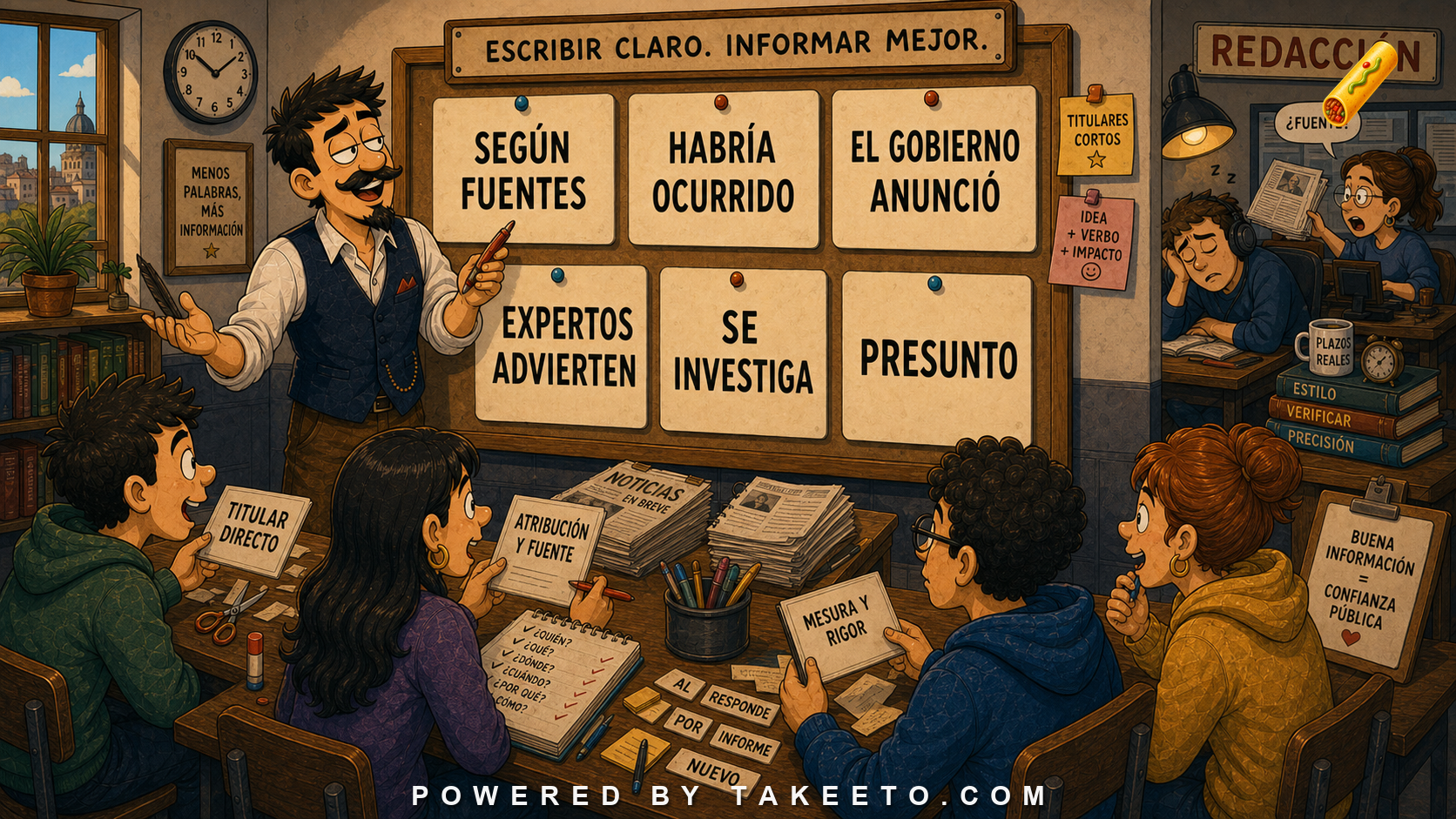
Example bank walkthrough
según fuentes
Source attribution phrase.
Learner action: identify who is responsible for the claim.
habría ocurrido
Conditional perfect often used for unconfirmed reporting.
Learner action: read as “reportedly” when context supports it.
el Gobierno anunció
Attribution to an institution.
Learner action: distinguish official announcement from independent verification.
expertos advierten
Warning frame.
Learner action: ask who the experts are and what evidence is provided.
se investiga
Impersonal/passive-like construction.
Learner action: ask who investigates and what is known.
presunto
Alleged/presumed in legal-journalistic context.
Learner action: do not treat accusation as conviction.
News reading workflow
For any article:
- Expand the headline.
- Identify the main event.
- Find the source of each claim.
- Mark attribution verbs.
- Watch for habría and other caution markers.
- Separate accusation, investigation, charge, conviction.
- Ask what se constructions hide or background.
- Compare with another source if the topic is important.
Remediation notes: news grammar as source tracking
The journalism article should train learners to ask one question constantly:
Who is responsible for this claim?
Headlines compress that answer. Body paragraphs distribute it. Attribution verbs, anonymous sources, legal labels, and conditional forms tell the reader how confirmed the information is.
A headline like:
Tres detenidos por fraude
does not mean three people have been convicted. It means they were detained/arrested in relation to an alleged fraud case. The article body should clarify who detained them, what authority is investigating, and what legal status they have.
The words presunto, detenido, investigado, imputado/acusado, procesado, and condenado are not interchangeable. Their exact legal meanings vary by country, but the learner should at least preserve the status ladder:
allegation or suspicion ≠ investigation ≠ charge/accusation ≠ conviction.
The conditional perfect also needs a strong warning. In news style:
habría ocurrido
often means "reportedly occurred" or "is said to have occurred," not simply "would have occurred" in a normal hypothetical sense. It marks distance from confirmation. Learners should look for the source:
según fuentes policiales,
de acuerdo con testigos,
según el informe,
de acuerdo con la fiscalía,
fuentes cercanas a la negociación.
Attribution verbs shape interpretation:
dijo = said, relatively neutral.
afirmó / aseguró = asserted or insisted.
advirtió = warned, risk frame.
denunció = denounced/reported wrongdoing, accusation frame.
reconoció = acknowledged, often unfavorable or previously resisted information.
negó = denied.
confirmó = confirmed.
Learners should not flatten all of these into "said."
The se section also deserves more force. Se investiga, se espera, se registraron, and se informó may background the actor. Sometimes that is normal news style. Sometimes it reduces accountability. The reader should ask:
Who investigates? Who expects? Who recorded? Who informed? Is the agent unknown, irrelevant, obvious, or strategically omitted?
A practical article-reading workflow:
- Expand the headline into a full sentence.
- Identify the event.
- Mark every source phrase.
- Label each attribution verb.
- Separate confirmed fact from allegation or report.
- Track legal status carefully.
- Compare another source for important topics.
The remediation rule:
In news Spanish, grammar is not just grammar. It is source responsibility.
Suggested interactive module: headline expander and attribution chart
A strong tool for this article would teach media literacy through grammar.
Suggested functions:
- Headline expander: add omitted articles and verbs.
- Attribution highlighter: según, afirmó, anunció, denunció, advirtió.
- Conditional detector: habría + participle as reported information.
- Legal status labels: presunto, detenido, acusado, condenado.
- Se construction parser: passive, impersonal, event report.
- Stance chart: neutral, warning, accusation, admission, denial.
- Source reliability prompt: named, anonymous, official, witness, expert.
- Rewrite mode: headline → neutral full sentence.
Final rule
Journalistic Spanish compresses events and assigns responsibility through attribution.
Expand headlines, track sources, read verbs like advirtió and denunció carefully, and treat habría and presunto as caution signals. News grammar is media literacy.