
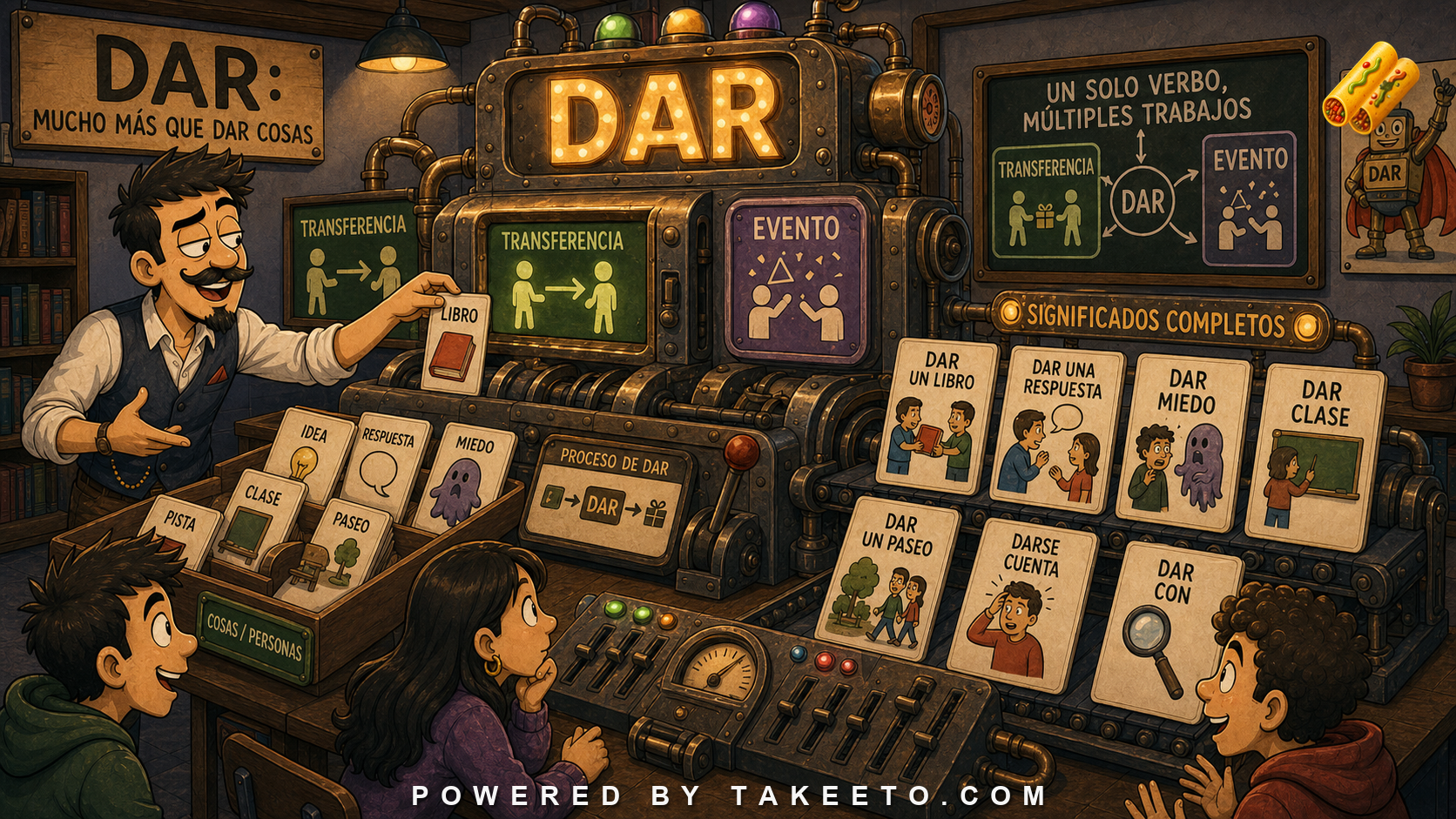
Dar is much bigger than “give”
The first meaning of dar is easy:
Le di un libro.
I gave him/her a book.
But dar is one of Spanish’s most productive verbs. It appears in literal transfer, communication, sensations, events, teaching, movement, idioms, and abstract packaging.
Examples:
dar una respuesta
give an answer
dar miedo
to scare / give fear
dar clase
to teach class
dar un paseo
to take a walk
darse cuenta
to realize
The key principle is:
Dar packages transfer broadly: objects, information, sensations, opportunities, events, and realizations can all be structured with dar.
Do not stop at “give.” Learn the construction family.
Literal giving and indirect objects
The basic structure is:
dar algo a alguien
give something to someone
Spanish often uses an indirect object pronoun:
Le di el libro.
I gave him/her the book.
Les dimos las llaves.
We gave them the keys.
Te voy a dar mi número.
I am going to give you my number.
The indirect object can be doubled for clarity or emphasis:
Le di el libro a Ana.
I gave the book to Ana.
This is normal Spanish, not redundant in the English sense.
Giving information and responses
Dar is common with nouns that package communication.
dar una respuesta
give an answer
dar una explicación
give an explanation
dar información
provide information
dar una opinión
give an opinion
dar instrucciones
give instructions
In English, these may also use “give,” but Spanish uses dar very broadly in institutional, academic, and everyday contexts.
Dar as a light verb
A light verb has little specific meaning by itself and combines with a noun to create an event.
dar un paseo
to take a walk
dar una vuelta
to take a walk/ride/turn around
dar un salto
to jump
dar un golpe
to hit / strike
dar un grito
to shout / let out a shout
The noun carries much of the event meaning; dar packages it as an occurrence.
Compare:
pasear
to walk/stroll
dar un paseo
to take a walk
Both can be possible, but dar un paseo packages the walk as a bounded event.
Dar clase, dar una clase
Dar clase means to teach class.
Doy clase los lunes.
I teach class on Mondays.
La profesora dio una clase excelente.
The professor gave/taught an excellent class.
This can confuse English speakers because “give class” is not ordinary English. Spanish treats a class as something delivered or conducted.
Related expressions:
dar una conferencia
give a lecture
dar un curso
teach/give a course
dar una charla
give a talk
Dar sensations and emotional effects
Dar is common with sensations and emotional reactions.
Me da miedo.
It scares me / It gives me fear.
Me da vergüenza.
It embarrasses me.
Me da hambre.
It makes me hungry.
Me da sueño.
It makes me sleepy.
Me da igual.
It is all the same to me / I do not care.
The experiencer is marked with an indirect object pronoun:
me, te, le, nos, les
The thing causing the sensation is often the grammatical subject.
Las películas de terror me dan miedo.
Horror movies scare me.
Dar ganas
Dar ganas de + infinitive means to make someone feel like doing something.
Me dan ganas de viajar.
It makes me want to travel.
Esa canción me da ganas de bailar.
That song makes me want to dance.
This construction is very useful because it expresses desire as an effect caused by something.
Compare:
Quiero bailar.
I want to dance.
Me dan ganas de bailar.
I feel like dancing / it makes me want to dance.
Dar with time, light, and direction
Dar appears in many spatial and environmental expressions.
La ventana da al jardín.
The window faces the garden.
Esta habitación da a la calle.
This room faces the street.
El sol da en la terraza.
The sun hits/shines on the terrace.
Dar la vuelta.
To turn around / go around.
These uses still involve a kind of directed contact, orientation, or event.
Darse cuenta: realization
Darse cuenta means to realize or notice.
Me di cuenta tarde.
I realized too late.
¿Te das cuenta?
Do you realize?
No se dieron cuenta del error.
They did not notice the error.
The structure often takes de before a noun:
darse cuenta de algo
and de que before a clause:
Me di cuenta de que era tarde.
I realized that it was late.
Do not omit de in careful Spanish.
Dar con: to find, hit upon
Dar con means to find, come across, or hit upon after searching or by chance.
Di con la solución.
I found the solution.
Finalmente dieron con el responsable.
They finally found the person responsible.
No doy con la palabra exacta.
I cannot find the exact word.
This is not literal giving. It is a contact/discovery idiom.
Translation limits
Because dar is so productive, direct translation is dangerous.
Me da miedo.
It scares me.
Not: it gives me fear, in normal English.
Doy clase.
I teach.
Not: I give class.
Dar un paseo.
Take a walk.
Not necessarily: give a walk.
Learners should store dar expressions as construction families, not as one-word translations.
Agreement matters in dar sensations
In sensation constructions, the thing causing the sensation controls the verb agreement.
Singular cause:
Me da miedo la oscuridad.
Darkness scares me.
Plural cause:
Me dan miedo las alturas.
Heights scare me.
With ganas, the noun is plural, so speakers commonly use dan:
Me dan ganas de salir.
I feel like going out.
But you will also hear singular agreement in some speech when the whole following idea is treated as one situation. For careful learner production, me dan ganas de... is the safer default.
The same agreement principle appears with other experiencer constructions:
Me gusta la idea.
Me gustan las ideas.
Dar miedo looks idiomatic, but it still has grammar.
Dar is not the same as hacer
Both dar and hacer can translate English “make” in some contexts, but they package causation differently.
Me da sueño.
It makes me sleepy.
Me hace dormir.
It makes me sleep.
The first causes a state or sensation. The second causes an action.
Me da risa.
It makes me laugh / it strikes me as funny.
Me hace reír.
It makes me laugh.
These overlap, but the structure is different. Dar + noun often creates an internal reaction: fear, shame, hunger, sleepiness, desire, laughter. Hacer + infinitive often causes an action or result.
A learner who stores only translations will miss this architecture. Store the pattern:
algo le da miedo a alguien
algo hace reír a alguien
That is how Spanish organizes the event.
Example bank walkthrough
dar un libro
Literal transfer.
Learner action: use indirect object pronouns and a phrases correctly.
dar una respuesta
Communication packaged as giving.
Learner action: learn common noun partners.
dar miedo
Cause fear.
Learner action: experiencer takes indirect object: me da miedo.
dar clase
Teach class.
Learner action: learn as an institutional event construction.
dar un paseo
Take a walk.
Learner action: dar + noun packages a bounded event.
darse cuenta
Realize.
Learner action: remember de / de que after the expression.
dar con
Find or hit upon.
Learner action: treat as an idiom with con.
Dar construction routine
When you see dar, ask:
- Is something literally transferred?
- Is information or a response being provided?
- Is dar packaging an event with a noun?
- Is someone experiencing a sensation or emotion?
- Is the expression idiomatic?
- Is there an indirect object pronoun?
- Does the construction require a preposition such as de or con?
Then interpret the whole construction, not just the verb.
Suggested interactive module: dar construction family map
A strong tool for this article would group dar expressions by construction type.
Suggested functions:
- Transfer map: giver, thing, recipient.
- Light-verb bank: dar un paseo, dar un salto, dar una clase.
- Sensation patterns: me da miedo, me da sueño, me da ganas.
- Idiom cards: darse cuenta, dar con, dar la vuelta.
- Preposition warnings: darse cuenta de, dar con.
- Translation repair: natural English output.
- Example builder: pronoun placement and agreement.
Final rule
Dar is not just “give.” It is a Spanish event-packaging engine.
It transfers objects, delivers information, causes sensations, conducts events, marks realization, and forms idioms. Learn dar by construction family: dar algo a alguien, dar una respuesta, dar miedo, dar clase, dar un paseo, darse cuenta, dar con.
The verb is small. The network is huge.
## Remediation summary for this pass
This pass upgraded the batch in four main ways:
- Mood and tense edge cases: added stance-based aunque, movable reference points in temporal clauses, future-form traps after si, result-clause variation in counterfactuals, and a compact sequence-of-tenses map.
- Register and variation: clarified -ra/-se production versus recognition, safer polite forms, deber/deber de variation, future subjunctive legal register, and deictic shifts in motion verbs.
- Verb architecture: expanded argument-structure explanations for gustar, parecer, quedar/quedarse, convertirse en, alcanzar a, and dar sensation patterns.
- Learner remediation: added contrast sets for high-risk English-transfer errors: “if will,” “for someone to,” “can,” “must,” “come/bring,” “become,” and light-verb dar translations.
The article sequence, headings, reader outcomes, example-bank format, interactive-module concepts, and final-rule pattern were preserved.