
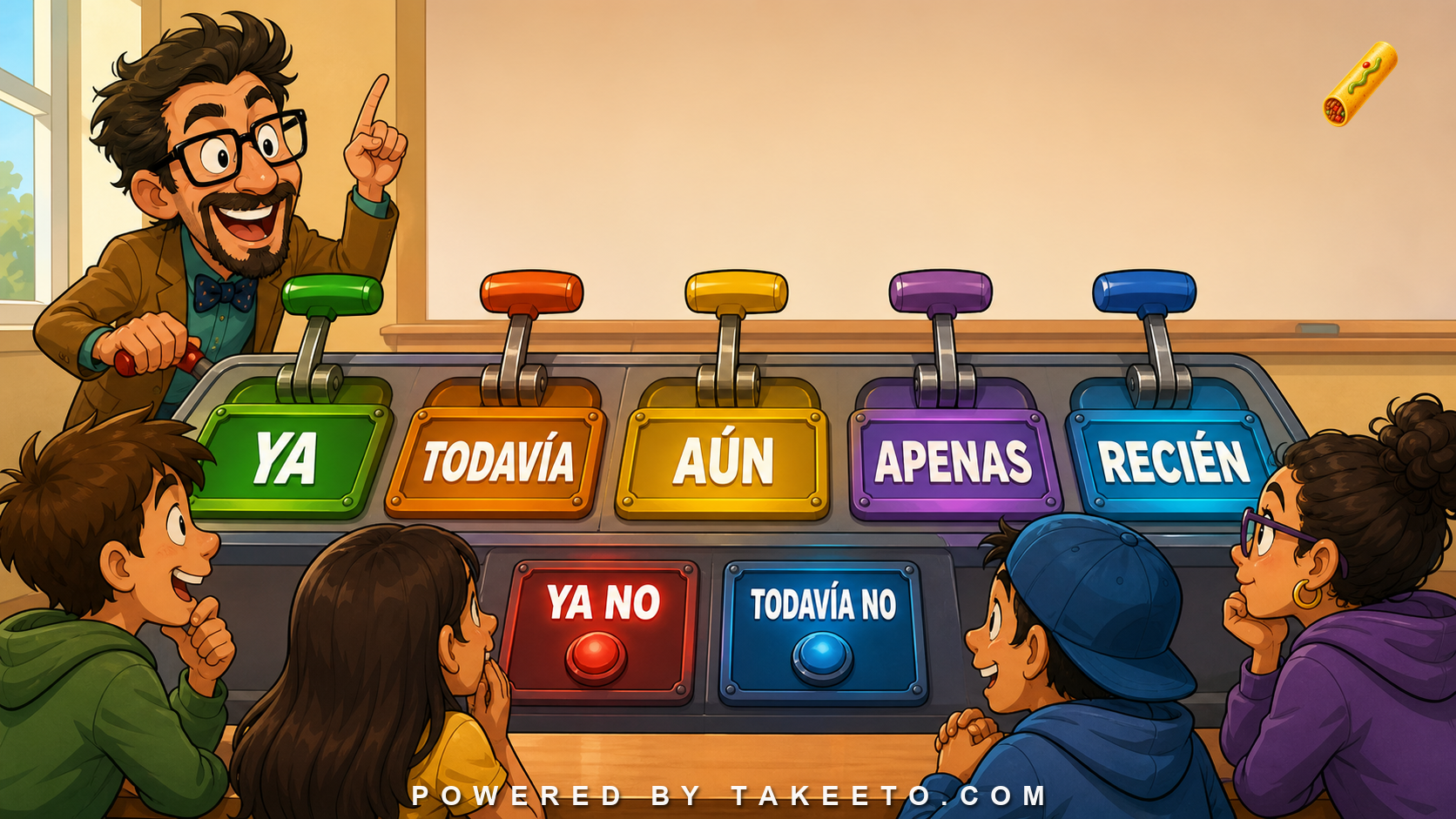
These words do not just tell time; they manage expectation
Temporal adverbs like ya, todavía, aún, apenas, and recién are small, frequent, and difficult. Their translations shift depending on context:
ya
already, now, anymore, right away, okay, enough
todavía
still, yet
aún
still, even, yet
apenas
scarcely, barely, just
recién
recently, just, newly, in some regions with finite verbs too
The key principle is:
Spanish temporal adverbs encode expectation, change, continuation, sequence, and speaker stance, not only clock time.
A learner who translates each one with a single English word will misread them constantly.
Ya: expectation satisfied or state changed
Ya often means that something has happened by now, or that a change of state has occurred.
Ya llegó.
He/she already arrived. / He/she has arrived now.
Ya entiendo.
I understand now.
Ya está listo.
It is ready now.
The underlying idea is often: before, not; now, yes. The speaker marks a transition.
Compare:
No entiendo.
I do not understand.
Ya entiendo.
Now I understand.
Ya can also mark impatience or immediacy:
¡Ya voy!
I’m coming!
Hazlo ya.
Do it now.
And in some conversational contexts, ya can signal acknowledgement:
Ya, ya.
Okay, I get it / enough / yes, yes, depending on tone and region.
Tone matters.
Ya no: a stopped state
Ya no means a previous state no longer holds.
Ya no vivo allí.
I do not live there anymore.
Ya no trabaja en esa empresa.
He/she no longer works at that company.
Ya no hay entradas.
There are no tickets left anymore.
The contrast is with the past. Something used to be true; now it is not.
Learner action: treat ya no as a unit of change.
Todavía: continuation
Todavía marks that a state continues.
Todavía vive allí.
He/she still lives there.
Todavía estoy esperando.
I am still waiting.
Todavía no ha llegado.
He/she has not arrived yet.
With negatives, todavía no usually means “not yet.”
Todavía no entiendo.
I still do not understand / I do not understand yet.
The speaker expected or might expect a change, but the current state continues.
Aún: still, yet, even
Aún overlaps with todavía when it means “still”:
Aún vive allí.
He/she still lives there.
Aún no ha terminado.
He/she has not finished yet.
It can sound more formal, literary, or emphatic than todavía in some contexts.
But aun without written accent also functions as “even” in many contexts:
aun así
even so
aun los expertos se equivocan
even experts make mistakes
Traditional spelling distinguishes aún when it means todavía from aun when it means incluso, though learners should consult current orthographic guidance for edge cases. For practical reading, notice whether the meaning is still/yet or even.
Todavía más and aún más
Both todavía más and aún más can intensify comparison:
Es todavía más difícil.
It is even/still more difficult.
Es aún más importante.
It is even more important.
Here the words are not simply temporal. They mark an increase beyond expectation.
Learner action: do not force “still” into every todavía or aún. Sometimes “even more” is the natural translation.
Apenas: barely, scarcely, just
Apenas has several important meanings.
It can mean barely/scarcely:
Apenas tengo dinero.
I barely have any money.
Apenas se oye.
You can barely hear it.
It can mean just/recently in sequence:
Apenas empezó la clase, sonó la alarma.
As soon as / just when class began, the alarm went off.
Apenas llegué, me llamó.
Just as I arrived, he/she called me.
It can also appear in apenas si:
Apenas si lo conozco.
I barely know him.
Learner action: identify whether apenas is about small quantity, weak degree, or immediate sequence.
Recién: recently and just
Recién is especially important because its usage varies regionally.
As an adjective-like modifier:
recién llegado
newly arrived
recién nacido
newborn
recién hecho
freshly made
In many Latin American varieties, recién can modify finite verbs in contexts where Spain Spanish might prefer acabar de or hace poco:
Recién llegó.
He/she just arrived.
Recién me enteré.
I just found out.
In other varieties, this may sound regional or marked. Learners should recognize it widely, especially in the Americas, and choose according to target variety.
Ya versus todavía no
A common pair:
¿Ya llegó?
Has he/she arrived yet? / Did he/she already arrive?
Todavía no.
Not yet.
The exchange is about expectation. The speaker expects arrival at some point. Ya asks whether the expected change has happened. Todavía no says the earlier non-arrival state continues.
This is more useful than memorizing “ya = already” and “todavía = still.”
Adverb placement
These adverbs often appear before the main verb:
Ya llegó.
Todavía trabaja allí.
Aún no sabemos.
Apenas empezó.
But placement can shift for emphasis, rhythm, and construction:
No vive allí ya.
Less common or marked in many contexts.
Ya no vive allí.
Normal.
No ha llegado todavía.
Normal.
Todavía no ha llegado.
Normal, often more expectation-focused.
Learner action: memorize common chunks: ya no, todavía no, aún no, apenas si, recién llegado.
Example bank walkthrough
ya llegó
Expected arrival has happened.
Learner action: think “now yes,” not only “already.”
todavía no
Expected change has not happened yet.
Learner action: learn as a response pair with ¿ya...? questions.
aún vive
Still lives; often more formal or emphatic than todavía vive depending on context.
Learner action: recognize aún as todavía meaning.
apenas empezó
Can mean “it barely began” or “as soon as it began,” depending on sentence structure.
Learner action: use context to distinguish degree from sequence.
recién llegado
Newly arrived.
Learner action: learn recién + participle/adjective as a strong pattern.
ya no
No longer.
Learner action: treat it as a change-of-state negative.
todavía más
Even/still more.
Learner action: recognize intensifying comparison.
Remediation notes: tiny adverbs carry tense, expectation, and region
The repair for temporal adverbs is to teach them as expectation operators. Ya llegó does not merely say “arrived.” It says the expected change has happened. Todavía no llegó says the non-arrival continues against expectation. Ya no vive aquí says a previous state has ended. Todavía vive aquí says a state continues. That contrast is more useful than memorizing ya = already and todavía = still.
Aún needs spelling discipline. With the value of todavía, write aún: aún vive, aún no ha llegado, es aún más difícil. Without the accent, aun often means incluso or has concessive value: aun los expertos se equivocan, aun así, aun cuando. This is not just accent trivia; it changes the reading.
Apenas has multiple values. It can mean “hardly/scarcely”: apenas habló. It can mean “only just” or signal a very recent/beginning action in many American varieties: apenas empieza. It can introduce a time clause like en cuanto: apenas llegó, llamó. The fixed phrase is apenas si, without accent on si, when it means “hardly even”: apenas si durmió.
Recién needs regional labeling. In general Spanish it strongly combines with participles and adjective-like forms: recién hecho, recién nacido, recién llegada. In much of the Americas, it can also modify finite verbs: recién llegó, recién lo vi, and can mean “only/just” with temporal expressions: recién ahora. A Spain-oriented formal rewrite may prefer acaba de llegar, hace poco llegó, or solo ahora depending on meaning.
Production target: learn contrast pairs. Ya llegó / todavía no llegó. Ya no trabaja aquí / todavía trabaja aquí. Aún no / aun así. Apenas habló / apenas llegó. Recién hecho / recién llegó. These pairs teach the grammar better than one-word translations.
Suggested interactive module: timeline expectation tool
A strong tool for this article would show how adverbs mark states and changes.
Suggested functions:
- Timeline view: before, expected change, now.
- Adverb toggles: ya, ya no, todavía, todavía no, aún, apenas, recién.
- Question-answer mode: ¿Ya llegó? → Todavía no.
- Regional mode: recién llegó recognition and production guidance.
- Meaning selector: already, now, still, not yet, barely, just, even more.
- Placement practice: before verb, after verb, negative combinations.
- Contrast drills: ya no vive vs todavía vive.
Final rule
Ya, todavía, aún, apenas, and recién are expectation words.
They tell you whether a change has happened, whether a state continues, whether something barely holds, whether something just occurred, or whether a comparison exceeds expectation. Learn them on timelines, not as one-word translations.