Spanish measurement uses different verbs for different dimensions
English often uses “be” for age, height, weight, duration, and price:
She is thirty.
It is two meters long.
The class is one hour.
It is ten euros.
Spanish usually does not translate these with one form of ser or estar. It uses different verbs for different measurement types.
The key principle is:
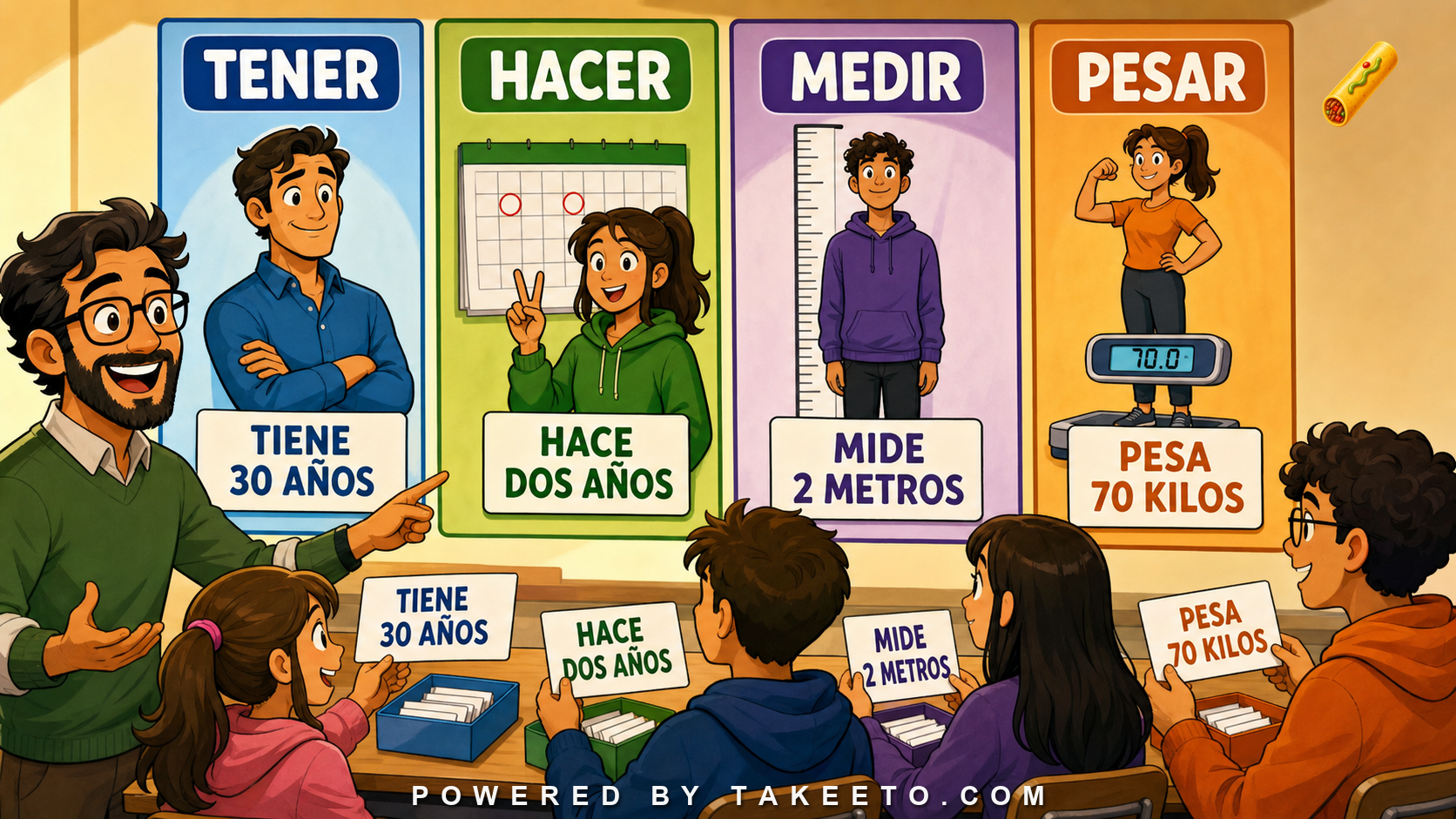
Spanish measurement is construction-based: people tienen age, things miden dimensions, things pesan weight, events duran time, prices cuestan money, and past events happened hace a duration.
A learner who masters these verbs stops translating “is” and starts expressing measurement naturally.
Tener for age
Spanish expresses age with tener + number + años.
Tengo treinta años.
I am thirty years old.
Mi hija tiene seis años.
My daughter is six.
¿Cuántos años tienes?
How old are you?
The structure is not optional. Do not say soy treinta años. Spanish treats age as something one has.
In context, años can sometimes be omitted:
Tiene treinta.
He/she is thirty.
But learners should master the full pattern first, especially in forms, introductions, medical contexts, and official settings.
Hacer for elapsed time
Hacer expresses elapsed time between an event and a reference point.
Llegó hace dos años.
He/she arrived two years ago.
Nos conocimos hace una semana.
We met a week ago.
Hace mucho que no hablamos.
We haven’t talked in a long time.
The same phrase hace dos años can participate in more than one structure:
Llegué hace dos años.
I arrived two years ago.
Hace dos años que vivo aquí.
I have lived here for two years.
The first locates a completed event in the past. The second measures an ongoing situation. Learners need the whole construction, not just the phrase.
Desde hace and ongoing duration
For ongoing duration, Spanish often uses desde hace, hace + time + que, or llevar + time + gerund.
Vivo aquí desde hace dos años.
I have lived here for two years.
Hace dos años que vivo aquí.
I have lived here for two years.
Llevo dos años viviendo aquí.
I have been living here for two years.
In some regions, learners will also hear:
Tengo dos años viviendo aquí.
This is common in many American varieties, but for broad formal or international production, llevar, desde hace, and hace... que are safer core structures.
Medir for height, length, and dimensions
Medir expresses physical dimensions.
Mide dos metros.
It is two meters long/tall.
Mido un metro setenta.
I am one meter seventy tall.
La mesa mide un metro de ancho.
The table is one meter wide.
For people, medir usually gives height. For objects, it gives length, width, height, or overall dimensions depending on the phrase.
The present tense is irregular:
mido, mides, mide, medimos, miden
Do not say soy un metro setenta as the neutral target. Use mido.
Pesar for weight
Pesar expresses weight.
Peso setenta kilos.
I weigh seventy kilos.
La maleta pesa veinte kilos.
The suitcase weighs twenty kilos.
¿Cuánto pesa?
How much does it weigh?
Pesar also has metaphorical uses:
Me pesa la decisión.
The decision weighs on me.
But the core learner use is physical weight. Use pesar, not ser.
Durar for duration
Durar expresses how long an event, process, object, or state lasts.
La clase dura una hora.
The class lasts one hour.
La película duró dos horas.
The movie lasted two hours.
La batería dura todo el día.
The battery lasts all day.
This differs from hace:
La reunión duró dos horas.
The meeting lasted two hours.
La reunión fue hace dos horas.
The meeting was two hours ago.
Costar and valer for price and value
Costar is the basic verb for price.
Cuesta diez euros.
It costs ten euros.
¿Cuánto cuesta?
How much does it cost?
Valer expresses value or worth and can overlap with price:
Vale diez euros.
It is worth/costs ten euros.
No vale la pena.
It is not worth it.
In a store, costar is the safest default. Valer is also common in many places, but it has broader value meanings.
Units and technical contexts
Measurement nouns pluralize normally:
un kilo / setenta kilos
un metro / dos metros
una hora / tres horas
Technical symbols behave differently:
70 kg
2 m
10 km
25 °C
Symbols do not pluralize like ordinary words. In technical documents, use the conventions of the domain. In ordinary learner writing, full words are often safer.
Common learner errors
The first error is using ser for age:
Tengo treinta años.
not: soy treinta años.
The second error is confusing age and elapsed time:
Tiene dos años.
He/she is two years old.
Hace dos años.
two years ago / for two years, depending on construction.
The third error is using ser or estar for height and weight:
Mide dos metros.
Pesa setenta kilos.
The fourth error is translating “how long is the class?” as physical length:
¿Cuánto dura la clase?
How long does the class last?
Remediation notes: measurement verbs and unit discipline
Spanish measurement sentences are not built from one neutral “be.” They use specialized verbs because age, elapsed time, dimension, weight, duration, price, and value are different semantic domains.
For age, use tener:
Tengo treinta años.
I am thirty years old.
For turning an age, use cumplir:
Cumplo treinta años en julio.
I turn thirty in July.
For elapsed time, use hacer structures:
Llegó hace dos horas.
He/She arrived two hours ago.
Hace dos horas que esperamos.
We have been waiting for two hours.
Esperamos desde hace dos horas.
We have been waiting for two hours.
Another common duration pattern is llevar + gerund:
Llevamos dos horas esperando.
We have been waiting for two hours.
This is not identical in style to hace dos horas que esperamos, but both are important.
For dimensions, medir is the clean verb:
Mide dos metros.
He/She/It is two meters tall/long.
La mesa mide un metro de ancho.
The table is one meter wide.
For weight, use pesar:
Pesa setenta kilos.
He/She/It weighs seventy kilos.
For event duration, use durar:
La reunión duró una hora.
The meeting lasted an hour.
For price, use costar; for broader value, use valer:
Cuesta diez euros.
It costs ten euros.
Esta edición vale mucho para los coleccionistas.
This edition is worth a lot to collectors.
Technical and administrative contexts require unit discipline. Spanish may use decimal comma in many countries and formal documents: 1,75 m, 70,5 kg. Spaces, symbols, and local formatting conventions matter in forms and reports. The learner’s job is not only to know the number; it is to choose the measurement verb and copy the unit system accurately.
The practical repair is to label the dimension before translating. Age? tener/cumplir. Time elapsed? hacer/desde hace/llevar. Physical dimension? medir. Weight? pesar. Duration? durar. Price? costar. Value? valer.
Example bank walkthrough
tiene treinta años
Age with tener.
Learner action: age is something one “has” in Spanish.
hace dos años
Elapsed time.
Learner action: decide whether the whole structure means “ago” or “for.”
mide dos metros
Height, length, or dimension.
Learner action: use medir for physical dimensions.
pesa setenta kilos
Weight.
Learner action: use pesar, not ser.
dura una hora
Duration.
Learner action: use durar for events and processes.
cuesta diez euros
Price.
Learner action: use costar as the basic price verb.
Suggested interactive module: measurement construction chart
A strong tool for this article would map measurement type to verb.
Suggested functions:
- Age mode: tener años.
- Elapsed-time mode: hace + time.
- Ongoing duration mode: desde hace, hace que, llevar + gerund.
- Dimension mode: medir.
- Weight mode: pesar.
- Duration mode: durar.
- Price/value mode: costar vs valer.
- Error repair: soy treinta, es dos metros, es diez euros.
Final rule
Spanish measurement is not one “to be” pattern.
Use tener for age, hacer for elapsed time, medir for dimensions, pesar for weight, durar for duration, and costar for price.
The number is only half the sentence. The measurement verb is the other half.