
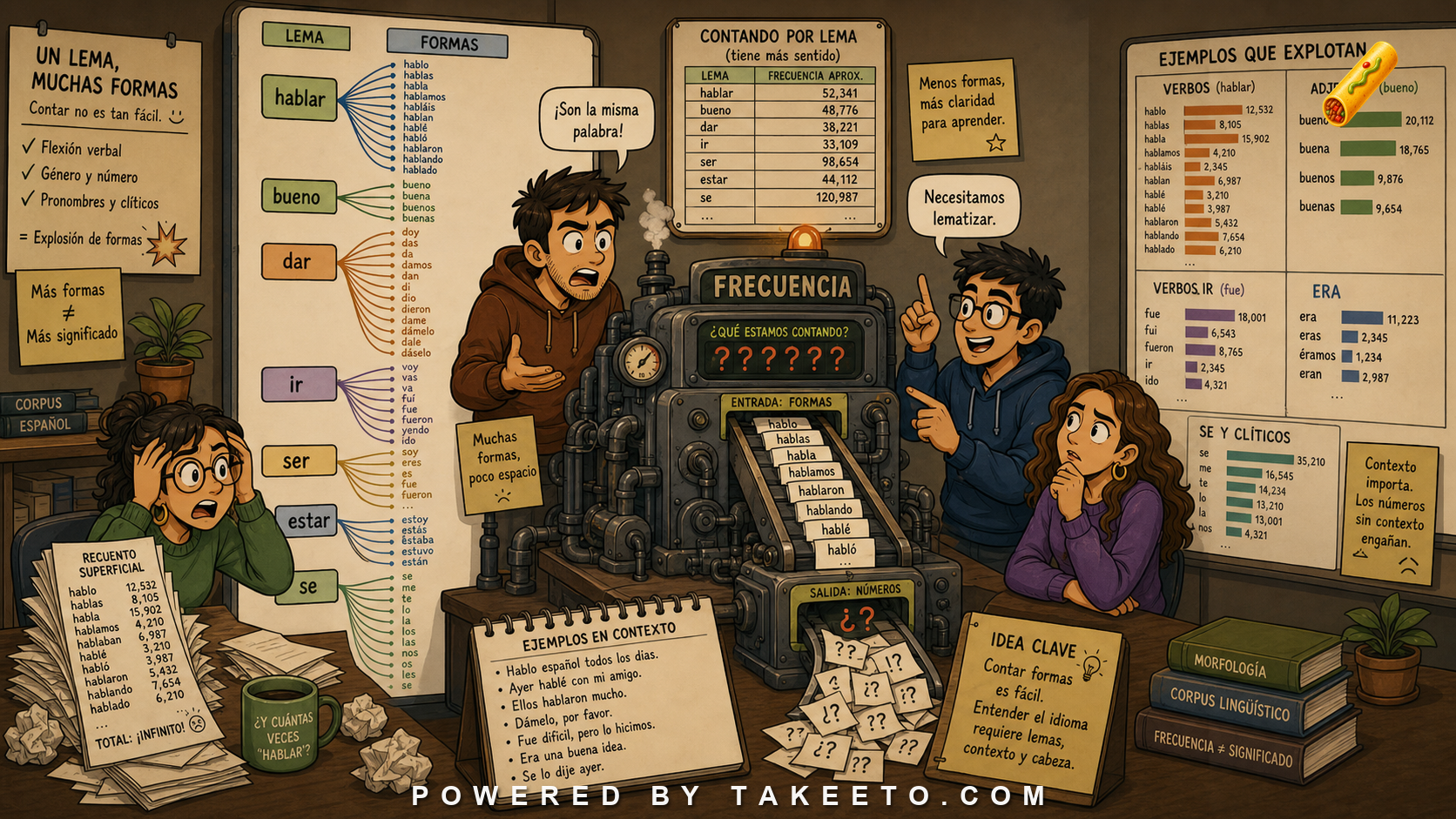
Counting Spanish words is not simple
A learner sees a frequency list and assumes each line is a word. But Spanish is morphologically rich. A single verb can appear in dozens of forms. Adjectives change for gender and number. Pronouns attach to verbs. Accent marks distinguish words. Some forms belong to more than one lemma.
Consider:
hablo
habló
hablaron
These are different word forms, but they belong to the same verb lemma:
hablar
Now consider:
fue
This may be linked to ser or ir, depending on context.
Counting Spanish requires decisions.
The key principle is:
Spanish frequency depends on how forms are tokenized, lemmatized, normalized, and disambiguated.
A frequency count is never just raw reality. It is a method.
Token, type, lemma, word family
A token is each occurrence in a text.
Hablo español y hablo francés.
This sentence has two tokens of hablo.
A type is a distinct written form.
In:
hablo, habló, hablaron
there are three types.
A lemma is the dictionary headword.
hablo, habló, hablaron → hablar
A word family may include related derivations.
hablar, hablante, habla, hablador
Different tools count different things. A list of word forms will show hablo separately from habló. A lemma list may group both under hablar. A word-family list may group related derived words.
Learner action: know what kind of list you are reading.
Verb inflection explodes the count
Spanish verbs produce many forms:
hablo
hablas
habla
hablamos
hablan
hablé
habló
hablaron
hablaba
hablaría
hable
hablara
hablando
hablado
A raw word-form frequency list spreads the verb across many entries. A lemma list groups them.
Both views teach something.
A form list helps learners see what they will actually encounter.
A lemma list helps learners see which verbs matter overall.
For beginners, form frequency can be important because irregular forms do not look like their lemmas.
soy, es, era, fue, será
A learner may not recognize these as connected to ser without explicit teaching.
Gender and number multiply adjective and noun forms
Adjectives change:
bueno
buena
buenos
buenas
A form count may split them. A lemma count groups them under bueno.
Nouns also vary:
estudiante / estudiantes
problema / problemas
ciudad / ciudades
Plural forms may be common in some domains. A legal document may use derechos, obligaciones, plazos, and requisitos more often than singular forms.
Learner action: when learning a lemma, practice the common forms you will actually read.
Clitic attachments complicate tokenization
Spanish object pronouns can attach to infinitives, gerunds, and affirmative commands.
dar + me + lo → dármelo
decir + se + lo → decírselo
enviando + nos + la → enviándonosla
da + me + lo → dámelo
A tokenizer must decide how to treat these. Is dámelo one token? Should it be split into da + me + lo? Should it count under dar? What about the pronouns?
For learners, attached clitics create recognition problems. A learner may know dar, me, and lo, but fail to recognize dámelo quickly.
Learner action: practice decomposing clitic clusters.
Accent marks can distinguish forms
Spanish accent marks are not decoration.
hablo
I speak
habló
he/she spoke
se
reflexive/impersonal/passive pronoun
sé
I know / command of ser
A tool that strips accents may merge distinct forms. Sometimes normalization is useful for search; sometimes it destroys meaning.
Similarly:
mas
but, literary/formal
más
more
Accent-sensitive counting matters.
Homographs require context
Some forms look identical but belong to different lemmas or categories.
fue
can mean:
he/she/it was
he/she/it went
from ser or ir.
era
can be a form of ser, or a noun meaning era.
vino
can be a form of venir, or the noun wine.
como
can be a conjunction/adverb or a form of comer.
A lemmatizer must use context to disambiguate. It may make mistakes.
Learner action: do not assume every frequency count has perfect grammatical tagging.
Spelling variants and regional forms
Spanish is standardized, but variation still affects counts.
Examples:
solo / sólo
Modern recommendations generally allow solo without accent except in cases where ambiguity motivates it in some guidance traditions, but older texts contain sólo frequently.
guion / guión
Accent practices differ across time and editorial tradition.
Voseo forms also complicate counts:
hablás
comés
vivís
A corpus or tool must include these forms to represent voseo regions well.
Learner action: frequency tools that ignore regional morphology underrepresent real Spanish.
Lemmatizers are useful and fallible
A lemmatizer tries to map word forms to lemmas. It is helpful for large-scale analysis.
But it can struggle with:
- ambiguous forms,
- proper names,
- clitic clusters,
- nonstandard spelling,
- dialect forms,
- old texts,
- code-switching,
- OCR errors,
- punctuation and tokenization.
A frequency list based on automatic lemmatization should be read as a useful approximation.
For learner purposes, that is usually enough. For strong claims, check examples manually.
Why this matters for learners
Lemmas and forms affect study strategy.
If you study only lemmas, you may know hablar but fail to recognize habló instantly.
If you study only forms, you may memorize many entries without seeing the system.
Good learning connects both:
hablar → hablo, habla, habló, hablaron, hablaba, hablando, hablado
bueno → buen, buena, buenos, buenas
dar → da, dio, daba, dámelo, darse cuenta
The goal is not to become a corpus linguist. The goal is to avoid being misled by lists and to build form recognition.
Example bank walkthrough
hablo / habló / hablaron
Different forms of the lemma hablar.
Learner action: connect accent, person, number, and tense.
bueno / buena / buenos
Gender and number variants.
Learner action: learn adjective families as patterns.
dámelo
Imperative plus clitics plus accent mark.
Learner action: decompose into da + me + lo.
fue
Ambiguous form of ser or ir.
Learner action: use context before assigning a lemma.
era
Verb form or noun.
Learner action: do not trust isolated form counts blindly.
sé / se
Accent distinguishes verb form from pronoun.
Learner action: preserve accent marks in serious reading.
Remediation notes: lemmatization is interpretation, not just sorting
The lemmatization article should make one point more explicit: grouping Spanish forms under a lemma is not a purely mechanical act. It involves analysis. A tool that groups hablo, hablas, habló, hablaron, and hablando under hablar is doing grammatical interpretation. Usually that works. Sometimes ambiguity fights back.
Consider fue. It may belong to ser or ir. Only context tells you:
Fue médico durante años. → ser.
Fue a Madrid. → ir.
Consider sé and se. Accent marks distinguish sé from saber or ser imperative-like forms in context, while se may be reflexive, reciprocal, impersonal, passive-like, lexical-pronominal, or part of another construction. A frequency tool that strips accents or fails to parse clitics can distort the count.
Clitic attachments are especially important:
dámelo = da + me + lo.
decírselo = decir + se + lo.
haciéndolo = haciendo + lo.
A token count may see one written form. A grammatical analysis sees a verb plus pronouns. For learners, this is not an abstract corpus problem; it affects dictionary lookup and reading. If you cannot decompose dámelo, you may fail to find dar, me, and lo.
Gender and number also complicate counts. Bueno, buena, buenos, buenas, and buen are related forms, but their distribution teaches syntax: adjective position, agreement, and apocopation. A lemma count hides that useful information. The learner needs both levels: lemma for vocabulary family, form for grammar.
A practical learner routine for unknown forms:
- Remove attached clitics if present.
- Identify tense/person/number if it is a verb.
- Restore the infinitive or dictionary form.
- Check accent marks before merging forms.
- Ask whether a homograph has multiple lemmas.
- Look at the sentence, not only the word.
Frequency tools can normalize forms, but normalization can erase exactly what a learner needs to study. The goal is not to distrust lemmatizers. The goal is to know what they simplify.
Repair rule:
Lemmas help you count vocabulary families; word forms teach you the grammar that actually appears on the page.
Suggested interactive module: lemmatizer demo with ambiguous forms
A strong tool for this article would show how frequency tools make decisions.
Suggested functions:
- Form splitter: identify stem, ending, gender, number, clitics.
- Lemma mapper: connect forms to dictionary headwords.
- Ambiguity alert: fue, era, vino, como, se/sé.
- Accent toggle: show what changes when accents are stripped.
- Clitic decomposer: dámelo, enviándoselo, decírselo.
- Regional morphology mode: include voseo forms.
- Frequency view: compare form frequency and lemma frequency.
Final rule
Spanish frequency counts are shaped by morphology.
Forms, lemmas, clitics, accent marks, homographs, and regional variants all affect what a list shows. Use frequency tools, but understand what they are counting.
A Spanish word is often not a single shape. It is a family of forms.