
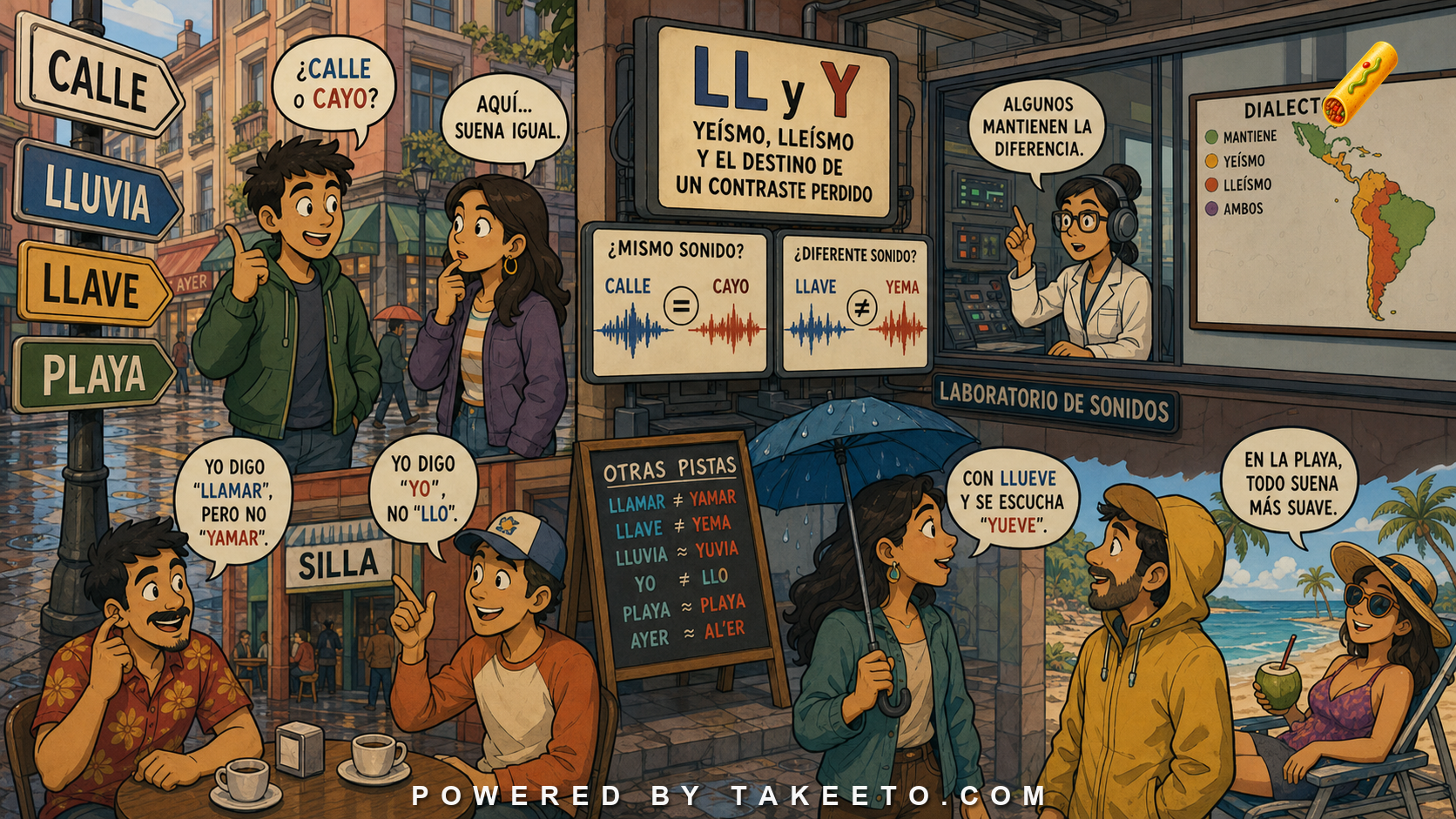
The spelling remembers what many accents no longer say
Spanish writes ll and y differently:
- calle
- cayó
- llamar
- yema
- lluvia
- yo
- silla
- playa
In many varieties, those spellings are pronounced with the same sound. For many speakers, calle and cayó can be homophones, distinguished only by context and spelling.
In other varieties, a distinction survives. And in Argentina and Uruguay, the merged sound may be pronounced in a way that sounds very different to learners expecting a simple English-like y.
The beginner explanation “ll sounds like y” is useful in many classrooms, but it is not a complete account of the Spanish-speaking world.
A better rule is:
LL and Y are distinct spellings whose pronunciation depends strongly on dialect.
Yeísmo
Yeísmo is the merger of historical ll and y. In yeísta speech, the older /ll/ sound has been absorbed into the /y/-type sound.
For yeísta speakers:
| Pair | Pronunciation |
|---|---|
| calle / cayó | same or very close |
| halla / haya | same or very close |
| pollo / poyo | same or very close |
| valla / vaya | same or very close |
| calló / cayó | same or very close |
Yeísmo is extremely widespread. It is common in much of Spain and the Americas and is fully standard in educated speech.
Learners should not think of yeísmo as a mistake or simplification by careless speakers. It is a major historical sound change.
Lleísmo or non-yeísmo
In non-yeísta varieties, ll and y remain distinct.
The traditional ll sound is a palatal lateral, often represented as /ʎ/. The y sound is a palatal approximant or related sound depending on context and region.
For non-yeísta speakers:
| Pair | Pronunciation |
|---|---|
| calle / cayó | different |
| halla / haya | different |
| pollo / poyo | different |
| valla / vaya | different |
| calló / cayó | different |
This distinction survives in some areas and among some speakers, but it is now a minority pattern in the Spanish-speaking world.
A learner who wants a broad standard model usually does not need to acquire non-yeísta ll, unless their target community uses it or they have a specific phonetic interest.
The y/ll sound is not the same everywhere
Even where ll and y merge, the merged sound varies.
Common realizations include:
| Broad realization | Where learners may hear it |
|---|---|
| English-like y sound | many varieties in some contexts |
| stronger affricate-like sound | after pause, after n/l, or in emphatic speech in many accents |
| fricative-like sound | various regional patterns |
| “zh” or “sh”-like sound | Rioplatense Spanish, especially Argentina and Uruguay, with variation by age, region, and social style |
Examples:
- yo
- ayer
- playa
- lluvia
- calle
- silla
The word yo may sound gentle in one accent and much stronger in another. Lluvia may begin with a y-like, j-like, zh-like, or sh-like quality depending on region.
Do not assume the spelling alone gives one universal sound.
Rioplatense rehilamiento and “sh”
Argentine and Uruguayan Spanish often surprise learners because ll/y may sound like English “sh” or like the “s” in English measure, depending on speaker and region.
Thus yo may sound close to “sho” or “zho” to an English ear. calle may sound like “cashe” or “cazhe” in rough approximation.
This is not a separate language. It is Spanish. It is also not random theatrical pronunciation. It is a well-known regional development.
A learner using Mexican or Peninsular materials may need a listening adjustment when first hearing Rioplatense speech.
Spelling still matters
If ll and y often sound the same, why keep both spellings?
Because writing preserves etymology, word identity, and distinctions that some dialects still pronounce. It also distinguishes homophones in text.
Compare:
| Form | Meaning |
|---|---|
| cayó | he/she/it fell |
| calló | he/she/it became silent |
| haya | subjunctive of haber; also beech tree in some contexts |
| halla | finds |
| vaya | go/subjunctive/command-related form; interjection |
| valla | fence, barrier |
| pollo | chicken |
| poyo | stone bench or platform in some varieties |
A yeísta speaker may pronounce these pairs alike, but the spelling carries the difference.
Learners must therefore read more than they hear. This is not unusual. Seseo creates a similar spelling burden for c/z/s.
How to choose a learner pronunciation
Most learners should choose a target variety and follow it consistently.
If your main exposure is Latin American media outside the Rioplatense region, a y-like or moderately strong palatal sound may be appropriate.
If your main exposure is Spain, yeísmo is still common, but local realization varies.
If your main exposure is Argentina or Uruguay, you need to become comfortable hearing and possibly producing the sh/zh-like realization.
If you are studying with a community that preserves ll/y distinction, learn the distinction.
The mistake is not choosing one model. The mistake is assuming your model is the only correct Spanish.
Listening strategy for multiple varieties
When you hear an unfamiliar y/ll sound, ask three questions:
1. Is the speaker merging ll and y?
Listen for pairs like calle/cayó or llama/yema. In real speech, minimal pairs are rare, so use broad pattern recognition.
2. What is the quality of the merged sound?
Is it y-like, affricate-like, fricative-like, sh-like, or zh-like?
3. Does position matter?
Many speakers pronounce the sound more strongly after a pause or after certain consonants.
Compare:
- yo
- el hielo, if relevant for y-like onset from hie-
- la llave
- ayer
- playa
- con lluvia
The same letter may sound stronger or weaker depending on context.
Common learner mistakes
Mistake 1: Believing ll must always sound like English y
That is common, but not universal.
Mistake 2: Treating Argentine/Uruguayan pronunciation as strange or incorrect
It is a normal regional Spanish pattern.
Mistake 3: Ignoring spelling because the sounds merge
You still need to distinguish calló and cayó in writing.
Mistake 4: Overcorrecting by pronouncing ll as English l + y
The traditional ll sound, where preserved, is not simply “l-y” pronounced as two sounds.
Mistake 5: Expecting every speaker in a country to match a map
Dialect maps simplify. Cities, generations, social groups, and individual speakers vary.
Practice sets
Yeísmo spelling awareness
Read and define:
- cayó / calló
- vaya / valla
- haya / halla
- pollo / poyo
- arrollo / arroyo
Even if you pronounce the pairs alike, spell them by meaning.
Regional listening
Listen for the first sound in:
- yo
- lluvia
- llave
- yema
- playa
- ayer
Try to identify whether the speaker uses a y-like, affricate-like, sh-like, or zh-like realization.
Production consistency
Choose a model and say:
Yo llevo la llave a la playa.
Ayer cayó lluvia en la calle.
La silla está junto a la valla.
Do not switch randomly among unrelated pronunciations unless you are deliberately practicing accent recognition.
Suggested interactive module: y/ll dialect audio grid
A useful tool for this article would compare the same words across regions.
Suggested functions:
- Dialect grid: Spain, Mexico, Colombia, Argentina, Uruguay, and non-yeísta samples where available.
- Pair comparison: calle/cayó, calló/cayó, valla/vaya.
- Spelling quiz: choose ll or y based on meaning.
- Sound-quality labels: approximant, affricate, fricative, sh-like, zh-like.
- Learner target selector: recommend practice sets based on target variety.
Example input:
calle / cayó
Possible output:
- Yeísta varieties: likely same or very close pronunciation
- Non-yeísta varieties: contrast preserved
- Rioplatense varieties: merged sound may be sh-like or zh-like
- Writing: always distinguish by meaning
Final rule
LL and Y show how Spanish spelling can preserve a contrast that much of the speech community has merged.
Yeísmo is widespread and standard. Non-yeísta distinction still exists. Rioplatense pronunciations add another layer of regional identity.
For learners, the goal is not to declare one sound correct. The goal is to recognize the variation, choose a consistent target, and keep the spellings straight.