
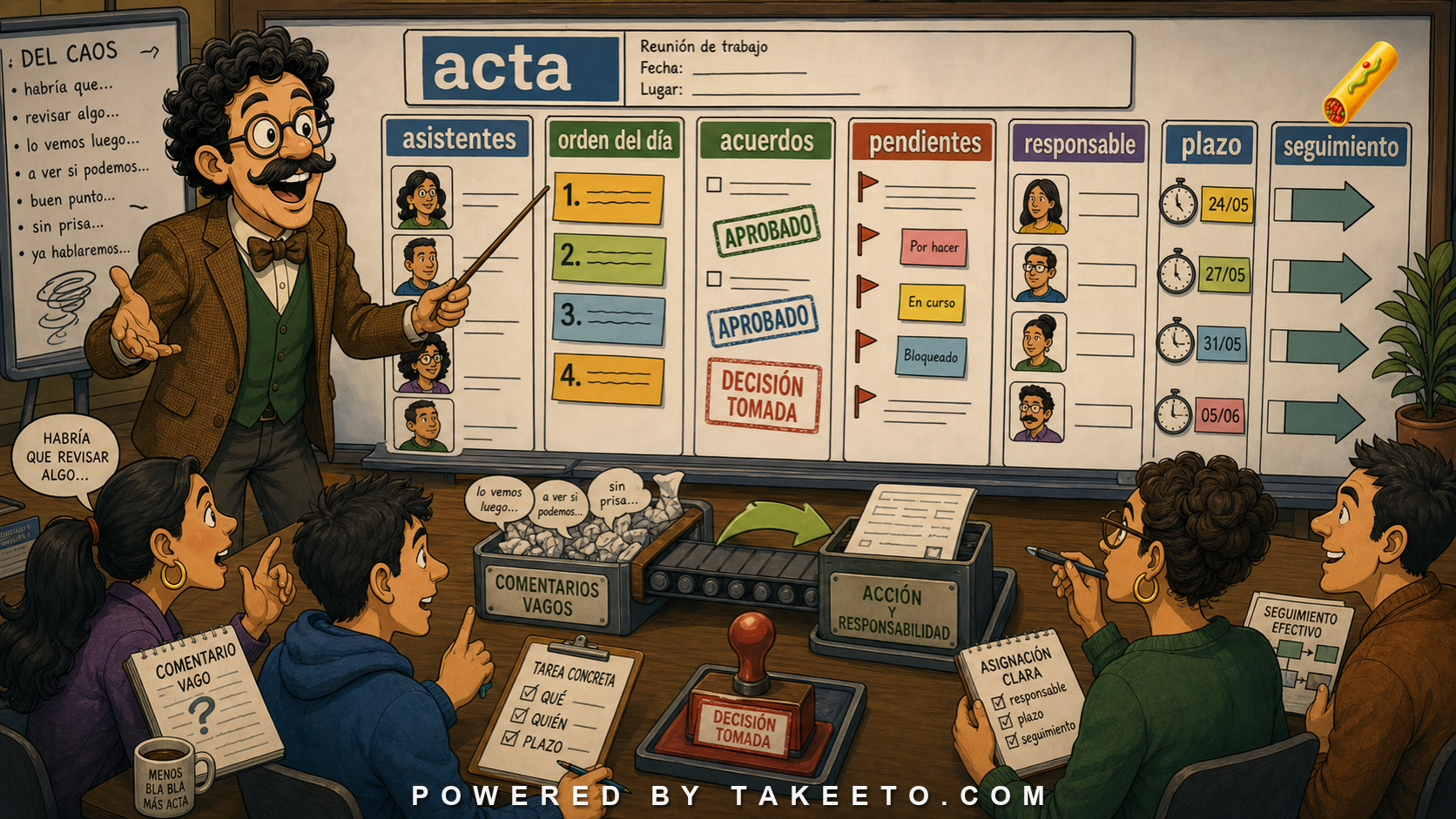
Meeting minutes are memory with responsibility attached
A meeting can feel conversational, but the written record is not conversation. In Spanish, acta, minuta, resumen de reunión, or notas de reunión may capture attendees, agenda, discussion, decisions, tasks, deadlines, and responsibilities.
The difference between a useful meeting note and a decorative note is accountability.
Weak note:
Se habló del proyecto.
The project was discussed.
Useful note:
Se acordó que Laura enviará la versión final del presupuesto antes del viernes 12 de junio.
It was agreed that Laura will send the final version of the budget before Friday, June 12.
The key principle is:
Meeting-minutes Spanish should convert conversation into decisions, tasks, owners, and deadlines.
Acta, minuta, resumen
Terminology varies.
acta — formal minutes/official record
minuta — minutes/meeting note, common in some countries and organizations
resumen de reunión — meeting summary
notas de reunión — meeting notes
acuerdos — agreements/decisions/action agreements
pendientes — pending items
seguimiento — follow-up
Acta may sound more formal and may require approval or signature in boards, committees, associations, public bodies, or formal institutional settings. Resumen or notas may be more practical for internal work.
Core sections
A clear Spanish meeting record often includes:
fecha — date
hora — time
lugar / modalidad — place / mode
asistentes — attendees
ausentes — absent persons
orden del día — agenda
temas tratados — topics discussed
acuerdos — decisions/agreements
tareas / acciones — tasks/actions
responsables — owners/responsible persons
plazos — deadlines
próximos pasos — next steps
Asistentes and roles
Asistentes means attendees, not assistants.
Example:
Asistentes: Ana López, Carlos Rivas, Marta Jiménez.
Attendees: Ana López, Carlos Rivas, Marta Jiménez.
Other role words:
convocante — person/body calling the meeting
moderador / moderadora — facilitator/moderator
secretario / secretaria — secretary/minute-taker, depending on institution
responsable — responsible person/owner
Responsable in meeting notes means the person accountable for a task, not necessarily the person to blame.
Orden del día
Orden del día means agenda.
Example:
Orden del día: 1. Revisión de avances. 2. Presupuesto. 3. Próximos pasos.
Agenda: 1. Progress review. 2. Budget. 3. Next steps.
Do not translate it literally as “order of the day” unless using a formal parliamentary style. In business documents, agenda is usually the function.
Acuerdos: decisions, not just agreement feelings
Acuerdo can mean agreement, decision, or arrangement. In meeting minutes, acuerdos usually means what was decided.
Examples:
Se acordó actualizar el calendario del proyecto.
It was agreed to update the project calendar.
Se aprueba el presupuesto presentado.
The submitted budget is approved.
Queda pendiente la validación del área legal.
Legal department validation remains pending.
The verb acordar is central. It can take an infinitive or a que-clause:
Se acordó enviar el informe.
It was agreed to send the report.
Se acordó que el informe se enviará el lunes.
It was agreed that the report will be sent on Monday.
Quedar en and encargarse de
In practical meeting Spanish, especially less formal notes, you may see:
quedamos en — we agreed to
quedó en — he/she agreed to
encargarse de — take charge of / be responsible for
dar seguimiento a — follow up on
Examples:
Marta quedó en revisar el contrato.
Marta agreed to review the contract.
Carlos se encargará de coordinar con el proveedor.
Carlos will take charge of coordinating with the provider.
Ana dará seguimiento a los pendientes.
Ana will follow up on the pending items.
Quedar en is very useful but less formal than se acordó. Match the organization’s tone.
Pendientes
Pendientes are pending items.
Example:
Pendientes: confirmar disponibilidad de sala; enviar versión final; validar presupuesto.
Pending items: confirm room availability; send final version; validate budget.
Related phrases:
queda pendiente — remains pending
asunto pendiente — pending matter
tareas pendientes — pending tasks
dar seguimiento — follow up
A good minutes document does not leave pendientes floating. It attaches owner and deadline.
Plazo and fecha límite
Deadlines can be written as:
plazo — deadline/time period
fecha límite — deadline
antes del viernes — before Friday
a más tardar el lunes — no later than Monday
para la próxima reunión — by the next meeting
durante la semana — during the week
Example:
Responsable: Luis. Plazo: 15 de julio.
Owner: Luis. Deadline: July 15.
For operational clarity, use exact dates. La próxima semana is weaker in archived minutes because the document may be read later.
Formal vs practical minutes
Formal:
En la ciudad de Madrid, siendo las 10:00 horas del día 5 de mayo de 2026, se reúne el Comité de Dirección...
Practical:
Reunión de proyecto — 5 de mayo de 2026, 10:00. Asistentes:...
Formal minutes may use:
se reúne
se aprueba
se acuerda
se levanta la sesión
firma
Practical notes may use:
acuerdos
tareas
responsable
fecha límite
próximos pasos
Choose by context. A board meeting, school council, public body, or association may require formal acta conventions. A product team meeting may need a concise action summary.
Avoid vague minutes
Weak:
Se revisará el tema.
The issue will be reviewed.
Better:
Paula revisará las opciones de proveedor y enviará una recomendación antes del 20 de mayo.
Paula will review provider options and send a recommendation before May 20.
Weak:
Se habló de mejorar la comunicación.
Improving communication was discussed.
Better:
Se acordó crear un canal semanal de actualización. Responsable: Equipo de operaciones. Inicio: 3 de junio.
It was agreed to create a weekly update channel. Owner: Operations team. Start: June 3.
Annotated meeting note
Acuerdo 3: Se acordó que el área de Finanzas enviará el presupuesto revisado antes del 15 de abril. Responsable: Mariana Torres. Seguimiento: próxima reunión de coordinación.
Plain reading:
Decision 3: It was agreed that the Finance area will send the revised budget before April 15. Owner: Mariana Torres. Follow-up: next coordination meeting.
Structure:
Acuerdo 3 = decision number
se acordó que = decision formula
Finanzas enviará = action by department
presupuesto revisado = deliverable
antes del 15 de abril = deadline
Responsable = accountable person
Seguimiento = review mechanism
Template for clear action items
A strong Spanish action item can follow this model:
Acción: Enviar la propuesta actualizada.
Responsable: Daniel Ruiz.
Plazo: 10 de junio de 2026.
Resultado esperado: Versión final compartida con el equipo.
Seguimiento: Confirmación por correo.
This is more useful than a paragraph that says “Daniel will work on the proposal.”
Meeting-minutes workflow
- Record meeting basics: date, time, attendees, purpose.
- List agenda items.
- Separate discussion from decision.
- Write decisions with se acordó / se aprobó / se decidió.
- Write tasks as action verbs.
- Assign responsible person or team.
- Add exact deadlines.
- List pending items.
- Confirm next follow-up.
- Use formal acta style only when the context requires it.
Remediation: minutes should separate discussion from decision
The most common weakness in meeting minutes is mixing what people discussed with what the group decided. Spanish has useful vocabulary for the distinction:
se comentó
it was discussed/mentioned
se informó
it was reported
se propuso
it was proposed
se acordó
it was agreed/decided
se aprobó
it was approved
queda pendiente
remains pending
se asigna
is assigned
A sentence beginning with se comentó should not be treated as a decision. A sentence beginning with se acordó carries more responsibility.
Weak minutes:
Se habló del nuevo calendario.
Better:
Se revisó el nuevo calendario. Se acordó aprobarlo con los cambios propuestos por el equipo de operaciones.
Even better:
Se acordó aprobar el nuevo calendario con los cambios propuestos por el equipo de operaciones. Responsable de enviar la versión final: Ana Ruiz. Plazo: 15 de junio.
Action items need four fields
A clear Spanish action item should include:
tarea
task
responsable
owner
plazo / fecha límite
deadline
entregable o resultado esperado
deliverable or expected outcome
Example:
Marta preparará el borrador del presupuesto y lo enviará al comité antes del viernes 12 de julio.
Task:
preparar el borrador del presupuesto
Owner:
Marta
Recipient:
el comité
Deadline:
antes del viernes 12 de julio
Deliverable:
borrador del presupuesto
A vague note such as dar seguimiento is not enough unless it says who follows up, with whom, about what, and by when.
Mini-workshop: repair vague minutes
Weak:
Pendiente revisar contrato.
Better:
Queda pendiente que Luis revise la cláusula de confidencialidad del contrato y envíe comentarios al área legal antes del 20 de mayo.
Weak:
Se discutió problema con proveedores.
Better:
Se informó que dos proveedores entregaron fuera de plazo. Se acordó solicitar a Compras un informe comparativo de alternativas. Responsable: Daniela. Plazo: próxima reunión.
Weak:
Todos de acuerdo.
Better:
Se aprobó por unanimidad contratar el servicio de soporte técnico por un periodo inicial de seis meses.
The upgrade is not just stylistic. It makes accountability auditable.
Formal acta versus working summary
An acta may be formal, signed, archived, or legally relevant. A minuta, resumen, or notas de reunión may be more practical and less formal. The labels vary by organization and country, but the reader should ask:
Is this an official record?
Was it approved?
Who signs it?
Does it create obligations?
Does it record votes or only tasks?
Can it be used later as evidence?
This matters in boards, associations, schools, government meetings, workplace discipline, project governance, and client delivery.
Upgraded template
A clean action-focused template:
Fecha y hora:
Asistentes:
Ausentes:
Objetivo de la reunión:
Temas tratados:
Acuerdos:
Tareas asignadas:
Responsable:
Plazo:
Pendientes:
Próxima reunión:
The remediation rule is simple: if a future reader cannot tell what changed after the meeting, the minutes failed.
Suggested interactive module: acta template with action-item extractor
A strong tool for this article would convert rough notes into accountable minutes.
Suggested functions:
- Meeting skeleton: date, attendees, agenda, agreements, tasks.
- Action extractor: identify verbs and missing owners.
- Deadline warning: flag “next week” or “soon” as vague.
- Formal/practical style toggle: acta versus internal summary.
- Decision/task distinction: se habló vs se acordó.
- Follow-up tracker: pending items by owner.
Final rule
Meeting minutes in Spanish should not merely prove that people talked.
They should record what was decided, who is responsible, what must be delivered, by when, and how follow-up will happen. Use acuerdos, pendientes, responsable, plazo, and seguimiento with discipline.
A good acta protects memory from becoming confusion.