
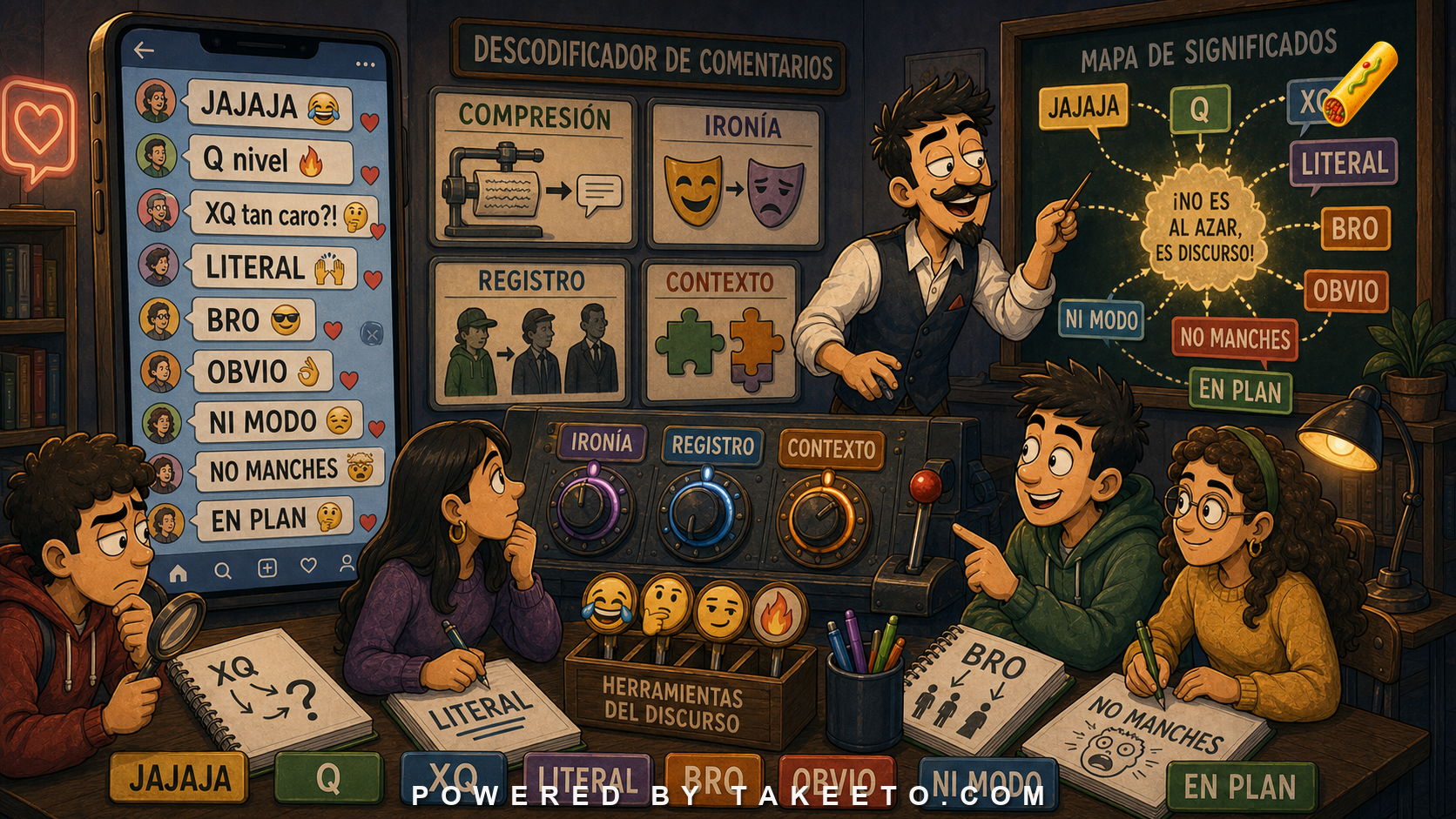
Comments are not broken essays
Spanish social media comments often omit punctuation, shorten words, mix English, use emojis, quote fragments, and rely on shared context. A learner may see:
jajaja q fuerte bro literal no puedo
This is not standard written Spanish, but it is not meaningless. It is compressed digital speech.
The key principle is:
Social media Spanish should be read as interactional writing: short, contextual, stance-heavy, and register-marked.
Compression and abbreviation
Common shortened forms:
q = que / qué
xq = porque / por qué
pq = porque / por qué
tmb = también
x = por
d = de
k = que in some informal writing
These forms are common in casual digital contexts, but they are not appropriate for formal writing.
xq no avisaste?
Could mean ¿Por qué no avisaste? Context and punctuation would normally distinguish porque from por qué, but comments often omit that distinction.
Laughter and reaction markers
Laughter appears in multiple forms:
jajaja
jaja
jsjsjs
JAJAJA
me muero
no puedo
lloro
Me muero and lloro may be figurative reactions: “I’m dying,” “I’m crying,” often from laughter, shock, or emotion. Context matters.
Capitalization can intensify tone. Repeated letters can dramatize reaction.
Emojis as discourse support
Emojis can soften, intensify, contradict, or signal irony. A sentence like:
claro, súper normal 🙃
may be ironic. The upside-down face helps signal that the literal words should not be taken at face value.
Learners should treat emojis as part of the comment’s grammar of stance.
Irony and sarcasm
Spanish comments often use literal positive words sarcastically:
Qué buena idea...
This may mean it is a terrible idea, depending on context.
Other markers:
ajá
claro
sí, cómo no
obvio
seguro
maravilloso
Tone is difficult without context. Do not overread isolated comments.
Regional slang and platform norms
Comment vocabulary varies by region and platform:
no manches
ni modo
en plan
tío / tía
boludo
wey / güey
pana
bro
No manches is strongly associated with Mexican informal speech. En plan is common in Spain. Ni modo means something like “oh well/that’s how it is” in many contexts. Bro is an English borrowing used widely but not uniformly.
A learner should recognize slang without forcing themselves to produce it.
Literal, random, and borrowed words
Words like literal, random, cringe, bro, and fan may appear in Spanish comments. Literal often functions as an intensifier or stance marker, not always a strict claim of literal truth.
Literal pensé lo mismo.
This means “I literally thought the same thing,” but in digital speech it may simply intensify agreement.
Quoting and reply structure
Comments often respond to invisible context:
esto
tal cual
el mejor comentario
alguien tenía que decirlo
venía a comentar eso
These phrases are interactional. Esto may mean “this,” as agreement with a previous comment. Tal cual means exactly / just like that.
Register caution
Social media forms are not random mistakes, but they are register-specific. Using q, xq, and slang in an email to a professor or official form is inappropriate. Learners must separate recognition from production.
Example bank walkthrough
Jajaja: laughter. Intensity depends on length/caps.
q: que/qué in informal typing.
xq: porque/por qué.
Literal: intensifier or stance marker.
Bro: informal address/solidarity, borrowed from English.
Obvio: obvious; can be sincere or sarcastic.
Ni modo: resignation/acceptance.
No manches: Mexican informal surprise/disbelief.
En plan: discourse marker common in Spain, roughly “like/as in.”
Comment interpretation workflow
- Reconstruct abbreviations.
- Identify reply context if available.
- Separate literal words from stance markers.
- Check emojis and punctuation.
- Watch for irony.
- Identify regional slang.
- Recognize English borrowings.
- Decide register: casual, hostile, playful, supportive, sarcastic.
- Do not copy slang into formal writing.
- When uncertain, treat tone as unresolved.
Before/after revision drill
Weak expansion:
Why, bro, this is obvious.
Source comment:
xq bro es obvio 🙃
Better reading:
“Why, bro? It’s obvious” — probably with ironic or annoyed tone because of the upside-down emoji.
The improved reading does not overclaim. It notes likely tone while admitting that comments depend on thread context. Digital Spanish often cannot be fully interpreted from one line alone.
Remediation: social-media Spanish is compressed interaction
Spanish social media comments are not broken textbook Spanish. They are compressed interaction shaped by platform, speed, audience, identity, irony, regional slang, emojis, quoting, and algorithmic visibility. The learner’s mistake is to treat every nonstandard form as an error or every informal phrase as safe to imitate.
Common compression patterns:
q = que
xq / pq = porque / por qué, depending on context
tmb = también
bn = bien
literal = literally / exactly / emphatic stance
jajaja / jsjs / jaja = laughter styles
emojis = stance, irony, softening, mockery, support
The first reading question is:
Is this comment informing, reacting, mocking, aligning, flirting, correcting, attacking, or performing identity?
Without that question, vocabulary knowledge is not enough.
Mini-workshop: interpret stance
Comment:
literal nadie pidió esto pero igual lo voy a ver jajaja
Plain reading:
Nobody asked for this, but I’m going to watch it anyway, haha.
Stance:
Mild mockery plus self-aware interest. literal intensifies the claim, nadie pidió esto is a common dismissive frame, pero igual reverses it, and jajaja softens the tone.
A too-literal translation misses the social move. The commenter is not only reporting demand; they are performing ironic consumption.
Irony and quote fragments
Social media comments often quote a word or phrase from a video, headline, or previous comment without context:
“innovador” dice 😂
claro, porque eso siempre sale bien
en plan, ¿quién pensó que era buena idea?
These may be ironic. The words alone do not reveal stance. You need surrounding media, thread history, and platform norms.
The phrase claro can mean genuine agreement or sarcastic “sure.” Obvio can be friendly, annoyed, or dismissive. Literal can mean exactly, emphatically, or ironically. Bro can be friendly address, mock address, or borrowed internet persona. Delivery and context are everything.
Regional slang caution
Examples such as no manches, ni modo, en plan, qué fuerte, mola, re, chido, bacán, weón, tío, and boludo are regionally and socially marked. Some can be friendly in one context and rude in another. A learner should tag slang by region and register before using it.
Recognition goal:
Understand more than you produce.
Production goal:
Use only forms you have heard repeatedly in the right social group and tone.
Before/after: from comment to neutral prose
Comment:
q onda con ese final??? ni modo, tocó llorar 😭
Neutral prose:
The ending was surprising or emotionally intense. The commenter resigns themselves to crying/reacting emotionally.
Comment:
no es hate pero la traducción está rarísima
Neutral prose:
The commenter frames the criticism as not hateful, but says the translation sounds very strange.
The phrase no es hate pero is a stance shield. It does not guarantee the comment is gentle; it prepares criticism.
Platform register
Comments under news, TikTok videos, YouTube tutorials, gaming streams, academic posts, and brand accounts do not behave the same way. A brand reply should not imitate private meme comments. A learner writing to a company should avoid slang that belongs to fan communities. A teacher analyzing comments should explain platform norms, not just grammar.
Comment-reading checklist
Mark:
- Reference: what is the comment responding to?
- Stance: support, mockery, correction, surprise, complaint, irony.
- Compression: abbreviations, omitted punctuation, emojis.
- Register: casual, vulgar, playful, hostile, fandom, professional.
- Region: slang clues.
- Risk: insult, sensitive identity term, sexual language, political charge.
- Imitation safety: recognize only or safe to produce?
Social-media Spanish is living language under pressure. Read it socially, not only grammatically.
Additional remediation drill: slow the document down
If this article still feels like vocabulary, turn one authentic-looking sentence into a four-line analysis before translating it. Write the original sentence. Then list the actor, the action, the object, and the condition or consequence. Only after that, produce a plain-language paraphrase.
This drill matters because domain Spanish often compresses too much into noun phrases. The learner sees familiar words and moves too quickly. Slowing the sentence down reveals whether the reader understands the document logic or only recognizes terms. For article 278, the safest practice is to treat each key term as a field in a larger system: who is acting, what status is changing, what evidence or condition controls the action, and what the reader should do with the information.
A useful production rule is: do not write a polished sentence until you can write a plain one. Plain Spanish is not inferior; it is the diagnostic layer that proves comprehension.
Suggested interactive module: comment annotation with register and stance labels
A strong tool would annotate comments without normalizing away tone.
Suggested functions:
- Abbreviation expansion.
- Emoji stance labels.
- Irony warning: literal positive words with sarcastic signals.
- Regional slang notes.
- Production caution: recognize versus use.
Mini-workshop: reconstructing a compressed comment
Comment:
jajaja q random literal pensé lo mismo
Expanded version:
Jajaja, qué random. Literalmente pensé lo mismo.
Functional reading:
The commenter is amused, finds the situation unexpected/weird, and agrees with a previous idea.
Do not stop at expansion. Expansion gives grammar; function gives meaning.
Common learner mistakes
One mistake is assuming nonstandard spelling means the writer is incompetent. Informal digital writing has its own conventions. Another mistake is treating emojis as decoration. Emojis can reverse tone, soften criticism, or mark irony.
A third mistake is copying informal forms into the wrong context. Recognizing q, xq, bro, no manches, or en plan is useful. Using them in a formal email can make you sound careless or socially off-target.
Applied interpretation drill: recover the missing context
A social media comment like this is impossible to read well in isolation:
literal nadie pidió esto jajaja
It might mean genuine amusement, criticism, playful exaggeration, fandom disappointment, or sarcastic rejection. The words are simple; the stance depends on context.
Recover the missing context by asking:
- What post is it responding to?
- Is the speaker aligned with the community or mocking it?
- Does jajaja soften or sharpen the comment?
- Does literal intensify truth or exaggeration?
- Are there replies that confirm the tone?
Now compare:
literal nadie pidió esto 😭
The crying emoji may signal comic despair rather than actual sadness. Digital Spanish often uses emotion markers theatrically. A learner should avoid over-literal translation and instead label the comment’s function: joking complaint, sarcastic dismissal, affectionate teasing, or serious criticism.
In comment Spanish, grammar is only half the meaning. Thread position supplies the rest.
Final rule
Spanish social media comments are compressed social actions. Read abbreviation, emoji, slang, reply context, and irony together. They are not formal Spanish, but they are not meaningless Spanish.