
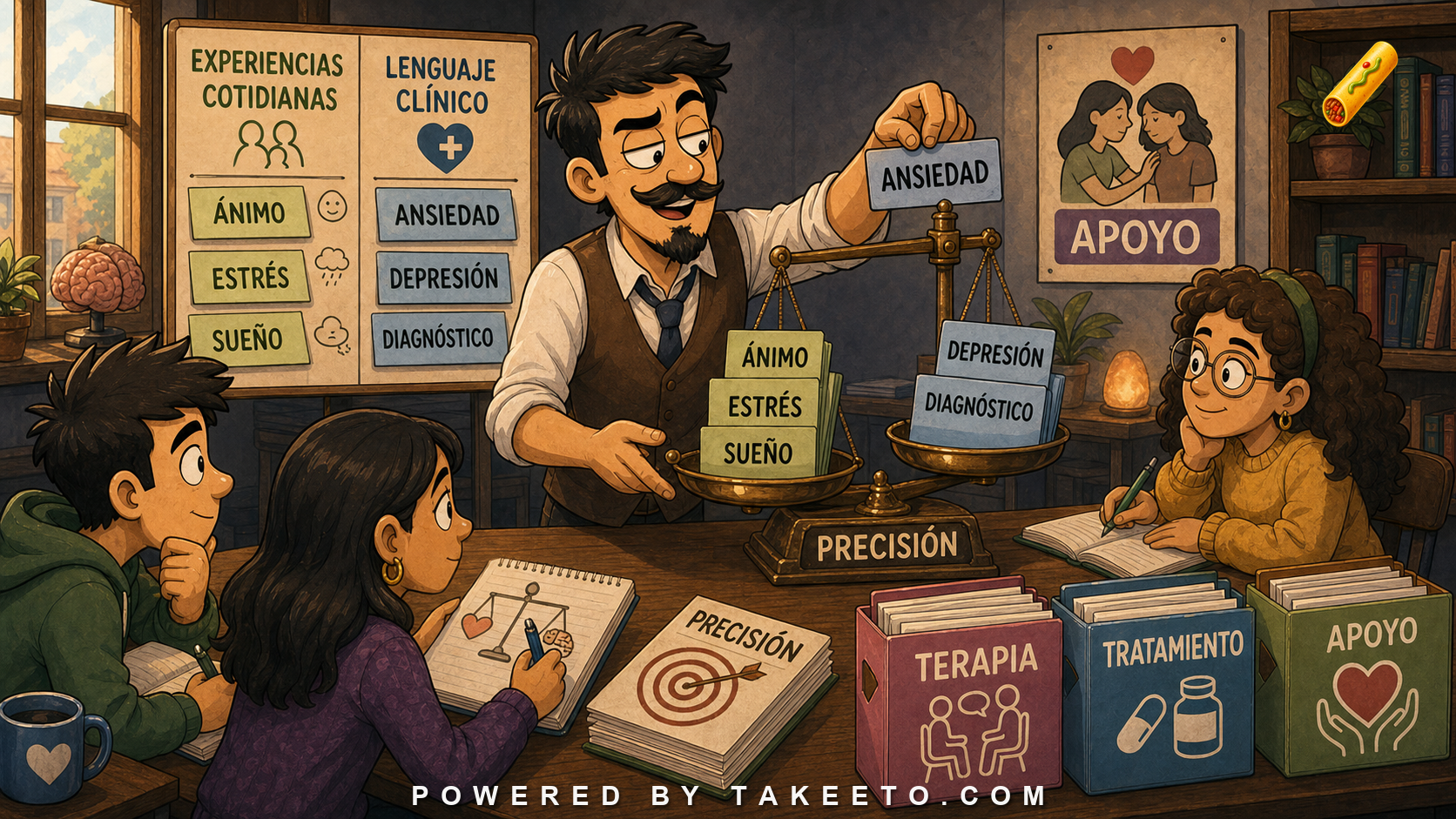
Mental-health Spanish requires precision and care
Mental-health language sits between medicine, everyday emotion, social stigma, family life, school, work, and identity. A Spanish learner may know words like ansiedad, depresión, and estrés, but using them well requires more than dictionary translation.
A person can say:
Estoy estresado.
I’m stressed.
That is not the same as saying:
Tengo un diagnóstico de trastorno de ansiedad.
I have a diagnosis of an anxiety disorder.
A friend can say:
Me siento triste.
I feel sad.
That is not the same as a clinician documenting:
síntomas depresivos persistentes.
persistent depressive symptoms.
The key principle is:
Mental-health Spanish must distinguish everyday feeling, symptom description, diagnosis, treatment, and identity with care.
This article is about language. It is not mental-health advice, diagnosis, or crisis support. If someone is at risk of harming themselves or others, seek immediate professional or emergency help in the relevant location.
Everyday mood versus clinical language
Common everyday expressions:
Estoy triste. — I’m sad.
Estoy nervioso/nerviosa. — I’m nervous.
Estoy preocupado/preocupada. — I’m worried.
Estoy agotado/agotada. — I’m exhausted.
Estoy pasando por un momento difícil. — I’m going through a difficult time.
No me siento bien. — I don’t feel well.
Clinical or semi-clinical expressions:
síntomas de ansiedad — anxiety symptoms
estado de ánimo bajo — low mood
alteraciones del sueño — sleep disturbances
pérdida de interés — loss of interest
diagnóstico — diagnosis
tratamiento — treatment
terapia — therapy
medicación — medication
Good translation and conversation do not over-medicalize ordinary emotions. They also do not trivialize clinical symptoms.
Ansiedad
Ansiedad can refer to ordinary anxiety or clinical anxiety depending on context.
Everyday:
Me da ansiedad hablar en público.
Public speaking makes me anxious.
Clinical:
Recibió un diagnóstico de trastorno de ansiedad generalizada.
He/she received a diagnosis of generalized anxiety disorder.
Associated vocabulary:
preocupación — worry
nerviosismo — nervousness
tensión — tension
pánico — panic
ataque de pánico — panic attack
dificultad para respirar — difficulty breathing
palpitaciones — palpitations
A learner should avoid using ansioso in a direct English way for “eager” in all contexts. In many Spanish contexts, ansioso suggests anxious or craving/impatient, not simply excited.
Depresión
Depresión can be a clinical diagnosis or a loosely used everyday word. Careful language separates sadness from depression.
Everyday:
Me siento triste desde hace unos días.
I’ve felt sad for a few days.
More clinical:
Presenta síntomas compatibles con depresión.
He/she presents symptoms compatible with depression.
Diagnosis statement:
Tiene diagnóstico de depresión mayor.
He/she has a diagnosis of major depression.
Associated vocabulary:
ánimo — mood
bajo ánimo / ánimo bajo — low mood
apatía — apathy
pérdida de interés — loss of interest
cansancio — tiredness
culpa — guilt
desesperanza — hopelessness
Use care with jokes or casual exaggeration. Calling every inconvenience “depresión” can trivialize suffering.
Estrés and burnout-like language
Estrés is common in everyday and clinical-adjacent language.
Examples:
Tengo mucho estrés en el trabajo.
I have a lot of stress at work.
El estrés crónico puede afectar el sueño.
Chronic stress can affect sleep.
Related terms:
carga laboral — workload
presión — pressure
agotamiento — exhaustion
desgaste — wear/exhaustion
sobrecarga — overload
descanso — rest
English “burnout” may appear as burnout, síndrome de desgaste profesional, agotamiento laboral, or other phrases depending on context and country. Do not assume one fixed translation.
Sueño, apetito, energía
Mental-health forms and interviews often ask about body functions.
Common phrases:
¿Cómo ha dormido? — How have you slept?
alteraciones del sueño — sleep disturbances
insomnio — insomnia
pesadillas — nightmares
apetito — appetite
energía — energy
fatiga — fatigue
concentración — concentration
Example:
Refiere dificultad para conciliar el sueño.
He/she reports difficulty falling asleep.
Conciliar el sueño means fall asleep. Learners may misread conciliar as reconcile in an emotional sense; here it is a sleep expression.
Diagnosis language
Important terms:
diagnóstico — diagnosis
trastorno — disorder
síntomas — symptoms
evaluación — evaluation/assessment
tratamiento — treatment
plan de tratamiento — treatment plan
seguimiento — follow-up
derivación / remisión — referral, depending on region
Clinical caution expressions:
compatible con — compatible with
se observa — it is observed
refiere — he/she reports
niega — he/she denies
antecedentes de — history of
riesgo — risk
Example:
La paciente refiere ansiedad intensa y alteraciones del sueño. Niega ideación suicida.
The patient reports intense anxiety and sleep disturbances. She denies suicidal ideation.
The verb niega in clinical notes means the patient denies/reports not having a symptom, not that the clinician is accusing them of lying.
Therapy and treatment
Common vocabulary:
terapia — therapy
psicoterapia — psychotherapy
terapeuta — therapist
psicólogo / psicóloga — psychologist
psiquiatra — psychiatrist
tratamiento — treatment
medicación / medicamento — medication
apoyo — support
grupo de apoyo — support group
seguimiento — follow-up
Example:
Está en tratamiento psicológico.
He/she is in psychological treatment/therapy.
Recibe medicación prescrita por psiquiatría.
He/she receives medication prescribed by psychiatry/a psychiatrist.
A learner should not confuse psicólogo and psiquiatra. Roles, training, and prescribing authority vary by country.
Stigma-aware language
Stigma-aware Spanish avoids reducing people to diagnoses or using mental-health terms as insults.
Less careful:
Es depresivo.
He is depressive.
More careful, depending on meaning:
Tiene depresión.
He has depression.
Vive con depresión.
He lives with depression.
Presenta síntomas depresivos.
He presents depressive symptoms.
Avoid using diagnostic words casually as insults:
loco, histérica, bipolar, esquizofrénico
Some words may be reclaimed or used in specific communities, but learners should not imitate sensitive usage without deep context. Professional and educational contexts require respectful precision.
Register comparison
Everyday supportive:
Siento que estés pasando por esto.
I’m sorry you’re going through this.
¿Quieres hablar?
Do you want to talk?
No tienes que hacerlo solo/sola.
You don’t have to do this alone.
Clinical:
Refiere ánimo bajo, insomnio y pérdida de interés.
Reports low mood, insomnia, and loss of interest.
Administrative:
Se recomienda seguimiento por salud mental.
Mental-health follow-up is recommended.
A user should match register to role. A friend should not sound like a chart note. A chart note should not sound like a vague conversation.
Translation cautions
Words with traps:
disorder = trastorno, not always desorden
support = apoyo, not soporte in most interpersonal mental-health contexts
coping = afrontamiento, manejo, estrategias para enfrentar, depending on context
therapy = terapia, psicoterapia, tratamiento, depending on specificity
counselor = consejero, orientador, terapeuta, psicólogo, depending on country and role
English mental-health categories do not always map cleanly onto Spanish institutional terms.
Annotated clinical-style sentence
El paciente refiere ansiedad, dificultad para conciliar el sueño y preocupación constante desde hace tres semanas. Niega consumo de sustancias y cuenta con apoyo familiar.
Plain reading:
The patient reports anxiety, difficulty falling asleep, and constant worry for three weeks. He denies substance use and has family support.
Language notes:
refiere = reports
conciliar el sueño = fall asleep
desde hace tres semanas = for three weeks
niega = denies/reports no
apoyo familiar = family support
Sensitive-language workflow
- Separate feeling from diagnosis.
- Use symptom language when diagnosis is not confirmed.
- Avoid using diagnostic labels as insults or personality summaries.
- Preserve uncertainty: refiere, compatible con, posible, diagnóstico de.
- Respect person-first or context-appropriate phrasing.
- Match register: friend, clinician, school, workplace, legal document.
- Use professional help in clinical, crisis, legal, or translation contexts.
Remediation: distinguish experience, symptom, diagnosis, and identity
Mental-health Spanish is especially vulnerable to casual misuse. Words such as ansiedad, depresión, trauma, bipolar, and obsesivo circulate in everyday speech, but they can also refer to clinical concepts. A careful reader separates four layers:
experience
how the person feels or what they report
symptom
a clinically relevant sign or reported problem
diagnosis
a professional diagnostic label
identity/social framing
how the person describes themselves or is described by others
Example:
Estoy muy ansioso por el examen.
This may describe ordinary anxiety about an event.
Presenta síntomas de ansiedad desde hace seis meses.
This is more clinical, but still not necessarily a diagnosis.
Fue diagnosticada con un trastorno de ansiedad.
This refers to a diagnosis.
Translation should preserve the level. Do not upgrade feeling into diagnosis. Do not reduce diagnosis to mood.
Person-first and stigma-aware phrasing
Stigma-aware Spanish often avoids defining a person entirely by a condition when the context calls for care and precision.
More careful:
persona con depresión
person with depression
paciente diagnosticado/a con trastorno bipolar
patient diagnosed with bipolar disorder
vive con ansiedad
lives with anxiety
Riskier or context-dependent:
un depresivo
a depressive person
una bipolar
a bipolar woman
está loco/a
crazy
Some communities reclaim or use terms differently, and ordinary conversation varies by region. The remediation rule is not to police every word mechanically. It is to choose forms that reduce stigma in educational, clinical, support, and public-facing contexts.
Crisis and support language
Some mental-health vocabulary signals urgency:
ideación suicida
suicidal ideation
autolesiones
self-harm
riesgo inmediato
immediate risk
crisis
crisis
plan de seguridad
safety plan
acudir a urgencias
go to emergency care
In translation or learning materials, do not soften these expressions so much that the risk disappears. Autolesión is not just “injury.” Ideación suicida is not just “dark thoughts.” At the same time, do not sensationalize. Precision is the ethical middle.
Mini-workshop: clinical versus everyday rewriting
Everyday:
No duermo bien y estoy agotado todo el tiempo.
Clinical-style intake:
Refiere dificultad para dormir y fatiga persistente.
Plain supportive language:
Dice que no está durmiendo bien y que se siente agotado casi todo el tiempo.
Each version has a context. The clinical version is compact and institutional. The plain version is human and accessible. The everyday version belongs to the speaker. A translator or educator should not erase the speaker's register unless the task requires it.
Sensitive translation checklist
Before translating or writing about mental health, ask:
- Is this everyday speech, clinical documentation, public health text, or personal narrative?
- Is the text describing feelings, symptoms, diagnosis, behavior, risk, or treatment?
- Does the Spanish preserve uncertainty where the source is uncertain?
- Does it avoid turning the person into the condition?
- Does it avoid casual insults and sensational language?
- Does it preserve urgent risk terms clearly?
- Does it distinguish therapy, counseling, psychiatric care, medication, and support?
- Does it respect regional vocabulary and institutional norms?
Mental-health Spanish is not a place to show off vocabulary. It is a place to protect meaning and dignity.
Suggested interactive module: mental-health register comparison table
A strong tool for this article would help learners choose careful phrasing by context.
Suggested functions:
- Register columns: everyday support, clinical note, school/work, formal translation.
- Stigma warning: flag insulting or casual misuse.
- Diagnosis-vs-symptom distinction: depressed mood versus depression diagnosis.
- Translation caution cards: support, disorder, counselor, coping.
- Crisis-language warning: direct users to emergency/professional help when risk language appears.
Final rule
Mental-health Spanish is not just vocabulary; it is responsibility.
Distinguish mood, symptom, diagnosis, treatment, and support. Use careful register. Avoid casual diagnostic insults. Preserve uncertainty and attribution.
When people are vulnerable, precision is kindness.