
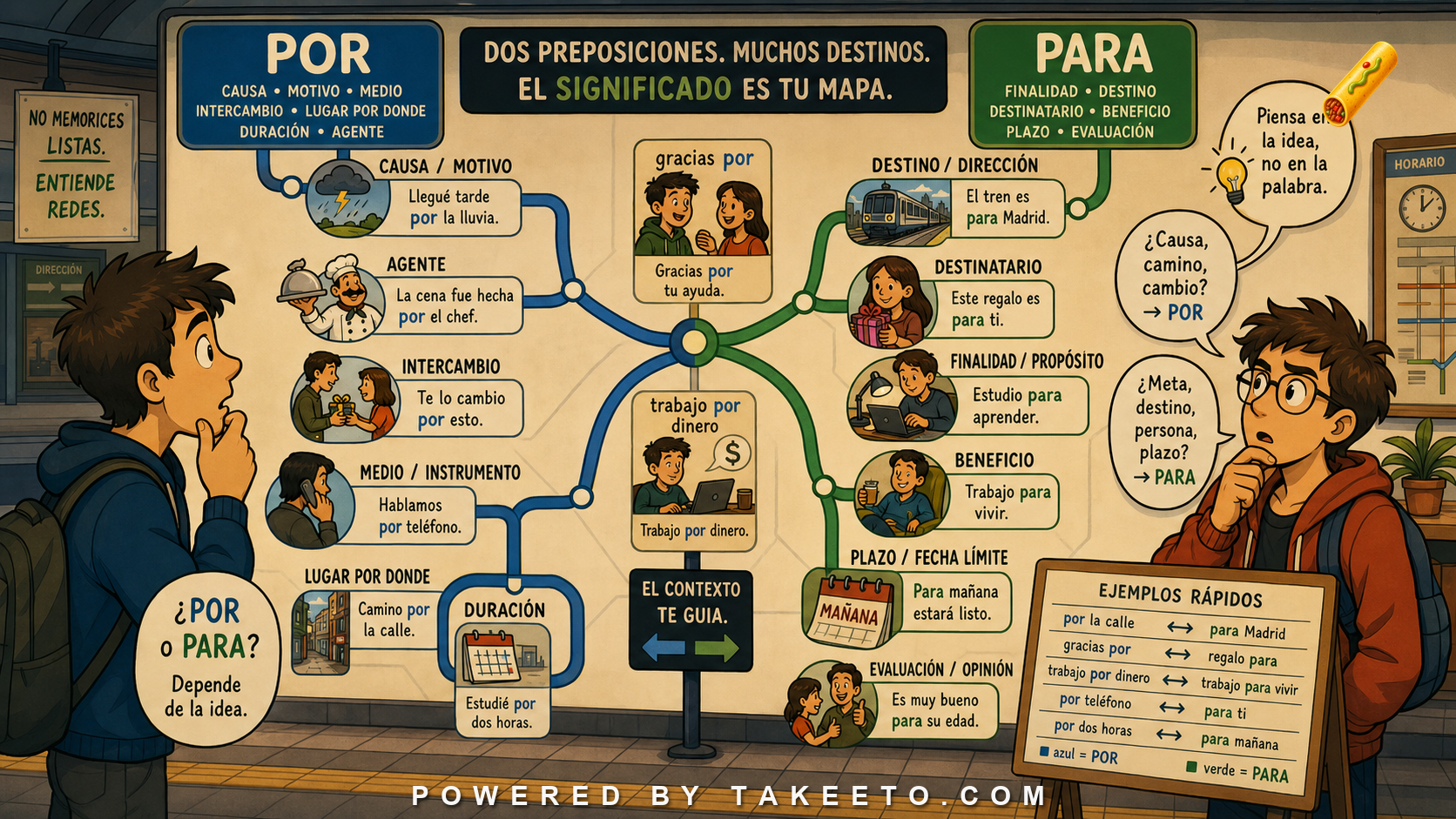
Por and para are not solved by “for”
English for covers too much territory:
for Ana
for money
for two hours
for that reason
for tomorrow
for living well
Spanish often divides these meanings between por and para. Learners then memorize long lists: por for cause, para for purpose; por for duration, para for deadlines; por for exchange, para for recipient. Lists help, but they often feel arbitrary.
A better model is to build semantic networks.
Por often marks path, cause, exchange, means, duration, substitution, or motive. Para often marks destination, purpose, recipient, deadline, function, or evaluative standard.
The key contrast is not one English word. It is how Spanish frames the relation.
Por as path or route
Por can mark movement through, along, around, or by a space.
Caminamos por la calle.
We walked along the street.
Pasamos por Madrid.
We passed through Madrid.
El perro corre por el parque.
The dog runs around the park.
The image is not endpoint but path or area.
Compare:
Voy para Madrid.
I am heading for Madrid.
Voy por Madrid.
I am going through Madrid / around Madrid.
The first points toward a destination. The second places movement within a path or zone.
Para as destination or direction
Para can mark destination, especially when the destination is intended or projected.
Salimos para Madrid mañana.
We leave for Madrid tomorrow.
Este tren va para Sevilla.
This train goes toward/for Seville.
With people, para marks intended recipient:
Este regalo es para Ana.
This gift is for Ana.
Hay un mensaje para usted.
There is a message for you.
The item is directed toward someone as recipient or beneficiary.
Por as cause or motive
Por often marks the reason, cause, or motive behind something.
Gracias por el regalo.
Thank you for the gift.
Lo hice por necesidad.
I did it out of necessity.
Cerraron la carretera por la nieve.
They closed the road because of the snow.
No salimos por miedo.
We did not go out because of fear.
The cause can be external, emotional, social, or explanatory.
This is why gracias por is the normal pattern: the gift is the reason for thanking.
Para as purpose or function
Para often marks the purpose, goal, or intended use of something.
Estudio para aprender.
I study in order to learn.
Trabajo para vivir.
I work in order to live.
Uso esta aplicación para practicar.
I use this app to practice.
Una taza para café.
A cup for coffee.
Purpose looks forward to an intended result. Cause looks backward to a reason.
Compare:
| Cause/motive | Purpose/goal |
|---|---|
| Lo hice por ti. | Lo hice para ti. |
| I did it because of you / on your behalf. | I did it for you / intended for you. |
| Trabajo por dinero. | Trabajo para vivir. |
| I work for money / in exchange for money. | I work in order to live. |
Por as exchange, price, or substitution
Por often marks exchange:
Compré el libro por diez euros.
I bought the book for ten euros.
Cambié mi turno por el tuyo.
I exchanged my shift for yours.
Trabajo por dinero.
I work for money.
It can also mark substitution or acting on someone’s behalf:
Lo haré por ti.
I will do it for you / on your behalf.
Firmó por su jefe.
He/she signed for the boss.
Here por connects one thing in place of another, or an action done because of or on behalf of someone.
Para as deadline
Para can mark a deadline or target time:
Necesito el informe para mañana.
I need the report by/for tomorrow.
La tarea es para el lunes.
The assignment is for Monday.
Tiene que estar listo para las ocho.
It has to be ready by eight.
The time is a target point.
Por with time often gives approximate time, period, or duration depending on context:
Trabajo por la mañana.
I work in the morning.
Estudié por dos horas.
I studied for two hours.
Pasaré por la tarde.
I will stop by in the afternoon.
Varieties differ in some time expressions, but the conceptual distinction remains useful: para points to a target; por often marks a period, approximate zone, or duration.
Para as evaluative standard
Para can mean “for” in the sense of “considering” or “relative to a standard.”
Para un niño, lee muy bien.
For a child, he reads very well.
Para mí, es una buena idea.
In my opinion, it is a good idea.
Es alto para su edad.
He is tall for his age.
This use compares something to an expected norm or viewpoint.
Do not confuse:
Para mí, es difícil.
In my opinion / for me, it is difficult.
with:
Lo hizo por mí.
He/she did it because of me / on my behalf.
Minimal pairs that matter
| Por | Para |
|---|---|
| Caminamos por el centro. = through/around downtown | Salimos para el centro. = toward downtown |
| Gracias por la ayuda. = reason for thanks | Esta ayuda es para Ana. = recipient |
| Trabajo por dinero. = exchange/motive | Trabajo para ahorrar. = purpose |
| Lo hice por ti. = because of/on behalf of you | Lo hice para ti. = intended for you |
| Estará por aquí. = around here | Esto es para aquí. = for here / intended for this place |
| Por mañana is not the deadline pattern | Para mañana = by/for tomorrow |
The contrast often changes the meaning, not just the preposition.
Fixed expressions and humility
Some uses are lexicalized. You should learn them as phrases:
- por supuesto
- por ejemplo
- por favor
- por fin
- para siempre
- para nada
- estar por + infinitive in some meanings
- estar para + infinitive in some meanings
A semantic network helps, but it does not remove the need to learn fixed expressions and verb-preposition patterns.
Common learner errors
Error 1: Using para for cause after gracias
Gracias para venir.
Better:
Gracias por venir.
The coming is the reason for thanks.
Error 2: Using por for deadlines
Necesito el informe por mañana.
Better:
Necesito el informe para mañana.
Error 3: Collapsing por mí and para mí
Lo hizo por mí. = because of me / on my behalf.
Lo hizo para mí. = intended for me.
Error 4: Treating lists as absolute
Purpose often uses para, but not every English “for + verb” is purpose. Learn the relation, not the English word.
Error 5: Ignoring verb patterns
Some verbs select prepositions in ways that must be learned lexically. The network guides meaning; the dictionary confirms patterns.
A relation-first method for por and para
The worst way to study por and para is to memorize English phrases alphabetically. The best way is to label the relation before choosing the preposition.
Use this decision routine.
1. Is the phrase looking backward to a cause?
Choose por.
Cancelaron el viaje por la tormenta.
They canceled the trip because of the storm.
Gracias por llamar.
Thank you for calling.
The storm or call is the reason behind the event.
2. Is it looking forward to a goal or intended result?
Choose para.
Estudio para aprobar.
I study in order to pass.
Esta guía es para principiantes.
This guide is for beginners.
The phrase points toward an intended endpoint.
3. Is it a path, route, or zone?
Choose por.
Caminamos por el parque.
We walked through/around the park.
The action unfolds within a space rather than terminating at it.
4. Is it a destination or recipient?
Choose para.
El paquete es para Laura.
The package is for Laura.
Salimos para Quito.
We leave for Quito.
The phrase points toward a target.
5. Is it exchange or substitution?
Choose por.
Pagué veinte euros por el libro.
I paid twenty euros for the book.
Trabajo por mi compañero hoy.
I am working for/in place of my coworker today.
6. Is it a deadline or evaluative standard?
Choose para.
Lo necesito para el lunes.
I need it by Monday.
Para su edad, escribe muy bien.
For his/her age, he/she writes very well.
This relation-first method prevents list fatigue. It also explains why pairs such as por mí and para mí differ so sharply. Por mí often gives motive, cause, or substitution; para mí gives recipient, viewpoint, or personal evaluation.
Reading por and para in the same sentence
Many real sentences contain both por and para, and the contrast becomes clearer when they appear together.
Trabajo por la mañana para tener las tardes libres.
I work in the morning in order to have the afternoons free.
Por la mañana marks the time period. Para tener marks purpose.
Pasamos por la oficina para recoger los documentos.
We went by the office to pick up the documents.
Por la oficina marks route or intermediate place. Para recoger marks purpose.
Lo hice por obligación, no para ganar dinero.
I did it out of obligation, not in order to earn money.
Por obligación gives motive or cause. Para ganar gives intended goal.
These combined examples are better than isolated lists because they show the two prepositions doing different jobs in one event frame.
A useful annotation practice is to write labels above each phrase:
Pasamos por la oficina para recoger los documentos.
route/intermediate point — purpose
Lo terminaré para mañana por respeto al cliente.
deadline — motive
This trains the brain to stop asking “which means for?” and start asking “what relation is this phrase adding?”
Micro-drill: cause or goal?
For every difficult por/para sentence, ask whether the phrase explains what pushes the action or what the action points toward.
Cerraron la escuela por la tormenta.
The storm caused the closing.
Cerraron la escuela para repararla.
The closing points toward a goal: repairing it.
Ahorro por necesidad.
Necessity motivates the saving.
Ahorro para viajar.
Travel is the goal.
This cause-versus-goal test will not solve every use of por and para, but it solves many of the highest-frequency choices and gives the longer semantic network a practical starting point.
Diagnostic refinement: por and para often contrast cause with intended endpoint
The best remediation for por/para is to stop treating them as two lists and start treating them as two relation networks. Many difficult pairs become clearer if you ask whether the phrase points backward to a cause/path/exchange or forward to a destination/purpose/standard.
Compare:
Trabajo por dinero.
I work in exchange for money.
Trabajo para vivir.
I work in order to live.
Por gives the motive, cause, exchange, or route through which the action is understood. Para gives the goal, intended endpoint, recipient, or evaluative standard.
The same contrast appears with people:
Lo hice por ti.
I did it because of you / for your sake.
Lo hice para ti.
I made it for you / intended it for you.
Both can translate as “for you,” but they do not mean the same thing. Por ti points to motive or benefit as cause. Para ti points to recipient or intended destination.
With time, learners also need a clean distinction:
Estudié por dos horas.
I studied for two hours. Duration.
Necesito el informe para mañana.
I need the report by tomorrow. Deadline.
With movement:
Caminamos por el parque.
We walked through/around the park.
Salimos para Madrid.
We left for Madrid.
A good decision procedure is:
- Is it a route, medium, cause, exchange, substitution, or duration? Try por.
- Is it a destination, recipient, purpose, deadline, function, or standard of judgment? Try para.
- Is it a fixed expression? Learn it whole: gracias por, por supuesto, para siempre, estar por hacer, estar para salir.
- Could both work? Then the meaning probably changes.
The mature goal is not to memorize a hundred translations of “for.” It is to name the relation the preposition creates.
Suggested interactive module: por/para semantic network
A useful tool for this article would ask what relation the phrase expresses rather than asking for an English translation.
Suggested functions:
- Relation selector: path, cause, exchange, duration, substitution, purpose, recipient, deadline, evaluation.
- Minimal-pair cards: por ti / para ti, por Madrid / para Madrid, por dinero / para ahorrar.
- Timeline view: por dos horas vs para mañana.
- Recipient vs motive warning: distinguishes regalo para Ana from gracias por Ana in context.
- Fixed-expression bank: stores common phrases that should be learned whole.
Example input:
I need it by Friday.
Output:
- Relation: deadline/target time.
- Preposition: para.
- Result: Lo necesito para el viernes.
Final rule
Do not ask whether por or para means “for.” Ask what relation is being expressed. Por often moves through cause, path, exchange, means, duration, and substitution. Para points toward destination, purpose, recipient, deadline, function, and evaluative standard.
The best learners combine a semantic network with memorized fixed expressions. That is how gracias por, regalo para, trabajo por dinero, and trabajo para vivir stop feeling arbitrary.