
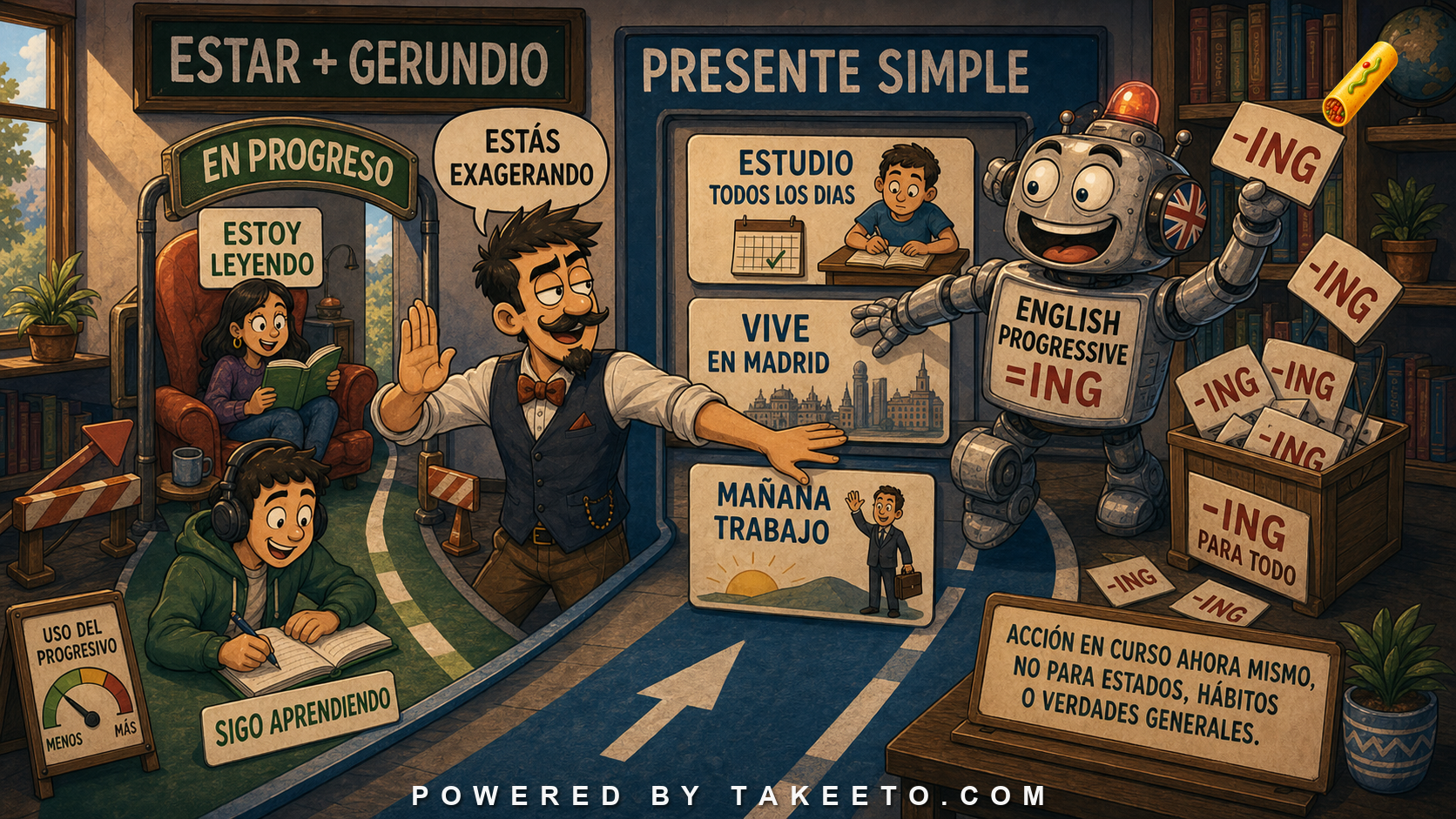
The progressive is powerful because it is narrower than English
English uses the present progressive constantly:
I am studying Spanish.
She is living in Madrid.
We are working tomorrow.
You are always exaggerating.
I am understanding it now? Usually not, but learners may expect symmetry.
Spanish has a close-looking construction:
Estoy leyendo.
I am reading.
But estar + gerundio is not a universal replacement for English “am/is/are -ing.” Spanish uses the progressive to focus on an event as unfolding, in progress, or developing. It is not the default present tense for habits, schedules, identities, general current situations, or many states.
A better rule is:
Use estar + gerundio when you want to look inside an ongoing event, not merely to say that something is true at present.
The form: estar + gerundio
The present progressive is formed with present-tense estar plus a gerundio:
estoy leyendo
I am reading
estás escribiendo
you are writing
está trabajando
he/she/you-formal is working
estamos aprendiendo
we are learning
Regular gerundio formation:
| Infinitive | Gerundio | Example |
|---|---|---|
| hablar | hablando | Estoy hablando. |
| comer | comiendo | Está comiendo. |
| vivir | viviendo | Estamos viviendo. |
Some common irregular or spelling-adjusted forms:
| Infinitive | Gerundio | Example |
|---|---|---|
| leer | leyendo | Estoy leyendo. |
| oír | oyendo | Estoy oyendo ruido. |
| ir | yendo | Está yendo al trabajo. |
| dormir | durmiendo | El niño está durmiendo. |
| pedir | pidiendo | Estamos pidiendo ayuda. |
| decir | diciendo | ¿Qué estás diciendo? |
The gerundio is not an adjective and does not agree with the subject. It stays the same:
Ana está leyendo.
Los niños están leyendo.
Las niñas están leyendo.
No leyenda, leyendos, or leyendas.
The core meaning: an event in progress
The clearest use of estar + gerundio is an action happening at the moment of reference:
Estoy leyendo.
I am reading.
Ana está cocinando.
Ana is cooking.
Estamos esperando el autobús.
We are waiting for the bus.
¿Qué estás haciendo?
What are you doing?
The speaker frames the event from the inside. It has begun and is not presented as completed.
This is why the progressive combines naturally with adverbs like ahora, en este momento, todavía, and justo ahora:
Ahora estoy trabajando.
I am working right now.
Todavía están hablando.
They are still talking.
En este momento estamos revisando los datos.
At this moment we are reviewing the data.
The simple present often translates English progressives
English uses the progressive for many current but not necessarily momentary situations. Spanish often prefers the simple present.
I am studying Spanish this year.
Estudio español este año.
She is living in Madrid.
Vive en Madrid.
I am working at a hospital now.
Ahora trabajo en un hospital.
The progressive is possible if the speaker wants to emphasize temporariness, transition, or current process:
Estoy estudiando español este año.
I am studying Spanish this year, with emphasis on the current course/process.
Está viviendo en Madrid por unos meses.
She is living in Madrid for a few months.
But the simple present is often the neutral choice for current states of life.
A learner should not ask, “Does English use -ing?” Ask instead, “Is Spanish focusing on an action in progress?”
Habits use the simple present
For habits and routines, Spanish normally uses the simple present:
Estudio todos los días.
I study every day.
Trabajo los fines de semana.
I work on weekends.
Mi padre lee el periódico por la mañana.
My father reads the newspaper in the morning.
Do not use the progressive just because English can say “I am studying a lot these days.” Spanish can use the progressive for a temporary trend, but the basic habitual pattern remains simple present:
Últimamente estudio mucho.
Lately I study a lot.
Últimamente estoy estudiando mucho.
Lately I am studying a lot, emphasizing ongoing temporary activity.
Both are possible; they are not identical. The progressive has a process-focused feel.
Schedules and future arrangements often use the simple present
English often says:
I am working tomorrow.
We are leaving at eight.
The train is arriving at nine.
Spanish often uses the present tense:
Mañana trabajo.
I work tomorrow.
Salimos a las ocho.
We leave at eight.
El tren llega a las nueve.
The train arrives at nine.
Spanish may also use ir a + infinitivo:
Mañana voy a trabajar.
I am going to work tomorrow.
But estoy trabajando mañana is not the normal way to express a scheduled future. It can occur in special contexts, but it is not the default learner choice.
States usually avoid the progressive
Many state verbs do not naturally take the progressive in their basic meanings:
Sé la respuesta.
I know the answer.
Creo que sí.
I think so.
Quiero café.
I want coffee.
Vivo en Madrid.
I live in Madrid.
Tengo hambre.
I am hungry.
Forms like estoy sabiendo, estoy queriendo, or estoy teniendo hambre are not the ordinary equivalents of English present meanings. Some progressive forms can appear when the verb is reinterpreted as a process, behavior, change, or temporary development:
Estoy conociendo mejor la ciudad.
I am getting to know the city better.
Estoy queriendo entenderte, pero no es fácil.
I am trying/wanting to understand you, with special pragmatic force.
Estoy teniendo problemas con el sistema.
I am having problems with the system, possible as a temporary series of difficulties.
The point is not that state verbs are banned. The point is that the progressive changes the viewpoint and often the meaning.
Estás exagerando and behavior in progress
Some progressive uses describe not just physical actions but current behavior:
Estás exagerando.
You are exaggerating.
Te estás portando mal.
You are behaving badly.
Está siendo muy amable.
He/she is being very kind.
These are natural because the speaker frames the behavior as currently unfolding or displayed. Compare:
Es muy amable.
He/she is very kind, a general characterization.
Está siendo muy amable.
He/she is being very kind, in this situation.
The progressive turns a property-like description into situational behavior.
Progressive chains: seguir, ir, venir, andar
Spanish has several gerundio periphrases beyond estar + gerundio.
Sigo aprendiendo.
I keep learning / I am still learning.
Va mejorando poco a poco.
It is gradually improving.
Viene trabajando en el tema desde hace años.
He/she has been working on the topic for years.
Anda diciendo cosas raras.
He/she goes around saying strange things.
These are not interchangeable with estar + gerundio. Each auxiliary adds meaning:
| Construction | Typical meaning |
|---|---|
| estar + gerundio | ongoing action/process |
| seguir + gerundio | continuation |
| ir + gerundio | gradual accumulation or progression |
| venir + gerundio | development from a past point to now/reference time |
| andar + gerundio | repeated, dispersed, sometimes casual or disapproving activity |
The outline example sigo aprendiendo is not a present progressive in the narrow estar sense, but it belongs to the broader gerundio system. It means the learning continues.
Pronoun placement with the progressive
Object pronouns can go before the conjugated estar or attach to the gerundio:
Lo estoy leyendo.
I am reading it.
Estoy leyéndolo.
I am reading it.
Both are grammatical. When the pronoun attaches to the gerundio, an accent mark may be needed to preserve stress:
leyendo → leyéndolo
escribiendo → escribiéndome
explicando → explicándoselo
This accent is not decorative. It keeps the original stress of the gerundio when extra syllables are added.
Common learner errors
Error 1: Translating every English -ing with estar + gerundio
I am working tomorrow.
Better default: Mañana trabajo.
I am studying Spanish this year.
Often: Estudio español este año.
Use the progressive when the process is being highlighted.
Error 2: Using the progressive for basic states
Estoy sabiendo la respuesta.
Use:
Sé la respuesta.
Error 3: Making the gerundio agree
Ana está leyenda.
Use:
Ana está leyendo.
Error 4: Confusing gerundio with English gerund nouns
English “reading” can be a noun: “Reading is useful.” Spanish normally uses the infinitive:
Leer es útil.
Reading is useful.
not:
Leyendo es útil.
Progressive in other tenses
The progressive is not limited to the present. Estar + gerundio can appear in several tenses:
| Tense | Example | Meaning |
|---|---|---|
| present | Estoy leyendo. | I am reading. |
| imperfect | Estaba leyendo. | I was reading. |
| preterite | Estuve leyendo dos horas. | I spent two hours reading / was reading for two hours. |
| future | Estaré trabajando. | I will be working / I am probably working, depending on context. |
| conditional | Estaría durmiendo. | He/she would be sleeping / was probably sleeping. |
The tense is carried by estar. The gerundio keeps the event in progress. This matters because learners sometimes think estaba leyendo and leía are the same. They overlap, but they are not identical. Leía can be habitual, descriptive, or ongoing. Estaba leyendo more explicitly places the reader inside a developing action.
Compare:
Leía mucho de niño.
I used to read a lot as a child.
Estaba leyendo cuando llamaste.
I was reading when you called.
The progressive is a viewpoint tool. Use it when the unfolding matters.
How to decide quickly
Use a three-question test:
- Is the action happening right now or at the reference moment?
- Do I want to emphasize its unfolding?
- Is the verb compatible with an event-in-progress reading?
If the answer is yes, estar + gerundio is likely:
Estoy preparando la cena.
I am preparing dinner.
If the sentence describes a routine, role, schedule, or stable state, start with the simple present:
Preparo la cena los domingos.
I make dinner on Sundays.
Progressive and temporary contrast
The progressive can also contrast a temporary process with a normal pattern:
Normalmente trabajo en casa, pero esta semana estoy trabajando en la oficina.
I normally work at home, but this week I am working at the office.
The form helps the listener hear “not the usual baseline.”
Diagnostic refinement: progressive aspect changes the lens
The safest way to use estar + gerundio is to ask whether the sentence needs an “inside-the-event” lens. If the answer is no, the simple present may be better.
| English prompt | Strong Spanish baseline | Why |
|---|---|---|
| I live in Madrid. | Vivo en Madrid. | residence as current fact |
| I am living in Madrid for three months. | Estoy viviendo en Madrid tres meses. | temporary unfolding arrangement |
| I study every day. | Estudio todos los días. | habit |
| I am studying right now. | Estoy estudiando ahora. | event in progress |
| I know the answer. | Sé la respuesta. | state of knowledge |
| I am getting to know the city. | Estoy conociendo la ciudad. | process of familiarization |
This is why state verbs are not simply “forbidden” in the progressive. Many can appear when the speaker turns a state into behavior, development, temporary performance, or change:
Está siendo muy amable.
He/she is being very kind right now.
Estoy entendiendo mejor el problema.
I am coming to understand the problem better.
Estamos viendo muchas mejoras.
We are seeing many improvements.
The progressive is doing work in all three examples. It does not merely translate English -ing. It tells the reader that the situation is unfolding, developing, or being judged as current behavior rather than permanent classification.
Also remember that Spanish has a broader gerundio family. Sigo aprendiendo is continuation, voy entendiendo is gradual progress, anda diciendo cosas raras suggests dispersed or sometimes disapproving repeated behavior. These are not just decorative variants of estoy aprendiendo. The auxiliary changes the aspectual meaning.
Use the progressive when the process, temporary behavior, or unfolding development matters. Do not use it just because English happens to use “am/is/are -ing.”
Suggested interactive module: English-to-Spanish progressive correction board
A useful tool would show English -ing sentences and ask whether Spanish wants the progressive.
Input:
I am reading right now.
Output:
Estoy leyendo ahora.
Progressive appropriate: event in progress.
Input:
I am studying Spanish every day.
Output:
Estudio español todos los días.
Progressive not needed for a habit.
Input:
She is living in Madrid for three months.
Output:
Está viviendo en Madrid por tres meses.
Progressive appropriate if temporary residence is emphasized.
Also possible: Vive en Madrid por tres meses, depending on variety and context.
Input:
I am working tomorrow.
Output:
Mañana trabajo.
Scheduled future normally uses present tense.
The tool should classify the sentence as momentary action, habit, state, schedule, temporary process, or behavior.
Final rule
Estar + gerundio presents a situation in progress. Use it for actions and processes viewed from the inside: estoy leyendo, estamos esperando, estás exagerando.
Do not use it merely because English uses “am/is/are -ing.” Spanish often uses the simple present for habits, current life situations, schedules, general truths, and many states: estudio todos los días, vive en Madrid, mañana trabajo.
The progressive is not weak because Spanish uses it less. It is strong because it has a clear aspectual job: it makes the unfolding of an event visible.