
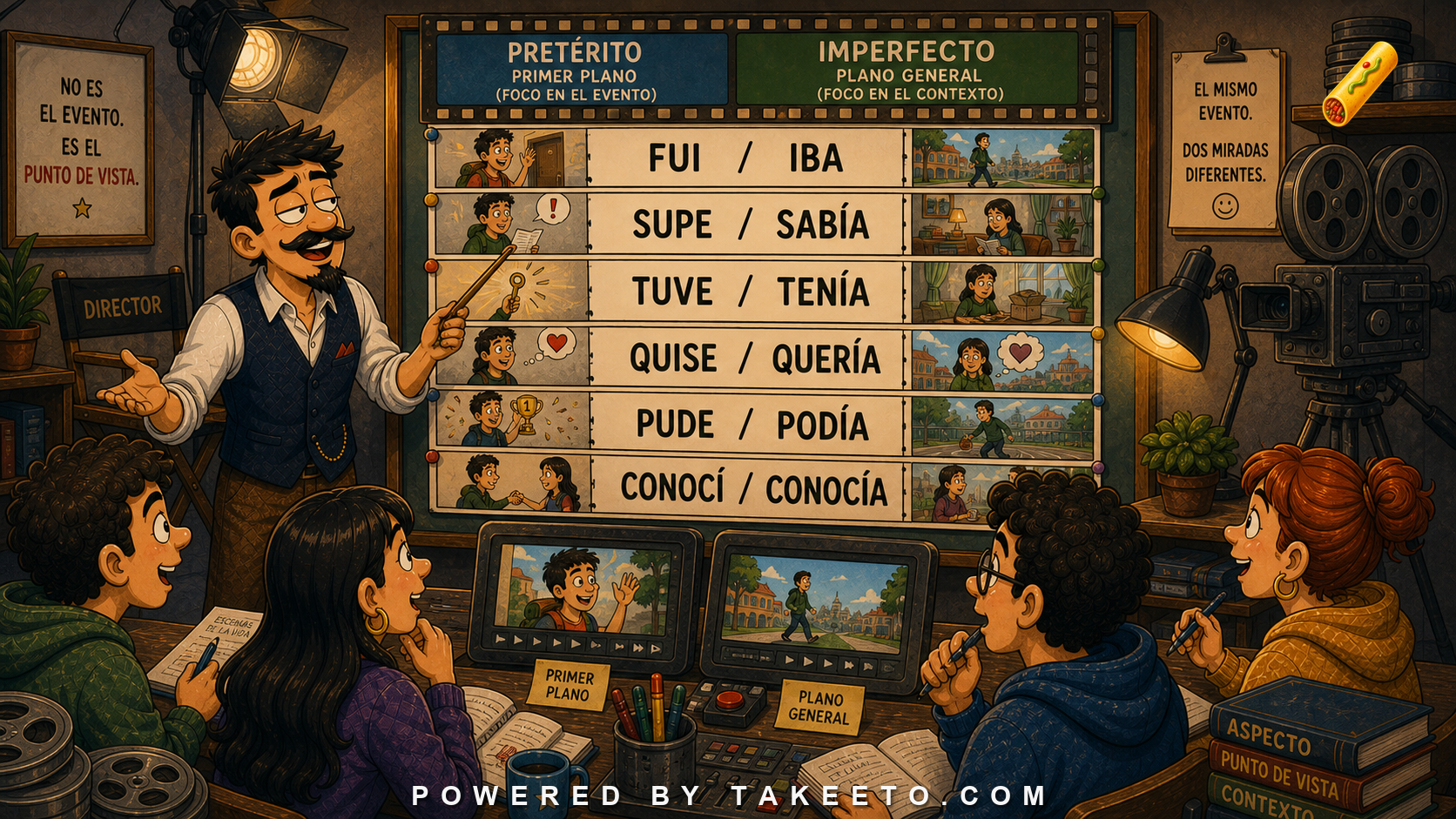
The wrong question is “Which verbs take the imperfect?”
Many learners are given lists:
- weather uses imperfect;
- age uses imperfect;
- repeated actions use imperfect;
- completed actions use preterite;
- emotions use imperfect;
- sequences use preterite.
These lists are helpful at first, but they can create a false belief: that some verbs belong to the preterite and others belong to the imperfect.
That is wrong.
The same verb can appear in both tenses:
Vivía en Madrid.
I was living in Madrid / used to live in Madrid.
Viví en Madrid diez años.
I lived in Madrid for ten years.
Conocía a Ana.
I knew Ana.
Conocí a Ana en 2019.
I met Ana in 2019.
The difference is viewpoint. The preterite presents a bounded event or completed block. The imperfect presents background, internal perspective, habit, description, or ongoing state.
A durable rule:
Do not ask what kind of verb it is first. Ask how the speaker is viewing the situation.
The same event can be framed two ways
Consider living in Madrid.
Vivía en Madrid cuando empecé la universidad.
I was living in Madrid when I started university.
The living is background. The preterite event empecé happens within that background.
Viví en Madrid durante cinco años.
I lived in Madrid for five years.
The same kind of situation is now presented as a bounded block: five years.
The real-world event could be identical. The grammar changes because the speaker’s viewpoint changes.
Foreground and background
Narratives often combine the two tenses:
Era tarde y llovía. Caminaba por el centro cuando vi a Ana. Me saludó, entramos en un café y hablamos durante una hora.
Layer by layer:
| Verb | Tense | Function |
|---|---|---|
| era | imperfect | background time/condition |
| llovía | imperfect | background weather |
| caminaba | imperfect | ongoing action/background |
| vi | preterite | bounded event that advances story |
| saludó | preterite | next event |
| entramos | preterite | next event |
| hablamos | preterite | bounded conversation event |
The imperfect paints the scene. The preterite moves the camera through events.
Fui vs iba
Both forms come from ir, but they frame motion differently.
Fui al supermercado ayer.
I went to the supermarket yesterday.
This is a bounded trip.
Iba al supermercado cuando me llamaste.
I was going to the supermarket when you called.
This looks inside the trip while it was in progress.
Iba al supermercado todos los sábados.
I used to go to the supermarket every Saturday.
This is a habit.
The contrast is not simply “went” vs “was going.” It is bounded event vs ongoing/habitual past.
Supe vs sabía
Saber is a classic example of aspect changing interpretation.
Sabía la verdad.
I knew the truth.
The imperfect presents knowledge as a state.
Supe la verdad ayer.
I found out the truth yesterday.
The preterite often marks entry into the state of knowing: the moment of learning.
But do not reduce supe to a rigid dictionary replacement. In some contexts, supe can mean “I knew” with a bounded frame, especially in literary or formal style. The key is that the preterite bounds the knowing in some way.
Conocí vs conocía
Conocer works similarly:
Conocía a Ana.
I knew Ana.
Conocí a Ana en una conferencia.
I met Ana at a conference.
The preterite marks the beginning of acquaintance. The imperfect describes the state of knowing.
With places:
Conocía bien la ciudad.
I knew the city well.
Conocí la ciudad en 2020.
I got to know / visited the city in 2020.
Again, the preterite event-ifies the acquisition or encounter.
Tuve vs tenía
Tener can describe possession, age, obligation, and states.
Tenía diez años.
I was ten years old.
Tenía un coche rojo.
I had a red car.
Tenía que estudiar.
I had to study / was supposed to study.
The imperfect presents the condition or obligation as background.
Tuve un problema.
I had a problem.
Tuve que estudiar toda la noche.
I had to study all night.
The preterite presents the problem or obligation as a bounded event or episode. Tuve que often implies that the obligation actually arose and was carried out or endured in that situation.
Quise vs quería
Querer in the imperfect usually describes desire:
Quería hablar contigo.
I wanted to talk with you.
De niño quería ser médico.
As a child I wanted to be a doctor.
In the preterite, quise can mean that the wanting became a bounded act of trying, deciding, or intending:
Quise ayudarte, pero no pude.
I tried/wanted to help you, but I could not.
The negative preterite is especially important:
No quise hablar.
I refused to speak / I did not want to speak.
The imperfect negative is softer or more backgrounded:
No quería hablar.
I did not want to speak.
This may describe reluctance, not necessarily refusal.
Pude vs podía
Poder also shifts with aspect.
Podía abrir la puerta.
I could open the door / had the ability.
Pude abrir la puerta.
I managed to open the door.
The preterite often implies successful realization of ability. The negative preterite often implies failure:
No pude abrir la puerta.
I could not / failed to open the door.
The imperfect negative can describe lack of ability or permission without focusing on one failed attempt:
No podía abrir la puerta.
I could not open the door / was not able to open it.
Context decides how sharp the contrast is.
Weather, age, and description are not locked to imperfect
It is true that weather, age, and description often use the imperfect:
Hacía frío.
Tenía diez años.
La casa era pequeña.
But they can be bounded:
Hizo frío toda la semana.
It was cold all week.
Cumplí diez años en 2010.
I turned ten in 2010.
La casa fue pequeña para una familia tan grande.
The house was small for such a large family, evaluating it as a bounded situation or whole.
The list “weather = imperfect” is a simplification. The better rule is: background weather often uses imperfect; bounded weather episodes can use preterite.
Decision procedure
When choosing between preterite and imperfect, ask:
- Is the sentence advancing the narrative with a bounded event? Use preterite.
Llegué, vi, compré, salí.
- Is the sentence setting background, describing conditions, or giving internal viewpoint? Use imperfect.
Era tarde, llovía, estaba cansado.
- Is the action repeated habitually in the past? Use imperfect.
Íbamos todos los domingos.
- Is a duration being presented as a completed block? Use preterite.
Viví allí tres años.
- Is a state being described as ongoing/background? Use imperfect.
Sabía la respuesta.
- Is a state being entered, discovered, attempted, refused, or completed? Preterite may appear.
Supe, conocí, pude, no quise.
The question is not “Was it completed in real life?” The question is “How is it framed in this sentence?”
Common learner errors
Error 1: Treating preterite as action and imperfect as description only
Habits are actions, but they often use imperfect:
Corría todos los días.
Durative states can use preterite when bounded:
Viví allí diez años.
Error 2: Memorizing state-verb translation lists without context
Pude often means “managed to,” but the deeper reason is bounded ability realized as an event. Learn the viewpoint.
Error 3: Thinking the imperfect means the action never ended
Vivía en Madrid en 2015.
This does not tell us whether the person still lives there. It simply frames the residence internally at that past time.
Error 4: Ignoring narrative structure
Tense choice is often paragraph-level, not sentence-level. A verb may be imperfect because it supports the scene, not because of its dictionary meaning.
Minimal pairs are useful only with context
Pairs like fui/iba or supe/sabía are often taught as if each form had a fixed English translation. A better exercise is to place both forms in contexts:
| Preterite | Imperfect |
|---|---|
| Fui al mercado ayer. | Iba al mercado cuando te vi. |
| Supe la verdad esa noche. | Sabía la verdad desde niño. |
| Tuve un problema con el coche. | Tenía un coche viejo. |
| Pude abrir la puerta. | Podía abrir la puerta con esa llave. |
| Conocí a Marta en 2020. | Conocía a Marta desde la universidad. |
The English translations change because the Spanish viewpoint changes. The Spanish forms should not be stored as separate vocabulary items; they should be stored as aspectual choices.
Paragraph-level tense choice
In real writing, the choice often depends on the paragraph’s architecture:
La ciudad era tranquila y las calles estaban casi vacías. Yo caminaba sin prisa. Entonces oí un ruido, miré hacia atrás y vi a un hombre junto a la puerta.
The first two sentences slow time down. The final sentence advances it. If you changed every imperfect to preterite, the paragraph would become a list of events. If you changed every preterite to imperfect, the narrative would lose its forward motion.
This is why tense choice cannot be solved by one sentence alone. Spanish past narration is a layering system.
One event, two valid stories
Imagine a person lived in Bogotá from 2018 to 2020. Both sentences can be true:
Vivía en Bogotá cuando empezó la pandemia.
I was living in Bogotá when the pandemic began.
Viví en Bogotá de 2018 a 2020.
I lived in Bogotá from 2018 to 2020.
The first sentence uses the residence as background for another event. The second packages the residence as a completed period. Spanish does not ask which tense the real-world event “is.” It asks what job the event has in this sentence.
This is the mental shift that unlocks the contrast.
Adverbs do not choose the tense alone
Words like ayer, siempre, durante, and cuando influence tense choice, but they do not decide it mechanically:
Ayer llovía cuando salí.
Yesterday it was raining when I left.
Ayer llovió toda la tarde.
Yesterday it rained all afternoon.
The same day can contain background or bounded events.
Study checkpoint
Rewrite one past sentence both ways and explain the shift. If you cannot explain the shift, you are still translating instead of choosing viewpoint.
Diagnostic refinement: test the same sentence under two story goals
The best way to master preterite versus imperfect is to write the same real-world situation under two different narrative goals.
| Real-world situation | Preterite framing | Imperfect framing |
|---|---|---|
| residence in Madrid | Viví en Madrid dos años. | Vivía en Madrid cuando empezó el proyecto. |
| knowledge of the answer | Supe la respuesta al final. | Sabía la respuesta, pero no quería decirla. |
| ability to help | Pude ayudarla. | Podía ayudarla, pero no sabía si debía. |
| wanting to leave | Quise irme. | Quería irme. |
| meeting Ana | Conocí a Ana en 2019. | Conocía a Ana desde hacía años. |
The event type did not force the tense. The story goal did. The preterite packages a whole event or transition. The imperfect supplies an internal state, condition, habit, or background.
Be careful with adverbs. Siempre, muchas veces, and durante años often appear with the imperfect because they describe repeated or extended background. But they can appear with the preterite when the speaker packages the repetition as a complete set:
Siempre íbamos al mismo café.
We always used to go to the same café.
Siempre fuimos al mismo café durante aquel viaje.
We always went to the same café during that trip.
Both are grammatical. They are not identical. The first recreates a habit as part of a past world. The second summarizes a bounded trip.
A useful editing question is: “Is this clause scenery, state, habit, or internal process? Or is it a completed event, result, transition, or narrative step?” That question beats any verb list.
Suggested interactive module: paragraph annotator
A useful tool would color verbs by narrative function.
Input:
Era sábado y hacía calor. Ana estaba en casa. De repente, sonó el teléfono. Contestó y escuchó una voz desconocida.
Output:
- imperfect background: era, hacía, estaba;
- preterite events: sonó, contestó, escuchó.
Then the tool would allow toggling:
Ana vivía en Sevilla.
Ana vivió en Sevilla cinco años.
and explain how the viewpoint changes from background residence to bounded life period.
Final rule
Preterite vs imperfect is not event type. It is viewpoint.
The preterite packages a past situation as a bounded event or completed block. The imperfect opens a window into a past situation as background, habit, description, state, or ongoing process.
The same verb can take either tense: fui/iba, supe/sabía, tuve/tenía, quise/quería, pude/podía, conocí/conocía. Do not memorize tense choice as a word list. Read the story structure.