Spanish punctuation is not English punctuation plus inverted signs
Learners often reduce Spanish punctuation to one rule: use ¿ and ¡. That rule matters, but it is not enough. Spanish punctuation organizes syntax, voice, dialogue, quotations, formal letters, lists, and reading rhythm.
The key principle is:
Spanish punctuation is structural. It tells the reader where the question begins, who is being addressed, how clauses relate, and whose voice is speaking.
A comma can mark direct address. A semicolon can organize a complex list. A colon can introduce an explanation. A raya can mark dialogue. Quotation marks can show levels of citation and speech.
Opening question and exclamation marks
Spanish uses opening and closing signs for direct questions and exclamations.
¿Qué dijo?
What did he/she say?
¡Qué bien!
How great!
The opening sign appears where the interrogative or exclamatory part begins, not necessarily at the beginning of the whole sentence.
Entonces, ¿vienes mañana?
So, are you coming tomorrow?
Si no te importa, ¿puedo pasar?
If you don’t mind, may I come in?
This lets the reader know the intonation before reaching the end.
No period after ? or !
A closing question or exclamation mark can close the sentence. Do not add a period after it.
¿Qué dijo?
Correct.
Not:
¿Qué dijo?.
Other punctuation can follow in certain structures:
¿Qué dijo?, ¿cuándo lo dijo?, ¿a quién se lo dijo?
What did he say, when did he say it, and to whom did he say it?
But a separate final period after ? or ! is not used.
Commas and syntax
Spanish commas separate elements, mark insertions, signal connectors, and prevent misreading.
Compré pan, queso, fruta y café.
I bought bread, cheese, fruit, and coffee.
Sin embargo, no pudimos entrar.
However, we could not enter.
Madrid, la capital de España, recibe muchos visitantes.
Madrid, the capital of Spain, receives many visitors.
Do not put a comma between subject and verb simply because the subject is long.
La profesora de historia explicó el tema.
The history teacher explained the topic.
Not:
La profesora de historia, explicó el tema.
Coma vocativa
The coma vocativa marks direct address.
Hola, Ana.
Hi, Ana.
Gracias, profesor.
Thank you, professor.
No te preocupes, mamá.
Don’t worry, Mom.
The comma can change meaning:
Vamos a comer, niños.
Let’s eat, children.
Without the comma, the sentence can be read absurdly as “We are going to eat children.” The example is extreme, but the rule is ordinary: direct address is set off by commas.
Punto y coma
The semicolon, punto y coma, is stronger than a comma and weaker than a period. It often separates complex list items or closely related clauses.
Vinieron Ana, la directora; Luis, el coordinador; y Marta, la traductora.
Ana, the director; Luis, the coordinator; and Marta, the translator came.
It can also connect closely related statements:
El problema era grave; la solución, urgente.
The problem was serious; the solution, urgent.
Semicolons are less common in casual messages, but they remain useful in formal prose, academic writing, legal writing, and editing.
Dos puntos
Dos puntos introduce explanations, lists, quotations, consequences, and formal openings.
Necesitamos tres documentos: pasaporte, comprobante de domicilio y solicitud firmada.
We need three documents: passport, proof of address, and signed application.
Solo había una opción: esperar.
There was only one option: wait.
Spanish formal letters and emails may use a colon after the greeting:
Estimada profesora:
Me dirijo a usted...
This differs from many English email habits.
Quotation marks: comillas
Spanish recognizes several quotation mark styles:
«texto»
“texto”
‘texto’
In formal publishing, angle quotes « » are often preferred as primary quotation marks, with English-style double quotes and single quotes available for nested quotation depending on style.
Dijo: «No entiendo la palabra “registro” en este contexto».
He/she said, “I don’t understand the word ‘registro’ in this context.”
Digital writing often uses English-style quotation marks. A learner should recognize all forms and follow the expected style of the context.
Raya for dialogue and interruption
The raya is a long dash. It is not the same as a hyphen. Spanish uses it for dialogue and parenthetical interruptions.
Dialogue:
—No puedo ir —dijo Ana—. Tengo que trabajar.
“I can’t go,” Ana said. “I have to work.”
Parenthetical use:
La decisión —aunque difícil— fue necesaria.
The decision—although difficult—was necessary.
Spanish dialogue punctuation often looks very different from English because turns of speech may be marked with rayas rather than quotation marks.
Capitalization with questions and exclamations
Capitalization depends on where the sentence begins.
¿Qué pasó? No entiendo.
What happened? I don’t understand.
Pero ¿qué pasó?
But what happened?
In the second sentence, qué is lowercase because the sentence began with Pero. The opening question mark begins the question portion, not the entire sentence.
Translation and editing
When translating into Spanish, do not preserve English punctuation mechanically. Spanish may require:
- opening question and exclamation marks,
- vocative commas,
- different dialogue punctuation,
- a colon after formal greetings,
- angle quotation marks in formal style,
- different comma placement based on Spanish syntax.
Punctuation is part of translation quality, not a cosmetic final pass.
Common learner errors
The first error is omitting opening signs in careful writing:
¿Puedes venir?
The second is adding a comma between subject and verb:
La profesora explicó el tema.
The third is missing the vocative comma:
Gracias, Ana.
The fourth is using a hyphen instead of a raya in dialogue.
The fifth is adding a period after ? or !.
Remediation notes: voice, hierarchy, and editing discipline
Spanish punctuation is not decoration added after translation. It is part of sentence architecture. A good remediation pass focuses on three high-risk zones: direct address, voice management, and punctuation hierarchy.
The coma vocativa changes meaning:
Vamos a comer, niños.
Let’s eat, children.
Vamos a comer niños.
Let’s eat children.
The second is absurd in ordinary context, but it shows why the comma matters. Names and forms of address must be separated:
Gracias, Ana.
Buenos días, profesor.
¿Puede ayudarme, doctora?
Connectors also often need punctuation:
Sin embargo, no aceptó.
However, he/she did not accept.
Por tanto, debemos revisar el plan.
Therefore, we must review the plan.
But punctuation should not separate subject and verb merely because the subject is long:
El informe que entregamos ayer contiene varios errores.
The report we submitted yesterday contains several errors.
Not:
El informe que entregamos ayer, contiene varios errores.
Dialogue requires special attention because Spanish prose often uses the raya rather than English quotation-mark habits:
—No puedo ir —dijo Marta—. Tengo que trabajar.
“I can’t go,” Marta said. “I have to work.”
When the narrator’s tag uses a speech verb, it often begins with lowercase after the raya:
—¿Vienes? —preguntó.
“Are you coming?” he/she asked.
Quotation marks also have hierarchy. In many formal printed contexts, Spanish prefers angular quotation marks first:
«texto “cita interna” texto»
English-style quotation marks are common in digital contexts, but learners should recognize comillas españolas and know that style varies by medium.
Finally, Spanish opening question and exclamation marks must be placed where the question or exclamation begins:
Si tienes tiempo, ¿puedes llamarme?
If you have time, can you call me?
This is not cosmetic. It tells the reader where the interrogative contour starts. The editing rule is: punctuate the Spanish sentence you actually wrote, not the English sentence you translated from.
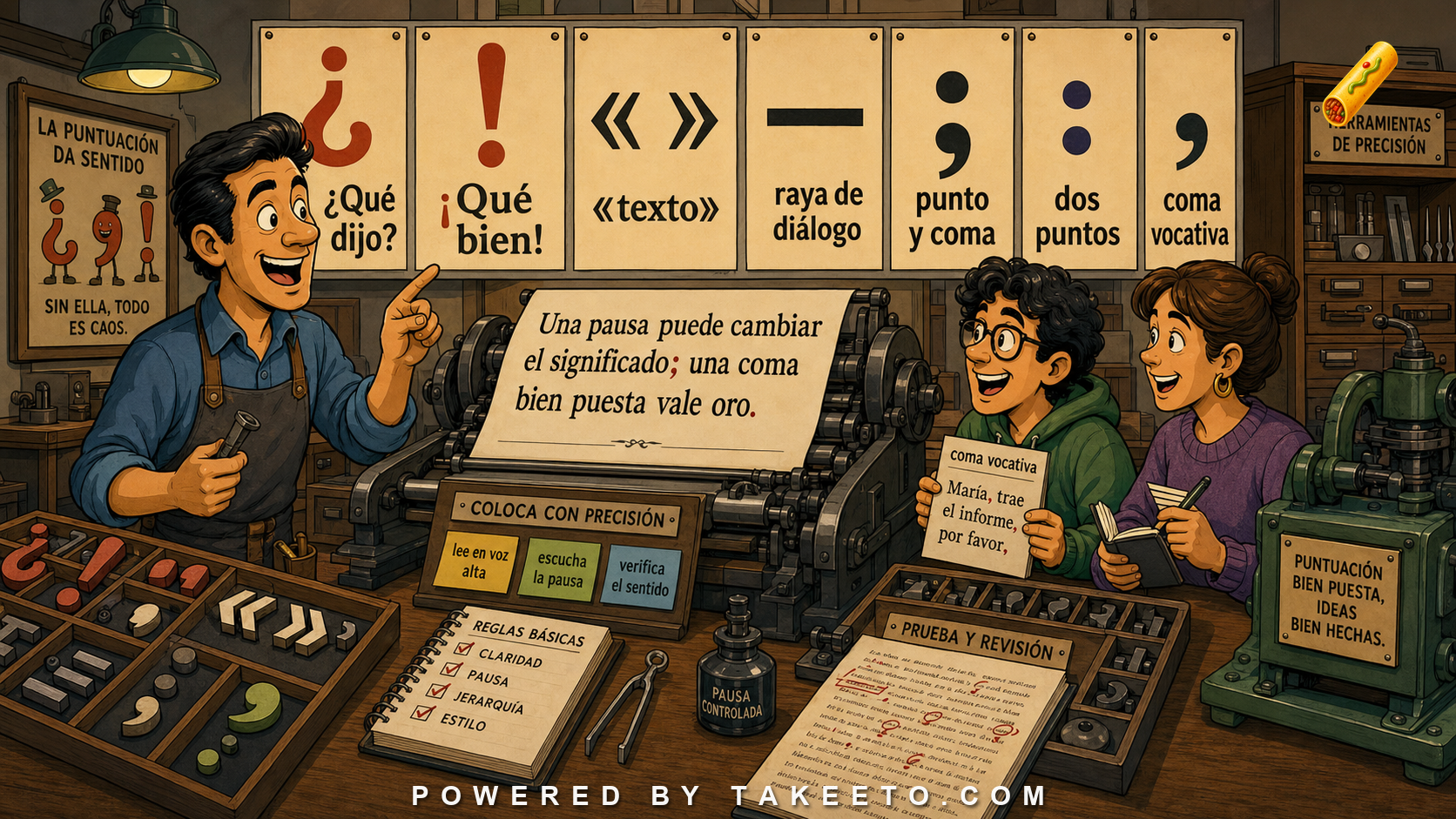
Example bank walkthrough
¿Qué dijo?
Direct question with opening and closing signs.
Learner action: place the opening sign where the question begins.
¡Qué bien!
Direct exclamation.
Learner action: do not add a final period after !.
«texto»
Angle quotation marks.
Learner action: recognize formal Spanish publishing style.
raya de diálogo
Long dash for dialogue.
Learner action: distinguish raya from hyphen.
punto y coma
Semicolon.
Learner action: use for complex lists and linked clauses.
dos puntos
Colon.
Learner action: use for lists, explanations, quotations, and formal greetings.
coma vocativa
Comma of direct address.
Learner action: write Hola, Ana, not Hola Ana, in careful punctuation.
Suggested interactive module: punctuation editor
A strong tool for this article would annotate punctuation choices in Spanish prose.
Suggested functions:
- Question/exclamation mode: opening-sign placement.
- Comma mode: vocatives, connectors, appositives, subject-verb warning.
- Semicolon mode: complex lists and related clauses.
- Colon mode: lists, explanations, formal greetings.
- Quotation mode: « », “ ”, ‘ ’ hierarchy.
- Dialogue mode: raya placement and narration.
- Translation mode: English punctuation converted to Spanish style.
- Error repair: missing ¿, subject comma, wrong dash, extra period.
Final rule
Spanish punctuation is structural.
Opening question and exclamation marks guide intonation. Commas mark syntax and address. Semicolons organize complexity. Colons introduce. Quotation marks and rayas manage voices.
Do not add Spanish punctuation at the end of editing. Build it into the sentence from the start.
## Remediation summary for this pass
This pass upgraded the 121–140 batch in five main ways:
- Verb semantics and argument structure: expanded high-frequency verb families for hacer, poner, meter, sacar, quitar, tomar, coger, agarrar, ver, mirar, buscar, encontrar, oír, escuchar, sonar, decir, contar, hablar, pedir, preguntar, saber, conocer, pensar, creer, opinar, and considerar.
- Learner-error repair: added contrastive repairs for English-transfer mistakes such as “ask,” “take,” “look,” “know,” “sound,” “think,” “put,” “become,” “for two years,” and “body-part possessives.”
- Regional and register caution: strengthened notes on coger, platicar, poner atención, weather vocabulary, address abbreviations, name-field conventions, surname particles, and institution-specific acronyms.
- Syntax and pronoun precision: expanded object-pronoun and affected-person patterns in causative hacer, reciprocal/reflexive se, body-part constructions, pedir/preguntar, and decir/contar.
- Document and orthography literacy: deepened the treatment of identity fields, Spanish surnames, abbreviations, siglas/acronyms, symbols, punctuation, quotation marks, rayas, and Spanish sentence-level editing discipline.
The article sequence, headings, reader outcomes, example-bank format, interactive-module concepts, and final-rule pattern were preserved.