
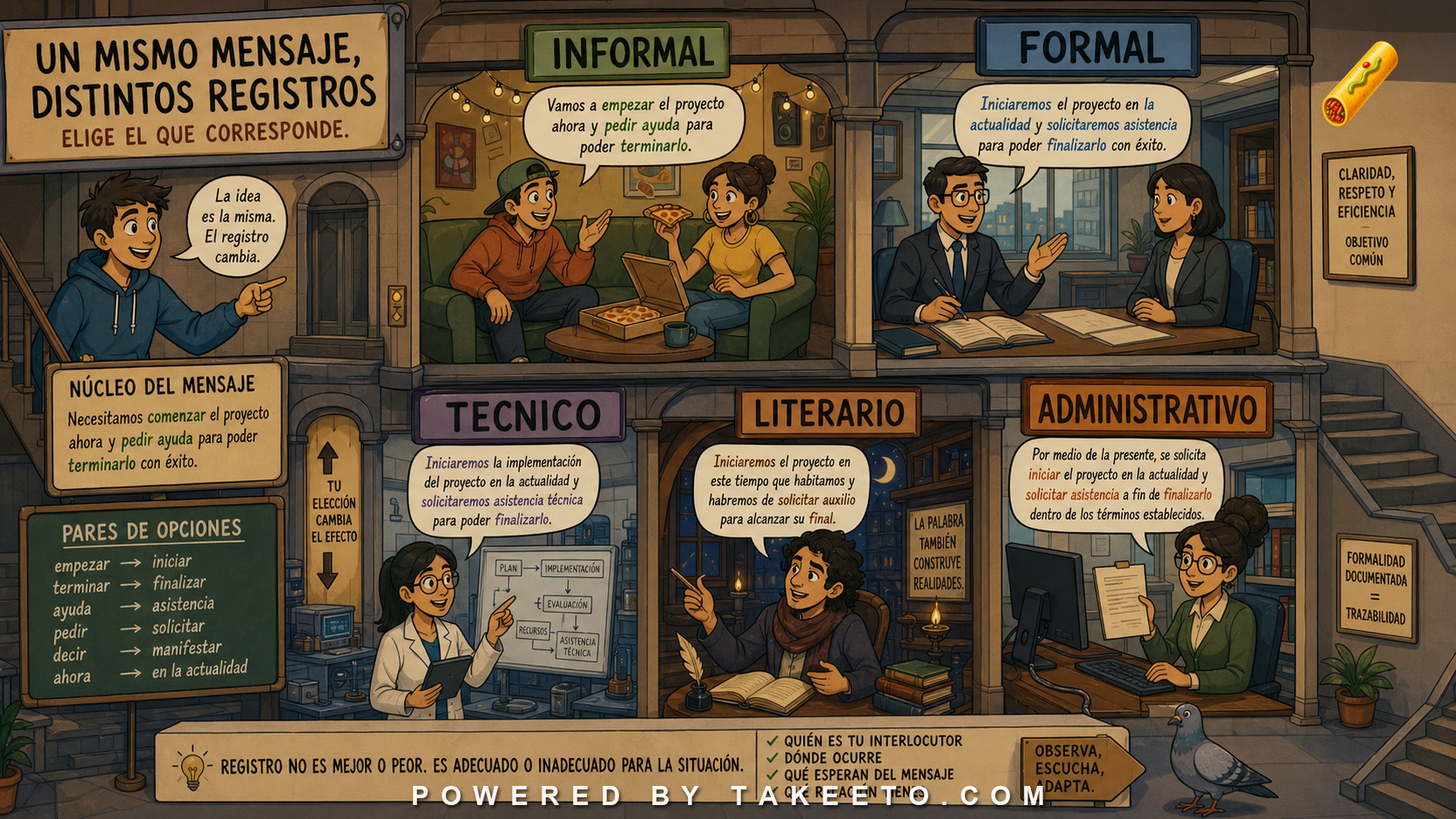
The learner problem is real
Learners often ask whether a word is “formal” as if register were a single ladder. Real register depends on situation, medium, relationship, topic, institution, and purpose.
That reaction is understandable. Spanish is close enough to English and other European languages to reward pattern recognition, but different enough that pattern recognition can become overconfidence. The stronger habit is to treat each form as evidence. Ask what shape the word or sentence has, what job that shape is doing, and what context would make it natural.
The working rule for this article is simple:
Do not tag words only by translation. Tag them by setting: conversation, classroom, journalism, academic prose, law, administration, literature, service interaction, or technical domain.
This rule matters because the topic is not only a small grammar point. It is a reading strategy, a writing strategy, and a way to keep learner Spanish from becoming a translation of English with Spanish-looking words.
The central pattern
Register is language shaped by context. The choice between empezar and iniciar, pedir and solicitar, ayuda and asistencia, decir and manifestar is not just a choice between simple and fancy words. It tells the reader what kind of social scene the sentence belongs to. Necesito ayuda is ordinary and human. Solicito asistencia belongs more naturally to a form, notice, institutional request, or formal exchange.
Register also affects syntax. Informal speech tolerates fragments, repetition, discourse markers, and pronouns anchored in shared context. Academic prose uses connectors, nominalizations, cautious claims, and explicit references. Administrative Spanish often uses passive se, participial modifiers, dense noun phrases, and procedural vocabulary: se establece el plazo para la presentación de documentos. Literary style may bend normal order or choose archaic, regional, or evocative words for effect.
A serious learner should stop asking only “What does this mean?” and start asking “Where would this be said or written?” A word can be correct and still wrong for the room. Finalizar is not better than terminar; it is more suited to certain written, official, or organized contexts. Manifestar is not simply “say”; it often means state, express, or make known in a more formal frame.
The pattern is useful precisely because it is not mechanical. A mechanical rule lets you produce a few classroom examples and then fails in real prose. A durable pattern lets you inspect unfamiliar material, make a reasonable hypothesis, and then verify it with context.
Annotated contrast table
| Form or pattern | Example | What the learner should notice |
|---|---|---|
| Everyday | empezar, terminar, ayuda, pedir, decir, ahora | conversation, neutral narration, simple instructions |
| Formal/written | iniciar, finalizar, asistencia, solicitar, manifestar, en la actualidad | reports, applications, academic or institutional prose |
| Administrative | presentación de documentos, se establece, dicho procedimiento | procedures, regulations, notices |
| Technical | parámetro, interfaz, diagnóstico, variable | domain-specific precision |
| Literary | al alba, morada, antaño, silencioso | aesthetic and narrative effect |
| Service interaction | ¿En qué puedo ayudarle?, le atiendo enseguida | politeness routines and institutional roles |
Tables like this are not meant to replace reading. They train attention. Once the contrast is visible in short examples, the learner can notice it inside longer sentences, forms, articles, transcripts, and essays.
How to read it in context
A good reader does not translate from left to right as if each word were independent. A good reader first identifies the structure. In this topic, that means asking what is being built, modified, asserted, evaluated, connected, or backgrounded before choosing an English equivalent.
Consider the difference between a dictionary match and a contextual interpretation. A dictionary can give a gloss. It cannot by itself tell you whether a word sounds bureaucratic, whether a pronoun is attached because the verb is an infinitive, whether a relative clause describes a known person or a desired category, or whether a familiar-looking word is a false friend. Those decisions come from structure plus context.
The safest habit is to annotate one layer at a time. First mark the visible form. Then mark the grammatical relation. Then mark register or discourse function. Only after those steps should you settle on a translation or write your own sentence.
Diagnostic workflow
Use this checklist when you meet the pattern in real Spanish:
- Identify the scene: who is speaking, to whom, through what medium, and for what purpose?
- Mark whether the text is conversational, academic, journalistic, technical, legal, administrative, or literary.
- Check whether a word is too heavy or too casual for the scene.
- Look for syntax that signals register: nominalizations, passive se, connectors, fragments, or discourse markers.
- When learning a word, record a register tag and one natural context sentence.
The point is not to slow down forever. The point is to slow down enough times that your eye starts doing the work automatically. Spanish becomes easier when you stop treating each example as a separate exception.
Common learner traps
| Trap | Better analysis |
|---|---|
| Thinking formal equals better | A formal word in a friendly message can sound cold, comic, or bureaucratic. |
| Using English academic cognates everywhere | Spanish academic prose has its own conventions; not every Latinate English translation sounds natural. |
| Ignoring country and institution | A word may be normal in one education system, bureaucracy, or business setting and odd in another. |
| Flattening synonyms | Pedir, solicitar, rogar, and requerir are not interchangeable in tone or force. |
The traps all have the same source: translating too early. If you first ask what the Spanish form is doing, many apparent exceptions become predictable.
Production practice
Rewrite “I need help now.” In a text to a friend: Necesito ayuda ahora. At a service counter: Disculpe, necesito ayuda con este trámite. In a formal email: Solicito asistencia para completar el trámite. In a technical support ticket: Requiero soporte para resolver el error de acceso. The propositional meaning overlaps, but the register changes the social relationship.
For writing, build sentences around real contexts rather than isolated forms. A learner who writes only bare examples can produce a correct phrase and still miss the register, discourse function, or argument structure. A better practice sentence includes a speaker, a listener or reader, a purpose, and enough surrounding language to make the grammar meaningful.
One useful exercise is to write three versions of the same idea: a neutral spoken version, a careful written version, and a formal or technical version. The differences reveal which parts of the pattern are grammatical and which parts belong to style. This is especially important in articles 081-100, where morphology, word choice, discourse, word order, clitics, commands, and subjunctive mood all interact with register.
Deepening the pattern: from recognition to control
Recognition is the first stage. Control begins when the learner can explain why a neighboring form would change the interpretation. For Register in Spanish: Formal, Informal, Technical, Literary, and Administrative, the essential habit is to keep three questions separate: what form is visible, what relation that form creates, and what discourse effect follows from it. When those questions collapse into one vague translation, the pattern becomes fragile. When they are separated, the learner can handle new examples without waiting for a memorized phrase.
Start with the example bank: empezar/iniciar, terminar/finalizar, ayuda/asistencia, pedir/solicitar, decir/manifestar, ahora/en la actualidad. Do not treat those items as decorative vocabulary. Treat them as test cases. For each one, ask what the form contributes that would disappear if the sentence were rewritten with a simpler, more English-like structure. Sometimes the answer is grammatical, as with agreement, clitic placement, or mood. Sometimes it is lexical, as with derivational families, false friends, loanwords, or register choices. Sometimes it is textual, as with connectors, discourse markers, word order, or formal nominalization. The same visible Spanish form can therefore carry information about grammar, vocabulary, stance, and genre at once.
| Control test | Example | What changes if the learner ignores it |
|---|---|---|
| Everyday | empezar, terminar, ayuda, pedir, decir, ahora | conversation, neutral narration, simple instructions |
| Formal/written | iniciar, finalizar, asistencia, solicitar, manifestar, en la actualidad | reports, applications, academic or institutional prose |
| Administrative | presentación de documentos, se establece, dicho procedimiento | procedures, regulations, notices |
| Technical | parámetro, interfaz, diagnóstico, variable | domain-specific precision |
A useful self-check is the replacement test. Replace the form with the nearest English-looking option and ask what breaks. If nothing breaks grammatically, ask what changes stylistically. If the sentence remains possible but sounds more bureaucratic, more colloquial, more regional, more emphatic, or less precise, the difference still matters. Serious Spanish learning is not only avoiding ungrammatical sentences. It is learning why one grammatical sentence fits a context better than another. That final comparison is where mature command develops: the learner stops asking only whether a sentence is allowed and starts asking whether it is the sentence a competent speaker or writer would choose here.
This is also where translation discipline matters. English often hides distinctions that Spanish marks openly, and English sometimes marks distinctions that Spanish leaves to context. A literal translation may therefore produce the right dictionary meaning while losing the Spanish architecture. In this article's topic, the learner should practice moving in both directions: Spanish to analysis, then analysis to natural English; English intention to Spanish structure, then Spanish structure to a context where it sounds credible.
Applied editing drill
Use the topic as an editing lens. Take a paragraph that already communicates a basic message and revise it once for grammar, once for register, and once for discourse flow. In the grammar pass, look for visible evidence: endings, articles, pronouns, prepositions, mood, word order, and agreement. In the register pass, ask whether the vocabulary belongs to speech, academic writing, administrative prose, journalism, technical explanation, or intimate conversation. In the discourse pass, ask whether the sentence introduces information, contrasts it, reformulates it, softens it, commands action, evaluates it, or presents it as asserted or nonasserted.
For teachers and curriculum designers, the practical sequence is diagnosis before production. First ask learners to identify the form. Then ask them to explain the role. Only after that should they generate original examples. Production without diagnosis often creates lucky correct answers. Diagnosis followed by production creates transfer. For independent learners, the notebook method should be the same: record the example, label the structure, write the contrast, and add one original sentence with context.
For translators and heritage speakers, the main danger is different. They may understand the message quickly but underestimate the formal signal. A connector, suffix, clitic position, or subjunctive choice may feel obvious in context, yet that small signal is exactly what gives the sentence its written polish or regional flavor. Slow analysis is still useful even when the meaning is already clear.
V2 remediation refinement: register is a bundle, not a ladder of “better” words
The draft’s register ladder is useful, but it needed one stronger warning: formal words are not automatically better. Register is a bundle of audience, medium, relationship, institutional setting, and purpose. A word can be precise in an administrative document and ridiculous in a text message.
Compare one request:
| Context | Natural version | What the register signals |
|---|---|---|
| Friend | ¿Me ayudas con esto? | direct, familiar, low distance |
| Service desk | ¿Podría ayudarme con este trámite? | polite, transactional |
| University email | Le escribo para solicitar información sobre el procedimiento. | formal, written, institutional |
| Legal/administrative | Se solicita la presentación de la documentación correspondiente. | impersonal, procedural, dense |
| Technical report | Se requiere asistencia para la validación del proceso. | specialized and abstract |
A learner who simply replaces empezar with iniciar, terminar with finalizar, ayuda with asistencia, and pedir with solicitar may make their Spanish heavier without making it more appropriate. The reverse is also true: casual vocabulary can weaken a report, application, or academic essay.
The upgrade also adds syntax to the register analysis. Formal Spanish often uses nominalizations, passive se, longer prepositional chains, and connectors such as no obstante, por consiguiente, and en relación con. Spoken Spanish relies more heavily on turn-management markers such as bueno, pues, o sea, and a ver. Register is therefore not only a vocabulary choice. It is a sentence architecture choice.
A strong vocabulary notebook should label each new word with at least one context: conversational, neutral written, journalistic, academic, administrative, legal, technical, literary, regional, or colloquial. Meaning alone is not enough. A learner who knows manifestar means “state/express” still needs to know that me manifestó que... can sound formal or bureaucratic compared with me dijo que....
Suggested interactive module: Register ladder
Register ladder. The tool would take one message and rewrite it across five settings: casual chat, polite service interaction, formal email, academic prose, and administrative notice. It would highlight vocabulary, pronouns, sentence length, connectors, and nominalizations so learners can see register as a system rather than a list of fancy synonyms.
Suggested functions:
- Structure detection: identify the relevant form or construction automatically.
- Role labels: mark meaning, grammar, discourse function, and register separately.
- Contrast mode: show a nearby form that looks similar but behaves differently.
- Correction mode: let the learner repair common English-shaped errors.
- Context export: generate a short annotated example for study notes.
Final rule
Register is not decoration. It is social grammar. Learn what a word means, then learn the room in which it belongs.