
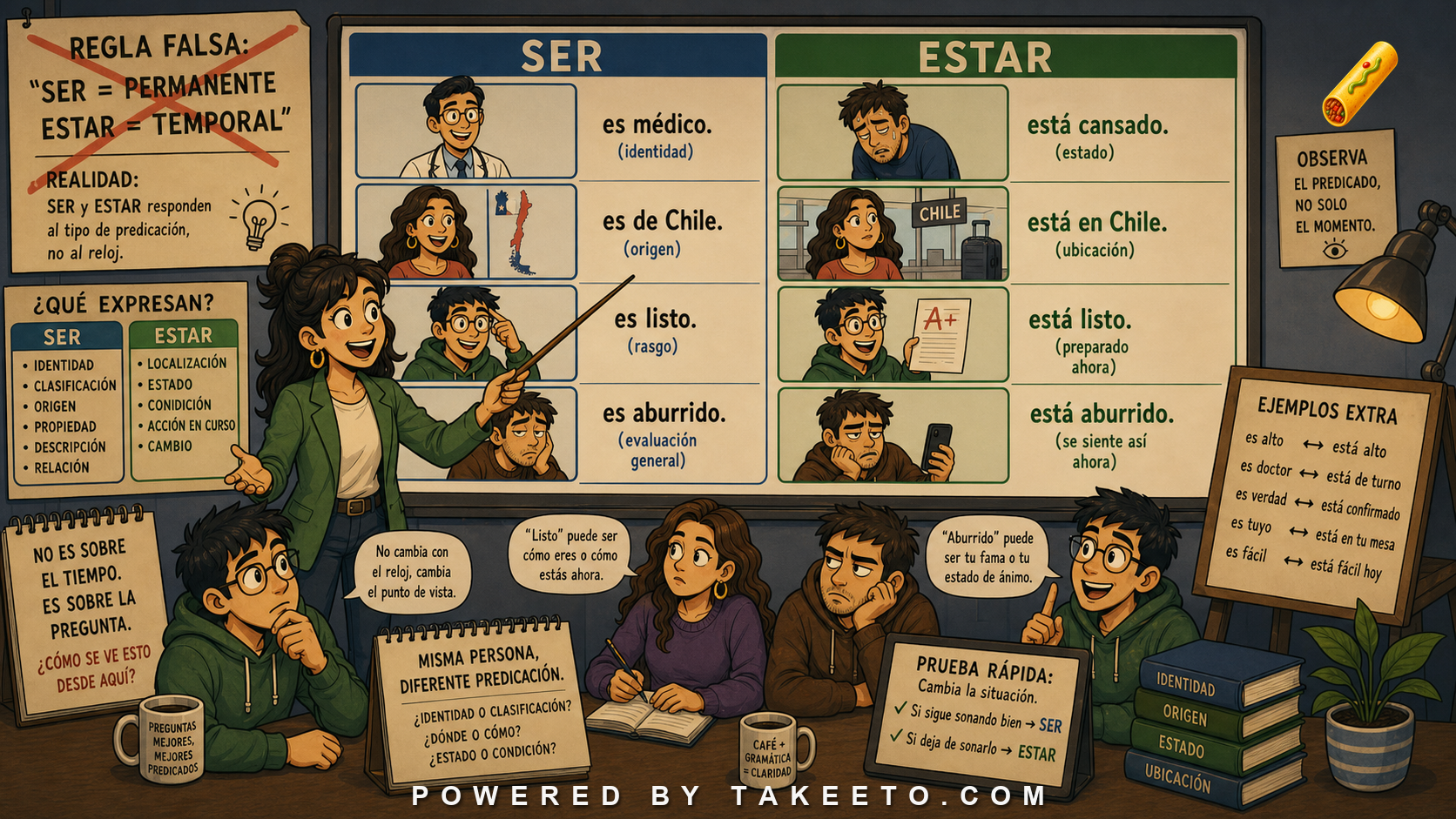
The permanent/temporary rule breaks too quickly
Most Spanish learners are taught:
- ser = permanent
- estar = temporary
This rule survives because it sometimes works.
Es alto.
He is tall.
Está cansado.
He is tired.
Tallness feels more stable. Tiredness feels temporary.
But the rule breaks almost immediately:
Está muerto.
He is dead.
Death is not temporary in ordinary meaning.
Es joven.
He is young.
Youth is temporary.
Madrid está en España.
Madrid is in Spain.
Location can be stable, but Spanish uses estar for most locations of things and people.
La reunión es en la sala 3.
The meeting is in room 3.
An event location uses ser, even though a meeting is temporary.
The permanent/temporary shortcut is not useless, but it is too shallow.
A better rule is:
Ser classifies, identifies, and characterizes; estar locates and presents states, results, or situation-bound conditions.
Ser as classification and identity
Use ser to say what something or someone is in a classificatory or identifying way.
Profession and role
Es médico.
He/She is a doctor.
Soy profesora.
I am a teacher.
Son estudiantes.
They are students.
The profession is not necessarily permanent. Someone can change jobs. But ser classifies the person by role.
Identity
Soy Ana.
I am Ana.
Ella es mi hermana.
She is my sister.
Esto es un problema.
This is a problem.
Identity statements use ser.
Origin
Es de Chile.
He/She is from Chile.
Somos de México.
We are from Mexico.
Origin uses ser, even if the person is currently somewhere else.
Material
La mesa es de madera.
The table is made of wood.
El anillo es de oro.
The ring is made of gold.
Material classification uses ser.
Ownership and relation
El libro es de Ana.
The book is Ana’s.
La decisión es del comité.
The decision belongs to/is from the committee.
Time and dates
Son las tres.
It is three o’clock.
Hoy es lunes.
Today is Monday.
Es el cinco de mayo.
It is May 5.
Time expressions use ser.
Estar as location
Use estar to locate people, objects, and many concrete entities.
Estoy en casa.
I am at home.
Ana está en Chile.
Ana is in Chile.
El libro está en la mesa.
The book is on the table.
Madrid está en España.
Madrid is in Spain.
This is one of the biggest failures of the permanent/temporary rule. Madrid’s location is stable, but Spanish uses estar because the predicate locates the subject.
Event location uses ser
Events are different.
La reunión es en la sala 3.
The meeting is in room 3.
El concierto es en el teatro.
The concert is at the theater.
La clase es a las ocho.
The class is at eight.
Events are not located with estar in the same ordinary way because the sentence identifies where/when the event takes place. This belongs to the ser system.
Compare:
La conferencia es en Madrid.
The conference is in Madrid. Event location.
El conferenciante está en Madrid.
The speaker is in Madrid. Person location.
Estar as state
Use estar for states, conditions, and situation-bound presentations.
Estoy cansado.
I am tired.
La puerta está abierta.
The door is open.
El café está frío.
The coffee is cold.
Los niños están enfermos.
The children are sick.
These may be temporary, but the deeper issue is that the adjective presents a state relative to a situation, not a classifying property.
Estar as result
Many estar + participle/adjective constructions describe a result state.
La puerta está cerrada.
The door is closed.
El trabajo está terminado.
The work is finished.
La comida está preparada.
The food is prepared.
El vaso está roto.
The glass is broken.
The sentence describes the state that results from an event.
Compare with ser + participle for passive event structure:
La puerta fue cerrada por el guardia.
The door was closed by the guard.
La puerta está cerrada.
The door is closed.
The first is event passive. The second is result state.
Ser as inherent characterization, not permanent truth
Ser often characterizes the subject as having a property independent of one immediate situation.
Es inteligente.
He/She is intelligent.
Es amable.
He/She is kind.
Es joven.
He/She is young.
Es alto.
He/She is tall.
These properties are not all permanent. Joven is obviously temporary over a lifetime. But Spanish uses ser because the sentence classifies or characterizes the person, rather than presenting a situational state.
Same adjective, different verb, different meaning
Some adjectives change meaning depending on ser or estar.
| Ser | Meaning | Estar | Meaning |
|---|---|---|---|
| es listo | is clever/smart | está listo | is ready |
| es aburrido | is boring | está aburrido | is bored |
| es bueno | is good, good person/quality | está bueno | tastes good, is attractive/healthy depending on region/context |
| es malo | is bad, bad person/quality | está malo | is sick, spoiled, not functioning, depending on context |
| es rico | is rich | está rico | tastes good |
| es seguro | is safe/certain | está seguro | is sure/confident |
| es vivo | is lively/sharp, depending on variety | está vivo | is alive |
| es verde | is green by classification/color | está verde | is unripe or inexperienced, depending on context |
These pairs prove that ser/estar is not only about duration. The verb changes how the adjective is interpreted.
Experiential stance with estar
Estar can express how something seems in a particular experience.
La sopa está salada.
The soup is salty.
El café está bueno.
The coffee tastes good.
La película está interesante.
The movie is interesting so far / seems interesting in this experience, depending on region and context.
A food can be inherently salty as a type, but está salada says this serving is salty. Ser would classify the item more generally:
La sopa de miso es salada.
Miso soup is salty.
Esta sopa está salada.
This soup is salty.
A decision procedure that works better
When choosing between ser and estar, ask:
1. Am I identifying or classifying the subject?
Use ser.
- Es médica.
- Es mi hermano.
- Es una decisión difícil.
2. Am I saying origin, material, possession, time, or event location?
Use ser.
- Es de Perú.
- Es de madera.
- Son las cinco.
- La reunión es en la oficina.
3. Am I locating a person, object, or place?
Use estar.
- Está en casa.
- El libro está en la mesa.
- Lima está en Perú.
4. Am I describing a state, result, or condition?
Use estar.
- Está cansada.
- La puerta está abierta.
- El vaso está roto.
5. Does the adjective have a known meaning shift?
Check the pair:
- listo: clever / ready
- aburrido: boring / bored
- rico: rich / tasty
- seguro: safe/certain / sure
Common learner mistakes
Mistake 1: Trusting permanent/temporary too much
Está muerto and es joven break the shortcut.
Mistake 2: Using ser for stable locations
Incorrect: Madrid es en España. Better: Madrid está en España.
Mistake 3: Using estar for event locations
Incorrect in ordinary standard use: La reunión está en la sala. Better: La reunión es en la sala.
Mistake 4: Missing adjective meaning shifts
Es listo and está listo are not interchangeable.
Mistake 5: Translating English “is” without asking predicate type
Spanish requires you to classify the predicate, not just translate the verb.
Suggested interactive module: predicate-type classifier
A useful tool for this article would ask users to identify what the predicate is doing.
Suggested functions:
- Predicate labels: identity, classification, origin, material, location, state, result, event location.
- Adjective-pair explorer: listo, aburrido, rico, seguro, vivo, verde.
- Permanent/temporary warning: show examples that break the shortcut.
- Correction mode: fix Madrid es en España and la reunión está en la sala.
- Context prompts: choose ser/estar based on situation.
Example input:
The meeting is in room 3.
Possible output:
La reunión es en la sala 3.
Explanation:
- Subject is an event.
- Predicate gives event location.
- Spanish uses ser for event location.
Example input:
Ana is in Chile.
Possible output:
Ana está en Chile.
Explanation:
- Subject is a person.
- Predicate locates the person.
- Spanish uses estar for location.
Final rule
The permanent/temporary rule is a beginner crutch. Keep it only until it starts causing errors, then replace it.
Ser classifies, identifies, characterizes, gives origin, material, possession, time, and event location. Estar locates people and things, and presents states, results, and situation-bound conditions.
The real question is not “Will this last forever?” The real question is:
What kind of predicate am I making?
Once you ask that, ser and estar become a grammar system instead of a superstition.