
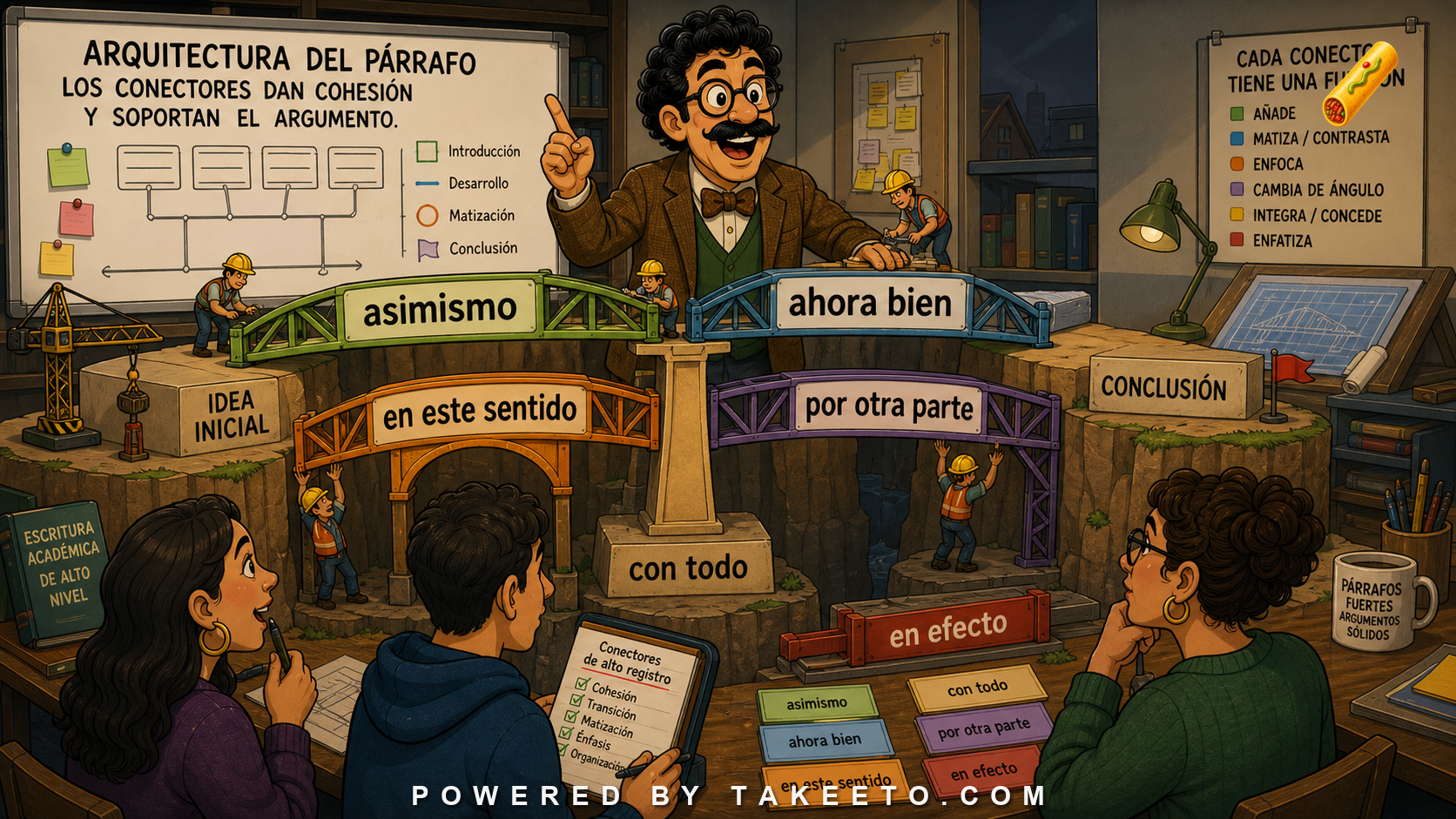
Formal connectors are architectural signals
Advanced Spanish prose often uses connectors that feel vague to learners:
asimismo
ahora bien
en este sentido
por otra parte
con todo
en efecto
The problem is not that these phrases are impossible. The problem is that learners memorize them as English equivalents without understanding what they do in a paragraph.
The key principle is:
Abstract connectors organize argument, not just sentences.
They tell the reader whether the writer is adding, shifting, framing, conceding, confirming, or limiting.
Asimismo: formal addition
Asimismo means likewise, also, or furthermore. It adds a related point, often in formal prose.
El programa ofrece apoyo económico. Asimismo, contempla medidas de acompañamiento académico.
This is not casual también. It has a more formal, text-organizing feel.
Learner action: use it when adding parallel information in written exposition, not in every everyday sentence.
Ahora bien: pivot or qualification
Ahora bien is one of the most useful advanced connectors. It often means something like “that said,” “now,” or “however,” but its function is more specific: it pivots from one accepted point to a qualification, complication, or new framing.
Example:
La medida ha ampliado el acceso. Ahora bien, su impacto no ha sido igual en todas las regiones.
The writer does not erase the first statement. The writer reframes it.
Learner action: when you see ahora bien, expect a controlled turn in the argument.
En este sentido: framing within an argument
En este sentido means “in this sense” or “in this regard,” but it often functions as a bridge between an idea and its implication.
Example:
La alfabetización digital no se limita al uso de dispositivos. En este sentido, la formación crítica resulta indispensable.
It tells the reader: given the previous framing, the next statement follows.
Bad use occurs when writers insert en este sentido without a clear preceding “sense.” Then it becomes empty padding.
Por otra parte: another angle
Por otra parte introduces another side, dimension, or consideration. It can be additive or contrastive depending on context.
La reforma reduce algunos costos administrativos. Por otra parte, exige mayor inversión inicial.
Here it introduces a balancing consideration.
Learner action: ask whether it means “another related point” or “another side of the issue.”
Con todo: concession after acknowledgment
Con todo is a formal concessive connector, close to “even so” or “nevertheless.”
El estudio presenta limitaciones metodológicas. Con todo, ofrece datos valiosos para investigaciones futuras.
It acknowledges a problem but preserves a positive claim.
Learner action: preserve concession in translation.
En efecto: confirmation or elaboration
En efecto confirms or develops a previous claim.
La participación aumentó de manera notable. En efecto, los datos muestran un crecimiento del 25 %.
It can introduce evidence that supports what was just said. It is not simply a fancy “actually” in the modern conversational English sense.
Connector overuse
Advanced learners sometimes stuff essays with formal connectors to sound academic:
Asimismo, en este sentido, por otra parte, ahora bien...
This creates mechanical prose. A connector is useful only if the relationship is real.
Better practice:
- Use asimismo for parallel addition.
- Use ahora bien for pivot.
- Use en este sentido only when a prior framing is clear.
- Use con todo for concession.
- Use en efecto for confirmation.
Example bank walkthrough
asimismo
Formal addition.
Learner action: use for parallel written points.
ahora bien
Argument pivot.
Learner action: expect qualification or complication.
en este sentido
Framing bridge.
Learner action: identify the previous “sense” or frame.
con todo
Concessive continuation.
Learner action: preserve “despite that” logic.
por otra parte
Another dimension or side.
Learner action: decide whether additive or contrastive.
en efecto
Confirmation or supporting elaboration.
Learner action: look for evidence after it.
Connector-reading workflow
- Circle the connector. Do not translate immediately.
- Label function. Addition, contrast, concession, pivot, framing, confirmation.
- Look backward. What statement does it connect to?
- Look forward. What move follows?
- Check whether the relationship is real. Some prose uses connectors mechanically.
- Translate the relation. English wording can vary; logic must remain.
- Use sparingly in writing. Choose connectors because the argument needs them.
Common learner failure: connector decoration
A weak essay often uses formal connectors as decoration:
Asimismo, la educación es importante. En este sentido, la sociedad cambia. Ahora bien, existen problemas.
The connectors are not doing real work. They create the sound of organization without the logic of organization.
Before using a connector, ask:
- What exact previous idea does it connect to?
- What kind of move follows?
- Could the reader infer the relation without it?
- Is the connector stronger or more formal than the paragraph needs?
Mini-workshop: remove and restore
Take one paragraph from an academic article. Remove all connectors. Read it. Then restore only the connectors that are needed for logic.
You may discover that some connectors are essential and others are habitual. This exercise teaches restraint. Mature Spanish prose does not use asimismo, ahora bien, and en este sentido because they sound educated. It uses them when the reader needs a map.
Common failure mode: using formal connectors to sound smart
Formal connectors do not improve prose by themselves. A paragraph full of asimismo, en este sentido, ahora bien, and por otra parte can sound mechanical if the logical relations are weak. The connector must be earned by the sentence relationship.
The repair is to draft without connectors first. Then add only the signals the reader truly needs. If the second sentence adds another point, use an additive connector. If it limits the first, use a contrast or qualification connector. If there is no clear relationship, the problem is not missing vocabulary; it is weak paragraph logic.
Remediation pass: connectors must describe real paragraph logic
Abstract connectors are often the first feature learners imitate when they want to sound advanced. They add asimismo, ahora bien, en este sentido, con todo, por otra parte, and en efecto to paragraphs that do not need them. The prose becomes more formal but not more coherent.
The remediation principle is blunt: do not choose the connector first. Choose the relationship first. If sentence two adds another point in the same direction, an additive connector may fit. If sentence two limits sentence one, a contrastive or concessive connector may fit. If sentence two reframes the discussion, a transitional phrase may fit. If there is no clear relationship, no connector will save the paragraph.
A connector is a promise to the reader. Asimismo promises addition. Ahora bien promises a turn or qualification. En este sentido promises that the next statement should be understood within the frame just established. Con todo promises concession or contrast after acknowledging what came before. Broken connector promises make prose feel fake.
Before/after repair: connector misuse
Weak paragraph:
La encuesta incluyó a estudiantes de tres universidades. Asimismo, el método presenta limitaciones importantes. En este sentido, los resultados no pueden generalizarse a todo el país.
The first connector is wrong or at least weak. The second sentence does not add a parallel point; it qualifies the method.
Stronger paragraph:
La encuesta incluyó a estudiantes de tres universidades. Ahora bien, el método presenta limitaciones importantes. Por ello, los resultados no pueden generalizarse a todo el país.
Another option:
La encuesta incluyó a estudiantes de tres universidades. Sin embargo, esta muestra limitada impide generalizar los resultados a todo el país.
The repair reduces mechanical formality and clarifies logic.
Mini-workshop: connector deletion test
Take a formal paragraph and remove every connector. Then write the relationship between each pair of sentences in the margin:
- addition,
- contrast,
- concession,
- result,
- cause,
- reformulation,
- example,
- summary,
- frame shift.
Now add back only the connectors that the reader genuinely needs. This test teaches an important lesson: strong paragraph logic can often survive without many connectors, but weak logic cannot be fixed by piling them on.
Connector profiles
A finished article should give short profiles rather than one-word translations.
Asimismo: formal addition, often parallel to a previous point. It should not introduce a contradiction.
Ahora bien: transition into qualification, complication, or a new angle. It often says, “That said, we now need to consider...”
En este sentido: frames the next sentence as belonging to the conceptual direction just established. It is overused in bureaucratic and academic prose.
Con todo: concessive contrast, roughly “even so” or “nevertheless,” after acknowledging prior material.
Por otra parte: another side, aspect, or line of discussion; not automatically the same as English “on the other hand” in every context.
En efecto: confirmation or elaboration of a previous claim; can sound formal and should be earned.
Writing guidance: fewer, sharper signals
Advanced learners should aim for fewer connectors used more accurately. A paragraph with one well-chosen sin embargo is often stronger than a paragraph with asimismo, en este sentido, and por otra parte scattered mechanically. The reader should feel guided, not managed.
One useful production rule: after writing a connector, paraphrase the relationship out loud. If you cannot say “this sentence contrasts with the previous one” or “this sentence gives the consequence,” the connector is probably decorative.
Editorial quality checks for this article
The article should treat connectors as paragraph architecture. It should include misused connector examples, because learners need to see that advanced words can make prose worse. It should distinguish register from function: a formal connector is not automatically a better connector. The final article should make the reader more skeptical of their own transitions, in a productive way.
Extended remediation: revise connectors after paragraph logic is clear
Connector study should end in revision practice. Learners need to write paragraphs, remove connectors, diagnose relationships, and restore only the useful signals. This prevents the common advanced problem of connector stuffing, where every sentence begins with a formal expression but the paragraph has no real architecture. The best connector is often the one that makes a genuine relation visible with the least noise.
Contrast set
- decorative connector: Asimismo placed before a sentence that actually contradicts the previous one.
- architectural connector: Ahora bien placed before a limitation after a generally positive claim.
The contrast set should be read aloud or rewritten, not merely admired. Advanced learners often understand a correction when they see it, then fail to reproduce it when the task changes. The repair is to make the contrast portable: identify the decision, name the cue, and apply the same decision to a new sentence, clip, paragraph, or writing task.
Real-use transfer drill
- Write a five-sentence paragraph without any formal connectors.
- Add margin labels for the sentence relations.
- Insert only three connectors, each with a different function.
- Read the paragraph aloud and remove any connector that slows comprehension.
- Swap one connector for a wrong one and explain how the argument changes.
The output is a revised paragraph plus a connector rationale: “I used sin embargo because sentence 3 limits sentence 2; I removed asimismo because the addition was already obvious.”
Do not treat connector lists as synonyms. No obstante, en cambio, por otra parte, con todo, and ahora bien are not interchangeable decorations.
A good remediation pass ends with a usable artifact: a marked paragraph, a recording comparison, a collocation card, a frame note, a stance map, a change-claim table, or a revision pair. Without an artifact, the learner may feel enlightened but have nothing to review. With an artifact, the explanation becomes part of a study system.
Depth reinforcement: paragraph architecture before connector choice
A useful remediation pass should tell learners to outline the paragraph before choosing connectors. Write the purpose of each sentence in the margin: topic, evidence, limitation, example, consequence, transition, conclusion. Once those roles are visible, connector choice becomes much easier. Asimismo belongs where another parallel support point appears. Ahora bien belongs where the paragraph turns. Con todo belongs where a concession is acknowledged but the argument continues.
This also prevents over-linking. Not every sentence needs an explicit connector. Spanish academic prose can be dense, but good prose still breathes. If every sentence begins with a formal connector, the paragraph may sound like a stitched list rather than an argument. The mature skill is knowing when the logical relation is obvious and when the reader needs a signpost.
Applied drill: connector replacement by logic
Start with one neutral sentence pair and connect it five ways. Notice how the relationship changes.
Base:
El programa aumentó su cobertura. Los resultados siguen siendo desiguales.
Possible connectors:
El programa aumentó su cobertura. Sin embargo, los resultados siguen siendo desiguales.
El programa aumentó su cobertura. En este sentido, los resultados muestran un avance parcial.
El programa aumentó su cobertura. Asimismo, incorporó nuevos centros de atención.
El programa aumentó su cobertura. Con todo, no logró reducir las brechas regionales.
El programa aumentó su cobertura. Por ello, se requiere evaluar si el crecimiento fue suficiente.
The content must change when the connector changes. If the second sentence stays exactly the same after every connector, the learner is probably treating connectors as interchangeable formal ornaments. A good exercise asks the learner to revise the second sentence so it fulfills the connector’s promise.
Suggested interactive module: connector function map
A strong tool for this article would visualize paragraph movement.
Suggested functions:
- Connector highlighter: Marks formal connectors in a paragraph.
- Function labels: Addition, pivot, concession, confirmation, framing.
- Before/after arrows: Shows what each connector links.
- Overuse warning: Flags stacked or unnecessary connectors.
- Rewrite practice: Learner replaces mechanical connectors with clearer structure.
- Register notes: Formal, neutral, conversational.
Final rule
Do not memorize abstract connectors as fancy synonyms.
They are paragraph architecture. Learn the move each one makes, and formal Spanish prose becomes much easier to follow and much easier to write.