
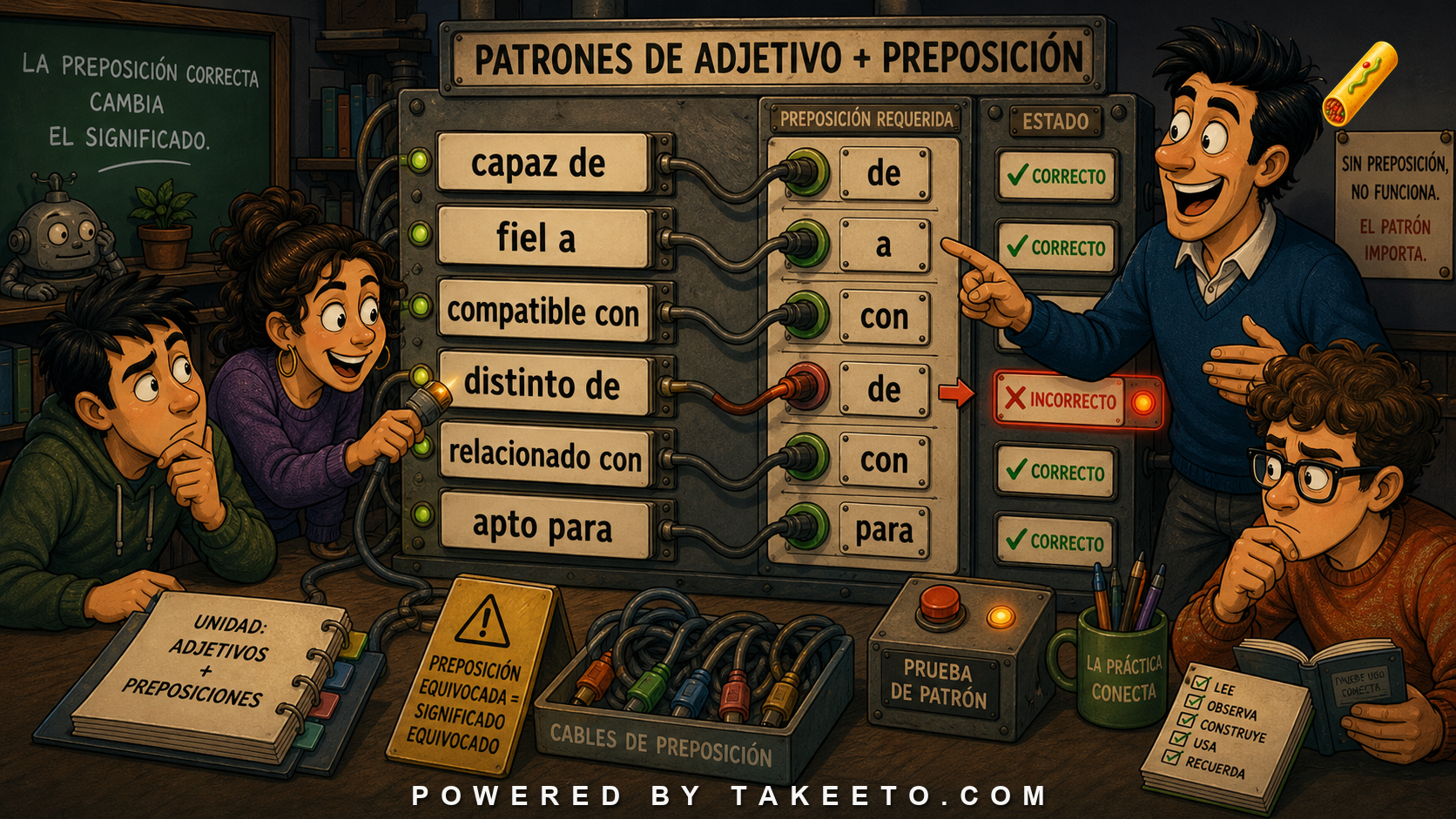
Adjectives also govern prepositions
Learners often notice verb-preposition patterns first. But adjectives also take complements, and the preposition is often fixed or conventional.
capaz de
fiel a
compatible con
distinto de
relacionado con
apto para
These patterns appear constantly in formal Spanish, technical documents, academic prose, product descriptions, job requirements, and everyday evaluation.
The key principle is:
Many Spanish adjectives are incomplete until their complement pattern is known.
Knowing capaz is not enough. You need capaz de.
Capaz de
Capaz de means capable of.
Es capaz de resolver el problema.
It can be followed by an infinitive:
capaz de aprender
capaz de producir
capaz de adaptarse
or a noun phrase in some contexts:
una persona capaz de gran esfuerzo
Learners should avoid direct English transfer with of. Spanish uses de.
Fiel a
Fiel a means faithful to or loyal to.
Fue fiel a sus principios.
Common complements:
fiel a la tradición
fiel a su palabra
fiel al texto original
This adjective is useful in literary, ethical, religious, political, and translation contexts. In translation discussion, una traducción fiel al original is a faithful translation to the original.
Compatible con
Compatible con means compatible with.
El sistema es compatible con varios dispositivos.
This is common in technology, law, medicine, schedules, values, and methods.
compatible con la normativa
compatible con el tratamiento
compatible con los datos
The preposition con expresses coexistence or fit.
Distinto de
Distinto de means different from.
Este caso es distinto de los anteriores.
In many everyday contexts, speakers also use diferente de or diferente a, with regional and register variation. Distinto de is a strong formal pattern.
Learner action: in formal writing, distinto de is a safe and precise choice.
Relacionado con
Relacionado con means related to.
El problema está relacionado con la falta de recursos.
This phrase is extremely common in academic and administrative prose. It allows writers to establish connection without overclaiming causation.
Compare:
causado por
related to
Relacionado con is weaker than causation. It says connection, not necessarily cause.
Apto para
Apto para means suitable for or fit for.
Este material no es apto para menores.
Common contexts:
apto para consumo humano
apto para principiantes
apto para uso comercial
This is common in labeling, classification, education, law, safety, and product descriptions.
Adjective complements in technical Spanish
Technical Spanish relies heavily on adjective complements:
equivalente a
superior a
inferior a
próximo a
sensible a
resistente a
libre de
sujeto a
útil para
Each pattern should be learned as a unit. A learner who says compatible a or apto de may be understood, but the sentence will sound wrong.
Dictionary and corpus checking
Good dictionaries often show adjective complements. Do not stop at the first translation. Look for examples.
For fiel, check whether examples use a. For compatible, check con. For apto, check para. A corpus can show common nouns:
apto para menores
apto para consumo
compatible con Windows
compatible con la ley
This is how you move from definition to use.
Example bank walkthrough
capaz de
Capable of.
Learner action: follow with infinitive or noun phrase.
fiel a
Faithful or loyal to.
Learner action: use in ethical, textual, personal, and institutional contexts.
compatible con
Compatible with.
Learner action: use con, especially in technical prose.
distinto de
Different from.
Learner action: safe formal pattern.
relacionado con
Related to.
Learner action: do not inflate to causation.
apto para
Suitable/fit for.
Learner action: common in labels and requirements.
Adjective-complement workflow
- Learn the adjective with its preposition.
- Add one noun complement and one infinitive complement if possible.
- Label register and domain.
- Check common collocations.
- Compare with English preposition.
- Note alternate patterns and regional variation.
- Practice cloze drills.
- Use in formal sentences.
- Review related nouns and verbs.
- Correct errors as lexical errors, not random grammar slips.
Mini-workshop: complete the adjective
Fill in the prepositions:
capaz ___ resolverlo
fiel ___ sus ideas
compatible ___ el sistema
distinto ___ lo esperado
relacionado ___ el tema
apto ___ menores
Answers:
capaz de resolverlo
fiel a sus ideas
compatible con el sistema
distinto de lo esperado
relacionado con el tema
apto para menores
The adjective and preposition form one learning item.
Common learner failure: treating complements as optional afterthoughts
A sentence such as:
Este sistema es compatible.
may be grammatical if the compatible object is obvious, but in many contexts it feels incomplete. Compatible with what? A law? A device? A treatment? A previous version?
The complement often carries the useful information:
compatible con el sistema operativo
fiel al texto original
apto para menores
relacionado con el estudio
Ignoring complements leaves formal Spanish vague.
Mini-workshop: complete the adjective
Take these adjectives and complete them with natural complements:
capaz de...
fiel a...
compatible con...
distinto de...
relacionado con...
apto para...
Then write each in two registers: everyday and formal/technical. Example:
Es capaz de hacerlo.
El sistema es capaz de procesar grandes volúmenes de datos.
This builds flexibility instead of one memorized phrase.
Common failure mode: treating adjective complements as optional
Adjective complements often look smaller than verb complements, so learners ignore them. But compatible a, fiel con, or apto de can make a formal sentence sound unstable. In technical writing, these patterns matter because they mark precise relationships: compatibility with a system, suitability for a purpose, loyalty to a principle, relation to a topic.
The repair is to learn adjectives in frames. Do not write compatible = compatible. Write compatible con X. Do not write apto = suitable. Write apto para X. The frame is the vocabulary item.
Remediation pass: adjective complements are vocabulary frames
Adjective complements look small, but they carry precision. Capaz de, fiel a, compatible con, distinto de, relacionado con, and apto para are not adjectives plus optional decorations. They are frames that tell the reader how the quality connects to something else.
The remediation move is the same as for verb-preposition patterns: store the adjective with its complement. A learner who knows compatible but writes compatible a has not fully learned the word. A learner who knows apto but cannot produce apto para menores or apto para uso médico lacks the frame needed for real texts.
Adjective complements are especially important in technical, legal, academic, and administrative Spanish because they define eligibility, relation, compatibility, difference, suitability, responsibility, and capacity. These are not decorative meanings.
Before/after repair: adjective frame control
Weak note:
capaz = capable.
Stronger note:
capaz de + infinitive/noun phrase: capaz de resolver el problema, capaz de soportar altas temperaturas.
Weak sentence:
El sistema es compatible a esta versión.
Repair:
El sistema es compatible con esta versión.
Weak sentence:
El documento es apto de presentación oficial.
Repair:
El documento es apto para su presentación oficial.
El documento es válido para trámites oficiales.
El documento puede presentarse oficialmente.
The best repair may require changing the adjective, not only the preposition.
Mini-workshop: adjective-complement deck
Build cards by semantic field.
Capacity:
capaz de, incapaz de, susceptible de.
Relation:
relacionado con, vinculado a/con, asociado con, relativo a.
Difference and similarity:
distinto de, diferente de/a depending on variety and style, similar a, equivalente a.
Suitability and purpose:
apto para, adecuado para, útil para, necesario para.
Loyalty and orientation:
fiel a, contrario a, favorable a, ajeno a.
For each card, include a sentence and a domain tag. Example: susceptible de modificación is formal; puede modificarse may be clearer in plain language.
Reading dense noun phrases
Adjective complements often appear inside long noun phrases:
materiales aptos para uso alimentario
medidas compatibles con la normativa vigente
resultados relacionados con el nivel socioeconómico
prácticas contrarias a los principios establecidos
A learner should parse the head noun first, then attach the adjective and complement:
medidas [compatibles con la normativa vigente]
This prevents the complement from floating unattached in the reader’s mind.
Dictionary and corpus checking
A finished article should teach readers how to verify adjective frames. Monolingual dictionaries often show examples. Corpora show real domains. Search engines can mislead because they include learner errors, translationese, and low-quality texts. The learner should prefer edited sources when checking formal patterns.
A good note should say not only “compatible con,” but also what kinds of nouns occur with it: systems, software versions, requirements, evidence, principles, policies. This builds collocational awareness around the adjective.
Editorial quality checks for this article
The article should show that adjective complements are not a minor grammar afterthought. They are part of lexical competence. It should include formal examples because the pattern is common in advanced reading. It should also include repairs where the right answer is not simply swapping a preposition but choosing a more natural adjective or verbal construction. The reader should leave with a simple rule: learn adjectives in frames, not as isolated qualities.
Extended remediation: treat adjective complements as precision tools
Adjective complements matter most when precision matters: technical compatibility, legal responsibility, academic relation, moral loyalty, professional suitability, and categorical difference. Compatible con, responsable de, relacionado con, apto para, and distinto de are not ornamental. They tell the reader what kind of relation the adjective asserts. In dense prose, that relation may carry the whole claim.
Contrast set
- loose adjective: El sistema es compatible.
- complete relation: El sistema es compatible con versiones anteriores del programa, pero no es apto para uso clínico.
The contrast set should be read aloud or rewritten, not merely admired. Advanced learners often understand a correction when they see it, then fail to reproduce it when the task changes. The repair is to make the contrast portable: identify the decision, name the cue, and apply the same decision to a new sentence, clip, paragraph, or writing task.
Real-use transfer drill
- Choose one adjective and list the kinds of nouns that can complete it.
- Write three examples from different domains.
- Replace the preposition with an English-shaped wrong option and notice the failure.
- Find one real example in a dictionary, corpus, or official text.
- Add the adjective frame to your review deck.
The output is a frame note: adjective, required/preferred preposition, semantic relation, example, and common error. This is more useful than a single-word gloss.
Do not overgeneralize by semantic field alone. Similar adjectives may take different complements. Check actual usage when writing important prose.
A good remediation pass ends with a usable artifact: a marked paragraph, a recording comparison, a collocation card, a frame note, a stance map, a change-claim table, or a revision pair. Without an artifact, the learner may feel enlightened but have nothing to review. With an artifact, the explanation becomes part of a study system.
Depth reinforcement: adjective complements in academic prose
Adjective complements become especially important in academic and technical writing because they often express relations between concepts. Relacionado con, compatible con, distinto de, similar a, relevante para, susceptible de, and dependiente de allow writers to connect variables, systems, arguments, and classifications. A wrong preposition can make the relationship unclear even if the vocabulary is recognizable.
Learners should therefore read adjective complements as relation markers. In resultados compatibles con la hipótesis, the phrase does not mean the results prove the hypothesis; it means they fit it. In un método apto para principiantes, para marks the intended user or purpose. In un argumento fiel a los datos, a marks loyalty or adherence. These are small patterns with large interpretive consequences.
Applied drill: adjective frames in technical descriptions
Write technical product or policy sentences using adjective complements.
El sistema es compatible con versiones anteriores.
El material es apto para uso alimentario.
La medida es contraria a la normativa vigente.
Los resultados están relacionados con el nivel de exposición.
El informe es distinto de la versión publicada en marzo.
Now rewrite each sentence in plainer Spanish:
El sistema funciona con versiones anteriores.
El material puede usarse con alimentos.
La medida contradice la normativa vigente.
The comparison teaches when the adjective frame is useful. Technical style often needs compact labels like compatible con and apto para. Plain language may prefer verbs. The learner should be able to move between both, not cling to one style.
A good card for these adjectives should test the whole frame: compatible ___, apto ___, contrario ___, relacionado ___, distinto ___. If the card tests only the adjective meaning, it is incomplete.
Suggested interactive module: adjective-complement pattern deck
A strong tool for this article would treat adjective patterns as vocabulary cards.
Suggested functions:
- Pattern cards: adjective + preposition + example.
- Domain tags: technical, legal, academic, everyday.
- Complement type: noun, infinitive, clause.
- Cloze practice: choose the preposition.
- Common collocations: compatible con, apto para, fiel a.
- False-transfer alerts: English preposition mismatch.
- Corpus examples: short authentic-style snippets.
Final rule
Spanish adjectives have grammar.
Learn capaz de, fiel a, compatible con, distinto de, relacionado con, and apto para as complete patterns. The preposition is not guesswork. It is part of the adjective’s behavior.