
Comparisons are structures, not just words
Learners often memorize más = more, menos = less, que = than, como = as. That helps, but it does not teach the comparison system.
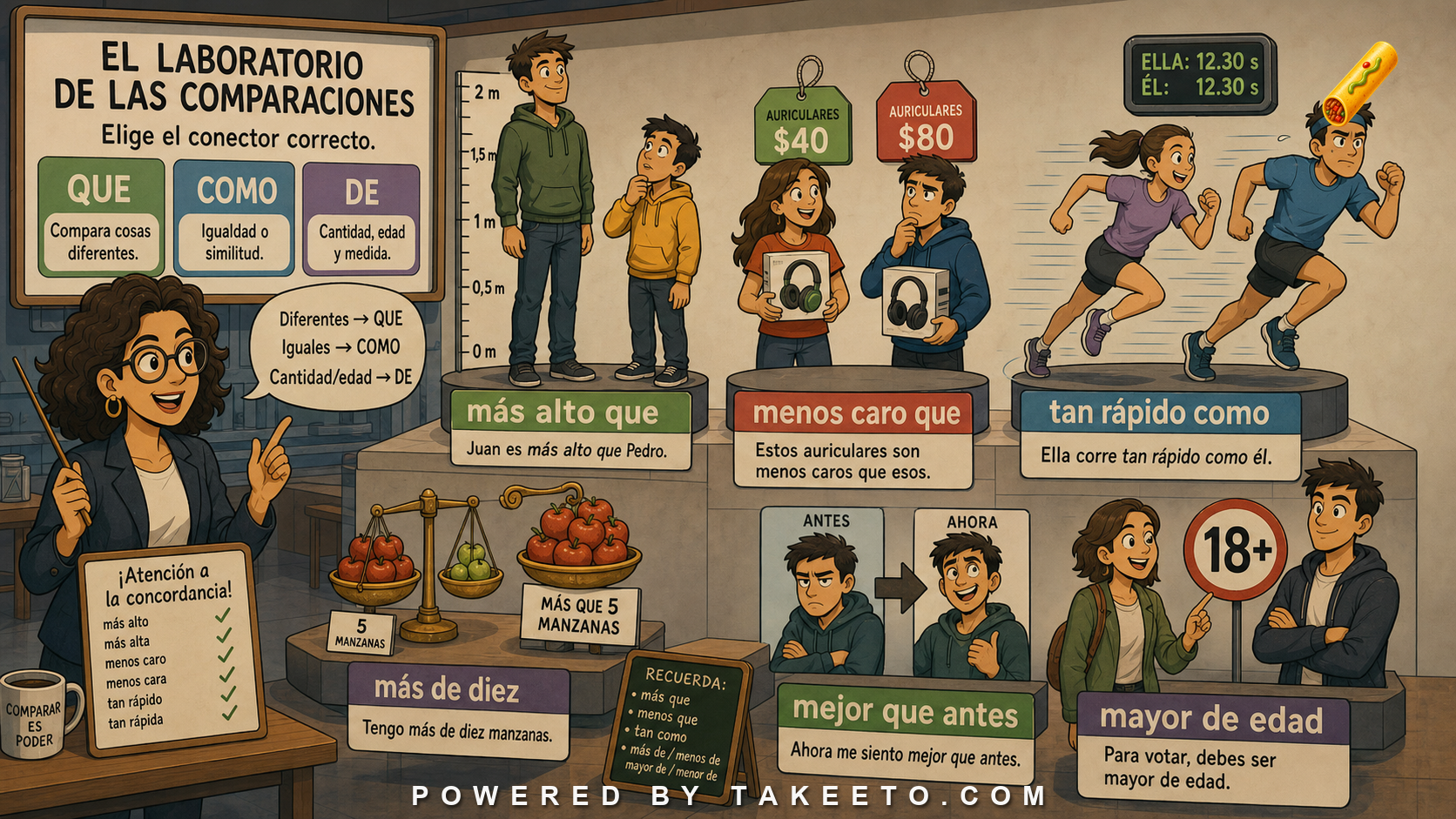
Spanish comparatives involve a measured property, a standard of comparison, and a connector. Sometimes the connector is que. Sometimes it is de. Sometimes equality uses como. Sometimes the comparative form is irregular: mejor, peor, mayor, menor.
Compare:
Ana es más alta que Luis.
Ana is taller than Luis.
Hay más de diez personas.
There are more than ten people.
Both English sentences use “than.” Spanish uses que in the first and de in the second. Why? Because the first compares two terms. The second sets a numerical threshold.
The useful rule:
Use que to compare one term with another. Use de before numbers and quantity thresholds when the meaning is “more than / less than” a numerical amount.
Superiority: más... que
The basic superiority structure is:
más + adjective/adverb/noun + que
With adjectives:
Madrid es más grande que Toledo.
Madrid is bigger than Toledo.
Este libro es más difícil que el anterior.
This book is more difficult than the previous one.
With adverbs:
Ana habla más rápido que yo.
Ana speaks faster than I do.
With nouns:
Tengo más libros que tú.
I have more books than you.
Hay más problemas que soluciones.
There are more problems than solutions.
When más modifies a noun, the noun still controls agreement in associated adjectives or determiners, but más itself does not change.
más libros caros
more expensive books
más preguntas difíciles
more difficult questions
Inferiority: menos... que
The inferiority structure parallels más... que:
menos + adjective/adverb/noun + que
Examples:
Este hotel es menos caro que el otro.
This hotel is less expensive than the other one.
Corre menos rápido que su hermana.
He/she runs less fast than his/her sister.
Tengo menos tiempo que antes.
I have less time than before.
Hay menos sillas que estudiantes.
There are fewer chairs than students.
English splits “less” and “fewer.” Spanish menos covers both mass and count quantity in this basic comparative structure.
Equality: tan... como
For equality with adjectives and adverbs, use tan... como:
Es tan alto como su hermano.
He is as tall as his brother.
Trabaja tan cuidadosamente como Ana.
He/she works as carefully as Ana.
No es tan difícil como parece.
It is not as difficult as it seems.
Tan modifies adjectives and adverbs. It does not agree.
For equality with nouns, use tanto/a/os/as... como:
Tengo tantos libros como tú.
I have as many books as you.
Hay tanta gente como ayer.
There are as many people as yesterday.
Necesitamos tanto tiempo como dinero.
We need as much time as money.
For equality with verbs, use tanto como:
Trabajo tanto como tú.
I work as much as you.
No viaja tanto como antes.
He/she does not travel as much as before.
This three-way distinction prevents many errors.
| Modified element | Equality form | Example |
|---|---|---|
| adjective/adverb | tan... como | tan difícil como |
| noun | tanto/a/os/as... como | tantas preguntas como |
| verb | tanto como | trabaja tanto como |
Más de and menos de before numbers
Use más de or menos de before numerical thresholds:
más de diez personas
more than ten people
menos de veinte euros
less than twenty euros
más de cien páginas
more than one hundred pages
menos de tres horas
less than three hours
This is not a direct comparison between two parallel terms. It means the quantity exceeds or falls below a number.
Compare:
Tengo más libros que Ana.
I have more books than Ana.
Tengo más de veinte libros.
I have more than twenty books.
Que compares with Ana. De marks a numerical threshold.
But if the number itself is being compared as a term, que may appear:
Es más inteligente que diez de sus compañeros juntos.
He/she is smarter than ten of his/her classmates together.
That is not the ordinary threshold structure. Learners should first master más de + number.
Más que and no más que
Spanish más que can mean more than, but no más que can mean “only” in some contexts.
No tengo más que cinco euros.
I have only five euros.
This differs from:
Tengo más de cinco euros.
I have more than five euros.
And:
Tengo más euros que dólares.
I have more euros than dollars.
The phrase no más que restricts the amount. Do not confuse it with más de.
Mejor, peor, mayor, menor
Spanish has several synthetic comparative forms.
| Positive idea | Comparative | Example |
|---|---|---|
| bueno / bien | mejor | mejor que antes |
| malo / mal | peor | peor que ayer |
| grande / old in age contexts | mayor | mayor que yo |
| pequeño / young in age contexts | menor | menor que su hermano |
Examples:
Este plan es mejor que el anterior.
This plan is better than the previous one.
Hoy me siento peor que ayer.
Today I feel worse than yesterday.
Ana es mayor que Luis.
Ana is older than Luis.
Su hijo menor estudia medicina.
His/her younger son studies medicine.
Learners sometimes say:
más bueno
más malo
In many standard contexts, use mejor and peor instead. However, más bueno can exist in certain contexts where bueno means morally good, kind, or has a particular adjectival meaning. Learners should treat mejor/peor as the safe default for “better/worse.”
Mayor, más grande, and age
Mayor can mean older:
Mi hermana es mayor que yo.
My sister is older than I am.
Más grande usually means bigger in size:
Esta casa es más grande que la otra.
This house is bigger than the other one.
But usage can vary, and mayor also has formal meanings such as “greater” or “major.” In age-related expressions, mayor is common:
mayor de edad
of legal age
personas mayores
older people / elderly people, depending on context
Do not assume mayor always means physically bigger.
Comparisons with clauses
Sometimes the second term is a clause, not just a noun phrase.
Gasta más de lo que gana.
He/she spends more than he/she earns.
Es más difícil de lo que pensaba.
It is harder than I thought.
Trabaja menos de lo que debería.
He/she works less than he/she should.
Notice de lo que. Spanish often uses this when comparing a degree or quantity with a whole clause.
Do not write:
más que pensaba in all contexts.
The natural form is often:
más de lo que pensaba
Similarly:
tan... como pensaba
as... as I thought
más... de lo que pensaba
more... than I thought
Equality and inequality behave differently.
Common learner errors
Error 1: Using que before numerical thresholds
más que diez personas
Usually correct:
más de diez personas
Error 2: Using tan with nouns
tan libros como tú
Correct:
tantos libros como tú
Error 3: Using tanto with adjectives
tanto difícil como
Correct:
tan difícil como
Error 4: Overusing más bueno
Default:
mejor
Use más bueno only when you know why the context calls for the analytic form.
Error 5: Forgetting de lo que with clausal comparisons
Es más caro de lo que esperaba.
It is more expensive than I expected.
This structure is extremely common in careful Spanish.
Diagnostic workflow: comparison term or numerical threshold?
When English says “than,” Spanish forces a distinction. Ask whether the phrase after “than” is a comparison term or a numerical threshold.
Comparison term:
Ana es más alta que Luis.
Tengo más libros que tú.
Este método es mejor que el anterior.
Here the second element is a person, thing, pronoun, phrase, or clause functioning as the other side of a comparison. Use que.
Numerical threshold:
Hay más de veinte personas.
Cuesta menos de diez euros.
Tardó más de tres horas.
Here the meaning is “exceeds/falls below the number.” Use de.
Now compare near-minimal pairs:
Tiene más años que experiencia.
He/she has more years than experience.
Tiene más de treinta años.
He/she is over thirty years old.
The first compares two quantities. The second crosses a threshold.
For clausal comparisons, Spanish often uses de lo que:
Es más caro de lo que esperaba.
It is more expensive than I expected.
This is not the same pattern as más caro que ese. The second term is a whole expected degree. Spanish packages it with lo que.
A practical builder:
- What is being compared: adjective, adverb, noun, verb, clause, number?
- Is the relation equality, superiority, or inferiority?
- Is the second term a parallel comparison term, a number, or a clause?
Examples:
| Input meaning | Spanish pattern |
|---|---|
| as fast as Ana | tan rápido como Ana |
| as many books as Ana | tantos libros como Ana |
| more books than Ana | más libros que Ana |
| more than ten books | más de diez libros |
| more difficult than I thought | más difícil de lo que pensaba |
This workflow prevents the two most expensive errors: más que + number where Spanish wants más de, and tan/tanto mismatches in equality comparisons.
Comparison diagnostics for ambiguous English sentences
English often leaves comparison roles ambiguous. Spanish can force you to clarify them. The famous type is:
She likes Luis more than me.
This can mean either:
- She likes Luis more than I like Luis.
- She likes Luis more than she likes me.
Spanish separates these readings:
Le gusta Luis más que a mí.
She likes Luis more than I do.
Le gusta Luis más que yo.
She likes Luis more than she likes me.
Depending on the verb and structure, the exact pronoun marking changes, but the principle remains: Spanish often marks whether the compared element is a subject, object, experiencer, or prepositional complement.
With direct objects, the contrast is especially visible:
Lo quiere más que yo.
He/she loves him more than I do.
Lo quiere más que a mí.
He/she loves him more than me.
The a mí is not ornamental. It marks the compared element as an object-like human participant.
Use this diagnostic procedure:
- Identify what quality, quantity, or action is being compared.
- Identify the first term of comparison.
- Identify the second term.
- Decide whether the second term is a noun, pronoun, number, or whole clause.
- Choose que, de, como, or de lo que accordingly.
For example:
more expensive than the other one → más caro que el otro
more than ten euros → más de diez euros
as expensive as the other one → tan caro como el otro
more expensive than I expected → más caro de lo que esperaba
The connector is the visible result of the comparison type.
Contrast lab: más que, más de, más de lo que
Use three versions of “more than” to keep the connectors separate:
Tengo más libros que Ana.
I have more books than Ana.
Tengo más de veinte libros.
I have more than twenty books.
Tengo más libros de los que puedo leer.
I have more books than I can read.
The first compares two possessors. The second crosses a number. The third compares an actual quantity with the quantity contained in a clause. Spanish marks these distinctions with que, de, and de los/lo que structures. A learner who uses que everywhere will sound English-shaped even when the meaning is recoverable.
V2 remediation refinement: de after numbers is a threshold, de lo que is a clause
The main que/de contrast needs one extra refinement. Más de + number marks a numerical threshold, but más de lo que + clause marks comparison against an expected or stated amount.
Threshold:
Hay más de veinte estudiantes.
There are more than twenty students.
Clause comparison:
Hay más estudiantes de los que esperábamos.
There are more students than we expected.
Gasta más de lo que gana.
He/she spends more than he/she earns.
These are not the same structure. In the first, veinte is the threshold. In the second, lo que gana is a clause standing for an amount.
The repair sequence is:
- If the second term is a person, thing, group, adjective, adverb, or ordinary comparison term, expect que:
más alto que Ana
mejor que antes
- If the second term is a bare numerical threshold, expect de:
más de cien páginas
menos de tres horas
- If the second term is a clause representing an amount, degree, or expectation, expect de lo que / de los que / de las que as needed:
más difícil de lo que parecía
más errores de los que admitieron
This also prevents a common overgeneralization. Learners learn más de + number and then write más de Ana for “more than Ana.” That is wrong for the ordinary comparative:
Tengo más libros que Ana.
I have more books than Ana.
The connector does not translate English “than.” It reveals the structure of the comparison.
Suggested interactive module: comparative builder
A useful tool would ask what kind of comparison is being made.
Suggested functions:
- Comparison type: superiority, inferiority, equality.
- Modified element: adjective, adverb, noun, verb, full clause, number.
- Connector selector: que, de, como, de lo que.
- Irregular comparative warning: mejor, peor, mayor, menor.
- Error correction: más que diez → más de diez; tan libros → tantos libros.
Example input:
more than 30 students
Output:
más de treinta estudiantes. Use de because thirty is a numerical threshold.
Final rule
Use más/menos... que to compare one term with another. Use más/menos de before numbers and thresholds. Use tan... como for equality with adjectives and adverbs, tanto/a/os/as... como with nouns, and tanto como with verbs.
Comparatives are not a single word. They are a pattern. Identify what you are comparing, then choose the connector.