
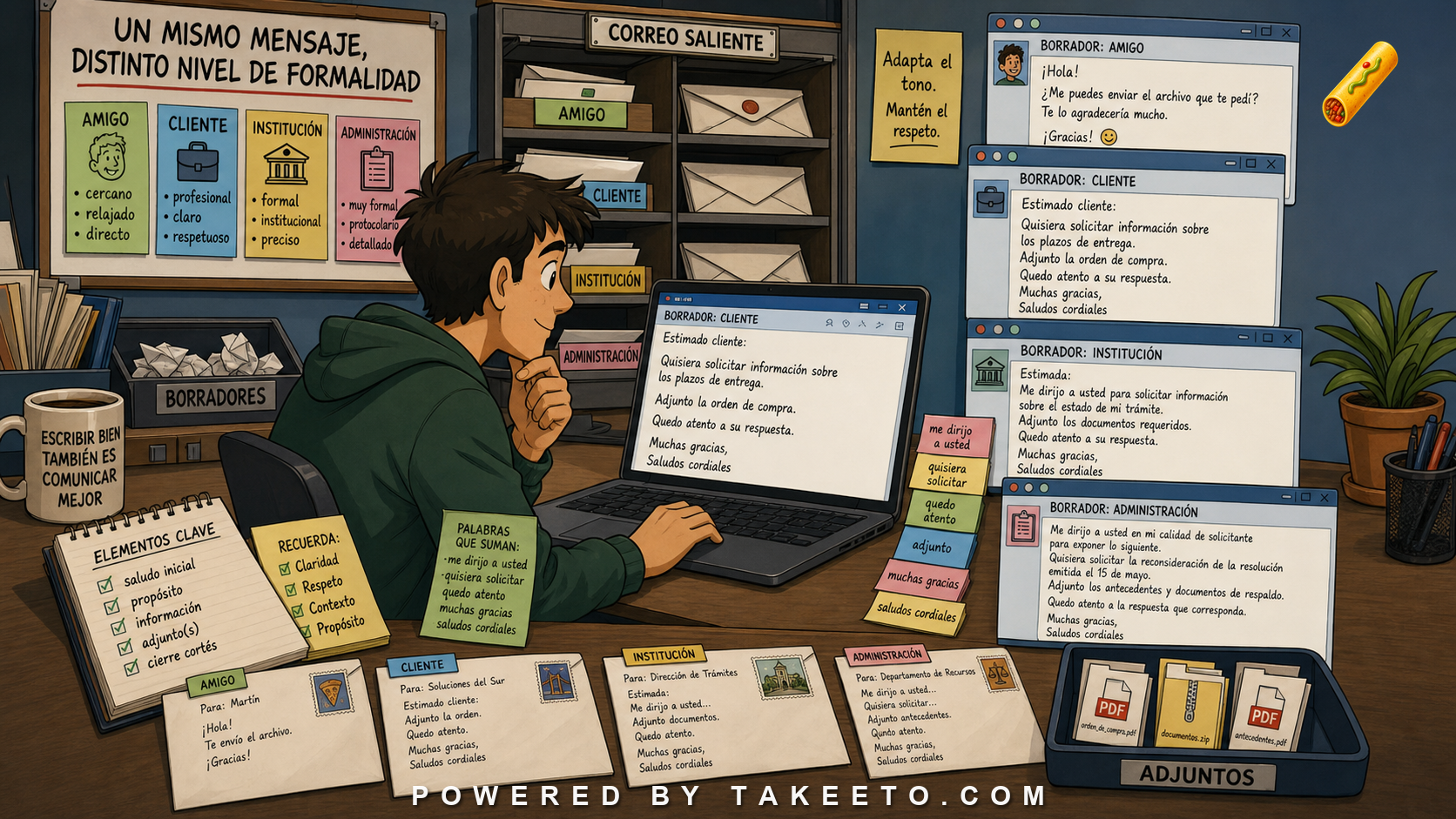
Email Spanish is not translated spoken Spanish
A Spanish email is not just a spoken request typed onto a screen. It has conventions: greeting, register, purpose, request, supporting information, closing, signature, and punctuation. The structure changes depending on whether you are writing a friend, professor, landlord, public office, client, doctor, or company.
Compare:
Hola, Laura:
¿Me mandas el archivo cuando puedas?
with:
Estimada profesora García:
Me dirijo a usted para solicitar información sobre los requisitos de inscripción.
Both are good Spanish in the right context. They are not interchangeable.
The key principle is:
A good Spanish email makes the relationship, purpose, and requested action clear without importing English email habits blindly.
The basic structure
Most useful Spanish emails have this architecture:
- Greeting.
- Brief identity or context if needed.
- Purpose of the message.
- Request or information.
- Deadline or attachment if relevant.
- Thanks.
- Closing.
- Signature.
Example:
Estimada profesora García:
Soy Carlos López, estudiante de su curso de Lingüística. Le escribo para consultarle si sería posible entregar el trabajo el lunes. Adjunto el borrador que mencioné en clase.
Muchas gracias por su tiempo.
Un cordial saludo,
Carlos López
This email works because it identifies the sender, states the purpose, makes a specific request, mentions the attachment, and closes politely.
Greetings: Hola versus Estimado/a
Hola is acceptable in many informal and semi-professional contexts, especially when the relationship is established.
Hola, Ana:
For more formal or first-contact emails, use Estimado/a:
Estimada profesora García:
Estimado señor Ramírez:
Estimados miembros del comité:
When the recipient is unknown:
A quien corresponda:
or:
Estimados señores:
Be careful with gender when unknown. Depending on context, you can use a role or office instead:
Estimado equipo de admisiones:
Punctuation after the greeting
In Spanish, the greeting in letters and emails is conventionally followed by a colon, and the body begins on the next line with a capital letter.
Correct:
Estimada Dra. Pérez:
Le escribo para solicitar...
Avoid the English pattern:
Estimada Dra. Pérez,
Le escribo...
This comma-after-greeting habit is common under English influence, but the careful Spanish convention in formal correspondence is the colon plus a new line.
Stating the purpose
Useful purpose frames:
Le escribo para...
I am writing to...
Me dirijo a usted para...
I am writing to you to... / I address you in order to...
Quisiera solicitar...
I would like to request...
Quería consultarle si...
I wanted to ask you whether...
Me gustaría saber...
I would like to know...
Examples:
Le escribo para confirmar la cita del jueves.
I am writing to confirm Thursday’s appointment.
Quisiera solicitar una copia del certificado.
I would like to request a copy of the certificate.
Me gustaría saber si todavía hay plazas disponibles.
I would like to know whether places are still available.
Requests: clear and polite
A strong email request is specific.
Weak:
Necesito información.
Better:
Quisiera saber cuáles son los documentos necesarios para completar la solicitud.
Weak:
Mándeme eso.
Better:
¿Podría enviarme el formulario actualizado, por favor?
Formal:
Le agradecería que me confirmara la recepción de este mensaje.
Do not bury the request under excessive indirectness. Spanish professional email values courtesy, but also clarity.
Adjuntar and attachments
Useful attachment phrases:
Adjunto el documento solicitado.
I attach the requested document.
Le envío adjunto el formulario.
I am sending the form attached.
En el archivo adjunto encontrará...
In the attached file you will find...
Quedo a la espera de sus comentarios.
I await your comments.
Common learner issue: adjunto can function as a verb form or adjective-like element. Keep it simple:
Adjunto el documento.
Attached is / I attach the document.
Usted/tú consistency
Do not switch randomly between tú and usted.
Consistent informal:
Hola, Marta:
Te escribo para preguntarte si puedes revisar el archivo.
Gracias,
Carlos
Consistent formal:
Estimada señora Pérez:
Le escribo para consultarle si puede revisar el archivo.
Muchas gracias,
Carlos López
Mixed without reason:
Estimada señora Pérez: te escribo para consultarle...
This sounds careless unless there is a special context.
Closings: match the register
Common closings:
Gracias.
Thank you.
Muchas gracias por su ayuda.
Thank you very much for your help.
Quedo atento/a a sus comentarios.
I look forward to your comments.
Quedo a la espera de su respuesta.
I await your response.
Saludos,
Regards,
Saludos cordiales,
Kind regards,
Un cordial saludo,
Kind regards,
Atentamente,
Sincerely,
Quedo atento is common in some American professional styles; quedo atenta if the writer is female. In plural or neutral institutional style, alternatives may be better depending on context.
Capitalization and concise style
Spanish does not capitalize every important word the way English subject lines sometimes do. Avoid writing subject lines and headings with English title capitalization unless required by a style guide.
Better:
Solicitud de información sobre matrícula
than:
Solicitud De Información Sobre Matrícula
Concise style is also valuable. A formal email does not need to be long. It needs to be complete.
Three register rewrites
Casual:
Hola, Ana:
¿Me puedes mandar el enlace cuando tengas un momento?
Gracias,
Carlos
Professional:
Estimada Ana:
¿Podrías enviarme el enlace cuando tengas un momento? Lo necesito para completar el informe.
Muchas gracias.
Un saludo,
Carlos
Institutional:
Estimada señora Gómez:
Le escribo para solicitar el enlace actualizado al formulario de inscripción. Le agradecería que me lo enviara cuando le sea posible.
Muchas gracias por su atención.
Atentamente,
Carlos López
Example bank walkthrough
estimada
Formal greeting agreeing with feminine recipient.
Learner action: match gender and title when known.
me dirijo a usted
Formal opening phrase.
Learner action: use for institutional or high-formality messages.
quisiera solicitar
Polite formal request frame.
Learner action: good for documents, appointments, certificates.
quedo atento
Professional closing phrase.
Learner action: adjust gender and region; do not overuse in casual email.
adjunto
Attachment phrase.
Learner action: Adjunto el documento is a simple reliable formula.
muchas gracias
Flexible thanks.
Learner action: combine with a specific reason when useful.
saludos cordiales
Professional closing.
Learner action: safe in many work contexts.
Remediation notes: email as action design
The email article needs one more practical frame: a Spanish email is successful if the reader can answer three questions quickly:
Who is writing?
Why are they writing?
What action is needed?
Register matters, but it should serve the action. Many learner emails are polite but unclear. Others are clear but socially abrupt. The best emails are both.
A reliable structure:
Greeting: Estimada profesora García:
Identity/context: Soy estudiante de su curso de...
Purpose: Le escribo para consultarle...
Request: ¿Podría confirmarme...?
Detail/deadline: antes del viernes / adjunto el documento.
Thanks: Muchas gracias por su ayuda.
Closing: Un cordial saludo,
Signature: full name if formal.
The punctuation point deserves reinforcement. In careful Spanish correspondence, formal greetings use a colon, and the body starts on the next line with a capital letter:
Estimada Dra. Pérez:
Le escribo para...
Learners can recognize comma patterns in real emails, especially under English influence, but the colon is the safer polished standard.
A second repair is tú/usted consistency. Check pronouns, clitics, possessives, and verb forms together:
Informal: te escribo, puedes, tu respuesta.
Formal: le escribo, puede, su respuesta.
Do not mix: le escribo para preguntarte unless the relationship intentionally shifts.
A third repair concerns adjunto. Keep attachment language simple:
Adjunto el documento solicitado.
Le envío adjunto el formulario.
En el archivo adjunto encontrará la información.
Do not overtranslate English "please find attached" into a heavy calque. Spanish can be direct.
A fourth repair concerns closings such as quedo atento/a. They are common in many professional contexts, especially in parts of the Americas, but not universal. Alternatives include:
Quedo a la espera de su respuesta.
Gracias de antemano por su ayuda.
Un cordial saludo.
Saludos cordiales.
The subject line also matters:
Solicitud de certificado de matrícula
Consulta sobre la cita del 12 de junio
Envío de documentación adjunta
Avoid English title capitalization:
Better: Solicitud de información sobre matrícula.
Avoid: Solicitud De Información Sobre Matrícula.
Final email test:
Could the recipient understand the request, deadline, attachment, and expected response in one reading?
If not, the email is not finished.
Suggested interactive module: email rewrite tool
A strong tool for this article would rewrite one message across registers.
Suggested functions:
- Input message: User writes rough email.
- Register selector: informal, professional, academic, institutional.
- Pronoun consistency checker: tú/usted mismatch alert.
- Greeting punctuation checker: colon after greeting.
- Request clarity score: missing action, deadline, attachment.
- Closing selector: saludos, cordialmente, atentamente, un cordial saludo.
- Attachment phrase generator: adjunto, le envío adjunto, encontrará adjunto.
- Regional style notes: quedo atento, a la espera, cordialmente.
Final rule
A good Spanish email is clear, socially aligned, and conventionally punctuated.
Choose Hola or Estimado/a by relationship, use a colon after the greeting, keep tú/usted consistent, state the request clearly, and close at the same register you opened.